|
|
|
|
|
|
|
|
|
|
|
||||||||
|
||||||||||||||||||
|
Email us at: |
||||||||||||||||||
 |
||||||||||||||||||
 |
 |
|||||||||||||||||
|
Click the sun to see the |
||||||||||||||||||


 |
|||||||||||
|
|
|
|
|
|
|
|||||
|
|||||||||||
|
|||||||||||
|
|||||||||||
|
When we first arrived at the Hale Koa, we saw advertised in the lobby a Magic Show, which included dinner. Now I'm a real pushover when it comes to a magic show. It turns out that the magician was an employee of the hotel, and the Magic Show was just a sideline hobby for him. He performs the show twice a week. I made a reservation for the day before we were to leave for Michigan.
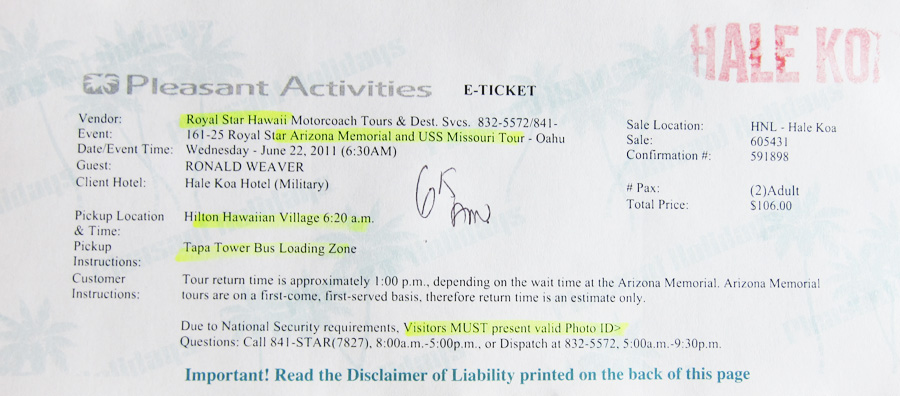
The guy in the hotel who told me about the magician said it was a great family show, and there would be lots of kids there. He was right, there were a lot of kids, and I began to wonder about the show. The dinner was buffet style of course. The magician has two sons, maybe 10 and 12 years of age. They each performed one magic trick, and the younger lad performed his trick first. He was listening to a voice instructing him how to perform the trick. He never said a word, but he was a master of facial expressions, in a Charlie Chaplin verve. His props were a yellow banana and a black silk bag. The voice told him to take the yellow "bandana" (which was actually the yellow banana), and fold the "bandana" twice. His facial expressions of shock and surprise matched those of the audience, yet he did attempt to fold the banana twice (you are correct if you think this is impossible). He then was instructed to take the magic black silk bag, which he turned inside out to show that it was empty, and to place the folded "bandana" inside the bag. The voice said a few magic words and instructed him to wave his magic wand over it, and voilà, he pulled out an actual yellow bandana, and the banana had completely vanished. He performed this trick with such skill, and for a 10 year old it was utterly amazing. The kid has a real talent. The older lad performed a trick with a rope that was also pretty amazing. I see a real business growing here. The father was very charismatic, and he had an amazing selection of magic tricks. The show was very enjoyable. There was also a good mix of audience participation. He called one young gentleman up onto the stage and began asking him to do various things, some of them pretty stupid, or demeaning, and he capped this off by saying; "You are married aren't you?" Of course the audience burst into uproarious laughter. Another humorous thing that only Pete and I saw, was when he had asked several youngsters up onto the stage to be witnesses behind one of his tricks. All went well, then the boys were told to return to their tables. One young lad returned to the table next to ours, and his mother asked him what is that thing on your shirt? He looked down and stared directly into the face of a chameleon. He let out a scream that could curdle milk, and the look on his face was priceless. Of course the chameleon went flying through the air onto their table and quickly disappeared onto the dark floor. When the kid recovered from his shock and realized what it was, he went scrambling around on the floor trying to find it, and Pete and I were in tears of laughter. These are the sort of things that stay with you, and continue to provide a source of laughter. We had also purchased tickets to see the Arizona Memorial and the USS Missouri.
We were told that the Arizona Memorial had been recently restored, and we had never been on a battleship before. I think everyone should visit the memorial, and to think about what actually happened here on 7 December 1941. To think that there are still hundreds of young sailors entombed in the bowels of this great ship really makes you think about the consequences of war, and realize just how senseless war actually is. And yet, today America is heavily involved in two wars, three if you count the global war on terrorism. One cannot help but ask the question; "When will it end?" I realize that we must protect and preserve our freedom, but surely there has to be a better way to preserve and safeguard our way of life without killing other human beings. It is true that there have been many errors committed along the way. We are all human, and we all suffer from the same propensity to make wrong choices at times. Like I say, the memorial really makes you stop and think. There is a museum which gives a pictorial history of the expansion of Asia from 1853 to 1914 when western powers stake claims in Asia as Japan emerges from more than two centuries of isolation. The isolation of Japan ended when Commodore Matthew Calbraith Perry led a U.S. Navy expedition into Tokyo Bay to open Japan to trade and diplomatic relations. Then there came World War I (1914 - 1918) called the "Great War" or the "War to End All Wars", and when it ended in 1918, President Woodrow Wilson warned "I can predict with absolute certainty that within another generation there will be another world war if the nations of the world do not concert the method by which to prevent it." The poverty and desperation left behind by Word War I fueled the rise of fascism and communism in Europe and militarism in Japan. Troubled times, 1929-1941. World economic crisis ushers in the Great Depression. America turns inward, while Germany, Italy, and Japan seek to expand. Is this starting to have a familiar ring? The rise of nazism in Germany, fascism in Italy, and militarism in Japan led to global destabilization and threatened democracy. The stock market crash sent the United States into economic depression. Military actions by the Japanese in China the Italians in Ethiopia, and the Germans in Poland sowed the seeds for global war. In response to Japanese aggression in Asia, the United States imposed economic embargoes and deployed its Pacific Fleet to Pearl Harbor. Commercial Attaché Frank S. Williams wrote, "Perhaps the phase of our order which struck the deepest into the sensibilities of the Japanese was that at last the United States has shown this country that it is no longer bluffing."
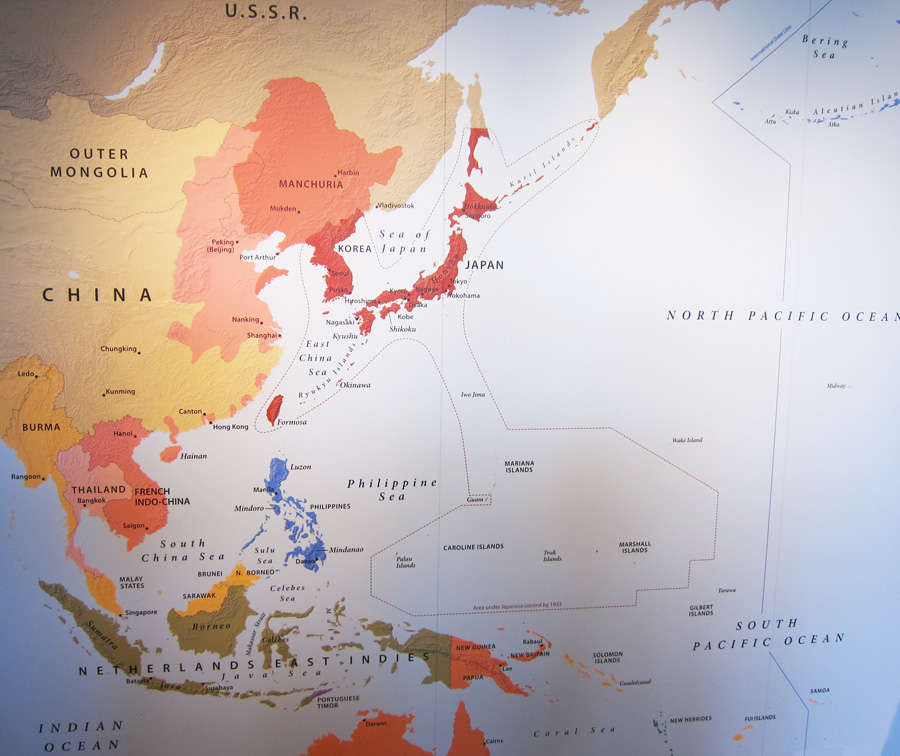
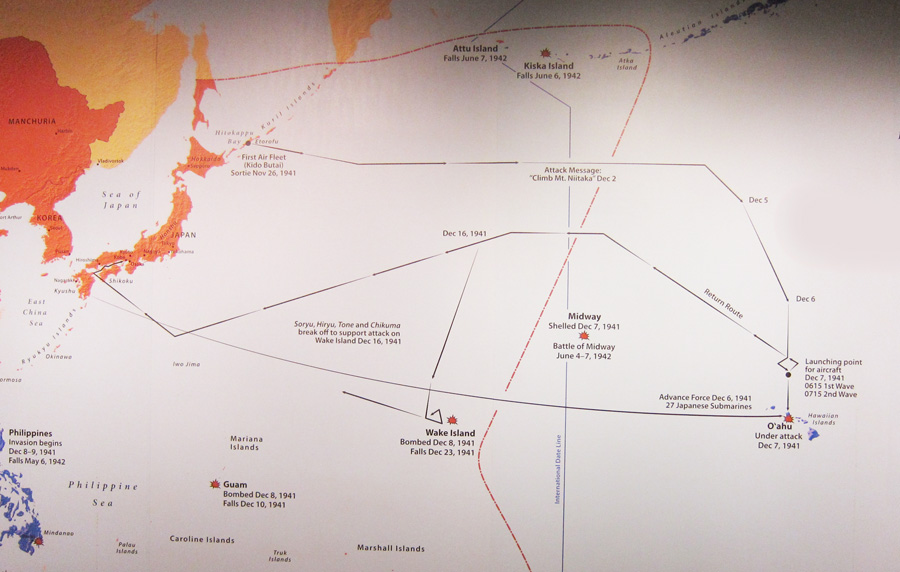
This map shows the expansion of Japan's militarism in December of 1941
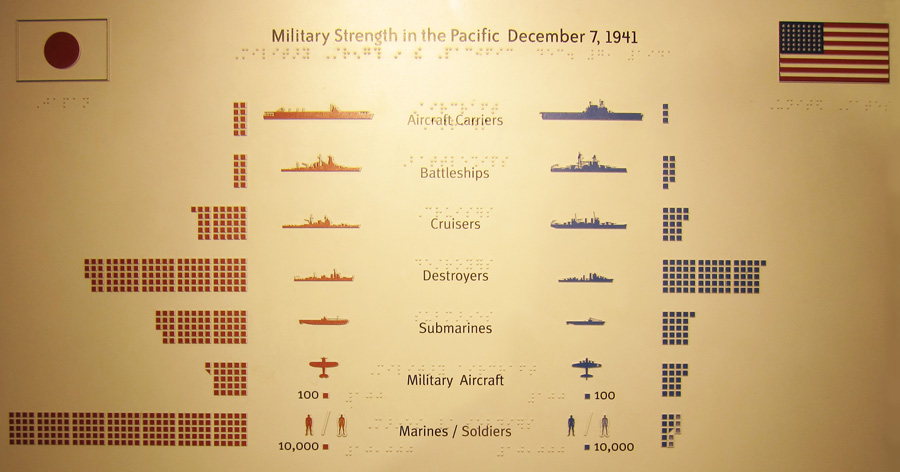
The military might of Japan seems to dwarf that of the United States in the Pacific theater
The path taken by the Japanese fleet in preparation for its sneak attack on Pearl Harbor
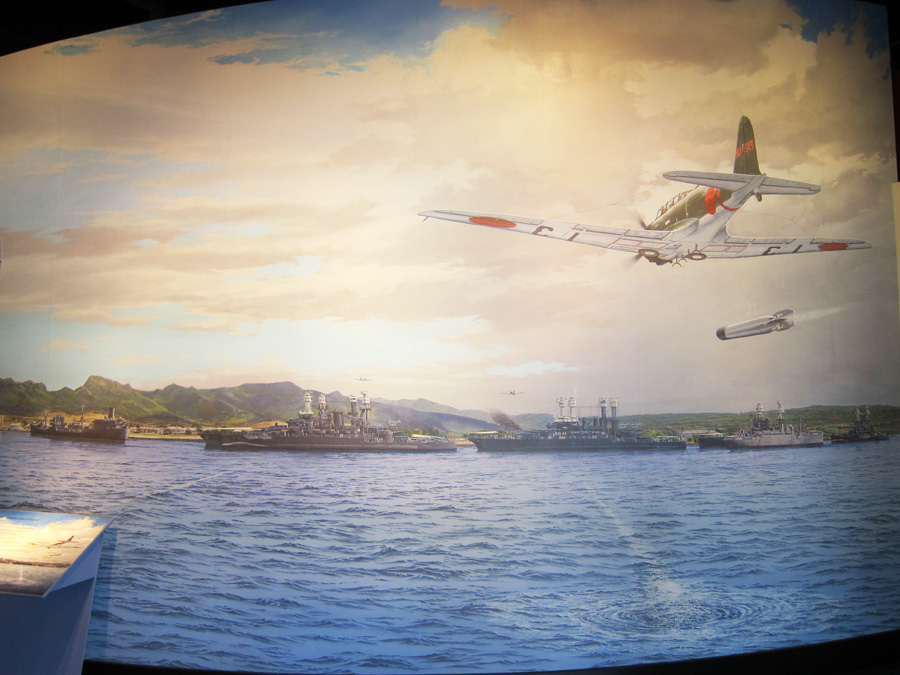
And then the unthinkable happened. The near destruction of the United States Pacific Fleet I recently received an email from a good friend in California with the following interesting words of Admiral Nimitz regarding THE SILVER LINING OF PEARL HARBOR. He said, "The Japanese made three of the biggest mistakes an attack force could ever make." Mistake number one: the japanese attacked on Sunday morning. Nine out of every ten crewmen of those ships were ashore on leave. If those same ships had been lured to sea and been sunk — we would have lost 38,000 men instead of 3,800. Mistake number two: when the Japanese saw all those battleships lined in a row, they got so carried away sinking those battleships, they never once bombed our dry docks opposite those ships. If they had destroyed our dry docks, we would have had to tow every one of those ships to America to be repaired. One tug can pull them over to the dry docks, and we can have them repaired and at sea by the time we could have towed them to America. Mistake number three: every drop of fuel in the Pacific theater of war is on top of the ground in storage tanks five miles away over that hill. One attack plane could have strafed those tanks and destroyed our fuel supply, but it didn't happen.
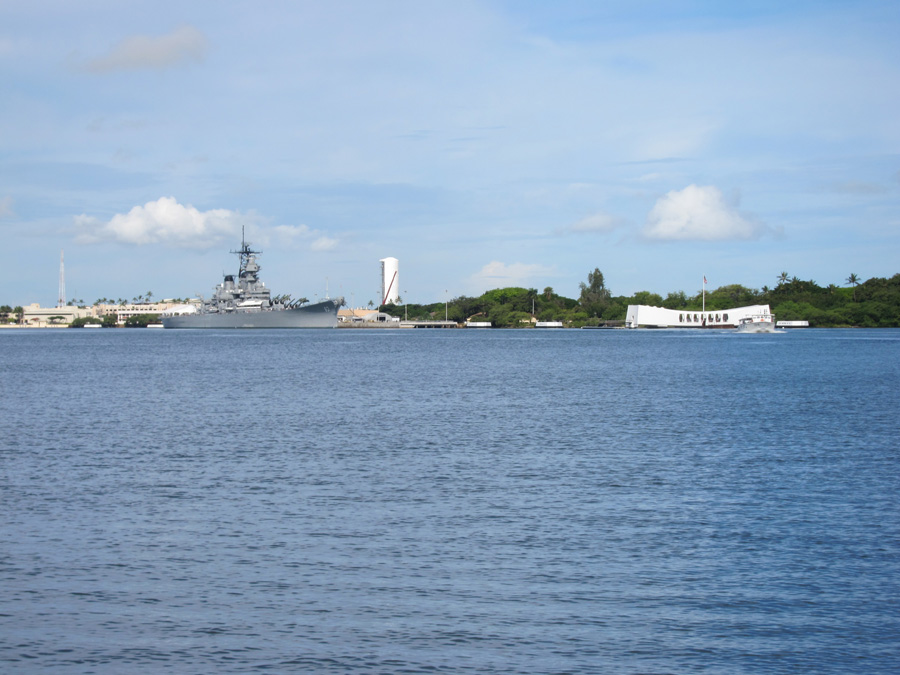
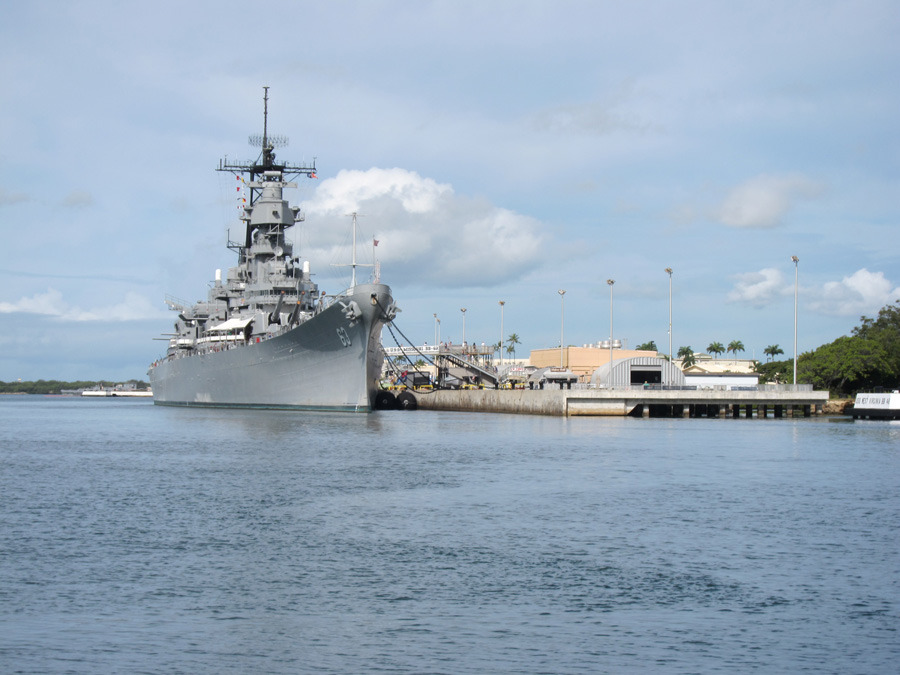
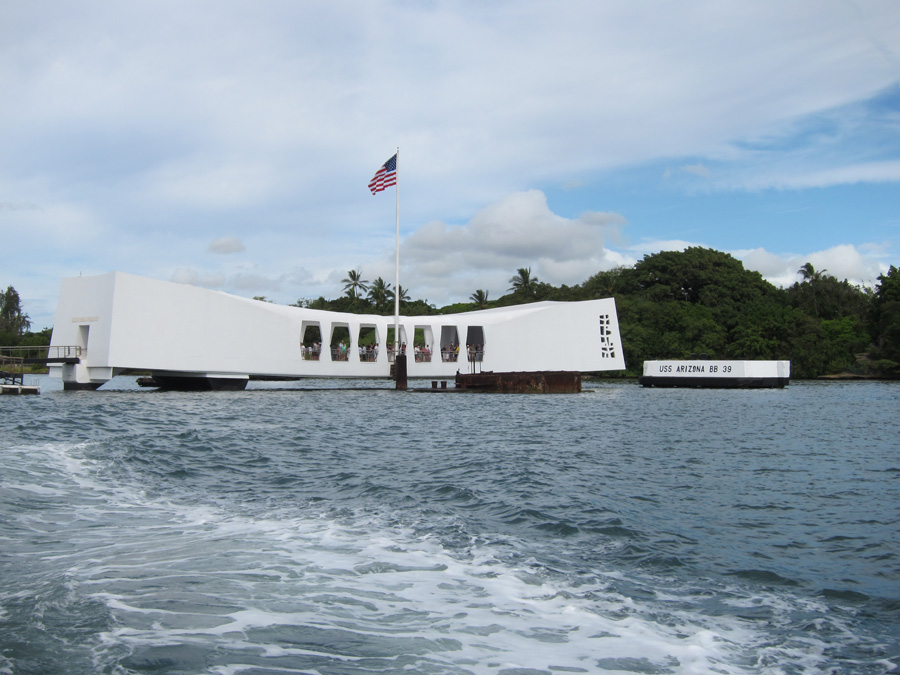
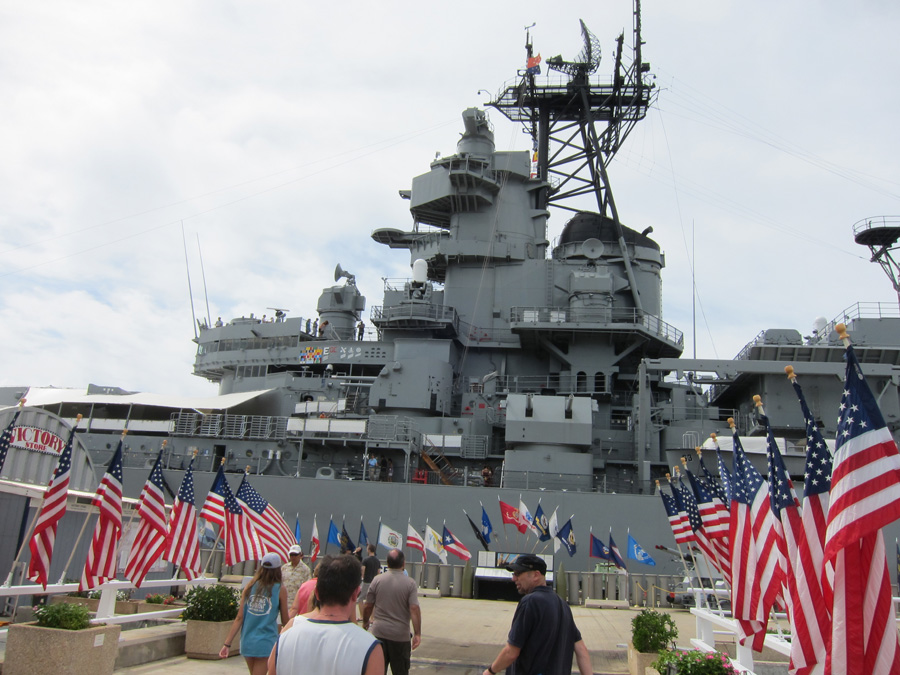
We cross the harbor by boat to visit the Arizona Memorial. Ahead you can see the Mighty MO. This
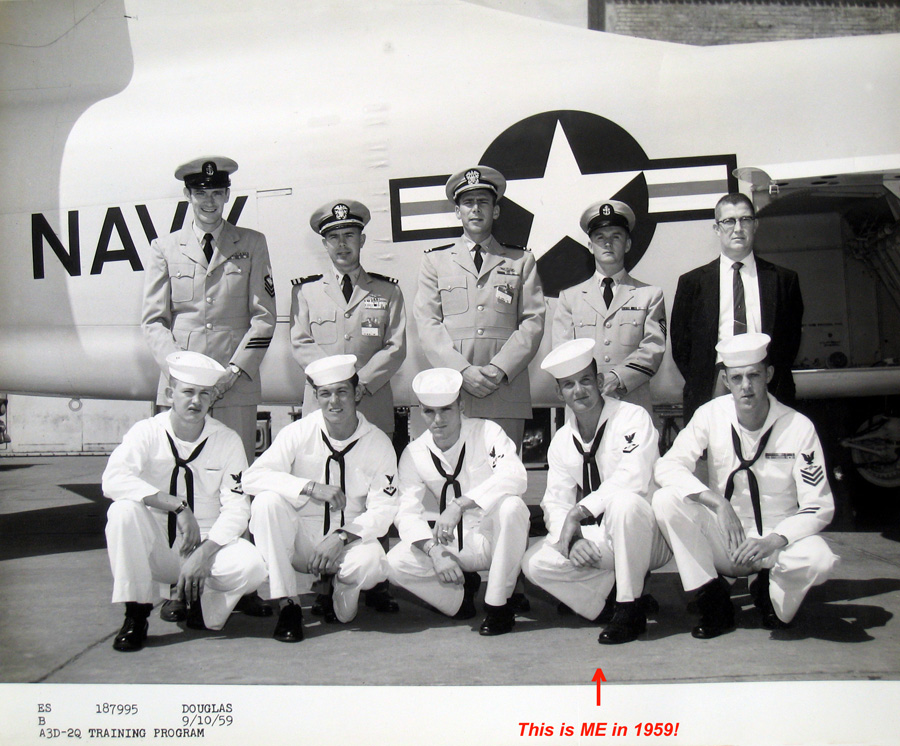
We will be boarding this monster after our visit to the Arizona Memorial. The biggest ship I had ever been on was In preparation for joining VQ-1 in Japan I attended a school in Virginia at the Naval Security Group Headquarters, to learn about the mission of the squadron. This was a month long class. There I met several of the people that I would be flying with. We then went to another school at Douglas Aircraft in El Segundo, California where we learned about the electronics equipment being installed by them in our aircraft, the Douglas A3D-2Q Sky Warrior. This next photo will give you a big laugh. I was only 22 when it was taken.
These are the guys I went through the two schools with, and we all ended up in VQ-1 together, except It was a grueling 6 weeks of intensive training on a huge array of electronic countermeasures (ECM) equipment being installed in the aircraft by Douglas. The squadron would not take delivery of the planes until several months after I had arrived in Japan.
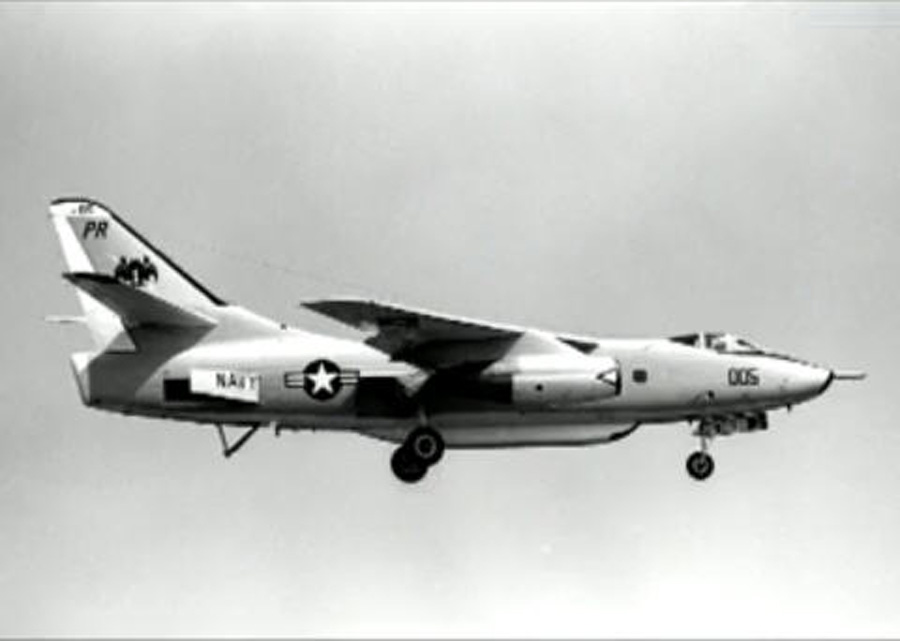
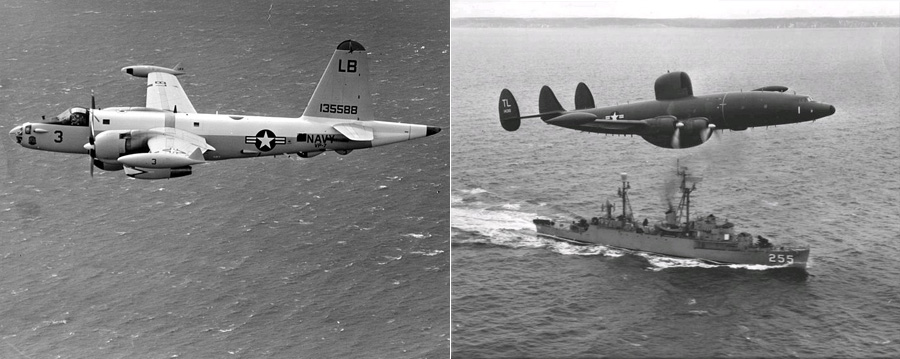
This is an A3D-2Q aircraft. In the Air Force it is called the RB-66, and it is a medium bomber. The 2Q conversion During the time before the A3Ds arrived in Japan, we flew missions in the P2V Neptune, otherwise known as "The Truculent Turtle" and the WV-2, or Lockheed's Super Constellation. A funny story regarding the P2V while I was in the squadron, was when the pilot and the flight engineer worked together to pull a prank on a carrier operating in the waters off Japan. The flight engineer had built using a 2 x 4, a long pole with a hook on it, and he painted it with black and white stripes, just like the tail hooks on fighter planes. The pilot radioed to the tower on the aircraft carrier requesting permission to land. Now obviously the P2V is not a carrier based aircraft. It is simply too big. But the pilot made his approach, and the flight engineer lowered his long pole out of the aft hatch in the belly, so that it looked like a tail hook on a fighter plane, ready to catch the arresting wire. The pilot made a very low and slow pass over the flight deck of the carrier, and I'm fairly certain the guys in the tower and on the edges of the flight deck were pretty sure that the pilot was actually intending to try to land the P2V on their flight deck. At the last second the pilot put the throttle to the firewall and everyone had a good laugh. That's the kind of crazy guys we had in VQ-1. Lots of camaraderie and thrill seekers to add just enough spice to keep us on our toes for the job at hand.
The P2V Neptune aircraft is a sub chaser The WV-2 is a sophisticated spy plane The long tail extension of the P2V fuselage housed a MAD boom, or Magnetic Anomaly Detector used for detecting submarines beneath the surface of the sea. The WV-2 was one heavily electronics filled work of art. The sail on the top was filled with many DF (Direction Finding) antennae which searched the radio and radar spectrum to locate where signals originated. The primary job was to fly close enough to the coast of China and Russia to cause them to bring up their early warning and fire control radar sites so that we could plot their locations, and from these plots analysts were able to detect holes in their defenses, so that if the United States should ever go to war with either country, they would know at which points they could enter their country with the least chance of being detected. The big guppy dome on the belly housed a long range search radar, among other things. I never flew on the WV-2, and I'm just as glad for that, because their missions were very long and tiresome, according my buddies who did fly in them. Also, on one mission, either they flew a little too close to the coast, or a fighter pilot became a little too bold, because they were actually fired upon, and the sail on top of the plane was pretty badly shot up. There were some pretty horrendous tails told about that mission. The A3D, on the other hand, actually could land on an aircraft carrier, and the pilots had to maintain their skill a doing so by making carrier landing periodically. Fortunately they did it with minimum crew, Pilot, Co-Pilot and Flight Engineer only. The position I flew in the A3D was the fire control station. That means that I monitored the airways for the very high frequencies of the fire control radars used by fighter planes. It was easy to tell when they were in search mode, and easier still to tell when they had a lock on our aircraft. This actually happened more than a few times, and when I notified the pilot that we had a lock, he would take the plane down to a few hundred feet above the sea and we would head for home. The fighters would not followed us down to sea level. Well, enough of the sidebar. Back to the Arizona Memorial.
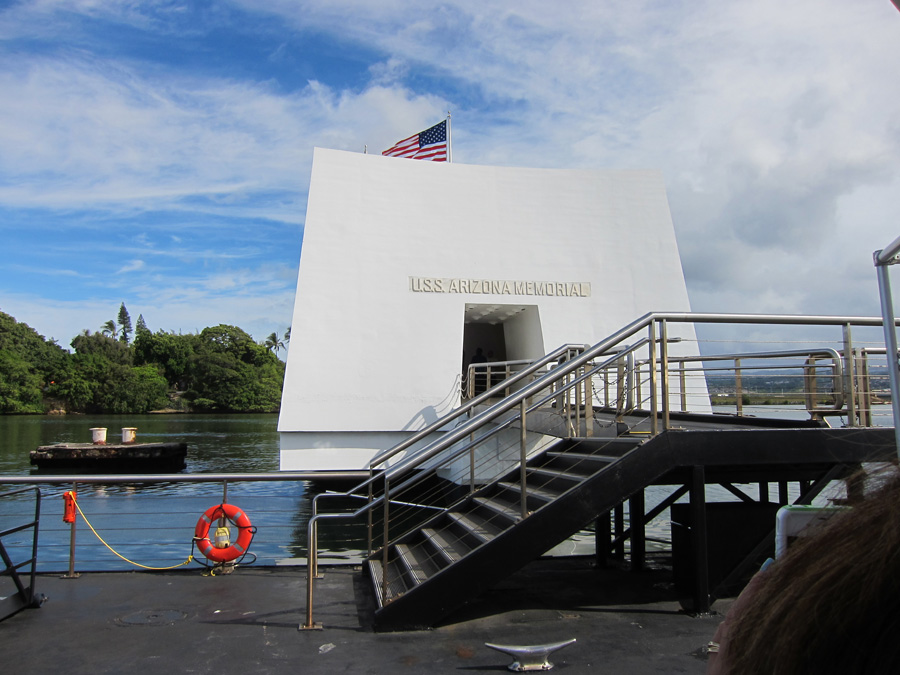
Our boat pulled up to the dock next to the memorial. The memorial is anchored to the sea
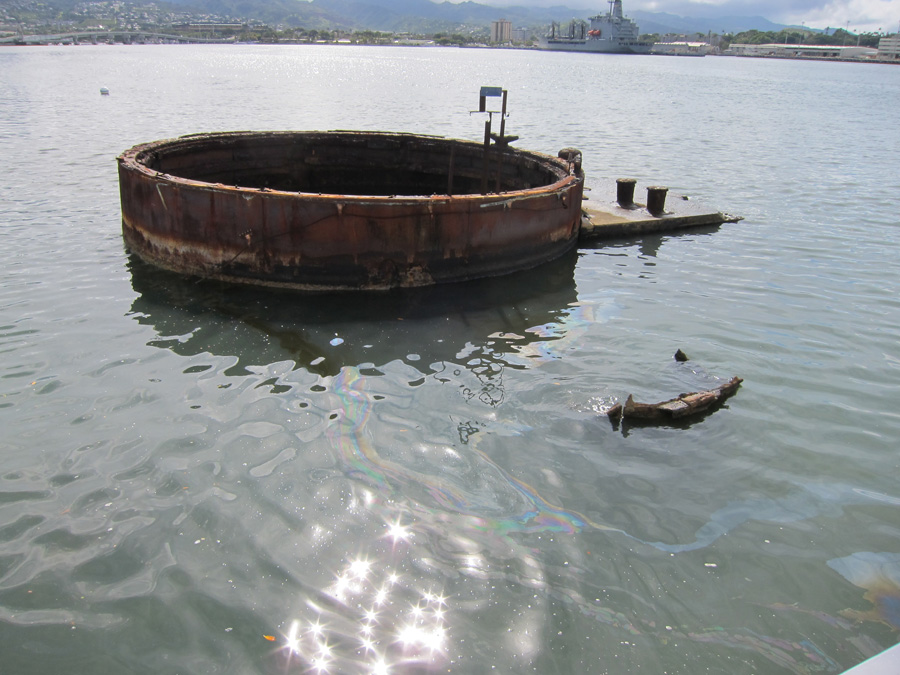
Oil still seeps from the hull of this great ship. This is a gun turret, and you can see the oil slick on the water.
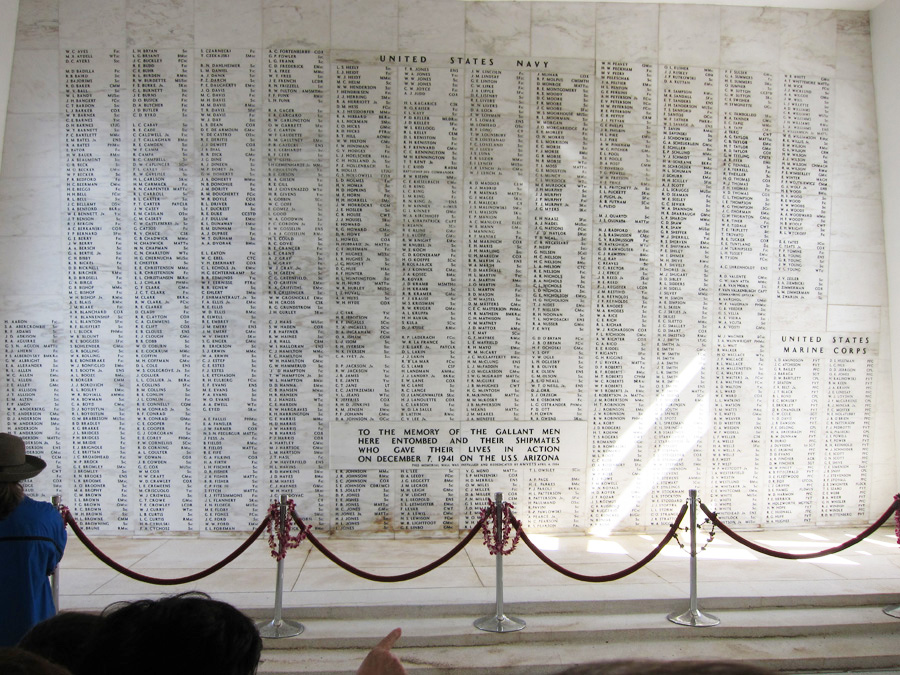
The memorial wall of marble with the names of those who perished inscribed there forever.
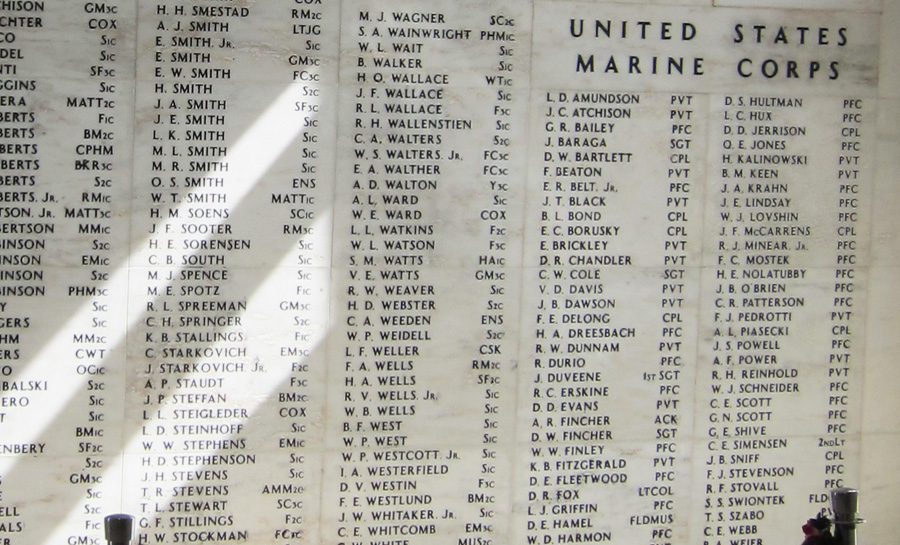
There was only one Weaver in the ships company. He perished in the attack.
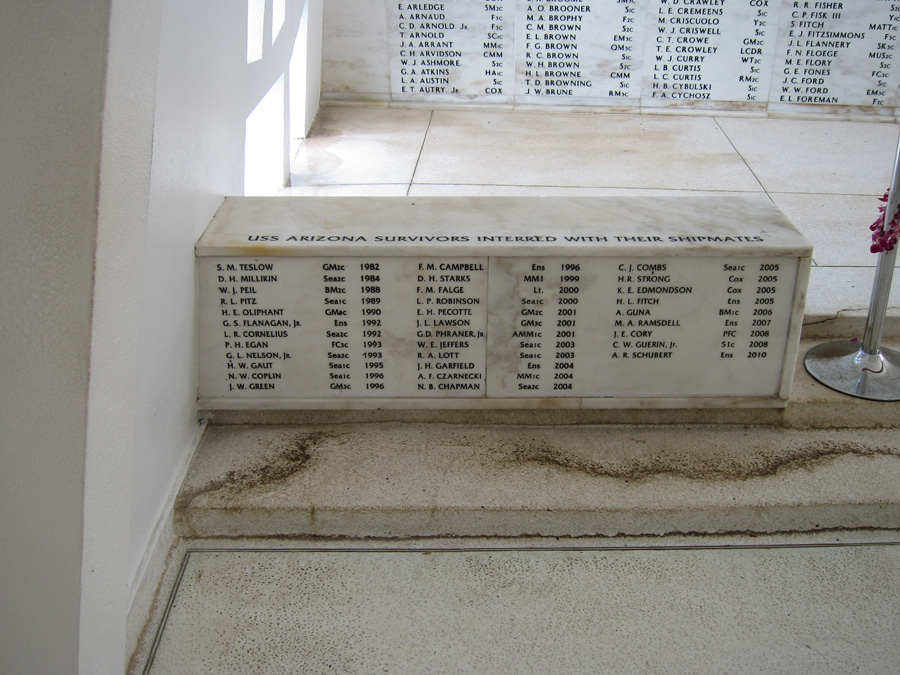
This box contains the remains of the USS Arizona survivors who wished to be interred with their shipmates.
Contrary to popular belief, USS Arizona is no longer in commission. As a special tribute to the ship and its lost crew,
A special bus took us from the visitor center to the battleship USS Missouri. Sorry, but photos from the interior will have to wait until the next chapter. |
|||||||||||
|
|||||||||||
|
|||||||||||
|
|||||||||||