 |
|
|
|
|
|
|
|
|
|
|
||||||||
|
||||||||||||||||||
|
Email us at: |
||||||||||||||||||
 |
||||||||||||||||||
 |
 |
|||||||||||||||||
|
Click the sun to see the |
||||||||||||||||||


|
 |
|
|



|
|
||
|
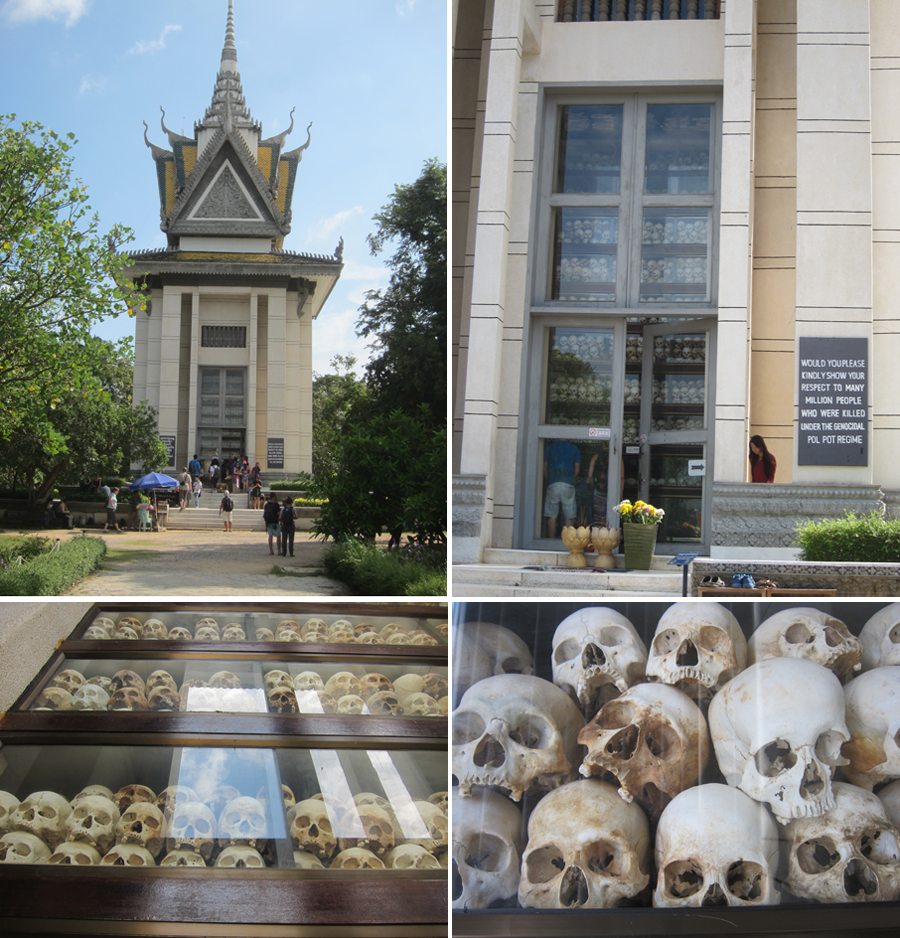
At the end of Chapter 10 I said we’d cast off from Phnom Penh and head for Tan Chau, but before we leave Choeung Ek and Phnom Penh, I’d like to share a few more photos. The most disturbing thing to me was to realize the time frame in which all this was happening, and what I was doing at the time. I felt pretty isolated from world events. I don’t know if it was because I was not paying attention, or the intensity of the situation never rose to a level to gain my attention. I was working at the Nasa Ames Research center, as a contractor with Bendix Field Engineering Corp. I was involved with the Pioneer Space Mission to the Moon, as well as Surveyor, a soft landing spacecraft, and the Apollo Program. I was more or less oblivious to what was happening on the other side of the world from me. Walking through this particular Killing Field was mind numbing to say the least. I vaguely recall hearing something about Pol Pot, but it was so far away, and I was very focused on my work. From a distance the shrine looked beautiful, but as you got closer, it’s more sinister aspect quickly became apparent.
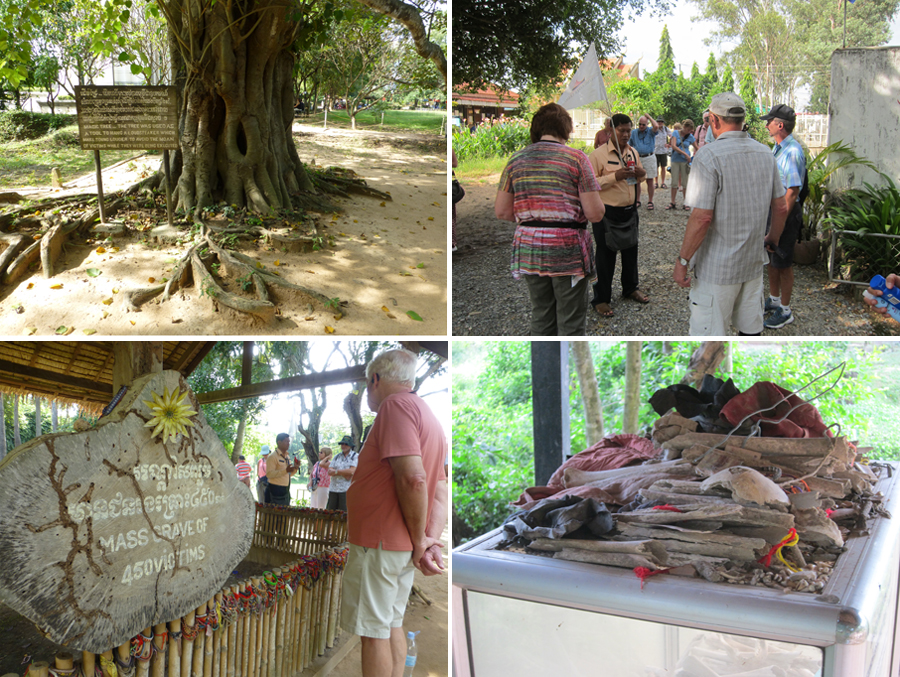
Shelf after shelf went up to the top of the shrine, and each one was filled with human skulls and other remnants of the carnage. Processing these images was a bit difficult to say the least. I had never seen so many human skulls in one place like this. As I walked around the shrine, the skulls just kept coming, on all four sides, through the windows, shelf after shelf of human skulls neatly stacked. I remember thinking to myself at the time that in the 1960s, when I had just been released from my 5 years of active duty with the Navy, all of these souls were alive, and totally unaware of a madman named Pol Pot who was soon to appear and darken their doorstep. From this tree, called the “Magic Tree”, was hung a loud speaker which made sound louder to avoid the moans of the victims while they were being executed.
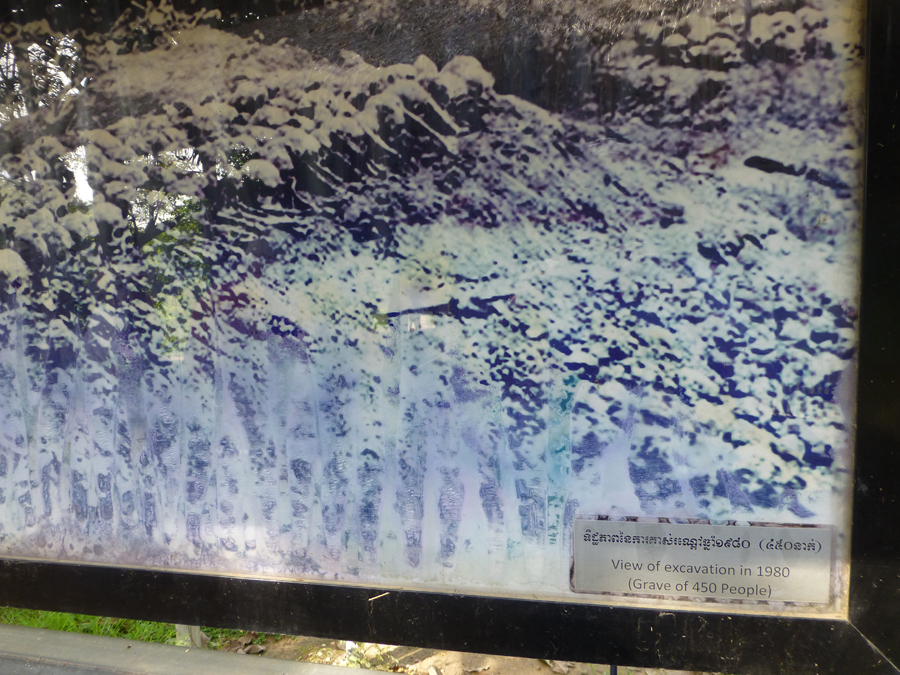
In frame three, this plot of ground is so small that it is impossible to imagine that it was a mass grave containing 450 bodies. This black and white photo taken in 1980 when the mass grave was excavated is difficult to make out due to age. But I think it shows enough to give you an idea of the horrible atrocity that was committed by the Pol Pot regime between 1975 & 1979.
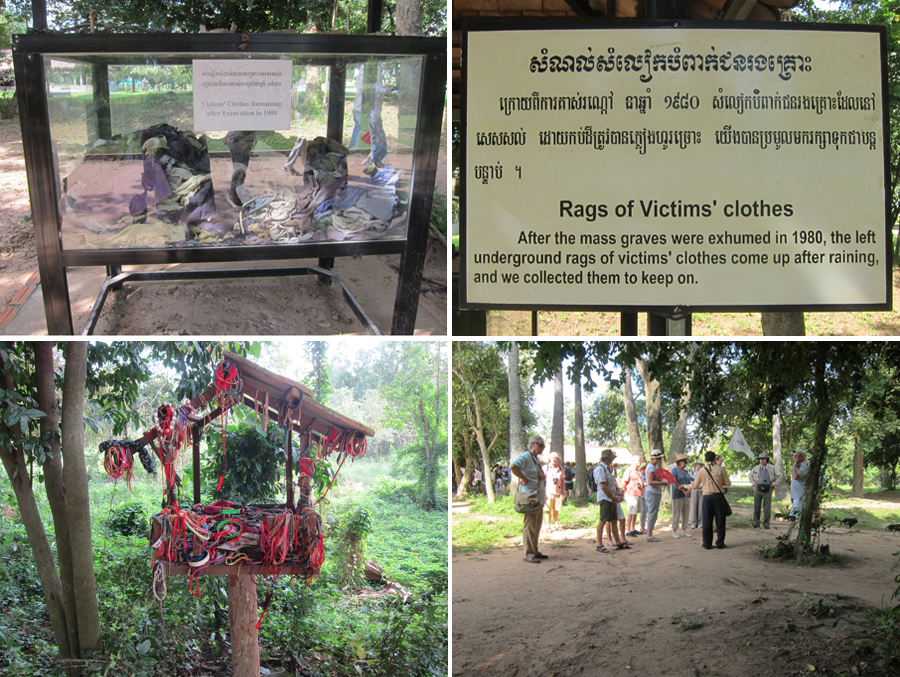
The Killing Field today has the appearance of a beautiful park, if you are careful about where you let your eyes wander. But as soon as you focus on what is before you, the stark reality lunges out at you like some horrible nightmare.
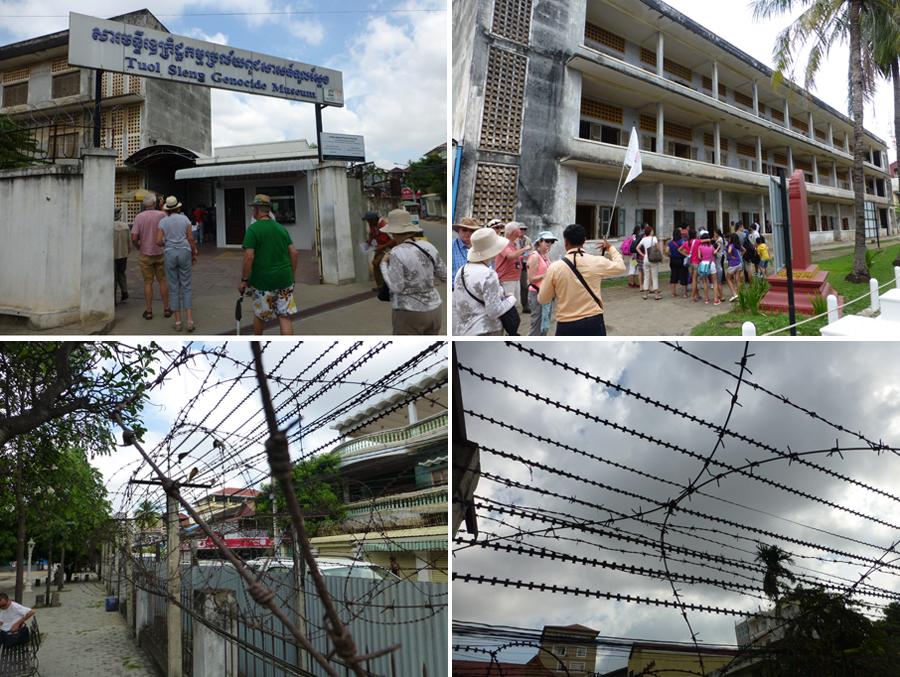
People brought friendship bracelets to leave at the shrine as an expression of their heartfelt grief and remembrance. Our guide tells us of some of the history of Choeung Ek, a history so horrifying it makes you cringe for being a part of the human race. From this Killing Field we went to the Tuol Sleng Genocide Museum, also known as the detention center S-21, which was so notorious that only seven of the roughly 20,000 people imprisoned there are known to have survived. It should be noted that Tuol Sleng is only one of at least 150 execution centers in the country. These are scenes of the Chao Ponhea Yat High School that was converted in August 1975 to the “Security Prison 21” (S-21), and it was surrounded by a double fence covered with an impenetrable tangle of electrified barbed wire.
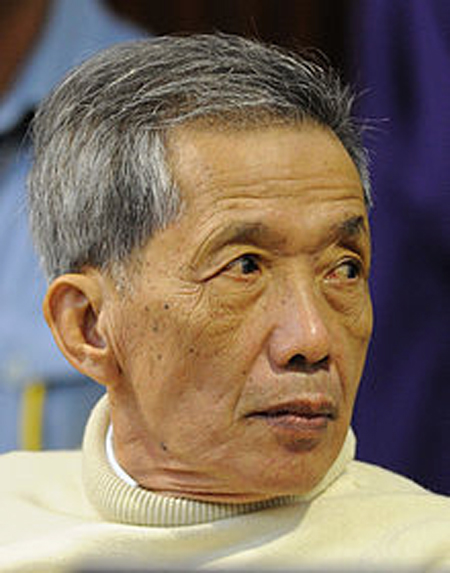
This is the man who was the Director of the S-21 prison camp, Kang Kek Iew, also known as Comrade Duch. Surprisingly, he is a Christian. In 1999, following the publication of his interview with Nate Thayer, a freelance journalist, who had previously interviewed Pol Pot, Duch surrendered to the authorities in Phnom Penh. He was tried, and on 26 July 2010, Duch was found guilty of crimes against humanity, torture, and murder, and was sentenced to 35 years’ imprisonment. His case was appealed, and on 3 February 2012, an upper court U.N. war crimes tribunal rejected his appeal and extended his sentence to life imprisonment because of his "shocking and heinous” crimes. This ruling is final with no other chance for appeal. Keng was born in 1942, five years after I was born, which makes us contemporaries.
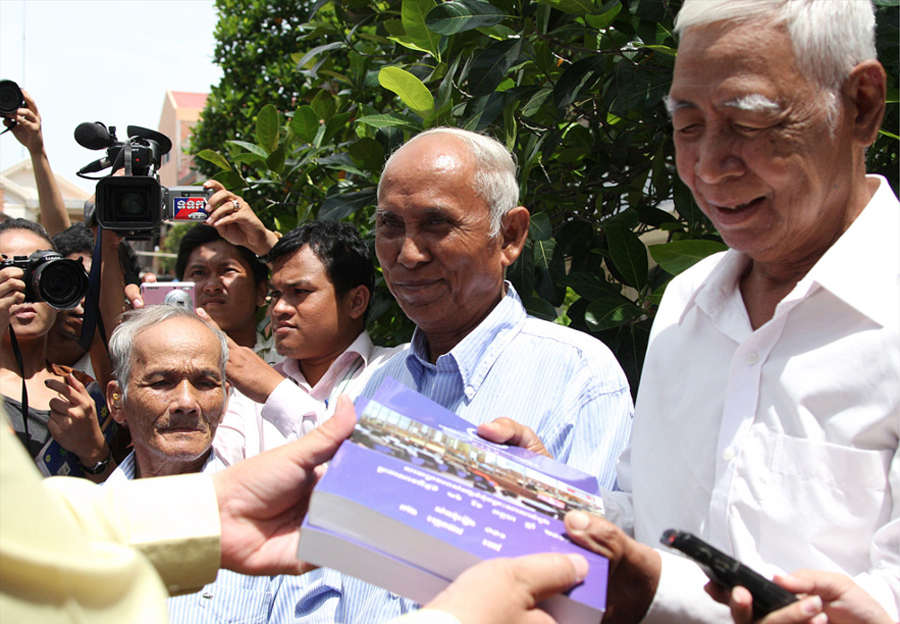
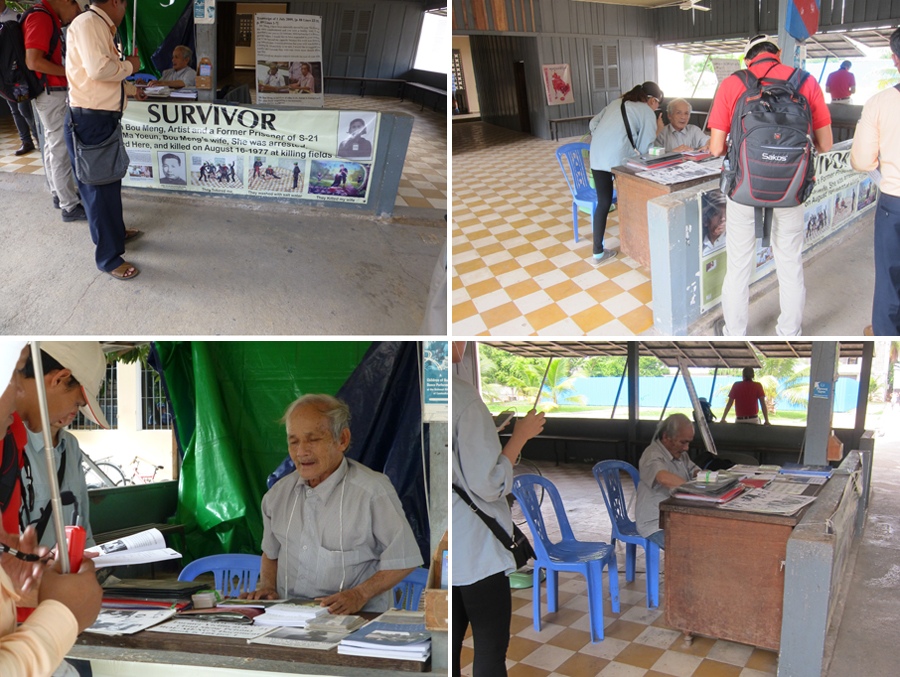
These are three of the handful of survivors from S-21. They are, from left to right, Bou Meng, Chum Mey and Vann Nath. They are receiving a copy of the Duch verdict on 12 August 2010. And this is Bou Meng, whom we saw just outside the prison. You’d think he’d want to be as far away from that place as possible, but his amazing survival makes him somewhat of a celebrity. Telling his story in person to anyone who will listen, it may be therapeutic.
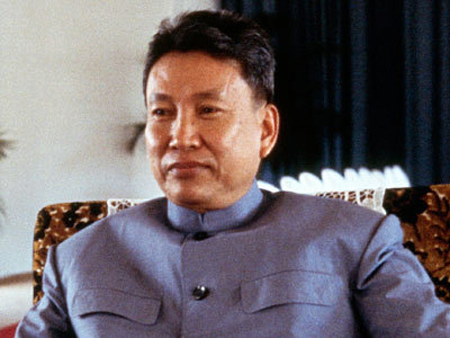
A book telling of his story, “Bou Meng: A Survivor From Khmer Rouge Prison S-21” by Huy Vannak, was available there. While I did not buy the book there, I planned to get it from Amazon for my Kindle, but as it turned out, it is not in Kindle format, so I bought the paperback instead through Amazon, USED at $1.97. To purchase it NEW, Amazon was asking $61.95. For an 80 page book? I don’t think so. ;o( And this is the monster responsible for perhaps one of the worse
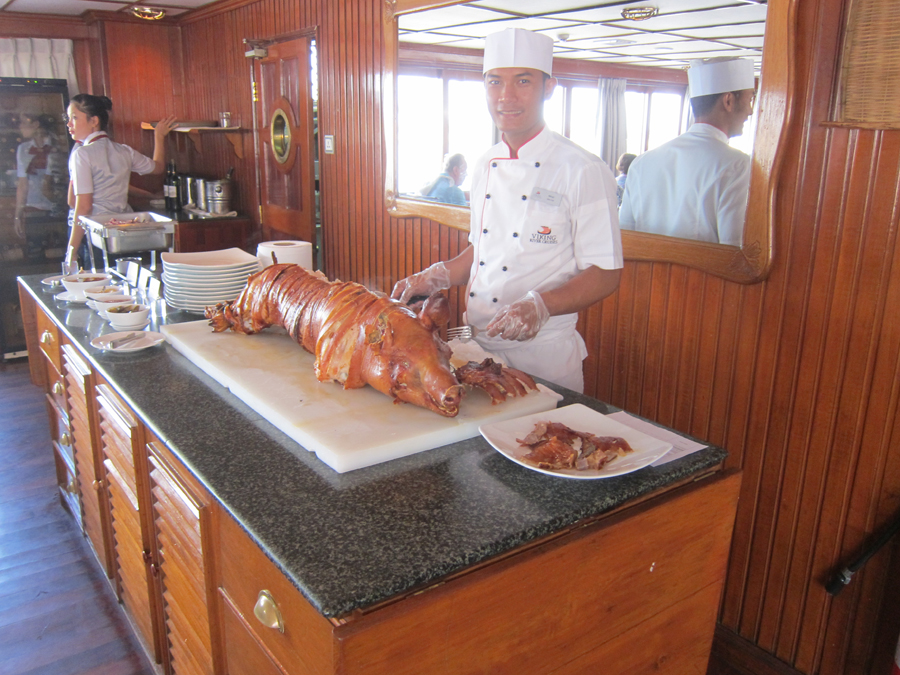
If interested in further reading on the history of this period, and to learn what happened to Poe Pot, go to http://www.historyplace.com/worldhistory/genocide/pol-pot.htm I found it to be very enlightening, as a concise and gripping history of this period. The conclusion was quite unexpected. We went back to the ship for lunch, which was quite enjoyable. Who doesn’t like pork? And this one was cooked to perfection.
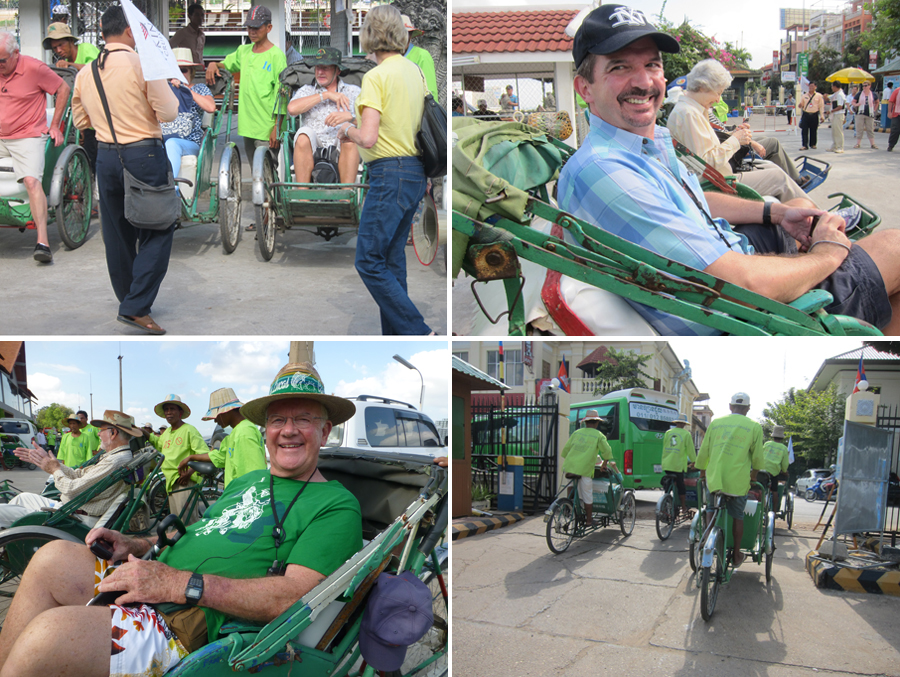
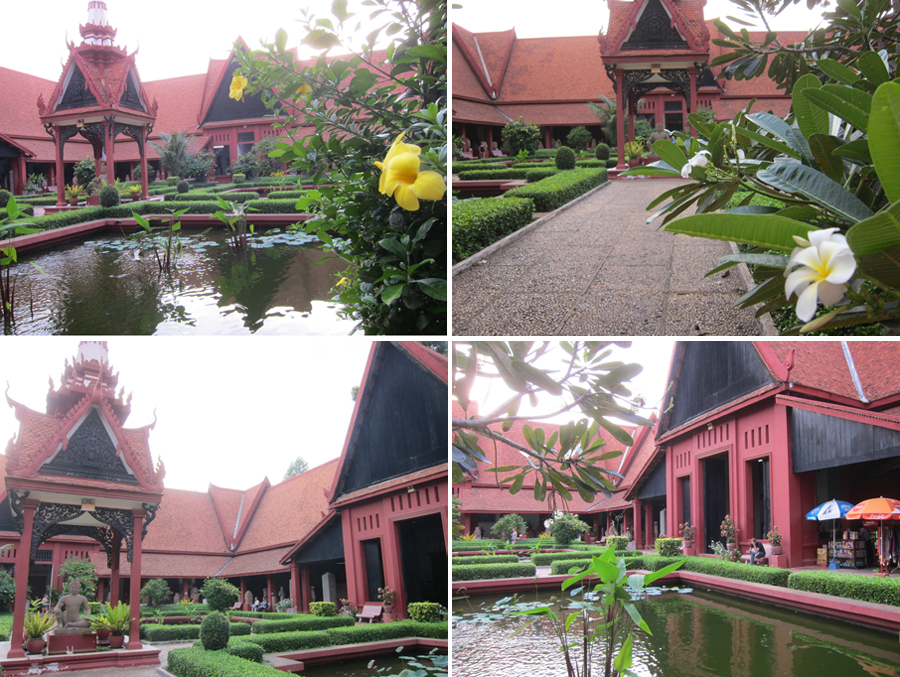
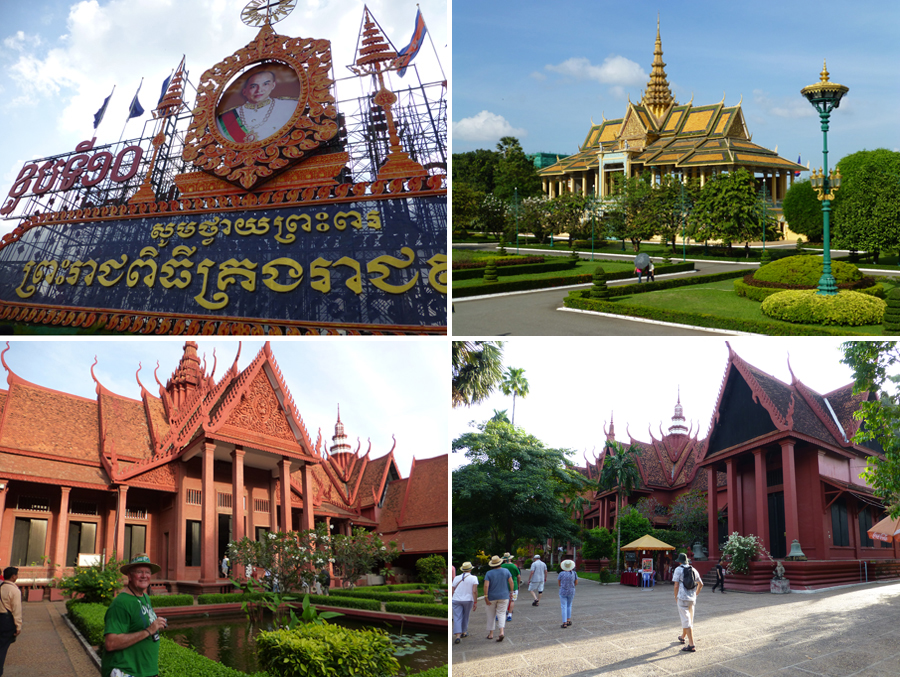
Following lunch we had a city tour of Phnom Penh, which included a visit to the Royal Palace and the National Museum by “Cyclo”, (see below).
I didn’t know what a 'cyclo’ was. In Hawaii they call them pedicabs. It was a pretty good way of getting around.
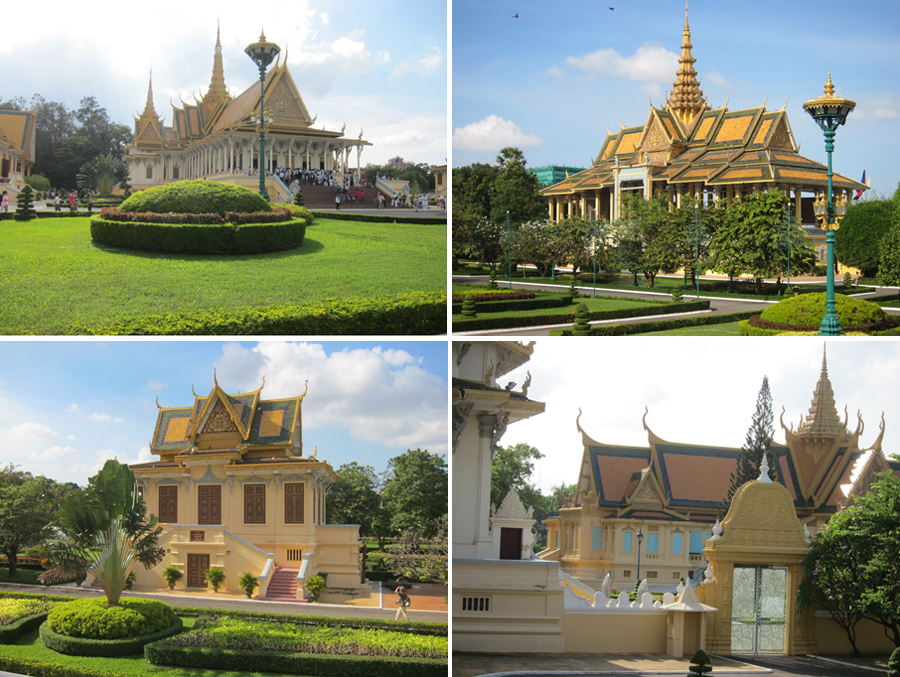
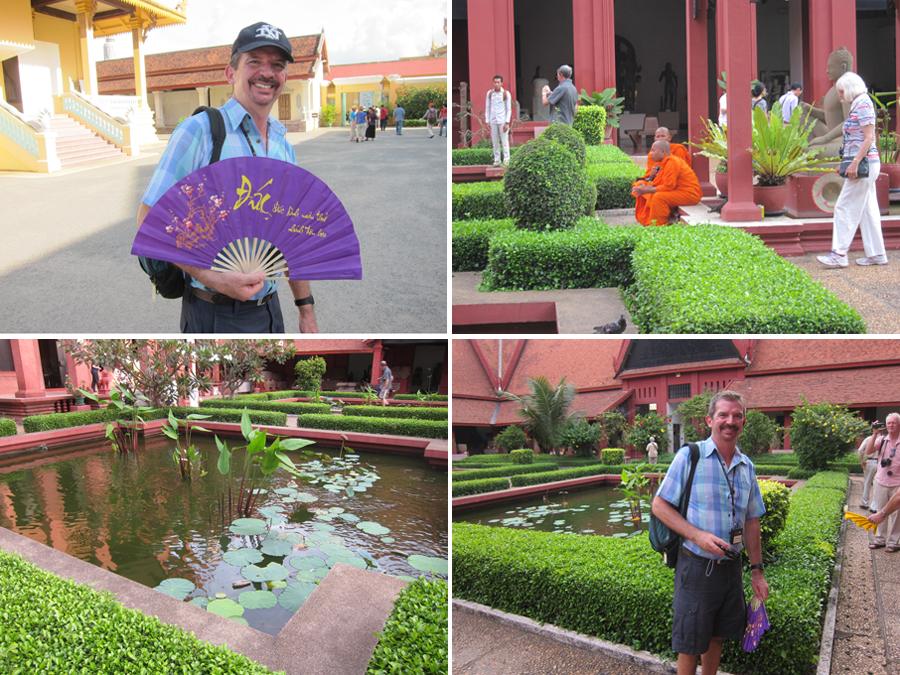
The Royal Palace was a beautiful structure. The grounds were magnificently manicured and maintained. It was a warm day, and the fans that Tin gave us were quite useful. Cambodia is 96.4% Buddhist, so it was not surprising to see a couple of monks on the palace grounds.
And what beautiful gourds they were.
Frame one is a daytime view of the scene we saw at night from the river of the Royal Palace as we entered Phnom Penh.
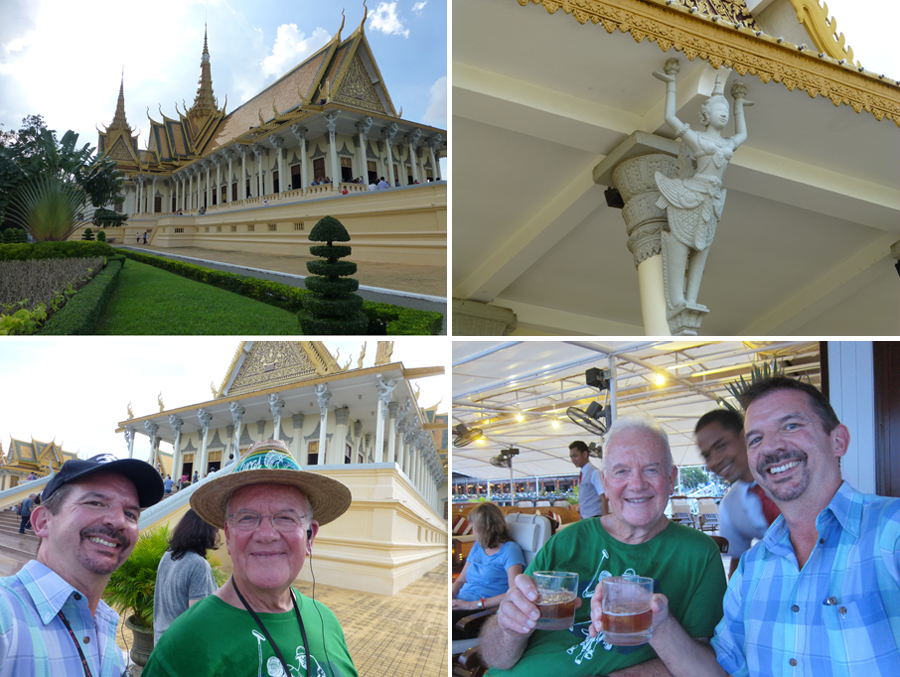
There were several major buildings on the palace grounds, ranging from golden, an almost brick red, to a burnt red color. The roof of the Royal Palace seems to be supported by Cambodian angels at the top of each column.
But I think we’ve seen enough of the Royal Palace. It’s time we relaxed and enjoyed a manhattan, or two. ;o) In the next chapter we’ll explore the interesting dinner menu we enjoyed on board this night, followed by an evening of folkloric dance performed by Cambodian children. |
|
||||
|