|
|
|
|
|
|
|
|
|
|
|
||||||||
|
||||||||||||||||||
|
Email us at: |
||||||||||||||||||
 |
||||||||||||||||||
 |
 |
|||||||||||||||||
|
Click the sun to see the |
||||||||||||||||||


 |
|||||||
|
|
|
|
||||
|
|||||||
|
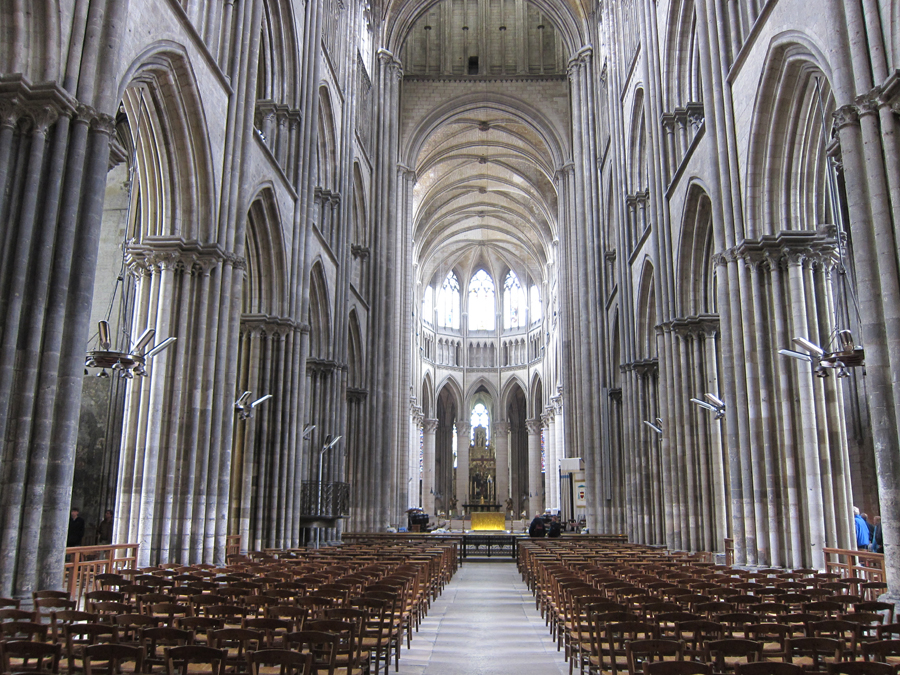
Part 6 A friend in Pennsylvania responded with an interesting reason for the rather overlarge size of cathedrals, and it makes sense.
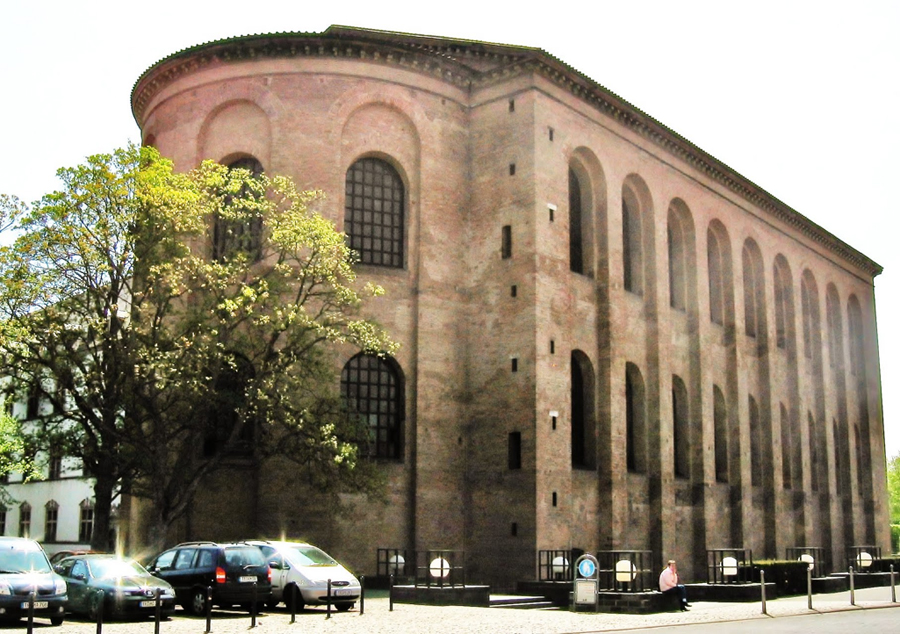
His understanding from his old history books is that (early on) the Popes wanted them built that way, because it was a way to impress the local peasants who were not yet converted to Catholicism. With no education and never having seen anything on such a grand scale, (except perhaps the exterior of the king's palace to which they had little access) they were more likely to give up their old (heathen) religions and accept the beauty and grandiosity of the Church. In the 17th, 18th and 19th century the Church denied this as being the reason and said they put their money and efforts into building such grand cathedrals "for the greater glory of God." However, history suggests that outside of Rome itself, it was rarely the Church's money that built them, but rather the money collected as a tax by the royalty of that particular country. The third theory is that the Kings and royalty of Europe were always trying to outdo each other with their palaces and churches, so a huge, cavernous cathedral would impress other royalty and would be favorably looked upon by Rome, which never hurt, considering the political clout Rome held at the time. This explanation reminds me of one of our trips several years ago, as we traveled by boat down the Rhine and Mosel rivers in Germany, following the guidance of one of Rick Steves' books. One of our stops was at the ancient city of Trier, the oldest city in Germany. Archeological evidence shows that a settlement existed at the present location of the city as early as 3,000 years B.C. In the 4th Century Emperor Constantine built his palace here.
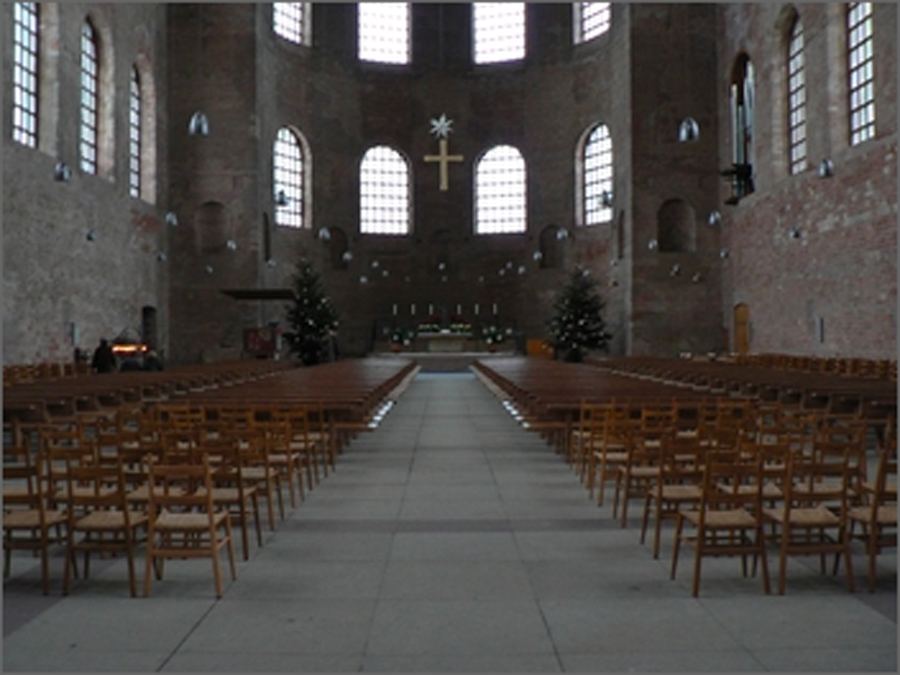
It has been restored after various wars inflicted damage over the years. It is 27 m (90 ft) wide and 67 m (220 ft) long. It is truly a magnificent structure, especially when you consider that when it was constructed, the peasants in the area were living in mud huts with little creature comforts. The long high-ceilinged brick structure was the throne hall of the Roman emperor. The Romans wanted the architecture to express the magnificence and might of the empire, and the sheer size of the great basilica still impresses The elongated rectangular brick structure is 29.9 m (98 ft) high with a vast semicircular aspe. It is the largest surviving single-room structure from Roman times.
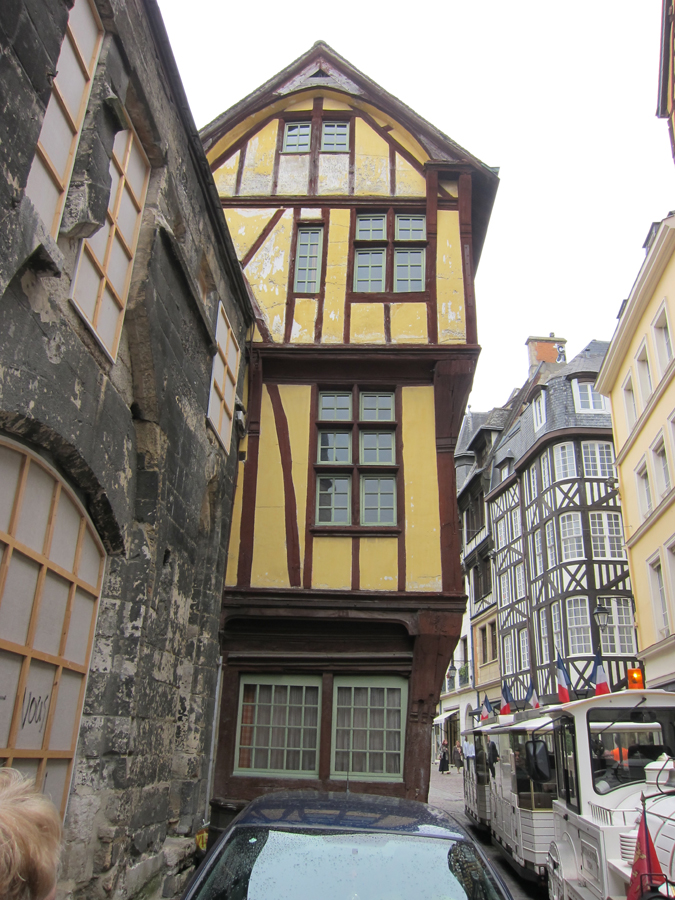
Today it is a church, but in Constantine's time it was embellished with colorful marble inlay, golden mosaics, and statues. When the peasants, who had been granted audience with the Emperor, entering this huge palace, and seeing Constantine sitting on his throne at the far end of it, and having to walk all the way down the length of the palace to address him, they were so impressed and struck with such awe, that they eventually gave up their pagan religions and became Christians. Sorry for that aside, but it fit well with the purpose of the huge size of the Catholic cathedrals and the intent of impressing the lowly surfs and peasants. Even today, I am very impressed as I walk into the Basilica of St. Peter in the Vatican, and I don't consider myself either a surf or a peasant, so I think the tactic still works today. And now back to Rouen. Building codes in Rouen were a little lax. Builders would expand the upper floors to obtain more floor space. However, this led to a problem due to the narrowness of the streets. At the top the buildings were so close together that if a fire broke out in one, it easily jumped to the adjacent buildings.
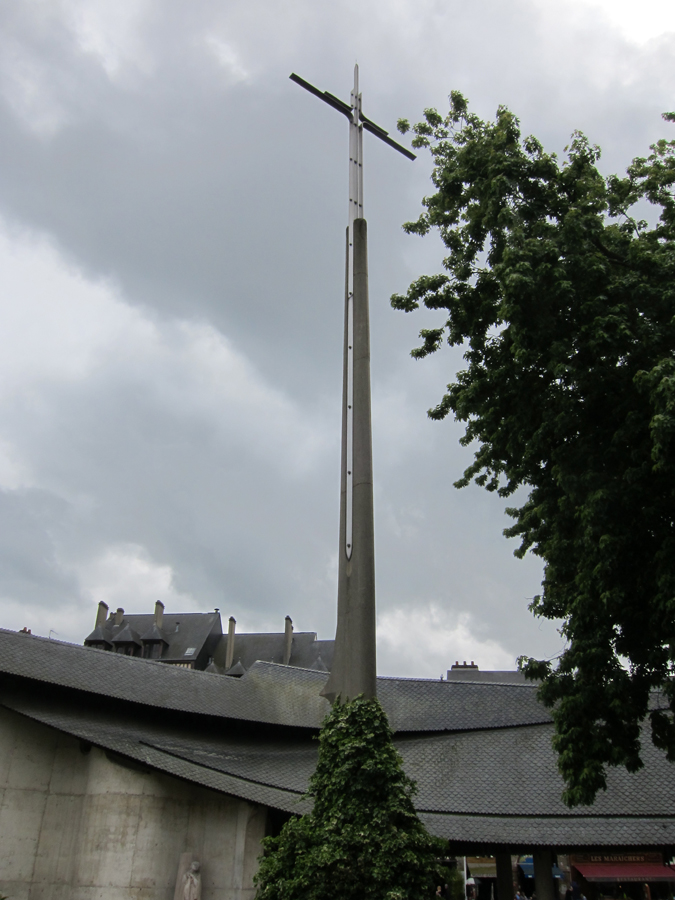
In this example you can't see just how close the buildings are, but some of the narrow Rouen is also the town there Joan of Arc was burnt at the stake for heresy. She was 19 at the time of her death. Witnesses attest that during the last minutes of her life, Joan prayed unceasingly before her executioners, asking for mercy on their souls, repeating that her voices were true and coming from God. When the flames reached her, she called for Holy Water and then spoke her final words, "Jhesus, Jhesus!"
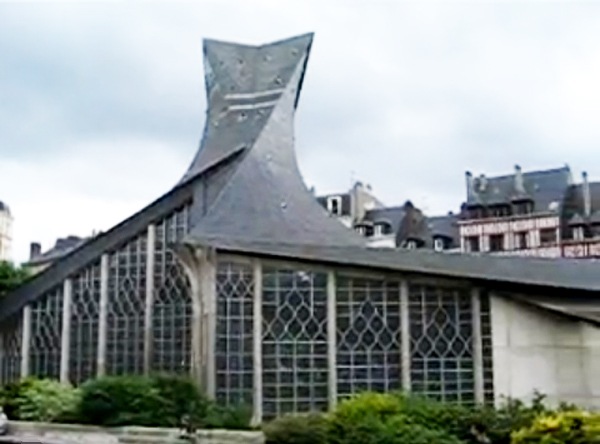
This cross stands on the very spot where Joan was put to death by fire. It stands next to the Saint Joan of Arc Church,
The Saint Joan of Arc Church has a unique design. It is fashioned in the likeness
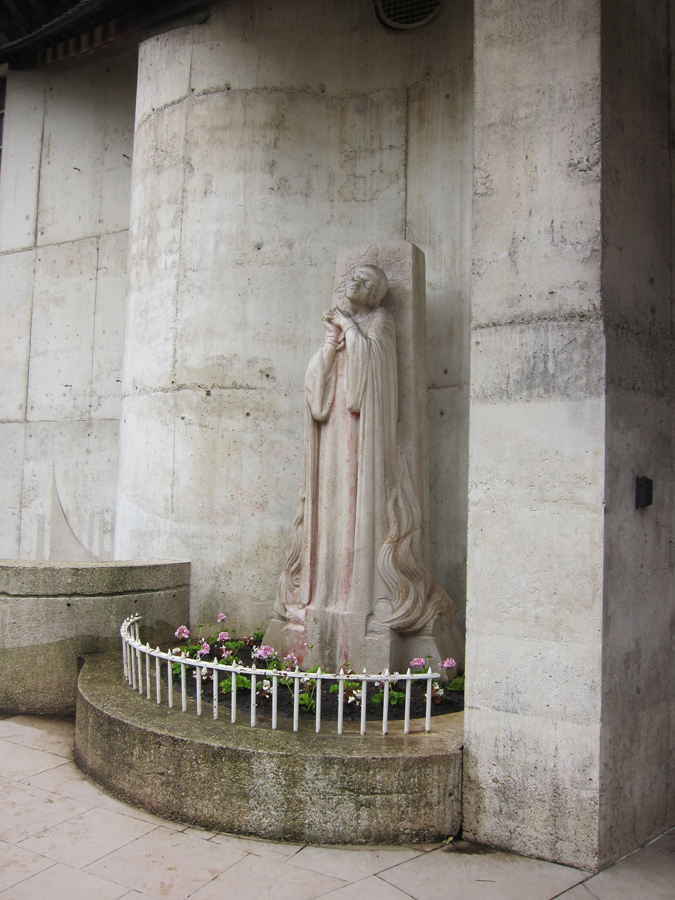
This statue, by Real de Sarte dates from 1926. It is nestled into an alcove created by the At the time of her martyrdom, the Hundred Years War was raging. The English repression over Rouen is terrible but Joan of Arc's exploits help Normandy to hope anew. Caught at Compiegne by the Burgundians, Joan of Arc is "sold" to the English by French bishop Cauchon for the price of 10,000 gold ecus. The trial starts on February 21st, 1431. Torn between questionings and doubt, Joan retracts on May 24 on scaffold. She is sentenced to life imprisonment, a decision that maddens the enemy. Joan, misled by foul stratagems, shown as having abandoned her faith, is burnt alive on May 30th, 1431. Her ashes are scattered and her heart is thrown into the Seine.
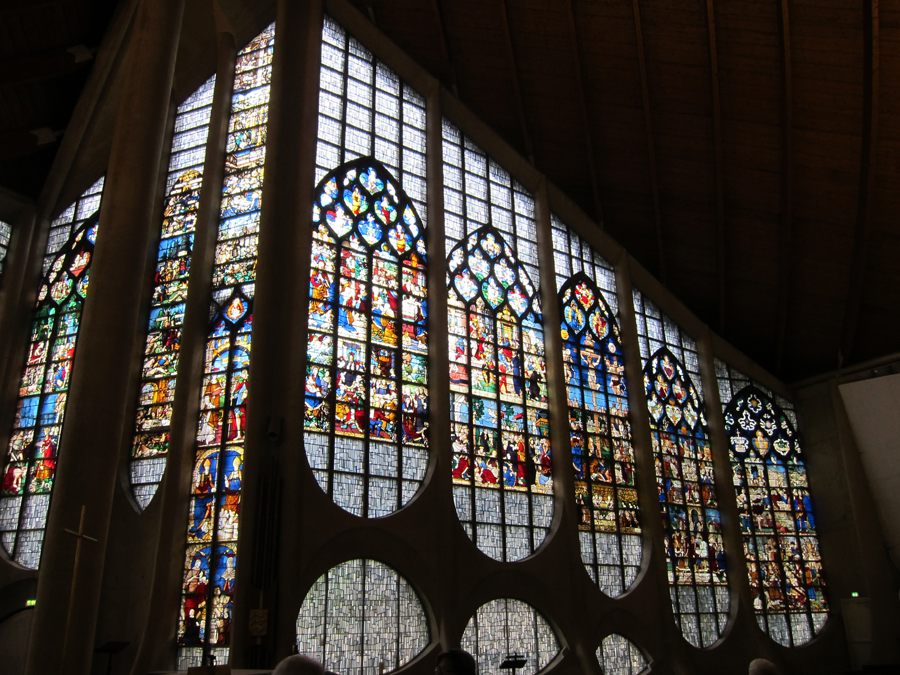
As I said, inside the church, the stained glass windows are very beautiful. The congregation sits in front of them I'm up against the magic number again, so I will resume this tour of the Saint Joan of Arc Church in Part 7. |
|||||||
|
|||||||