|
|
|
|
|
|
|
|
|
|
|
||||||||
|
||||||||||||||||||
|
Email us at: |
||||||||||||||||||
 |
||||||||||||||||||
 |
 |
|||||||||||||||||
|
Click the sun to see the |
||||||||||||||||||


 |
||||||||||||||||||||
|
|
|
|
|
|
|
||||||||||||||
|
||||||||||||||||||||
|
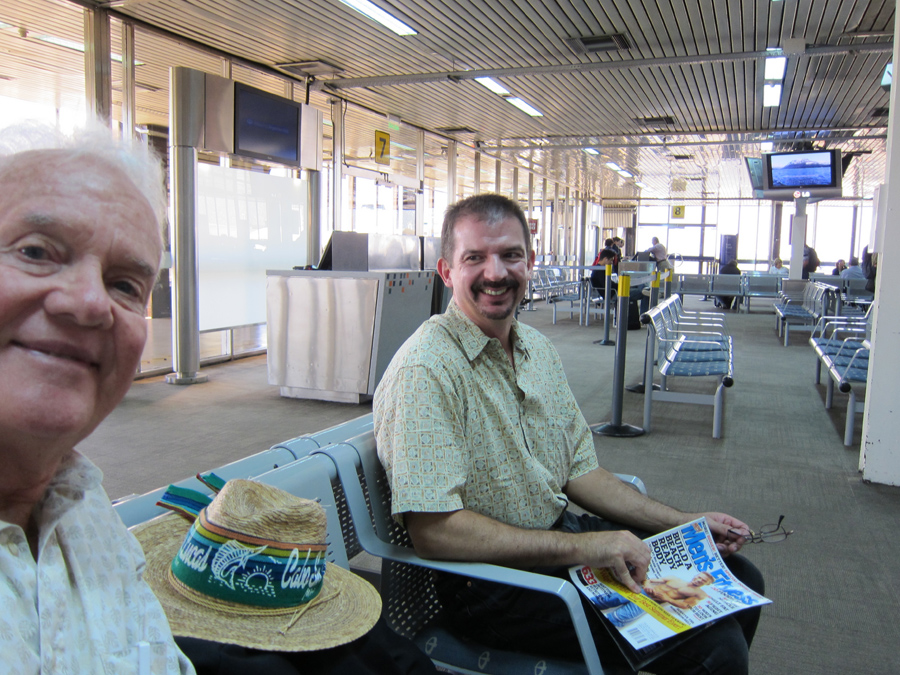
Well, I've been procrastinating long enough about getting into this travelogue. Our trip to Ecuador and the Galapagos Islands took place in October. November was taken up by our wedding & reception, and Thanksgiving. December was taken up by a week at The Native Sun Resort just north of Fort Lauderdale, followed by a week on the huge cruise ship Carnival Liberty, with a 3,000 passenger capacity. We sailed from Miami to Saint Thomas, with stops at St. Maarten and San Juan, Puerto Rico. Next came Christmas, and lastly New Years. So, as you can gather, I've been just a wee bit preoccupied. But now it is time to get to work and try to make this amazing adventure come to life. DAY ONE ~ Getting there. Pete doesn't much care for airport photographs, but I simply can't resist. I'm too eager to get the show on the road, and my camera comes out and I'm like little kid as I wander the airport taking photos of whatever strikes my fancy.
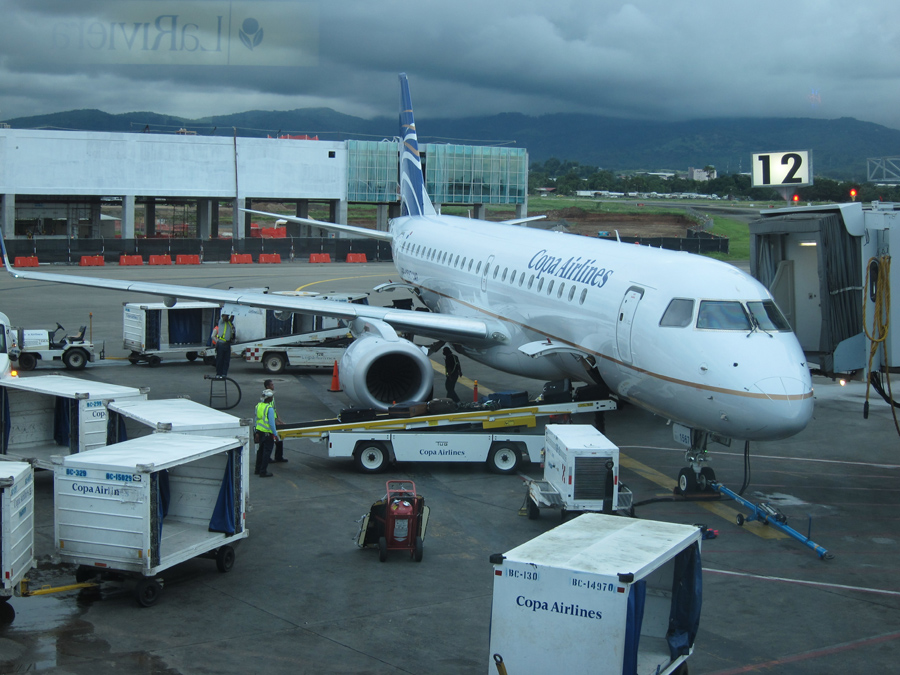
I disrupted Pete from reading his Men's Fitness magazine, but I did manage to get that smile. This will be our first time to fly Copa Airlines, the Panamanian airline. It's quite true, as their flight route maps clearly show, that all their flights go to Panama City first, and then on to your destination.
Our flight was to leave Ezeiza at noon on the 20th of October. It was an overcast day, and quite chilly.
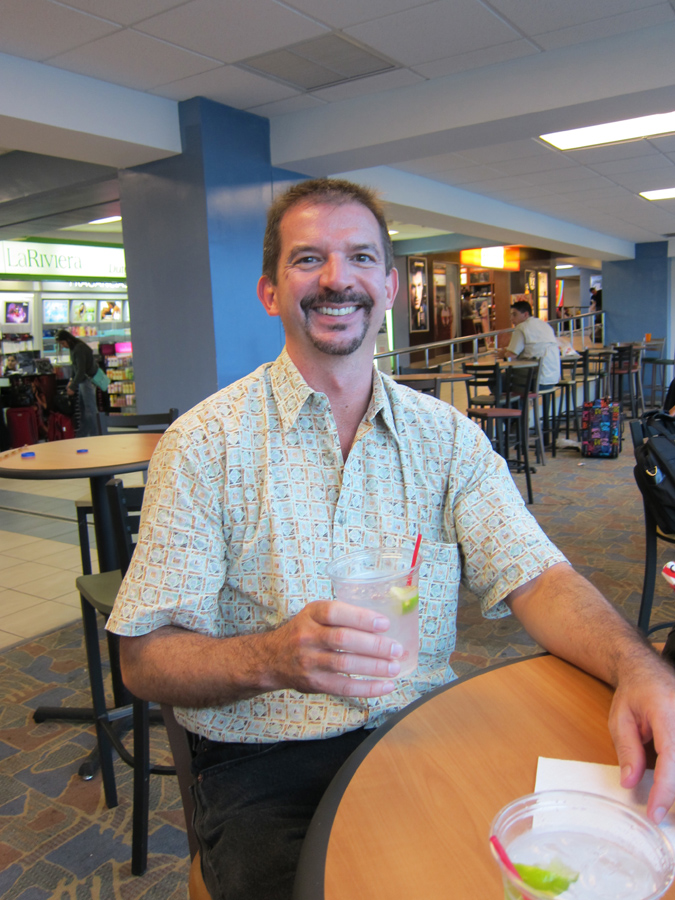
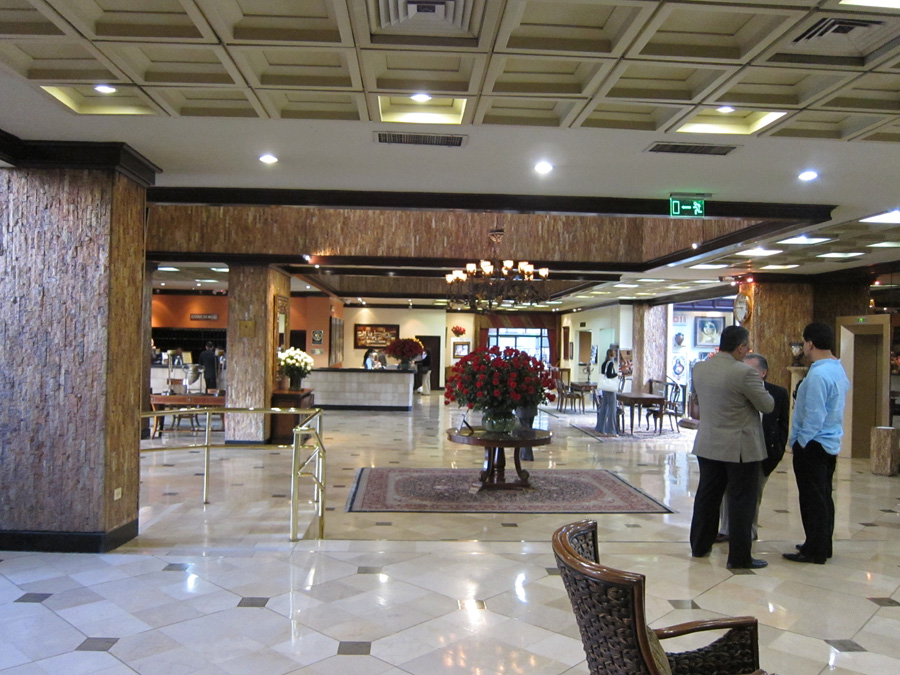
While waiting in Panama for our connecting flight to Quito, (it was a 3½ hour layover) We checked into the Swissotel in Quito for a three night stay. It was a beautiful hotel.
The lobby was huge, and there were grand bouquets of flowers at every turn.
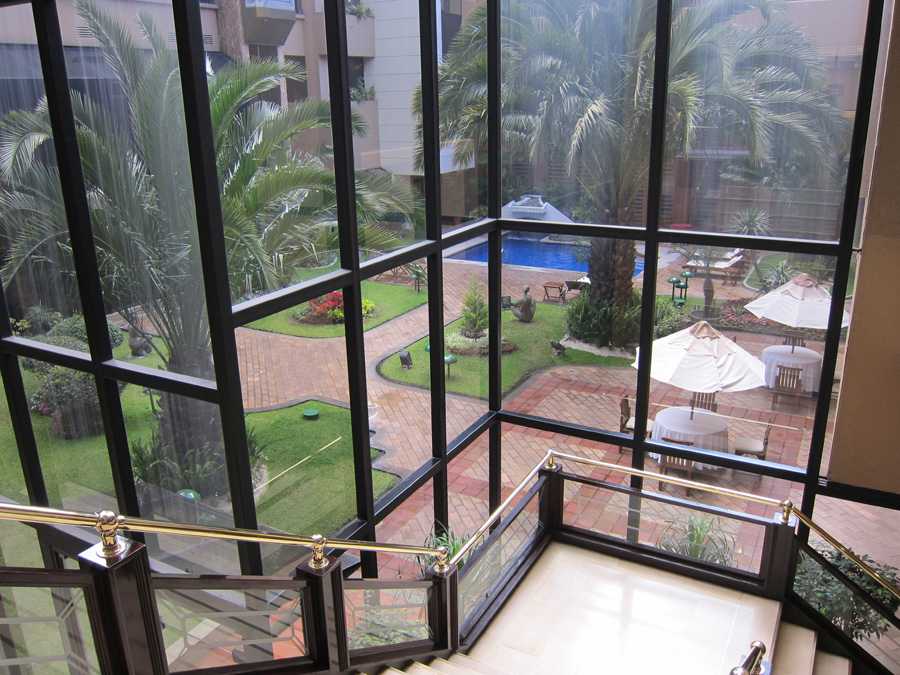
There was a magnificent inner courtyard with a beautiful garden.
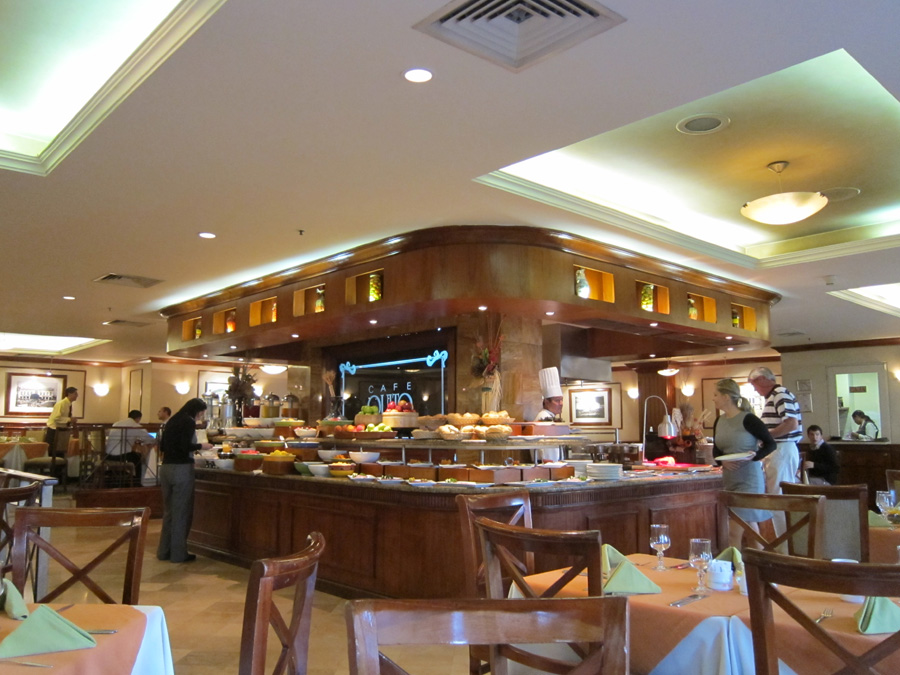
The dining room served the most extravagant breakfasts that were complimentary for guests. DAY TWO ~ A City Tour of Quito
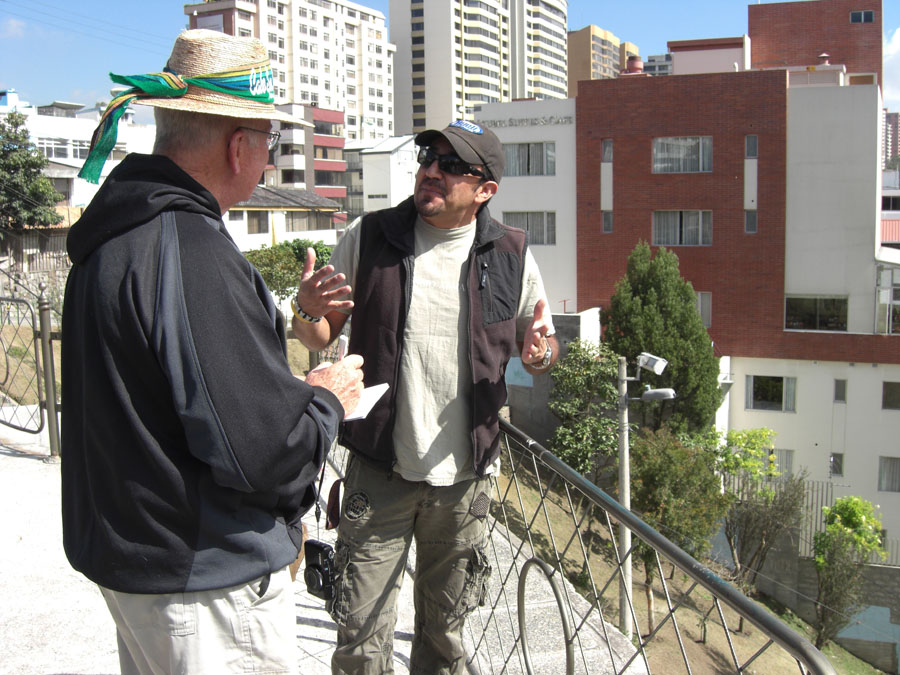
This is Byron, and he will be our personal tour guide for the next two days. We are standing at a vista point, overlooking a canyon which leads to a broad valley, on the other side of which lies the Andes Mountains. Quito, officially San Francisco de Quito, is the capital of Ecuador, and it lies in north-central Ecuador in the Guayllabamba River basin, on the eastern slopes of Pichincha, an active stratovolcano in the Andes Mountains. It has a population of approximately 1,504,000 (per the municipality estimate in 2005 census). Quito is the second most populous city in Ecuador, after Guayaquil. The elevation of the city's central square (Plaza de La Independencia) is 2,800 meters, or 9,200 feet.
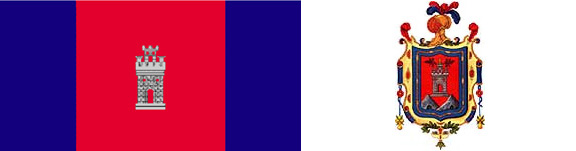
The Ecuadorian flag and cote of arms Ecuador is the Spanish word for equator, and the central square is just 25 kilometers south of the actual equator. Our day trip today will take us to the site marking the actual equator. We assume it will be as exciting as it was to stand on the longitudinal meridian of 00° 00' 00'' at Greenwich, England, which we actually did in June 1999. But first we get a history lesson from Byron.
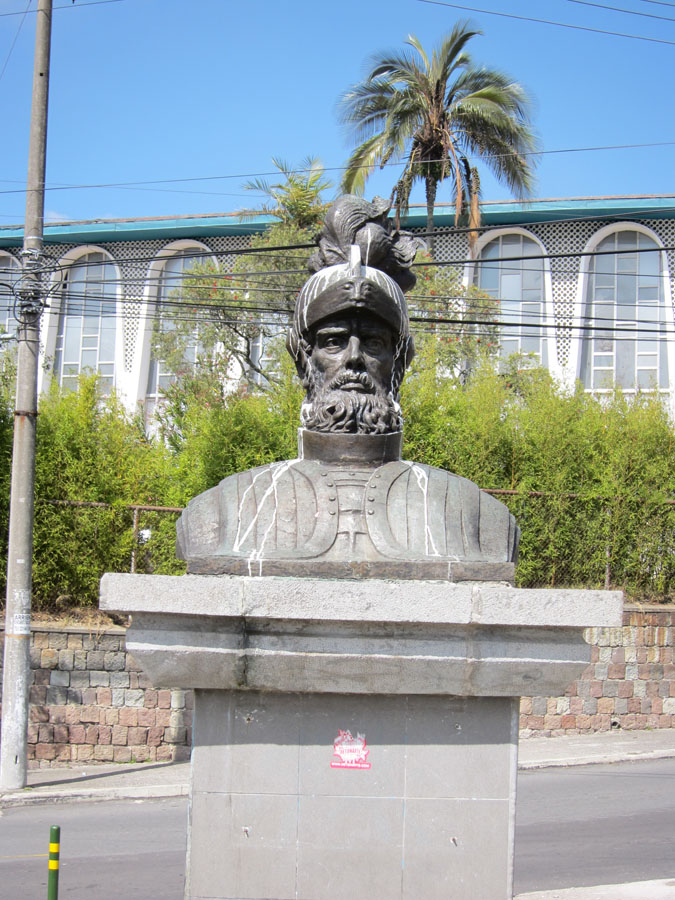
This monument stands at a vista point, and commemorates Francisco de Orellana. Francisco de Orellana, who was a Spanish conquistador, and the founder of the port city of Guayaquil, set out in 1541 with 6,000 men, on an expedition to find gold & silver, and to locate the "Land of Cinnamon". In all honesty, the story our guide told us was somewhat different from what actually transpired. If you are at all interested, I suggest that you read a more accurate account of the life of Francisco de Orellana at this link: http://en.wikipedia.org/wiki/Francisco_de_Orellana It is a fascinating story.
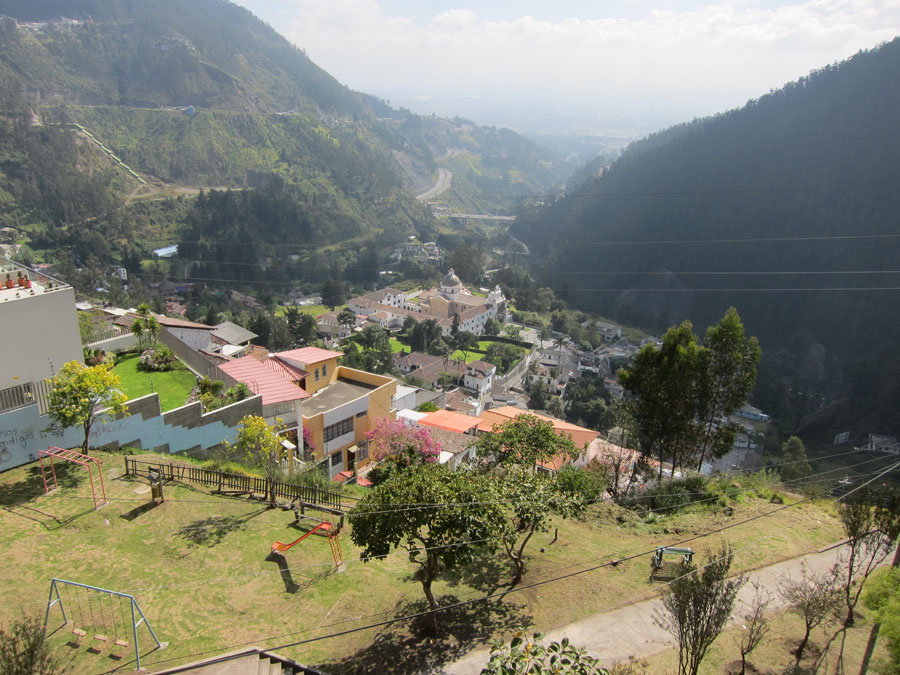
A view from the vista point overlooks the route taken by Francisco de Orellana. The expedition set out to the east from Quito. On this historic journey they discovered the Amazon River, and they encountering innumerable hardships along the way, such as malaria, wild animals and an extremely hostile environment. He returned to Quito 2 years later with only 16 men remaining from the original 6,000, the rest having either died or deserted the expedition. This road leading from Quito and winding through the distant valley was the exact route that Francisco took as he led his huge contingent of men. This is also the road our guide would take the following day, when we visit the SPA at Papallacta and spend a full day there.
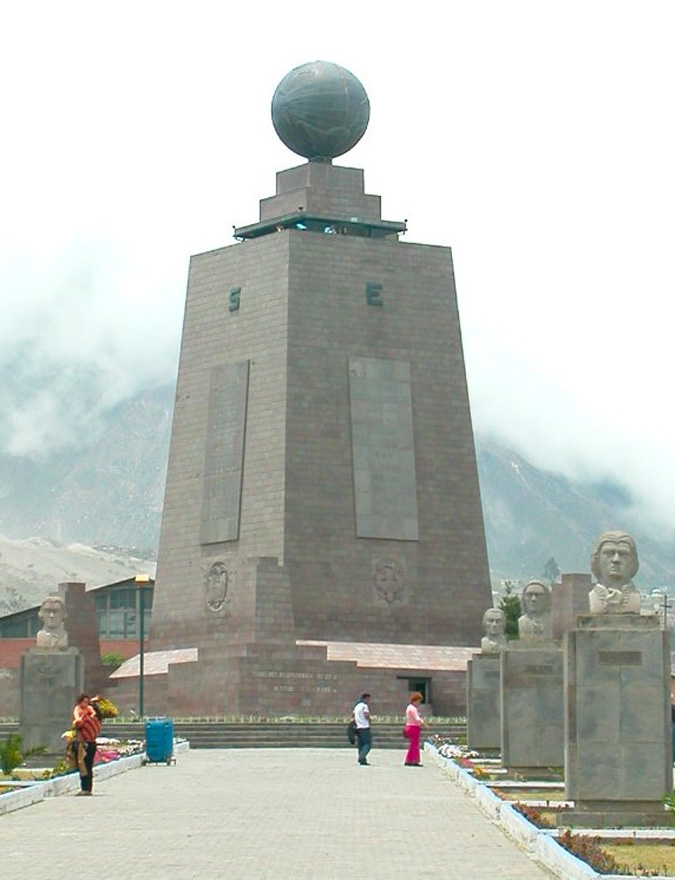
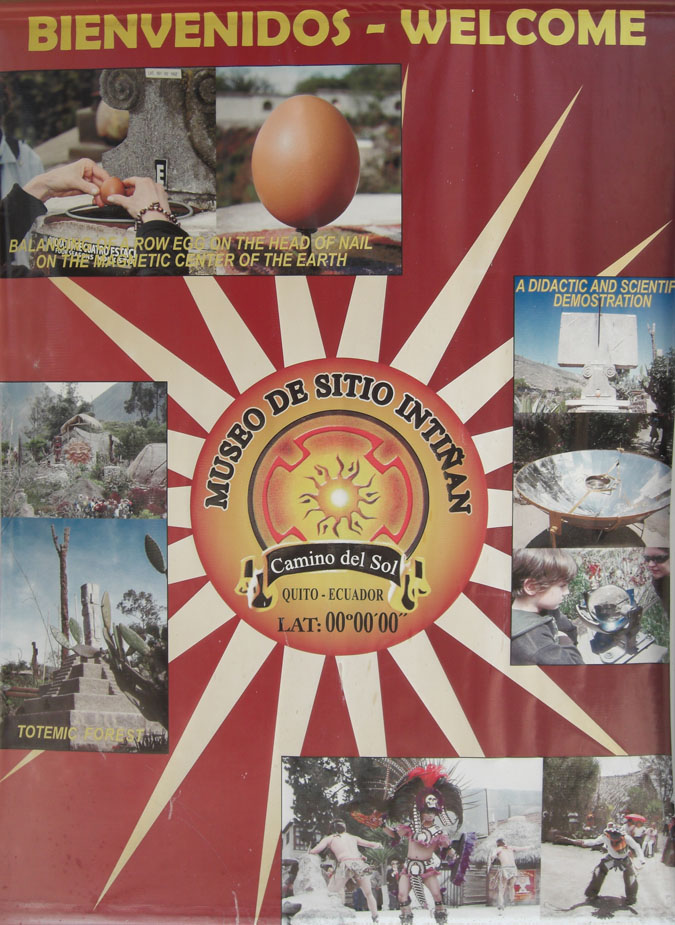
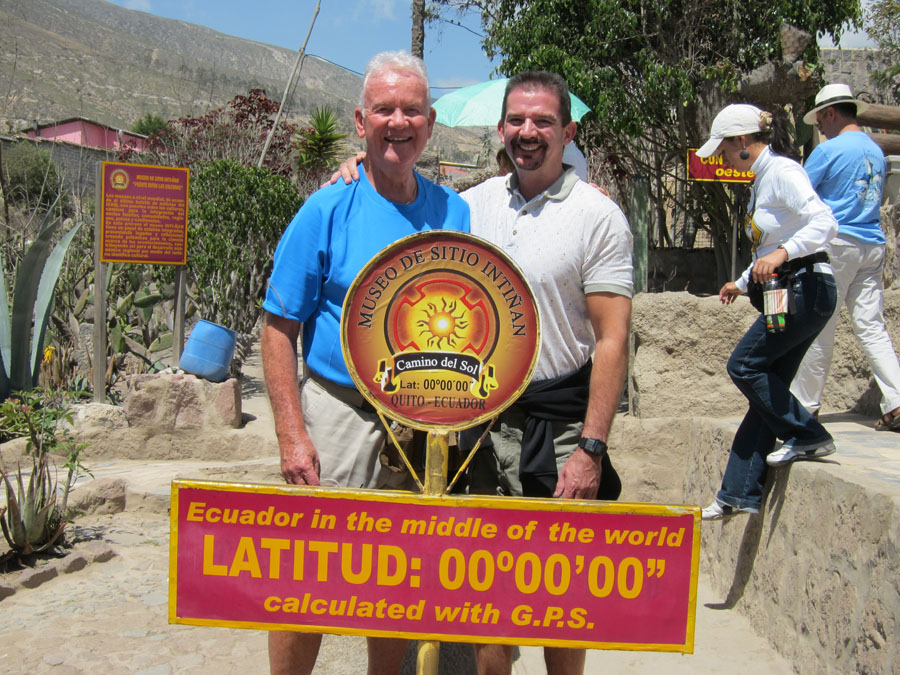
This is La Mitad del Mundo (the middle of the world) and is 35 kilometers north of Quito. It was built in 1980 at a We visited that actual equatorial crossing at the MUSEO DE SITIO INTIÑAN (or Solar Museum), at Latitude 00° 00' 00", where we would observe some very strange behaviors.
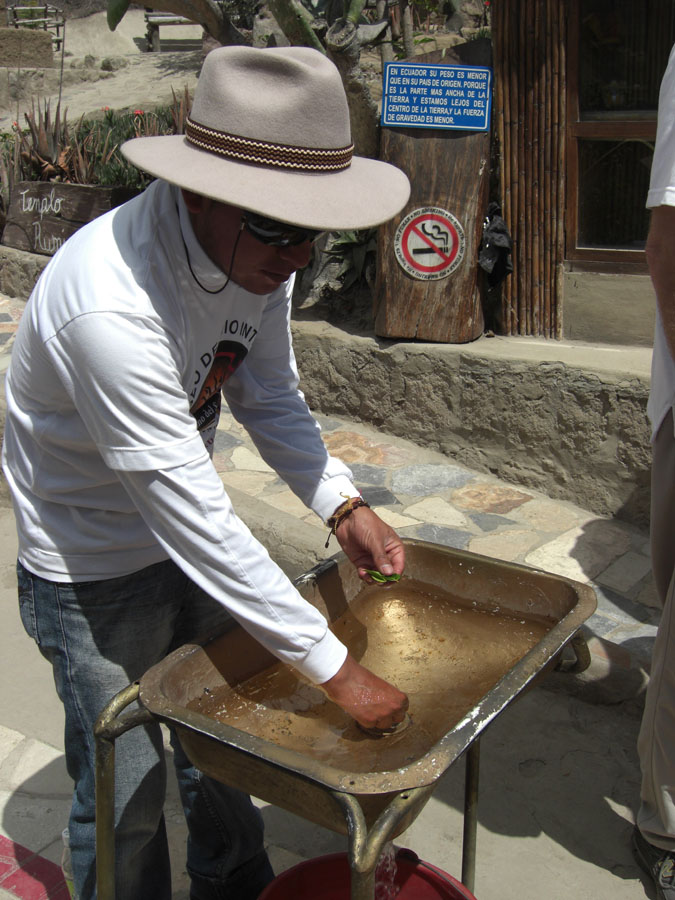
At the museum we had an English speaking guide for just the two of us. Byron turned us loose and disappeared. The first thing our guide demonstrated was the Coriolis force. He had a bronze basin sitting directly on the equator, filled with water. He dropped what appeared to be coca leaves on the surface of the water then pulled the plug. The leaves settled straight to the bottom of the basin without any circular motion at all, just dropping straight down. He then moved the basin about two yards north, refilled it with water and dropped the same leaves on the surface. This time when he pulled the plug, there was a very obvious clockwise swirl of the leaves as they settled to the bottom of he basin. Next he moved the basin about 2 yards south of the equator and repeated the experiment. This time when he pulled the plug the leaves swirled in a counterclockwise direction as they settled to the bottom. Now I wouldn't consider myself a "Doubting Thomas", but it is just possible that when he poured the water into the basin from the pail, it would be a simple matter to put a very slight swirl in the water that would be undetectable to us. Just a tiny bit of clockwise spin for the North, and a tiny bit of counterclockwise spin for the South. The basin on the equator had been sitting there for some time, and I assume there was absolutely no swirling motion in the water at all when he pulled the plug.
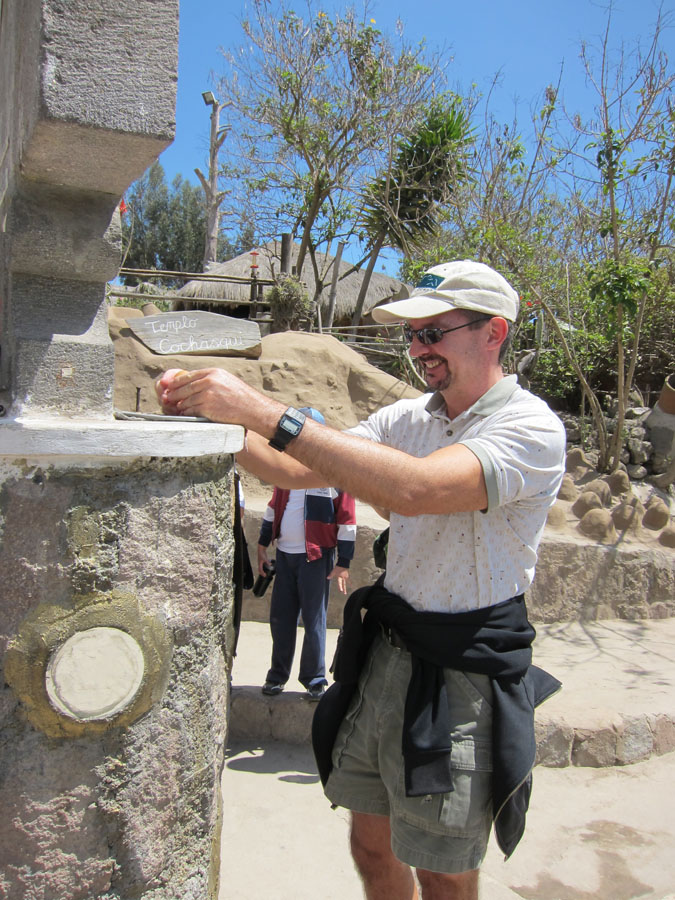
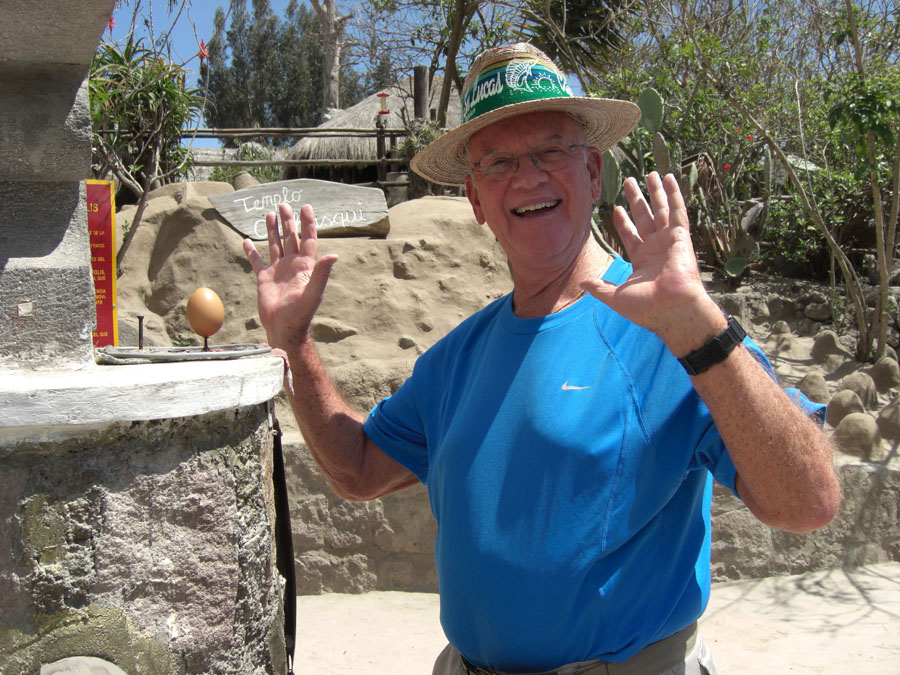
It was a fun demonstration, but I doubt that just 2 yards away from the equator was a sufficient distance to cause such an effect, so I must reserve my judgement until I can perform this experiment myself, and wait a sufficient amount of time so that the water is absolutely still before pulling the plug at the north and south locations away from the equator. The next experiment was to balance an egg on the head of a nail, demonstrating that the forces at the equator were directed straight down, and the Coriolis forces were non existent.
Pete decides to give the egg a try first. His concentration is intense
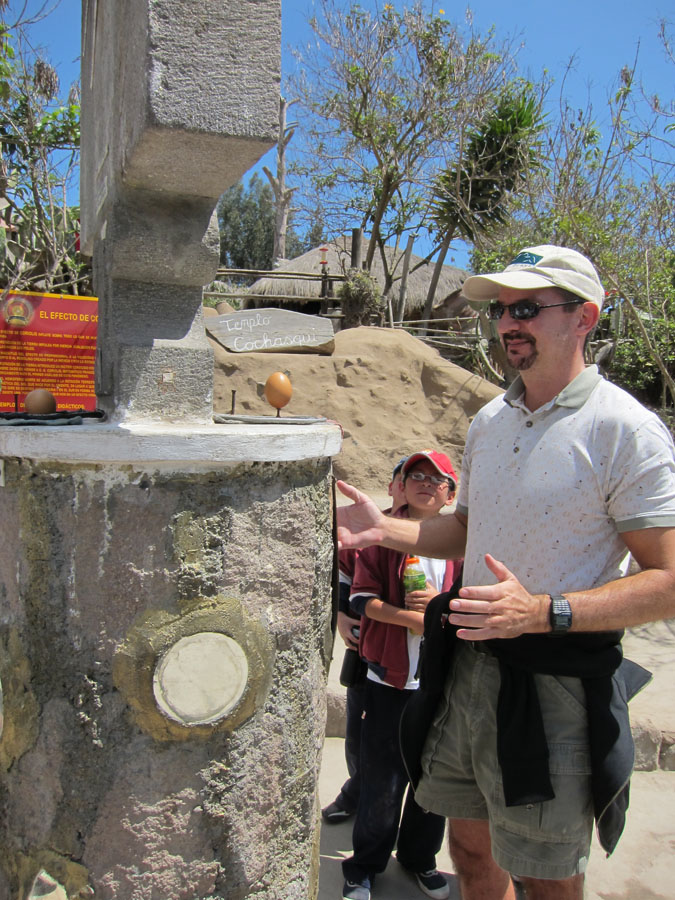
Success! He steps back in disbelief. Now this is pure science. LOL
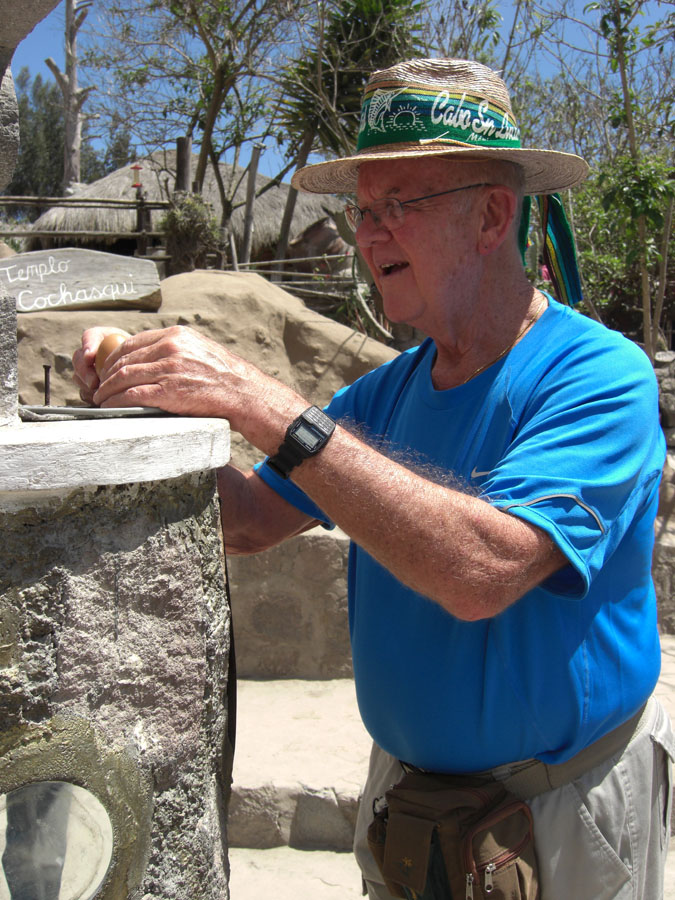
Our guide said, "All you have to do is concentrate." I think if he were the Kung Fu Master from the 70's TV series, and I were David Carradine, the Master would have said, "Become one with the egg, grasshopper".
Voila! I guess this is one experiment that bears out the underlying theory
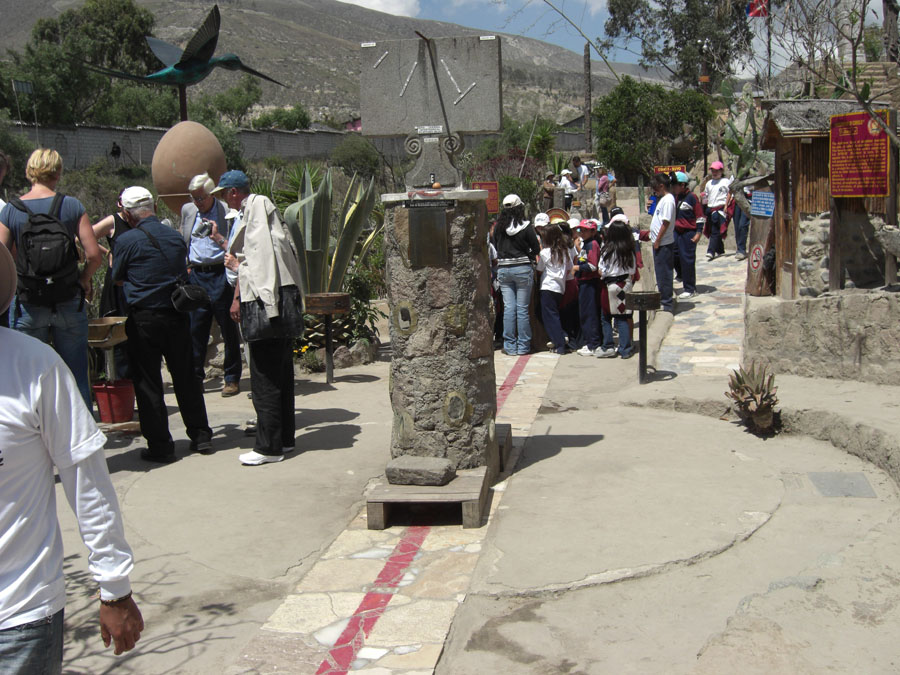
Pete and I straddle the equator as we pose behind this marker. In the Navy, when you cross the equator for the first time you are initiated into the Order of Neptune, or something crazy like that, and the initiation can be quite brutal and disgusting, depending upon the mood of the Captain. Here we could step across the equator as many times as we wished, with no repercussions at all. The archeology and astronomy of the equatorial solar culture is amazing. There is a special ceremony and festival to mark the one time in the year that the sun passes directly over head, and there is absolutely no shadow. I wish I took better notes, because the guides description was very interesting. You'll just have to go there, and get the story first hand.
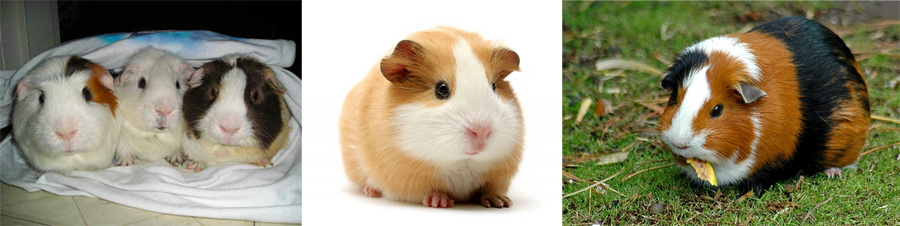
The solar clock on top of that stone pyre was extremely accurate, as in to the minute, Next our guide took us to a native dwelling which contained a family of guinea pigs, historically a basic part of the Ecuadorian diet. They raised them in their homes. There were several tiny baby Guineas, and our guide jokingly said they call those Guinea McNuggets. The common guinea pig was first domesticated as early as 5000 BC for food by tribes in the Andean region of South America. Statues of guinea pigs dating from circa 500 BC to 500 AD have been unearthed in archaeological digs in Peru and Ecuador. They continue to be a food source in the region; many households in the Andean highlands raise the animal, which subsists off the family's vegetable scraps.
Just take a look at these cute little guys. Do you think you could actually eat one of them? I don't think I could.
Our guide finished up his part of the tour and pointed us in the direction of the gift shop
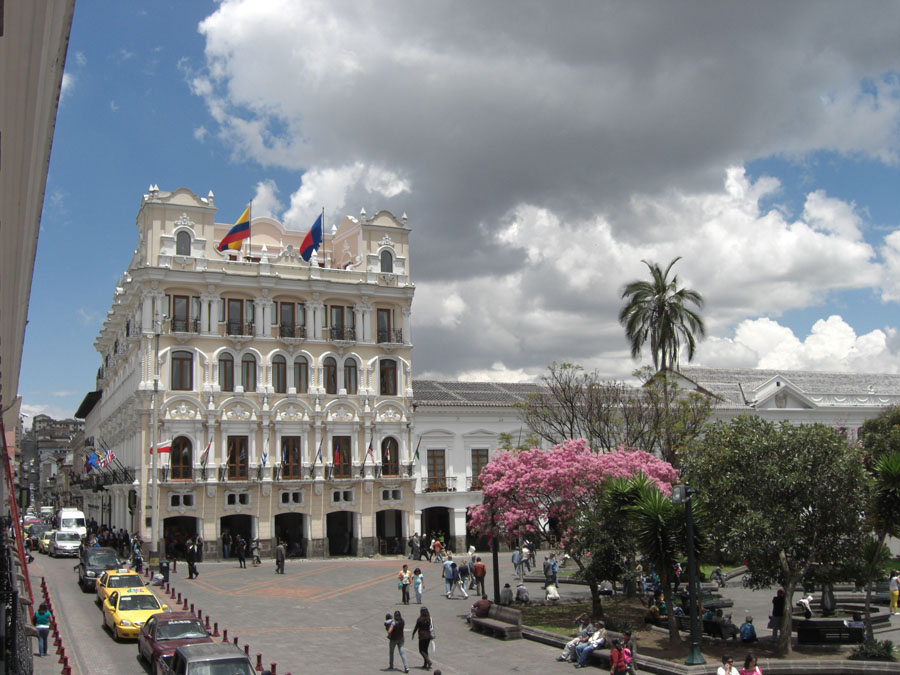
It was a beautiful day for visiting this site. We were now ready to head back to the city and continue our tour Byron parked the car in a garage near where we were going to have lunch. It was early yet, so we began a 2 hour walking tour around the "Great Plaza", or Independence Square.
I'm not certain, but I believe this building is equivalent to Casa Rosada in Buenos Aires or perhaps
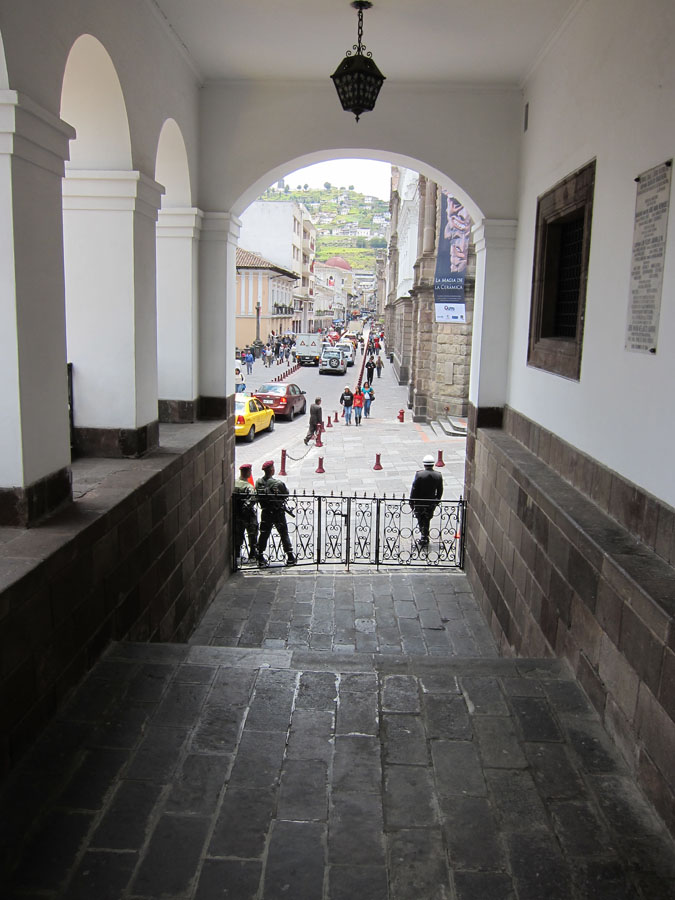
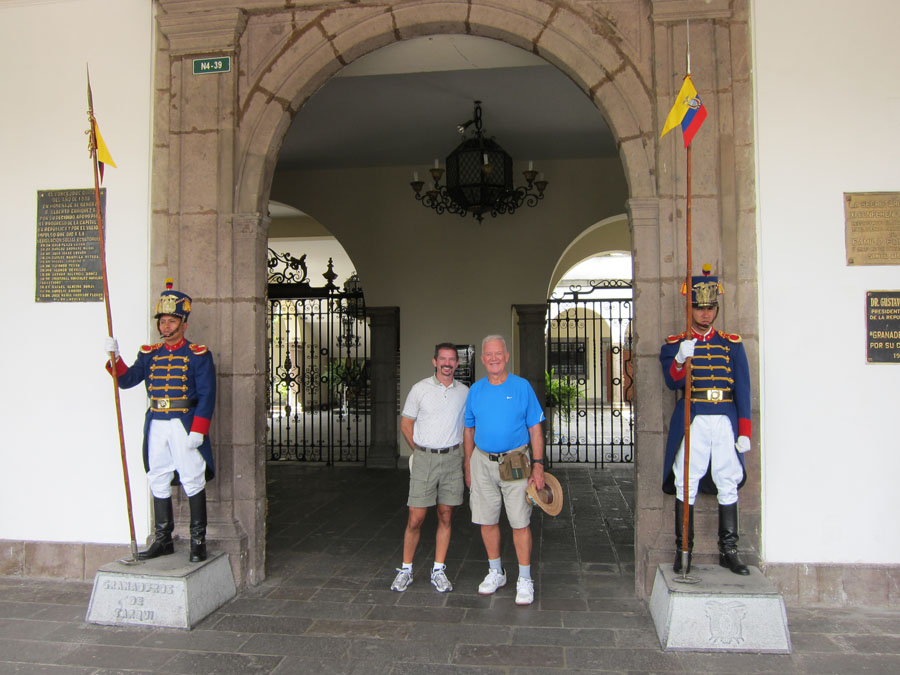
We entered the palace through this guarded gate. Byron said that two days ago the
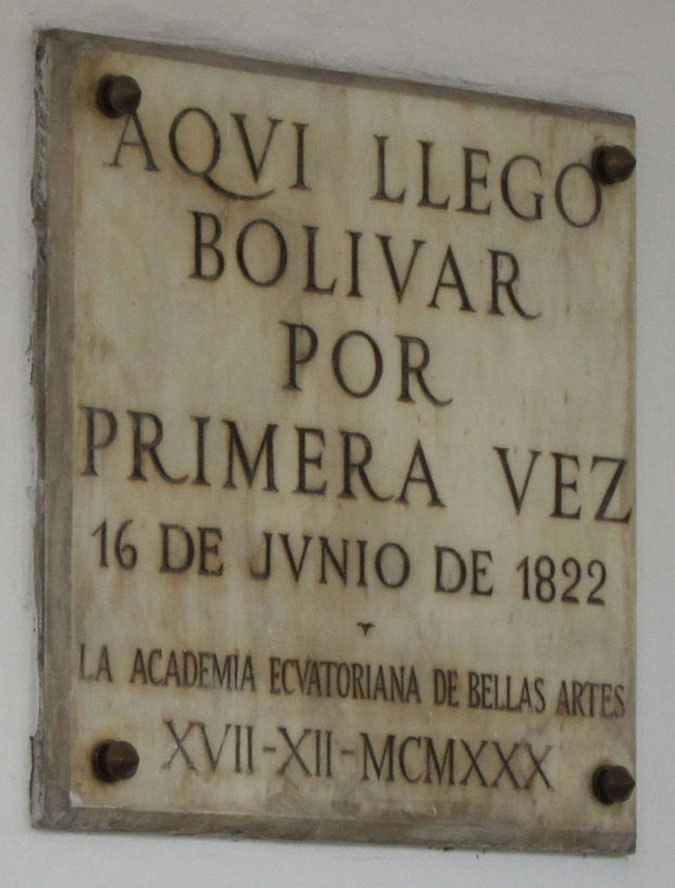
This plaque is attached to the wall. It states that BOLIVAR came here
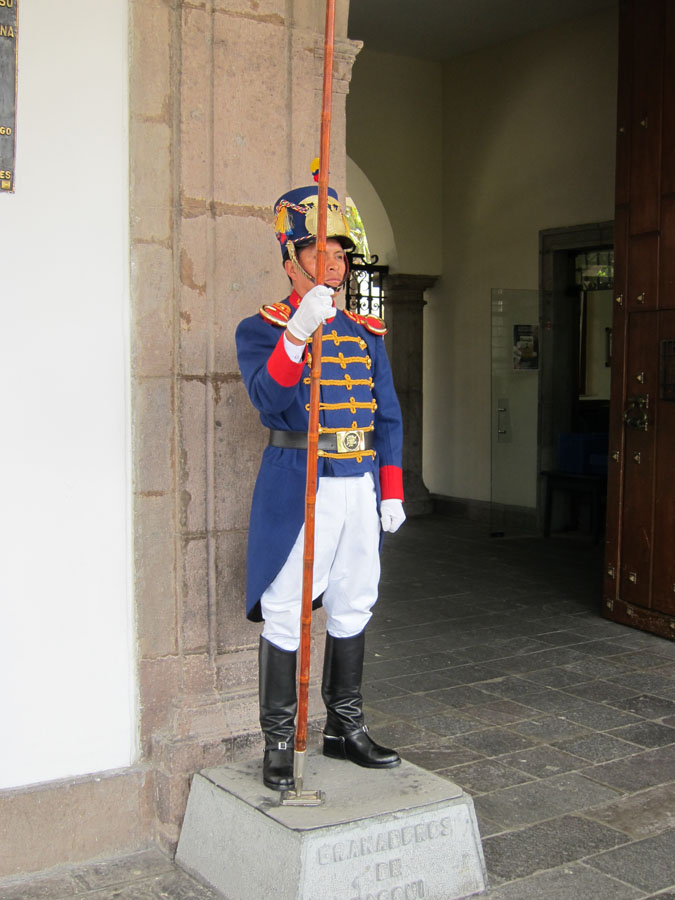
The guards wore the same style uniforms as the soldiers of Bolivar's liberation army
The guards stood like statues. I don't even think they so much as blinked while we were there
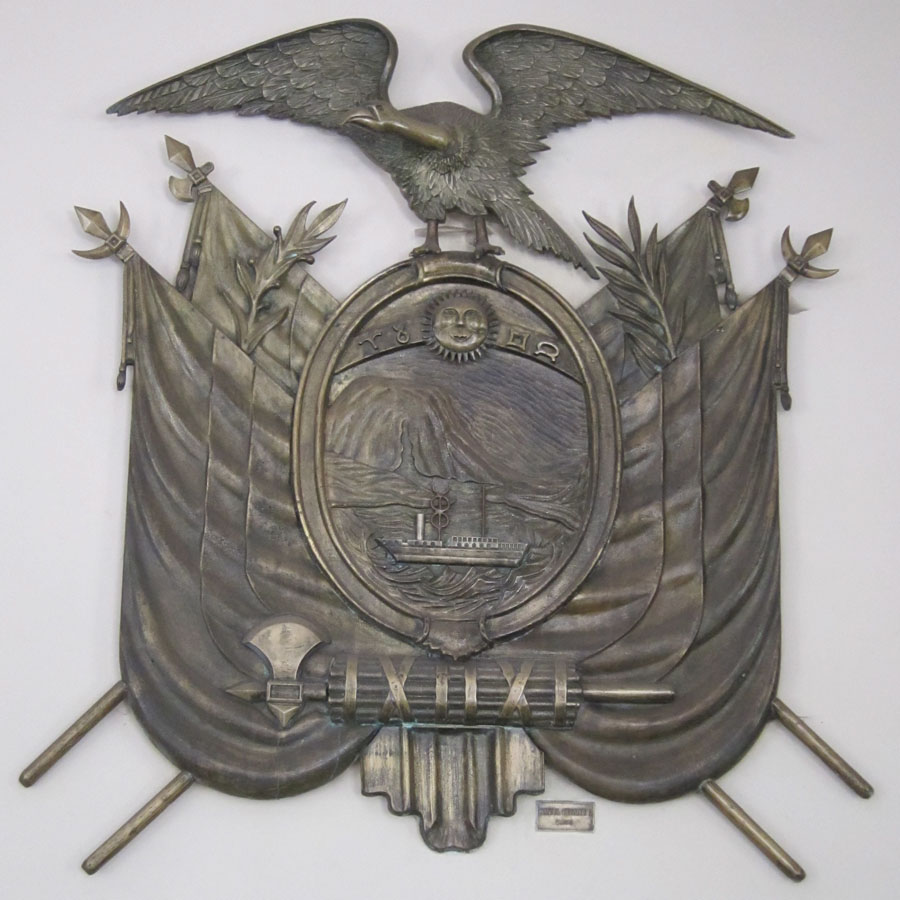
I believe that this was the presidential cote of arms, but I could be wrong. I didn't ask enough questions.
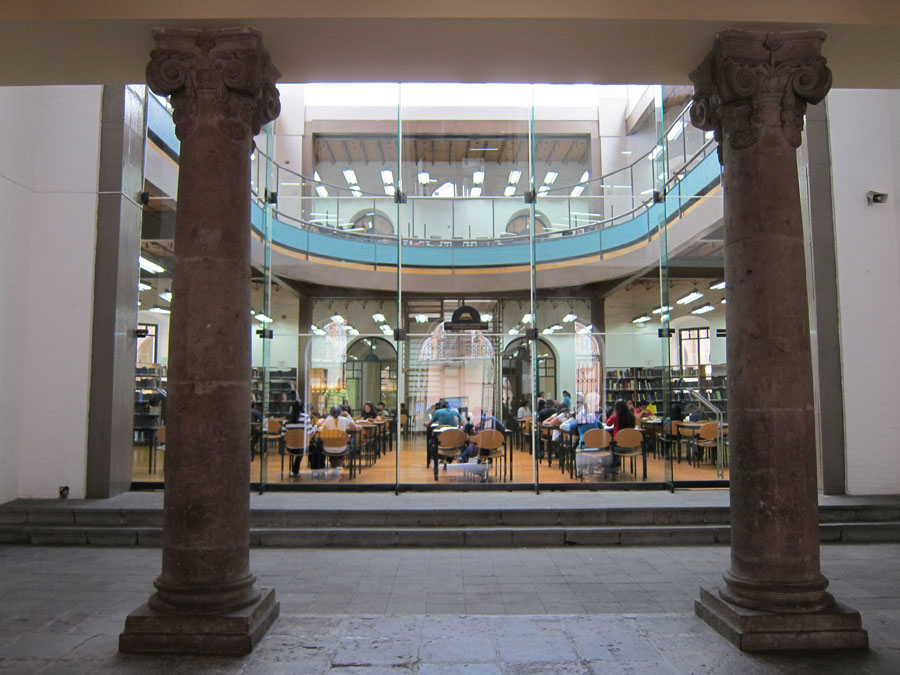
Across the street from the palace was another huge building which housed an art museum and
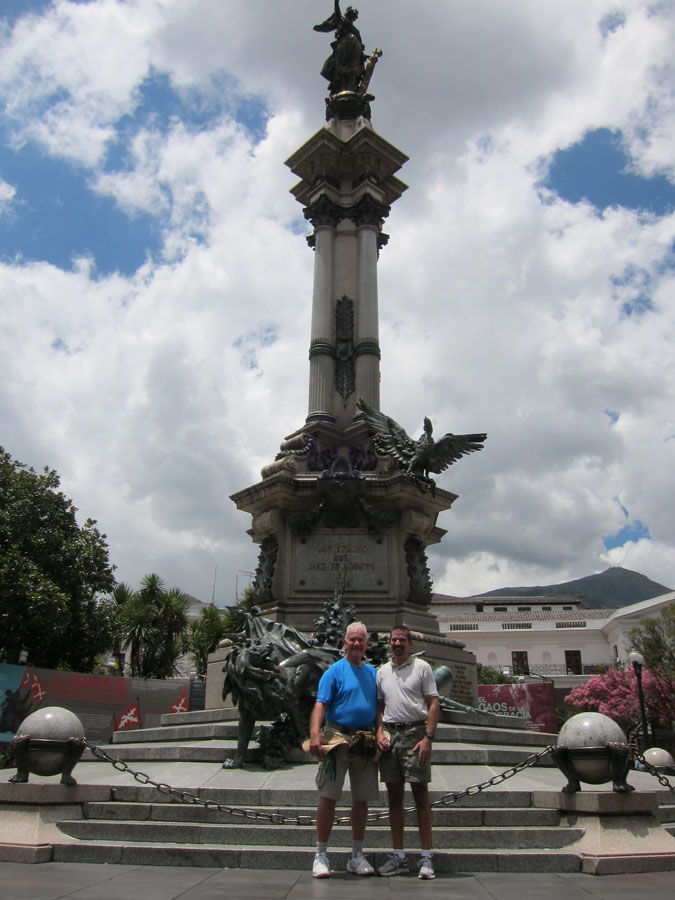
This rather impressive monument stands in Plaza Independencia
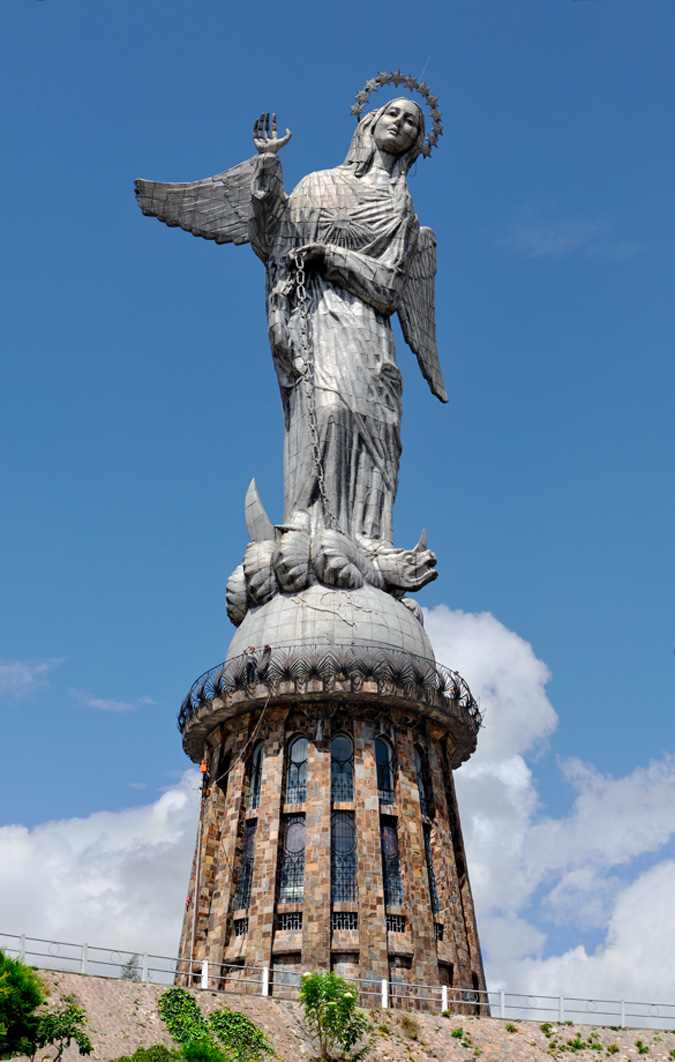
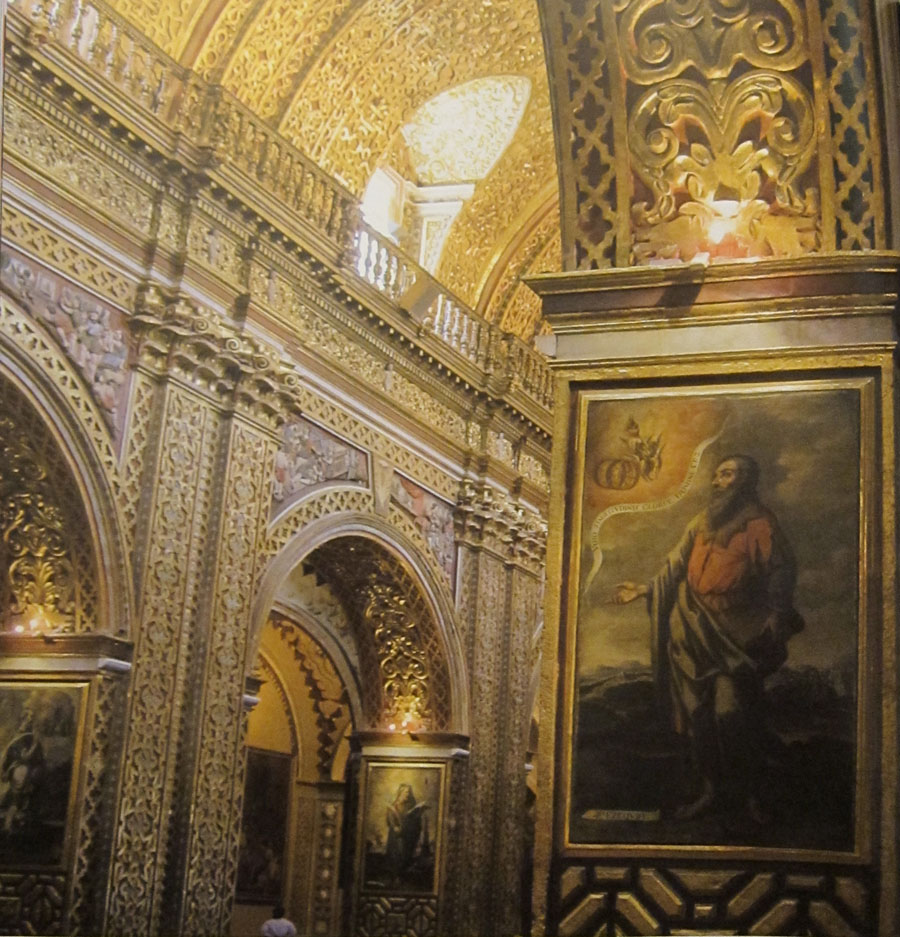
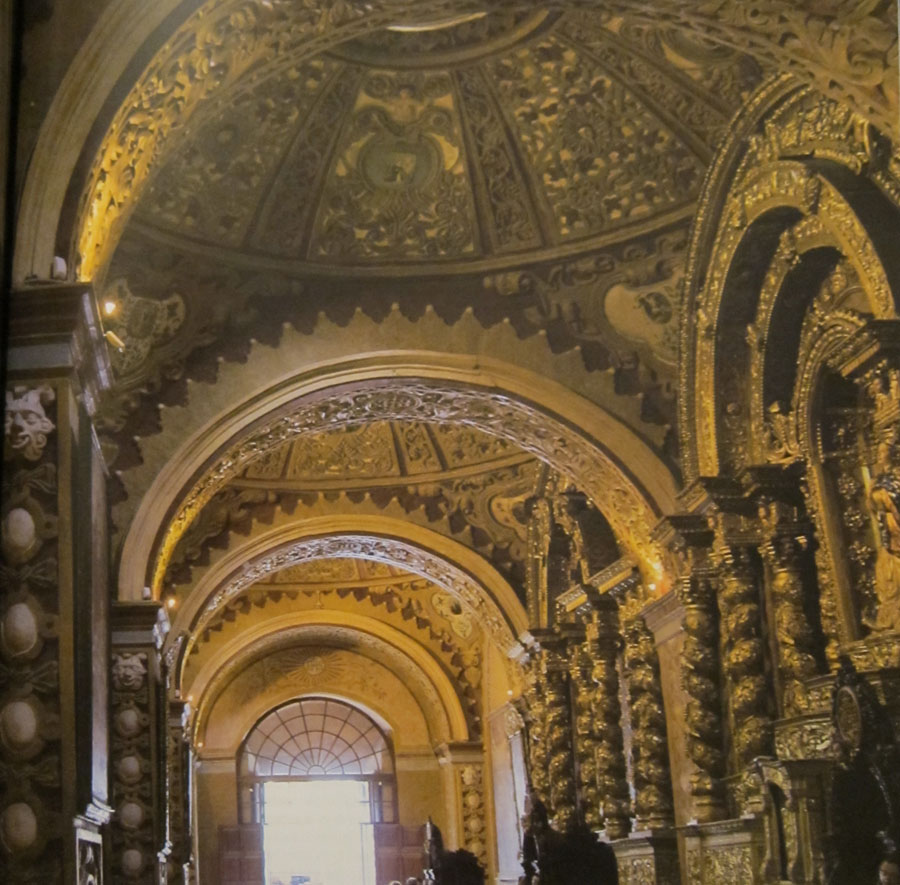
El Panecillo is a hill located in the middle west of the city at an altitude of 3,016 meters. This monument to the Virgin Mary is located on top of El Panecillo and is visible from most of the city of Quito. The figure stands on top of a globe, and is standing on top of a chained snake, symbolizing her triumph over evil. It is constructed of approximately 7000 pieces of aluminum. Along the Avenue Garcia Moreno which passes by Plaza Independencia, there are a series of churches known as The Seven Crosses. One block from Plaza Independencia there was the Fifth Cross, or Iglesia de La Campañía de Jesús. It was strikingly unique. It is Quito's Jesuit Church, and is a masterpiece of religious architecture in Latin America. It was built and decorated in several phases between 1605 and 1765. It is the most heavily gilded church I've ever seen. Byron said that it contains no less than six tons of gold gilding on its walls, ceilings and ornate pillars and pulpits. We were not allowed to take photographs inside, but I was able to grab a couple off the Internet.
Practically ever inch of he interior is gilded, and these photos hardly come close to doing justice to he impact it has.
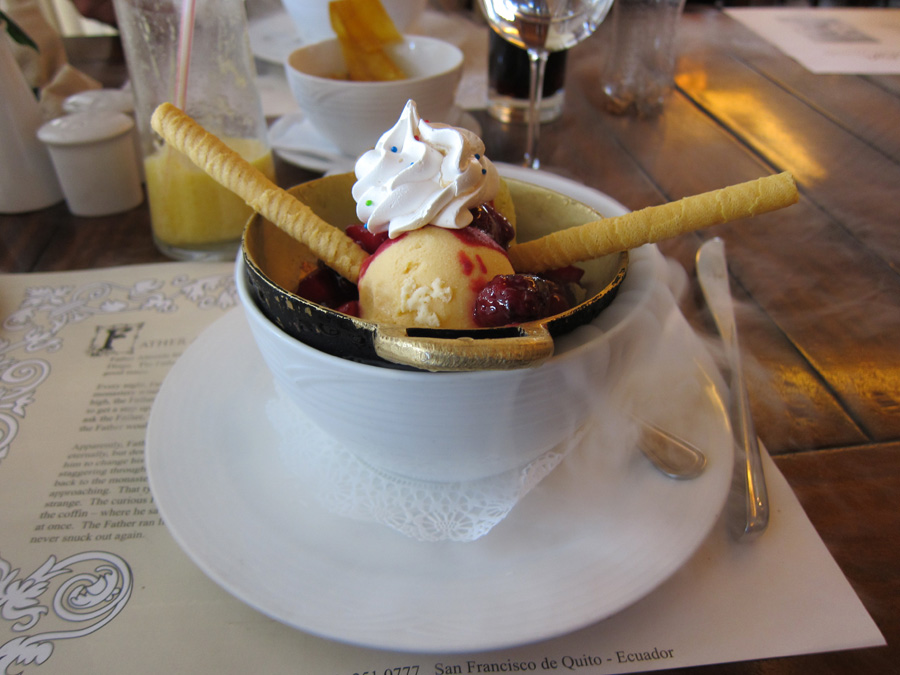
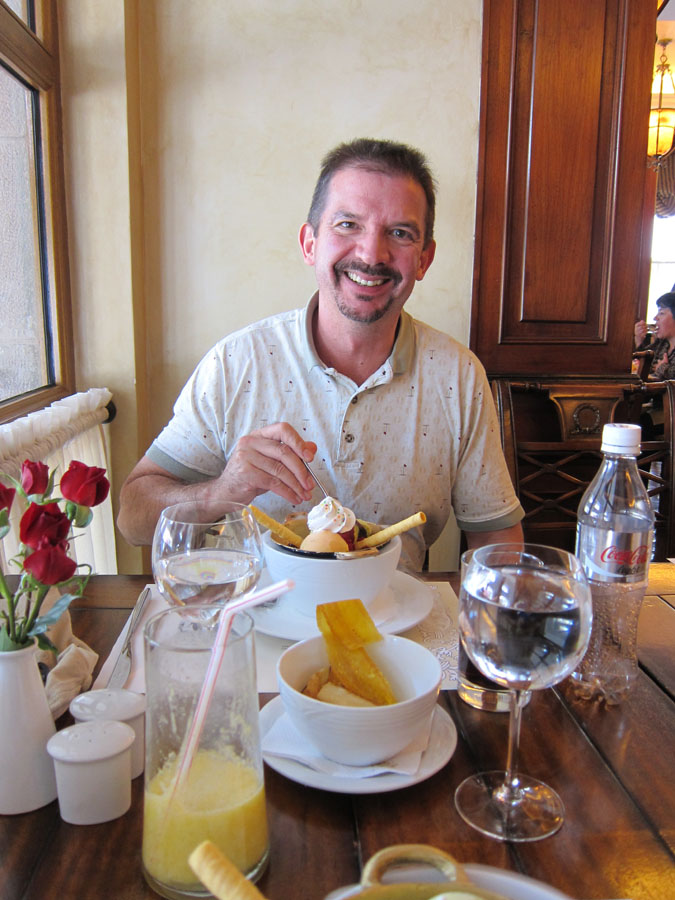
Ecuador is a very poor country, but entering this church you'd never know it. There is something Also, our tour was concluded with a very nice lunch at a restaurant facing Plaza Independencia. Byron recommended a couple of dishes, and we each had one of them. He also recommended a dessert, which consisted of a bowl within a bowl, the bottom bowl holding dry ice, and the top bowl holding scoops of ice cream with berries, and topped with whipped cream. The dry ice gave it the appearance of an erupting volcano. It was a novelty obviously designed to impress the tourist trade, but it was delicious just the same.
The vapor from the dry ice spilling over the right hand edge of the bowl is
The restaurant was quite nice, with good ambiance. And the view of the plaza
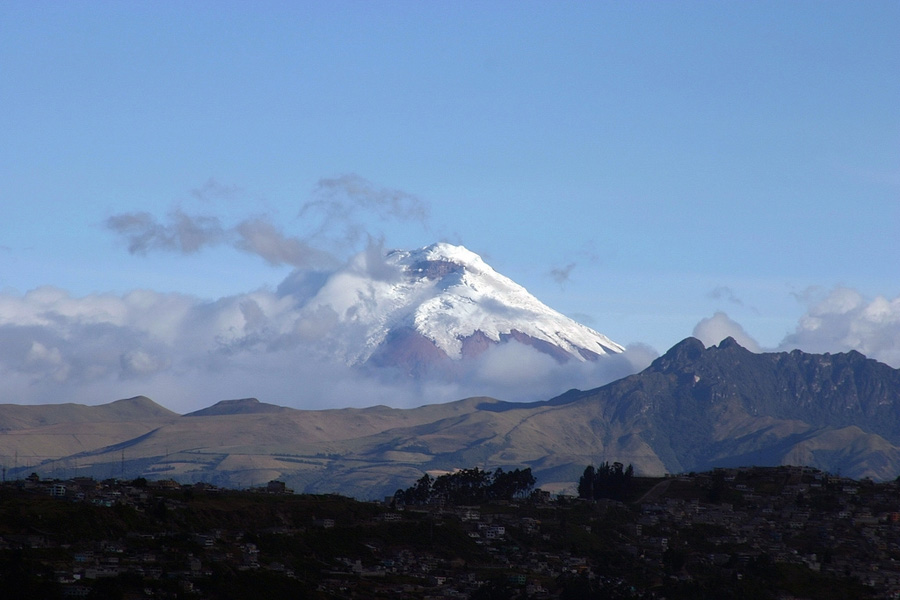
Pinchincha is Quito's closest volcano, looming over the western side of the city. Quito is also the only On our way back to the hotel Byron negotiated the pick-up time for the following morning. He knew the traffic patterns, and when rush hour would begin. Even though our scheduled pick-up time was 8:00 AM, he suggested that he pick us up at 6:00 AM to avoid rush hour traffic as we left the city. Internally we groaned at having to get up at such an early hour if we were to make it to breakfast by 5:00 AM, but we acquiesced to his desire to make the drive more comfortable, and we agreed to the earlier pickup. We had an early dinner in the hotel that evening, and went to bed earlier than normal. Time to end this chapter. I'll pick up on Day Three in the next chapter, and our all day visit to the SPA at Papallacta, and then on to the Galapagos Islands. Cheers! Ron |
||||||||||||||||||||
|
||||||||||||||||||||