 |
|
|
|
|
|
|
|
|
|
|
||||||||
|
||||||||||||||||||
|
Email us at: |
||||||||||||||||||
 |
||||||||||||||||||
 |
 |
|||||||||||||||||
|
Click the sun to see the |
||||||||||||||||||


|
 |
|
|



|
|
|
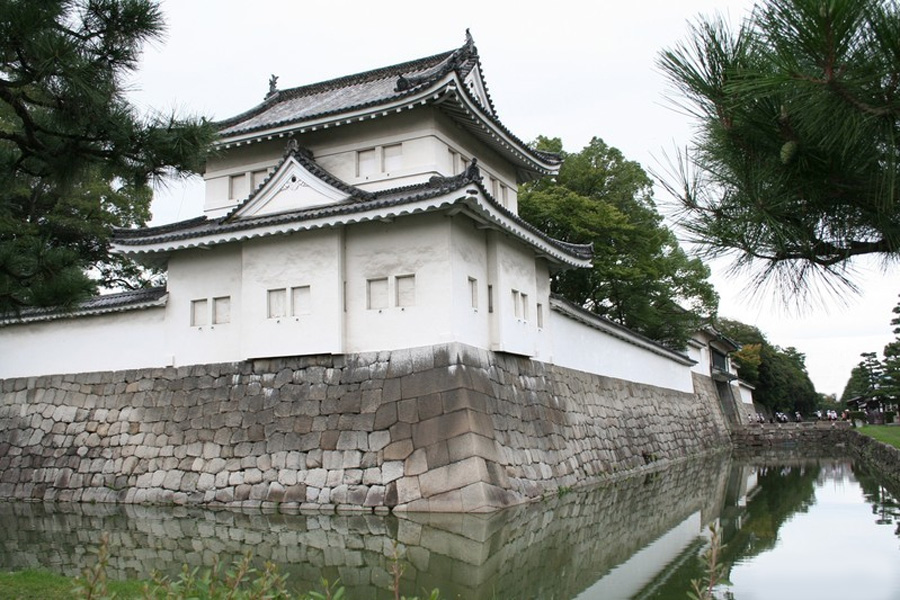
On Day 10 (16 April 2018) we explore Nijo Castle, whose buildings are arguably the best surviving examples of castle palace architecture of Japan’s feudal era. It was designated a UNESCO world heritage site in 1994. Nijo-jo Castle was the residence of the Tokugawa shoguns in Kyoto. Of course, getting to the castle must be done on foot, and walking through the great shopping streets of Kyoto is a shoppers paradise.
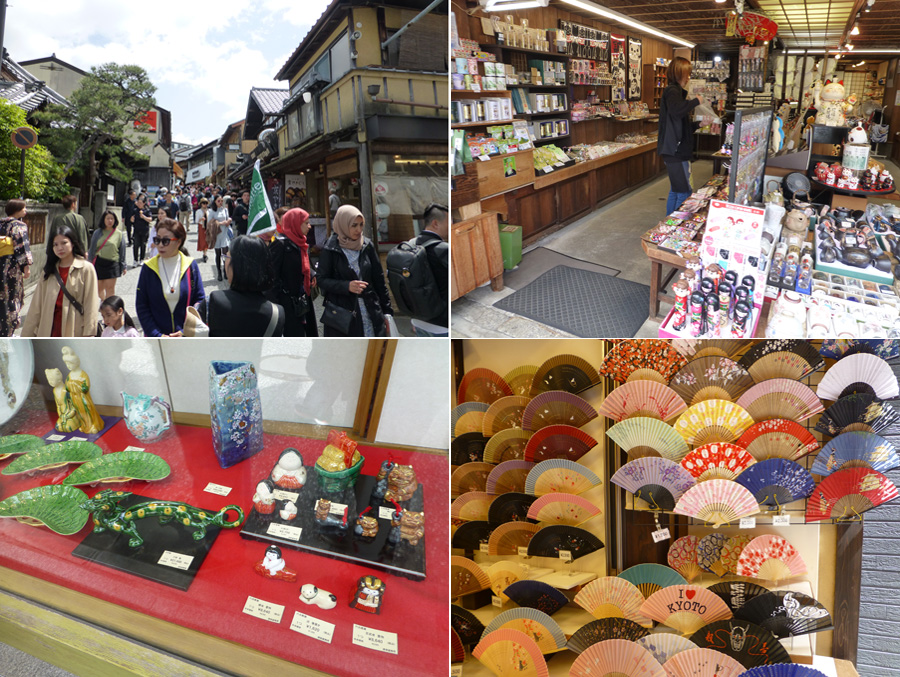
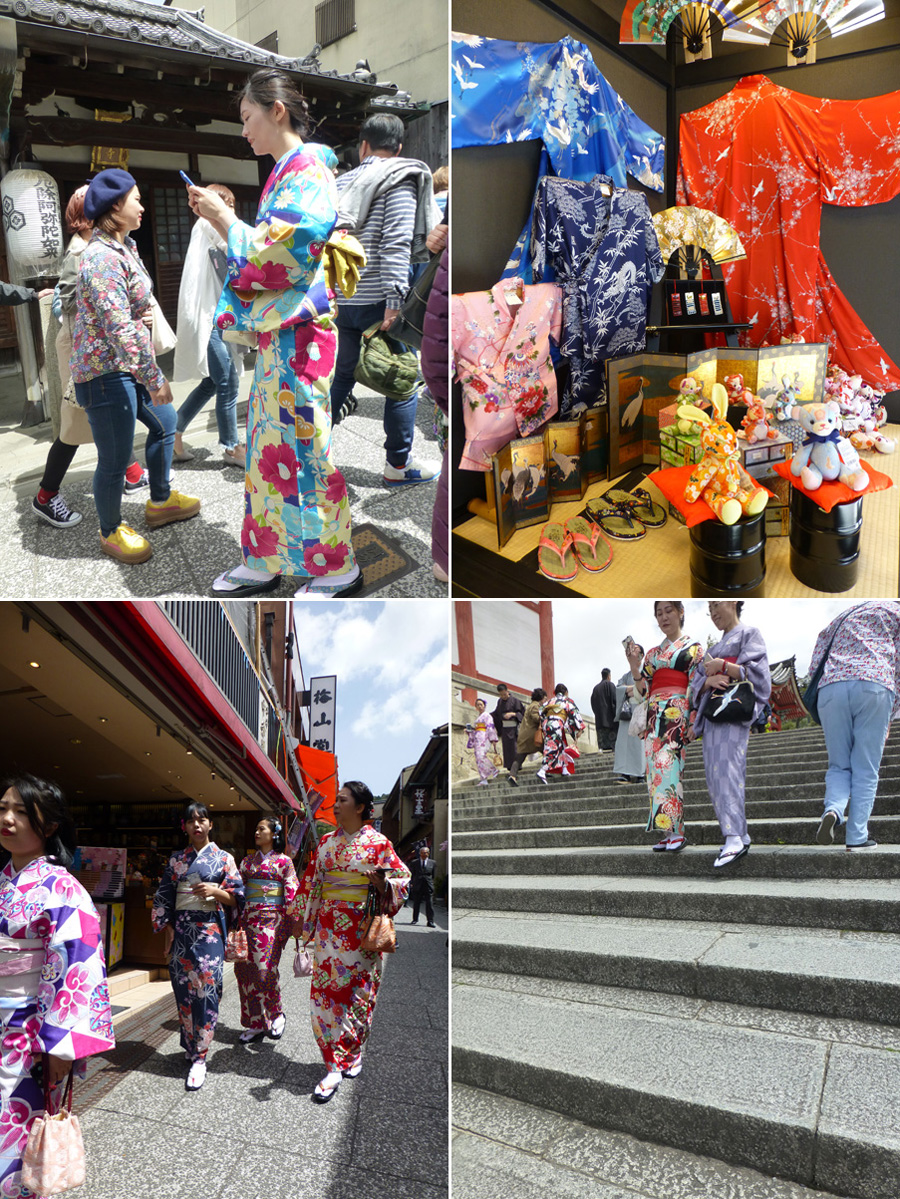
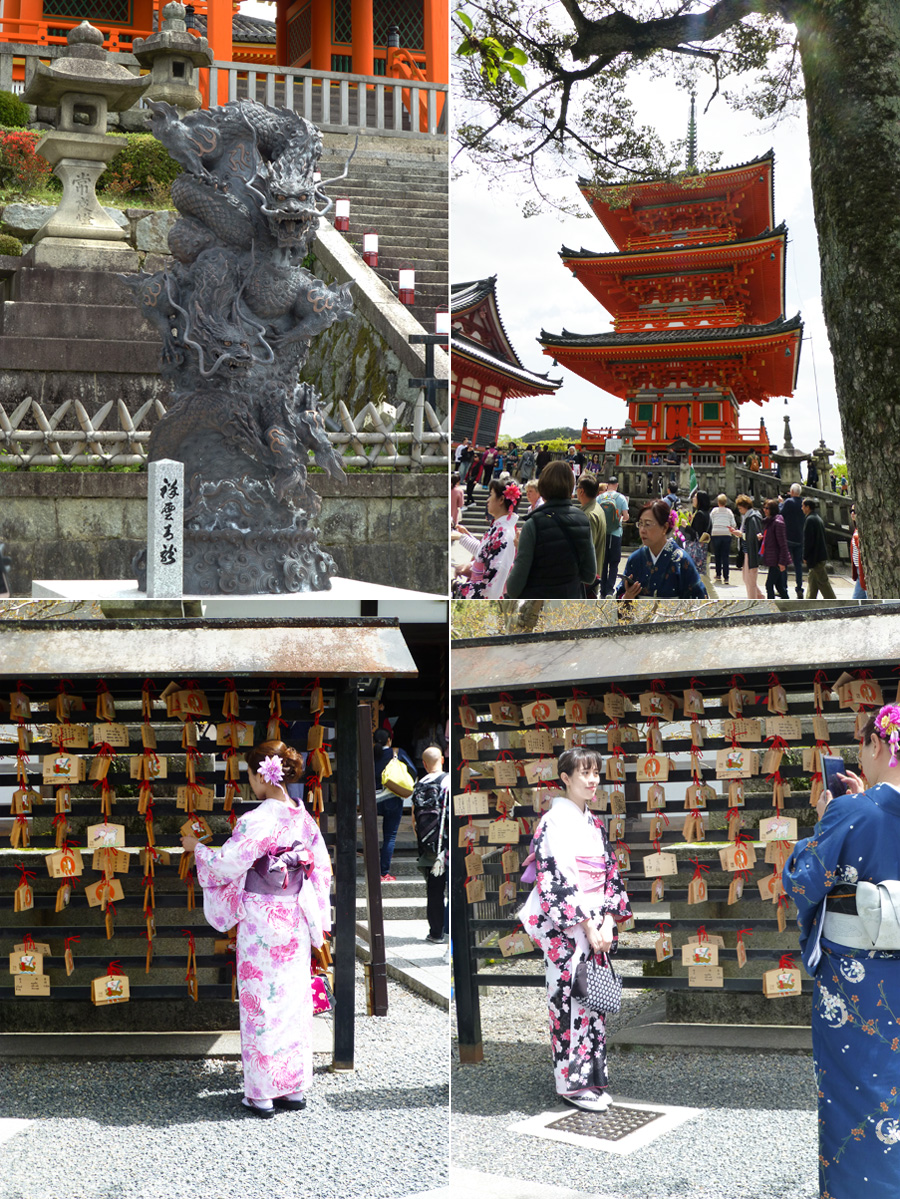
There are so many wonderful treasures, a temptation to any shopper with a purse full of yen. The fans seemed a little pricy, at ¥2,000 which is about $17.50 for a very nice fan, but then what do I know, that may be a very good price. They do seem to be put together rather well, and are handsomely decorated, and we are on vacation. LOL There were lots of young girls wearing the traditional kimono. I was noticing that most people were carrying smart phones, and either texting on them, or taking photographs. Now, kimonos seem to be cut in such a way that one can only take baby steps, which I suppose is considered the proper way for a lady to walk.
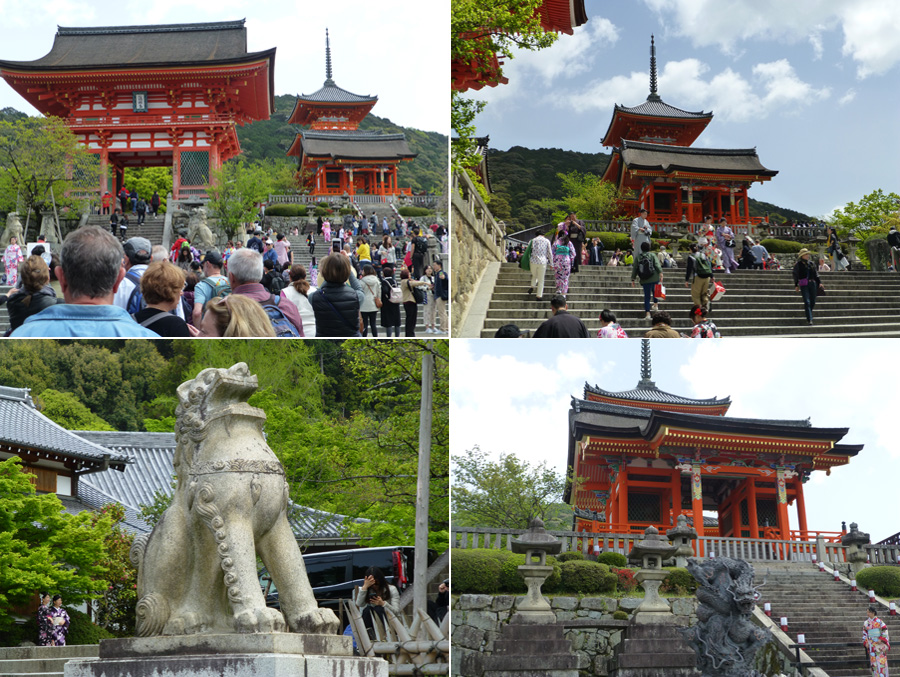
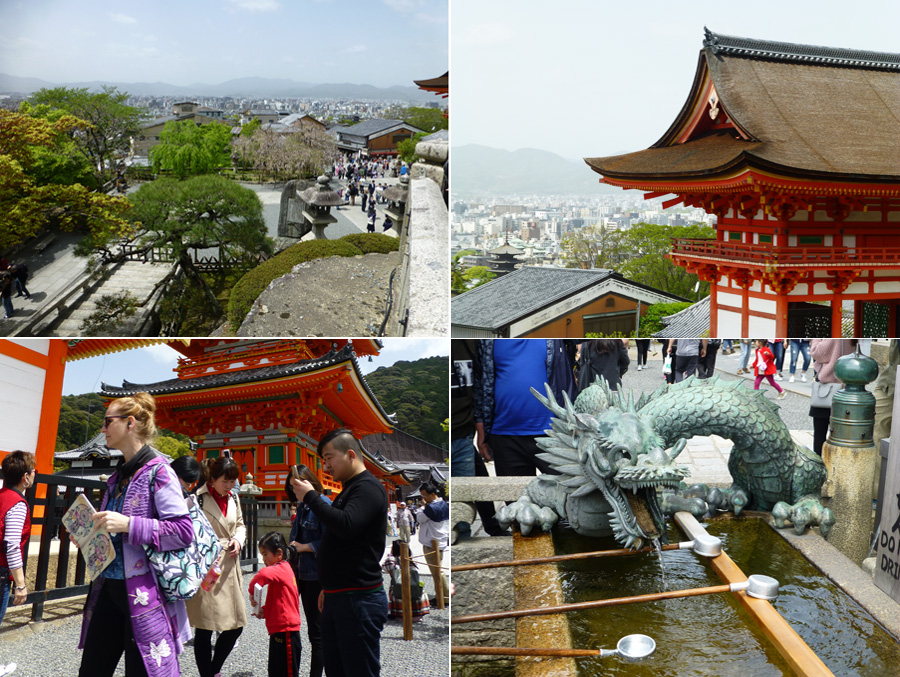
However, going down steps appeared to be a bit of a challenge, especially while texting on your smart phone. You gotta love technology and how it has captivated every bit of our attention. I bought my very first smart phone only last June, the Samsung Galaxy S9+, and I love it. I will probably never master it like my grandson Jon seems to have mastered his Samsung, but I will say this, it’s probably the only camera I will ever use on our vacations going forward, the camera on this phone is just that good. I’ve compared it to both my Canon and my Sony digital cameras, which I always thought were pretty good, but it beats them both for features and photo quality. Kyoto, which means “Capital City” was actually the capital of Japan for more than a thousand years. When the city of Edo was renamed Tokyo (meaning “Eastern Capital”) in 1868, the seat of the Emperor was moved there. Kyoto has more than 2,000 temples and shrines. The Kiyomizu-dera (below) is an independent Buddhist temple, which was founded n 778 AD.
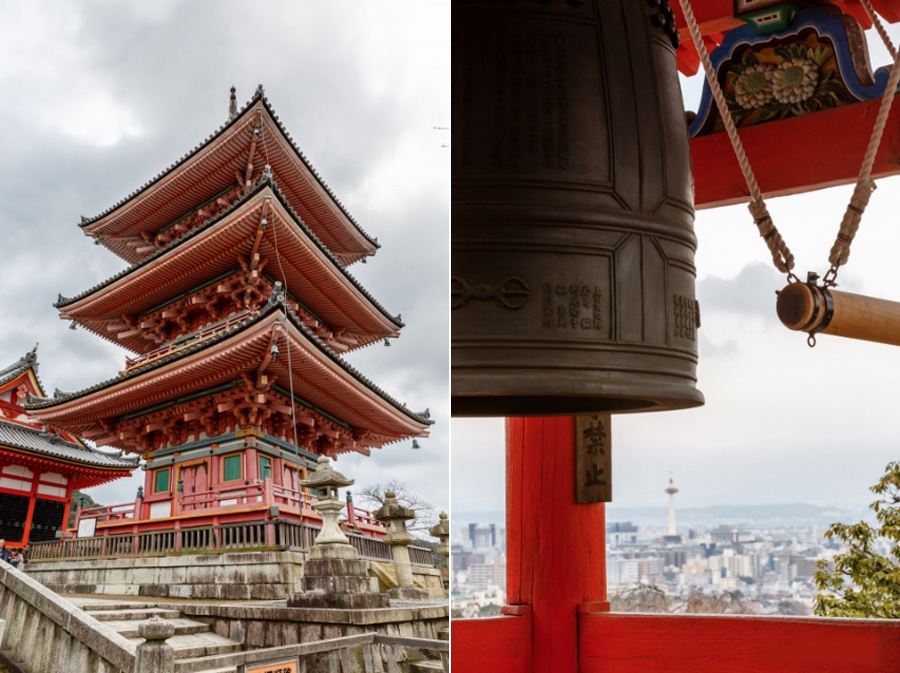
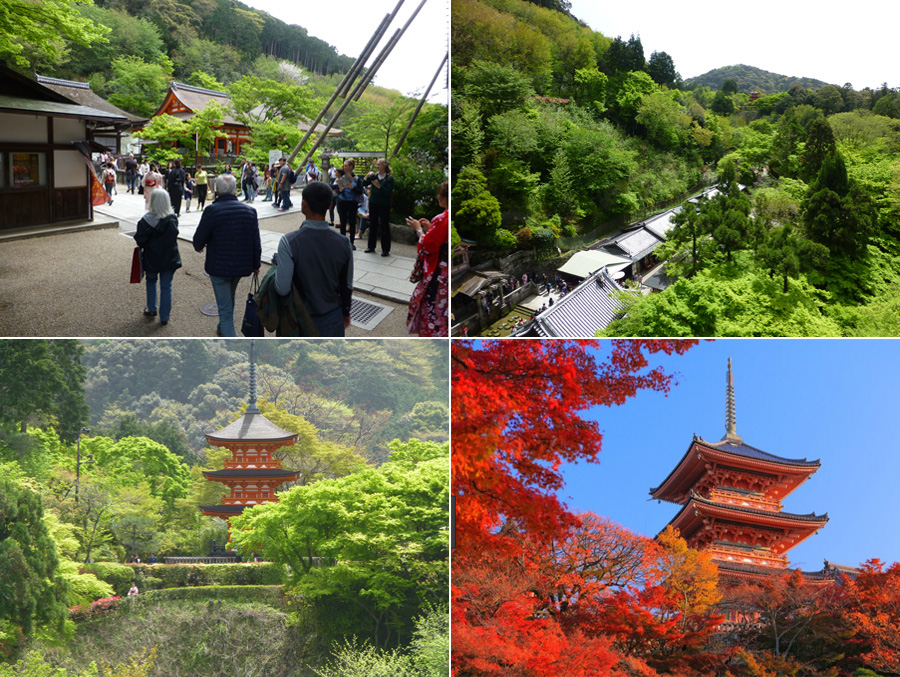
The three story pagoda is one of the tallest of its kind in Japan, standing at 31 meters high. The current structure dates from a reconstruction carried out in 1633, when its original red coloring was also restored.
The Bell Tower was constructed in 1596, and was restored in 1999, when the beautiful vermilion color was enhanced. Though in the past these sorts of bells were used to direct the monks during the day, now it is most famously rung on New Year’s Eve, when the bell is rung 108 times to symbolize the 108 earthly desires Buddhism acknowledges must be overcome. Hmmm! I didn’t know there were that many. I must be missing out on something. ;o) From this temple you get wonderful views of Kyoto, and it appears to be quite a sprawling city surrounded by mountains.
This candid shot of Cheryl in front of the pagoda epitomizes the relaxed nature of our tour today. And this beautiful bronze dragon employed as a fountain for the ritualistic water used to cleanse visitors to this temple is one of the most realistic examples I’ve seen. It makes one almost a believer that such creatures actually existed in the distant past. This impressive tower of dragons which guard the entrance to the temple are equally impressive. Pagodas attract lightening strikes because of their height. Many pagodas have a decorative finial at the top of the structure, and when made of metal, this finial, sometimes referred to as a “demon-arrester”, can function as a lightning rod. This pagoda has such a finial.
For a nominal fee you can purchase a prayer to offer in the temple The area surrounding the temple consists of a lush forest of beautiful trees, and in the fall the green turns to brilliant reds.
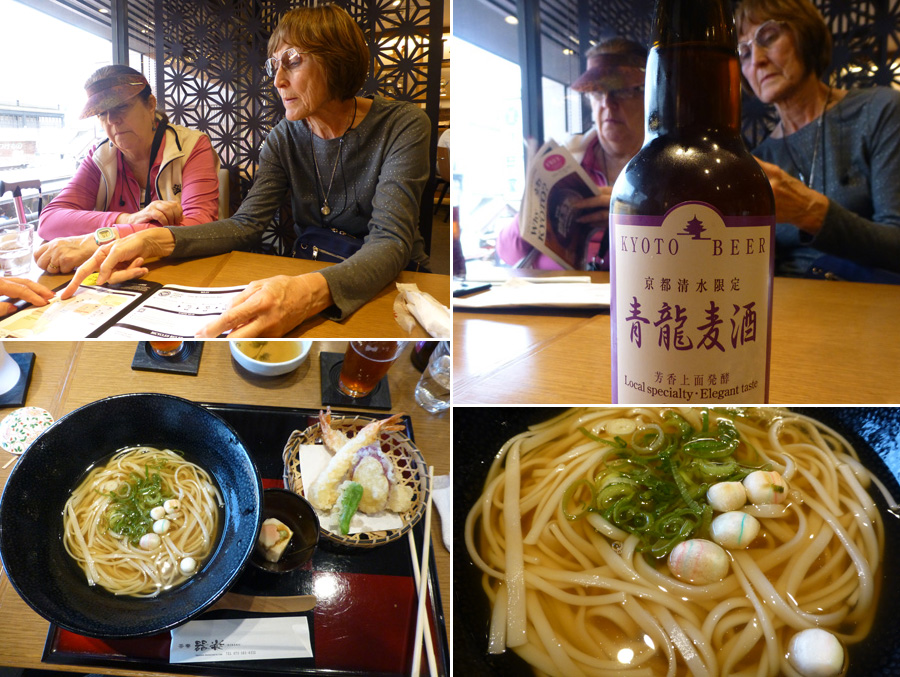
It looks like it’s lunch time, but Ginny and Karen don’t seem to be studying the menu. Pete has the right idea, having ordered the local bear, and taking a photo of the label. In my Navy days in Japan, my favorite beer was Sopporo.
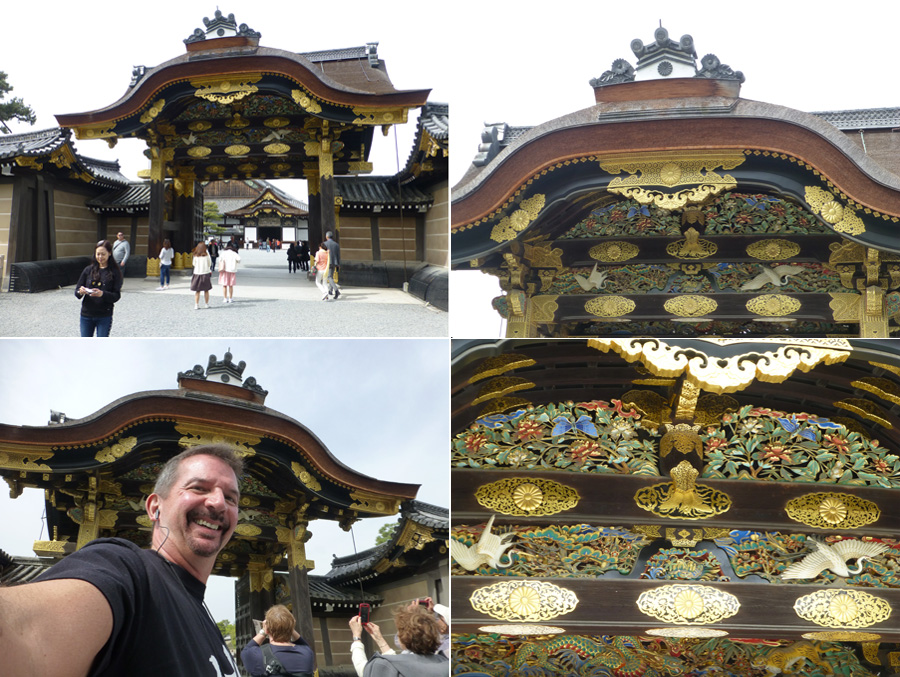
Pete got a delicious noodle dish with hard boiled quail eggs. I believe this is what you call soba. The Kara-Man Gate, gateway into the Nijo Castle grounds was magnificent. It gave you the feeling that what was to come inside must be splendid and beyond the imagination.
The detail was colorful and significant, symbolizing good fortune and long life. To enter the Ninomaru-golen Palace you needed to remove your shoes, and photography was forbidden.
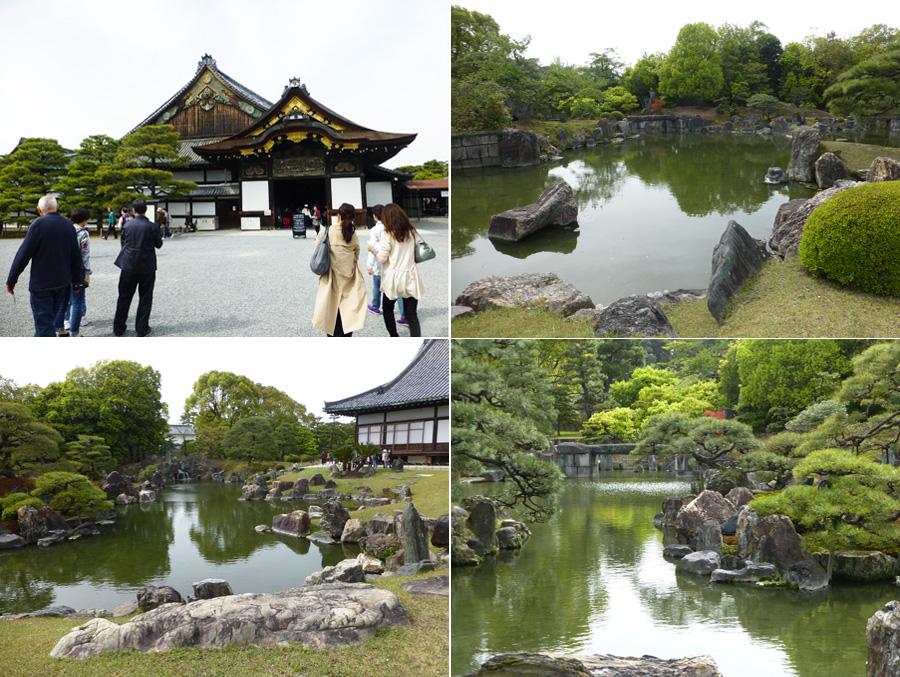
But the beautiful gardens on the grounds made the trip totally worth it. Japan is famous for its gardens.
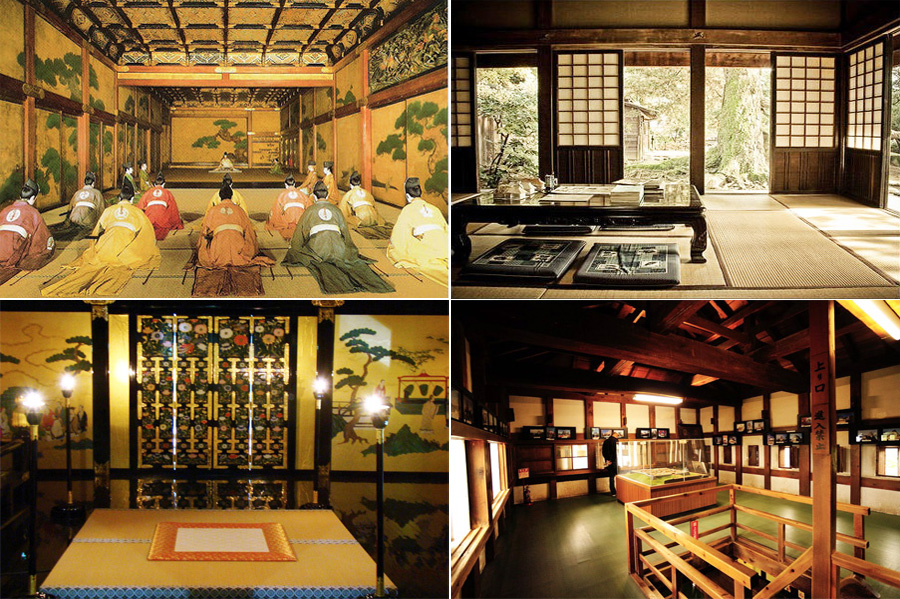
The gorgeous style of the Nijo-jo Castle was intended as a demonstration of Shogun Tokugawa leyasu prestige. It was the residence of the Tokugawa shoguns in Kyoto, who had been ruling Japan for over 260 years from 1603 to 1868, and it remains an eloquent testimony to their power. Here are a few Internet photos of the inside of the castle. The first one shows the Shogun giving audience to his lieges.
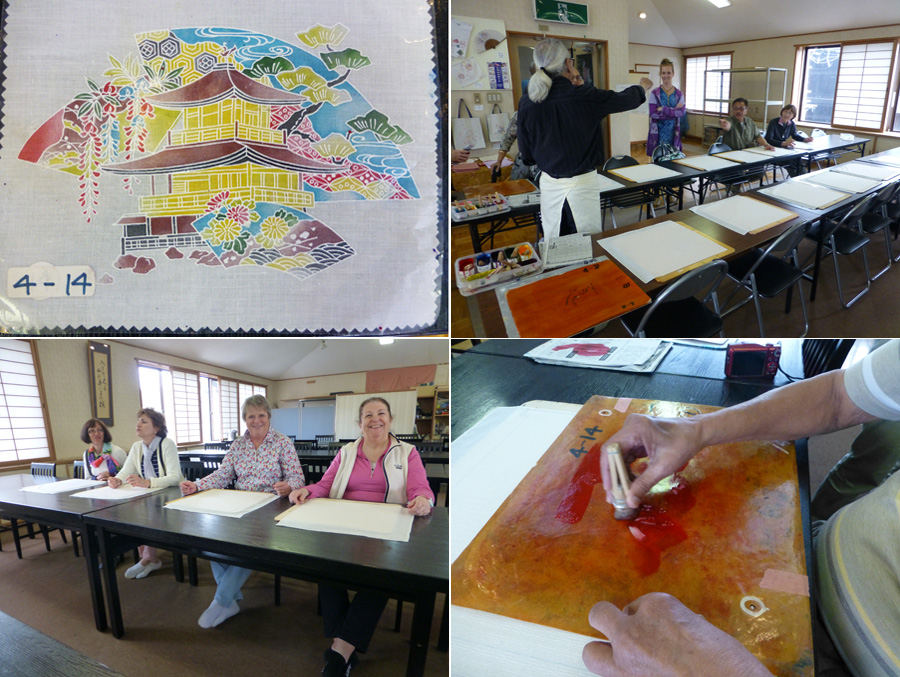
I always have to chuckle when photography is prohibited in prime tourist sites. I know that I can always find photos on the Internet that are even better than those I could have taken there myself. I assume the reason for the ban is so you will make purchases in the gift shops. I view it as capitalism functioning well in a land where it might otherwise be frowned upon. Next we travel to the Kodai Yuzen-en Gallery for a lesson in the art of stenciling. The goal is to create a handkerchief with the complex design below on it. The professor begins the class by showing the students what they are to accomplish.
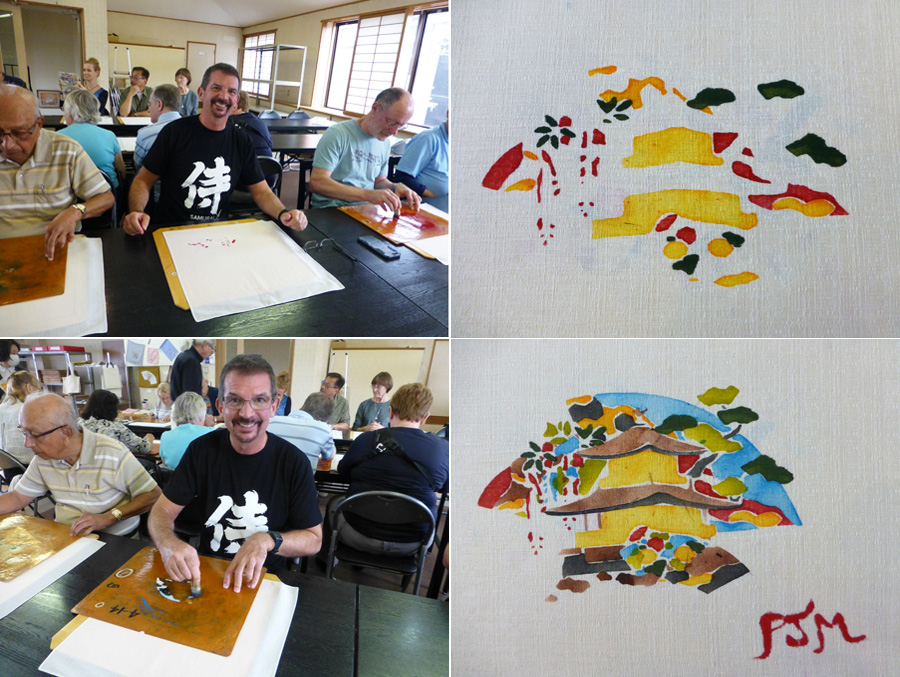
The students sit in rapt attention with glowing smiles on their faces, and the work begins. Pete has made the first pass, with the red stencil, followed by the yellow and then the black stencils.
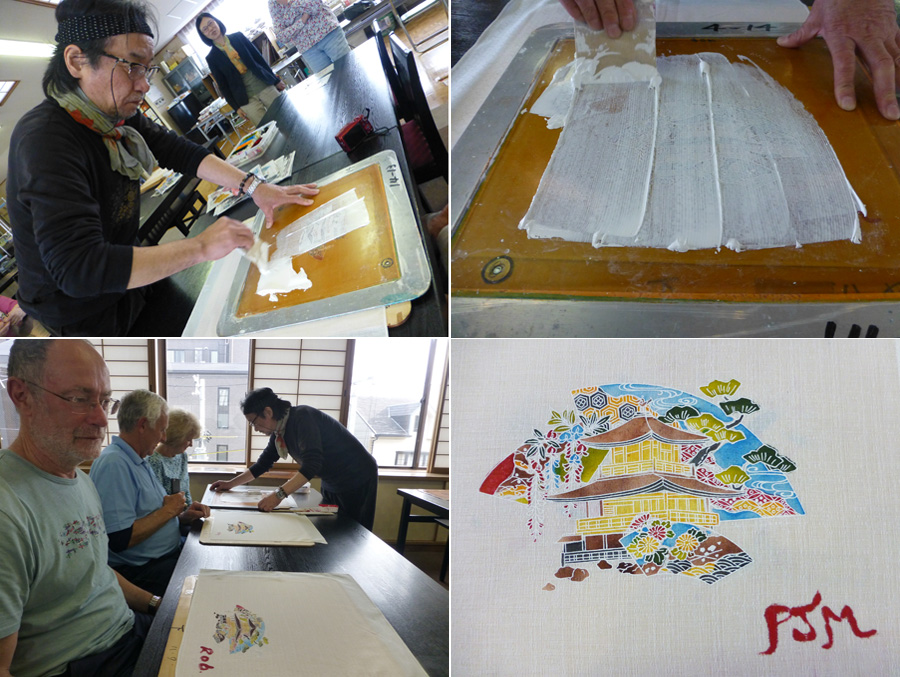
He looks like he is enjoying this. Being creative is always a joy. And this is the completion of his part of the process. Then the master takes over and adds the white outlines to give the image the finishing touches.
Gee, it looks just like the example that was shown at the beginning of the class, but with Pete’s initials on it. Great job Pete! Since this part is getting a bit long, I’ll break up Day 10 into two parts, and will resume with the visit to the Fushimi Inari Taisha shrine, the head shrine of the god Inari. |
|
||||
|