|
On Day 7, which happens to be the 12th of June, we arrive at Kirkenes at 9:00 am, and after a brief tour of the town of 5,000 inhabitants, we board a bus that will take us to Storskog - the border station between Norway and Russia. Kirkenes is the only town in Norway where East meets West. It is also the turning around point of our Hurtigruten voyage. Our guide told us that this part of Norway suffered a lot of bombing from the Germans during World War II, and that it was the Russians who drove the Germans out, thus freeing Norway from Hitler’s grip.
This marks the border crossing. We could not cross, but we were allowed to take pictures.
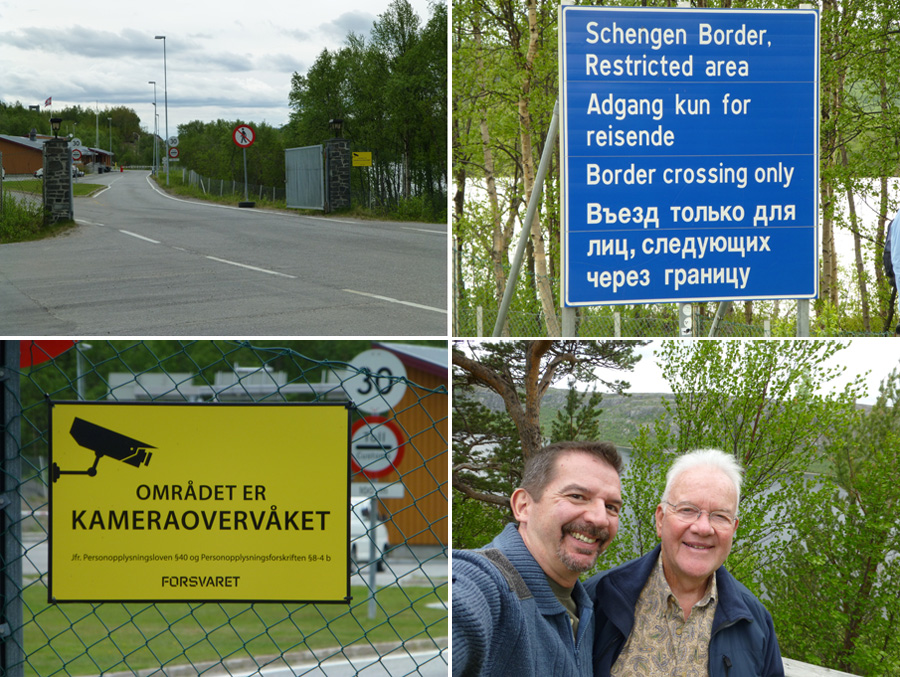
Our guide told us about one group of tourists she had where a husband and wife were having quite a row, and the wife asked the guide if she were to push her husband across the border, would he be arrested and never returned. That sounds like they were having a very serious fight. Some of you may be thinking “Oh, if it were only that simple”. ;o)
The gift shop below is on the Norwegian side of the border, where we could purchase Russian souvenirs if we were of a mind to do so. Actually, we were not. It was a strange feeling just being so close to Russia, and we could not see anything on the other side except a few buildings which were obviously for processing travelers, but there was no signs of life. While we were taking in the view, two young Norwegian soldiers, a boy and a girl, who couldn’t have been more than 20 years old, dressed in fatigues wearing helmets, and carrying weapons and a radio, came from the other side of the border. They crossed to the Norwegian side of the border, and the young man used his radio. They were shortly met by an army vehicle which took them, I imagined, back to Kirkenes. Their watch at the border crossing must have just ended. For some reason I had an uneasy feeling just being here. I had no such feeling when we flew into Moscow in August of 2008 for a Viking River cruise on the Volga. I actually felt very much at ease, and found the Russian people to be quite nice. Perhaps my unease now is due to what is going on in the Ukraine at the moment, and the fact that Putin is rattling his saber, just itching for us to make a false move.
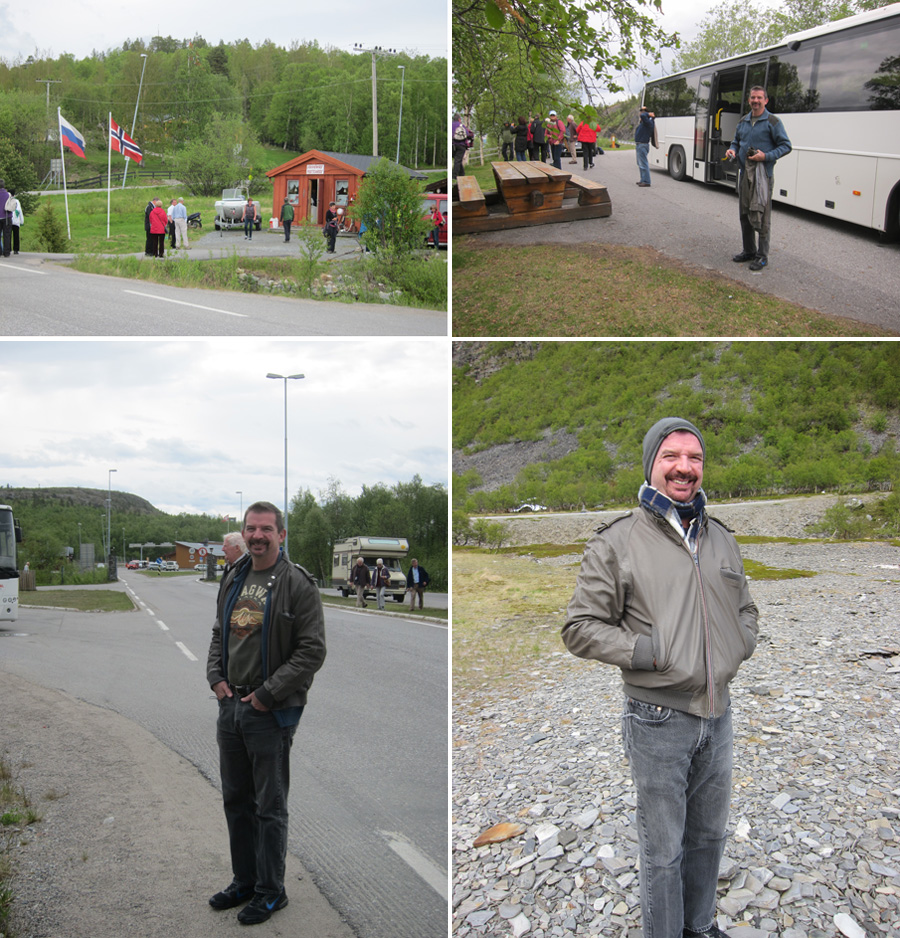
Yes, it was a little chilly. Notice that Pete went from a sweater jacket, to putting on his leather jacket, and finally his wool cap. We are after all at 69° 49’ North.
On Day 8, heading south now, we leave Kirkenes for Vardø, Båtsfjord, Berlevåg, Kjøllefjord, arriving at Honningsvåg at 5:30 in the morning, to begin our next shore excursion, which was Breakfast at North Cape. Pete wished I had not signed us up for this one, since we had to get up so early in the morning. Had I read the excursion descriptions more carefully I may have skipped this one, but in hind sight I’m glad I did.
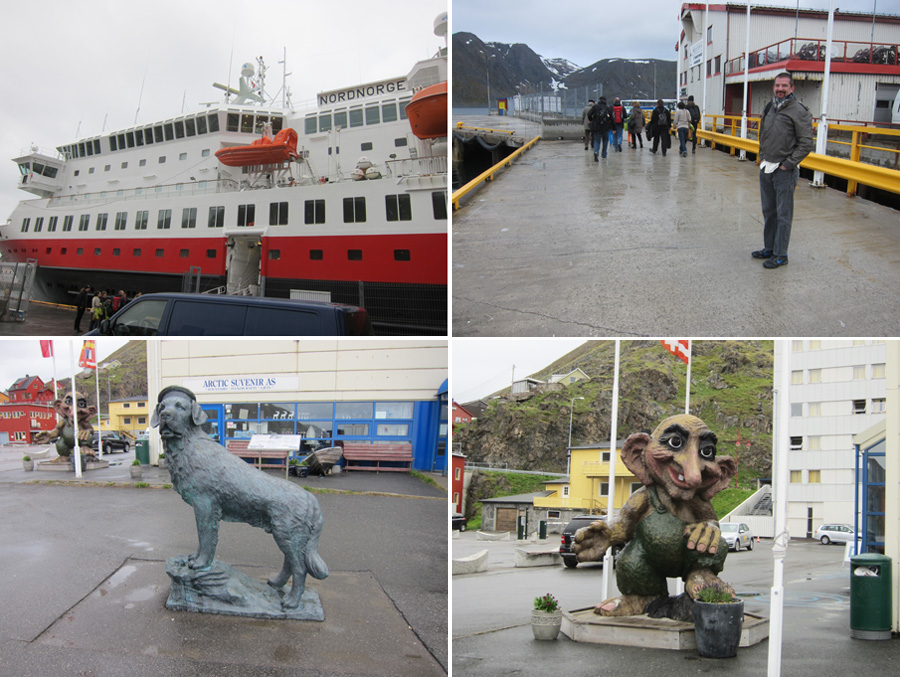
We disembark at Honningsvåg and on our way to the bus we encounter a huge statue of a Saint Bernard, and a Troll. Norway must be famous for their trolls, because they seem to be everywhere. The guides seem to enjoy telling stories of these folkloric creatures. They tell them so well that you almost begin to believe in them yourself. ;o)
We are back at North Cape, and it’s a very cold morning, colder than our previous visit just two days ago. We did enjoy a wonderful breakfast at the Visitor Center cafeteria, and afterwards we did some more exploring of the cape, getting the feel of the immensity of this geological wonder.
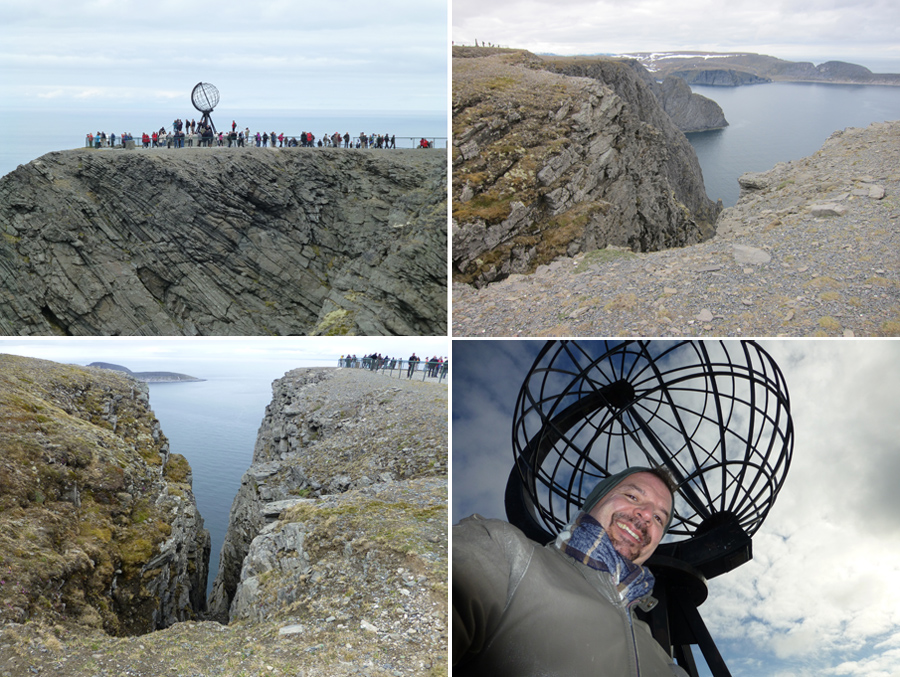
It the first frame above, the slanted angle of the rocks lends credence to the explanations of how the earth was formed, consisting of several tectonic plates constantly in motion, but on a geological time scale. As one plate pushes against the other, one rising up, as evidenced by the bluff of North Cape (being on the European plate), and the advancing plate slides underneath the European plate. In our lifetimes, as short as they are, we never see this constant movement, but it is going on as I type. We can only observe the effects of this movement due to Nature, which has taken place over eons of time. At least that’s my understanding of it, right or wrong.
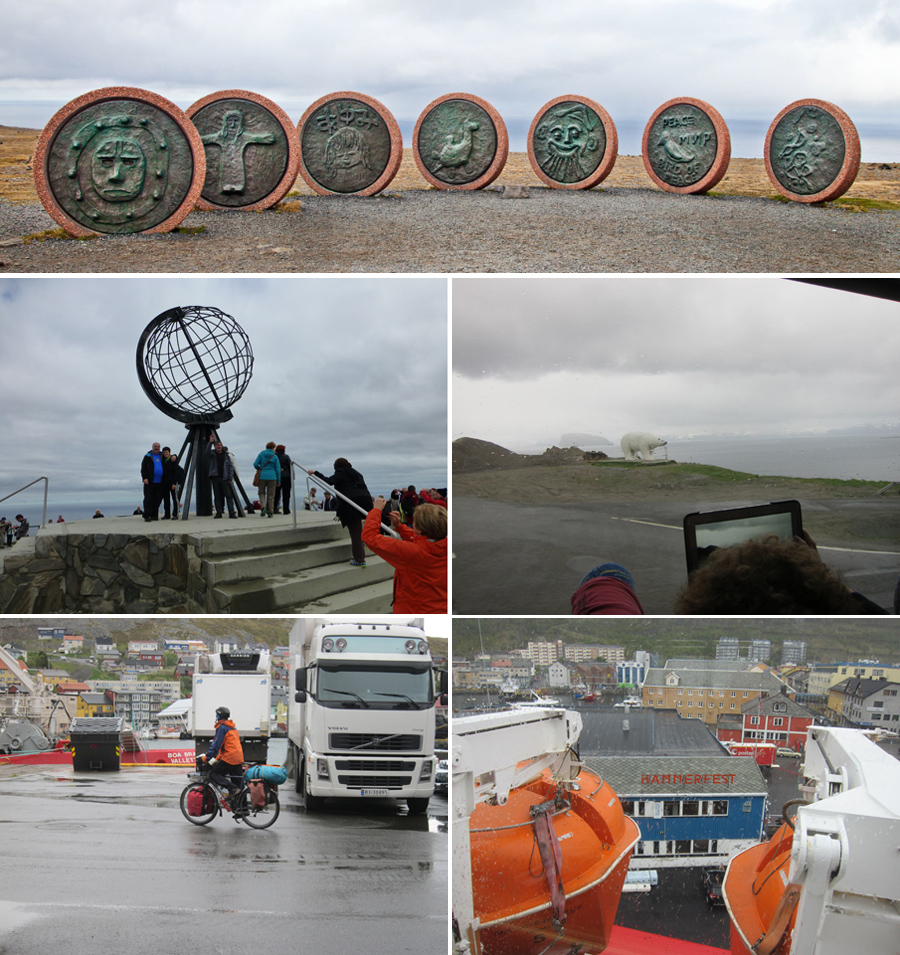
We say good bye once more to North Cap and the “Children of the Earth” monument, and head for our rendezvous with the ship at Hammerfest. The route will take us through an underwater tunnel from Honingsvåg to the mainline. Our guide tells us that we will be seeing a polar bear, and we are skeptical, but we wait to see. Yes, there was a polar bear, a huge fiberglass one, like something out of “B” movie. We all got a chuckle from that letdown. It had been raining in Hammerfest, and our boat was waiting there for us. It was lunch time, and we still had an appetites, although I don’t know how. I suppose this shore excursion business entails a lot of work.
Hammerfest is known as the northernmost town in the world. There is a Meridian Column there, which is on the UNESCO list of World Heritage sites and commemorates the first official measurement of the exact size and shape of the Earth.
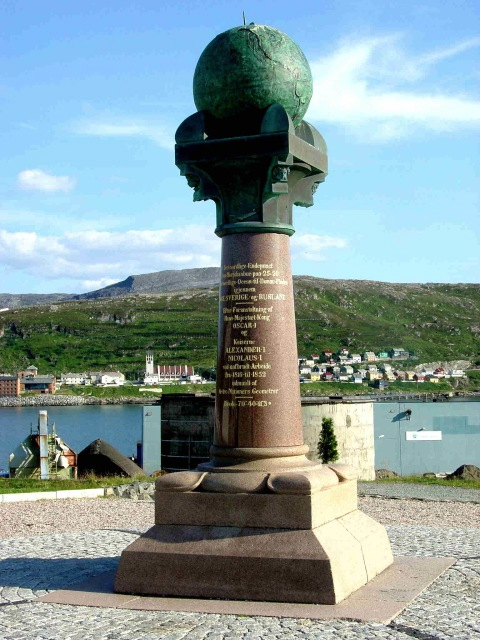 |
The Meridian Column was raised to commemorate the first international measurement of the earth. Between 1816 and 1840, the astronomer W. von Struve took measurements along a meridian in Russia. In 1844 he proposed to King Oscar I of Norway and Sweden that the two countries should join the Russian effort and complete the measurement from points as far north and south as possible. The measurements were concluded in Hammerfest in 1852. The distance measured was approx. 2000 kilometres. The memorial column was raised by King Oscar II.
The town of Hammerfest has a long and eventful history; back in 1891 it was the first town in northern Europe to get electric street lighting produced purely from water power.
On our city tour of Hammerfest, we are taken to an old church, which has lots of character. In the distance we see our shop heading for its next port of call.
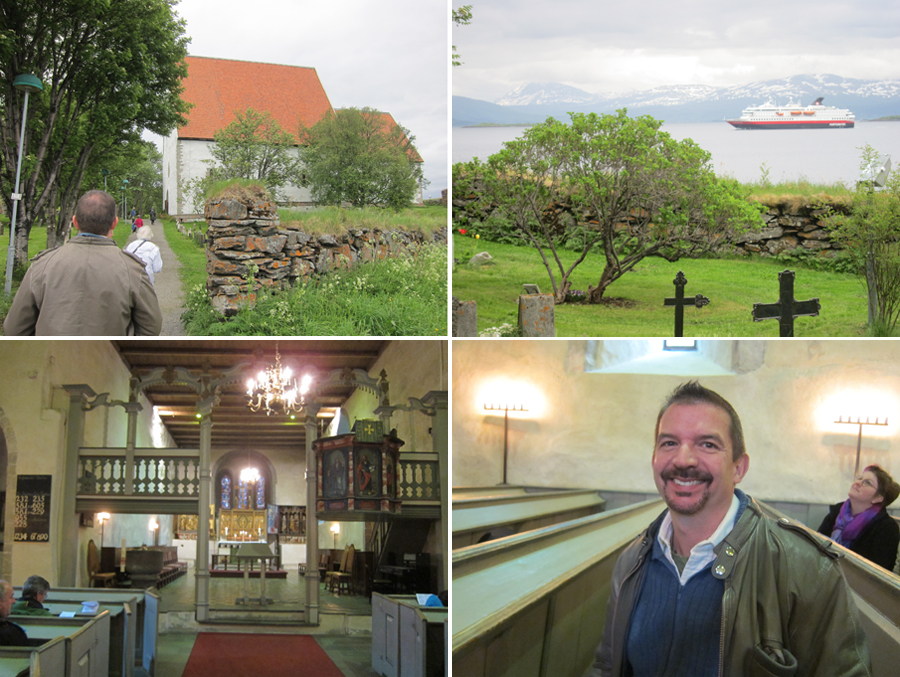
The church is quite small, yet inside it is warm and cosy. I could probably enjoy a service given here.
The clergyman was merely placing some papers on the pulpit, in preparation for his next sermon I supposed. We would not be here for that. The statues at the alter were very ornately and exquisitely made.
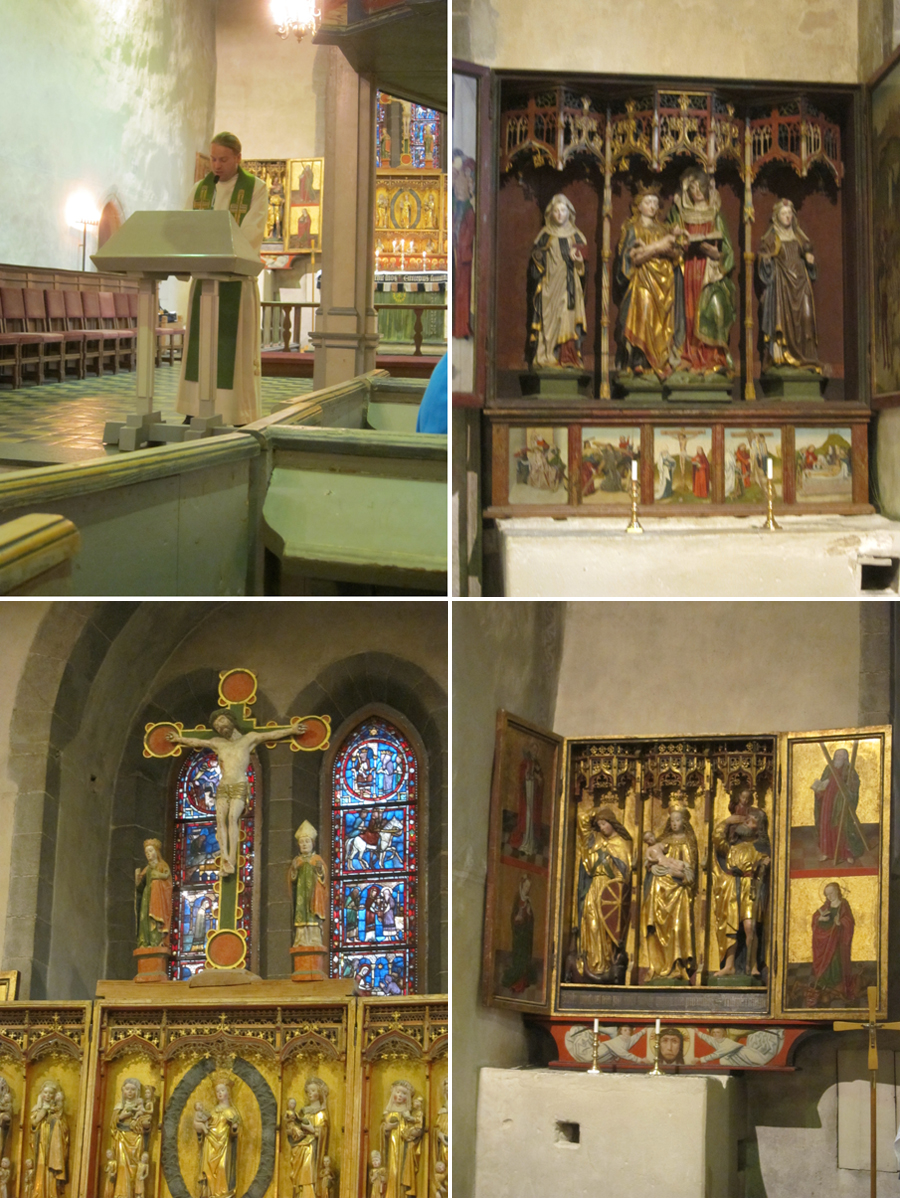
All of the figures were quite beautiful. And the stained glass windows provided a magnificent backdrop.
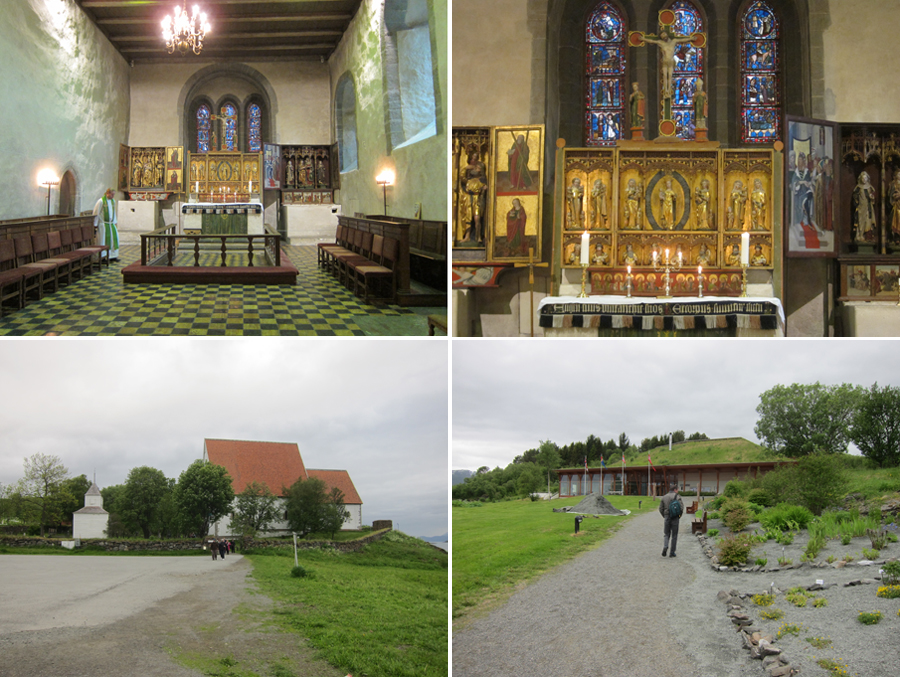
We leave the church and walked a short distance to a museum. Its roof was covered with sod, which created a nice effect.
The garden was very well kept, and I loved the tulips.
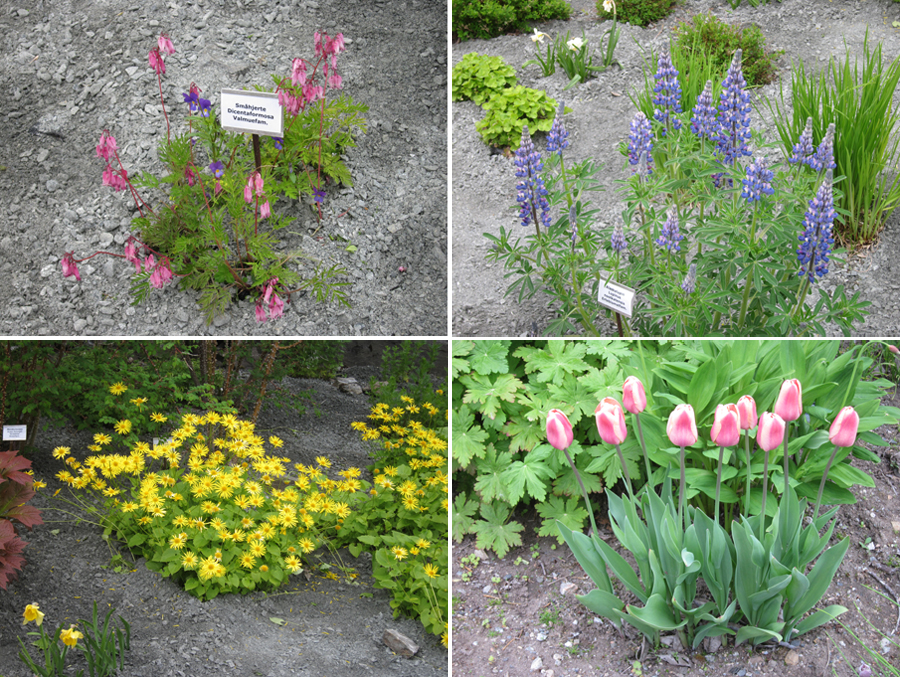
I’ve heard it said that flowers are the smiles of God. A picture like this next one sort of clinches it for me.

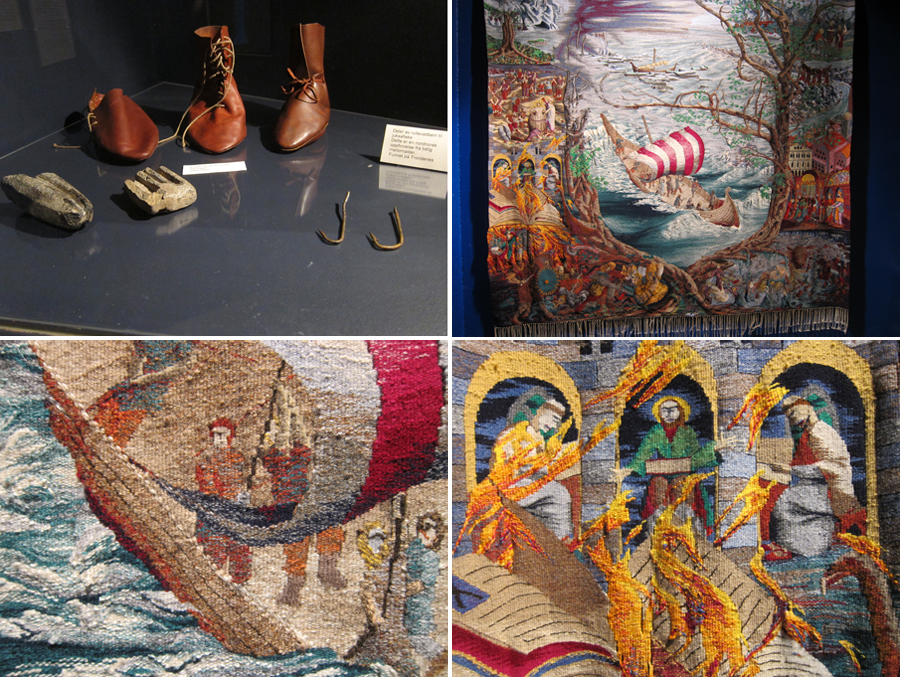
Inside the museum there were the normal Viking crafted objects you’d expect. The thing that caught my eye was a beautiful tapestry. You’ve really got to admire the amount of patience that goes into creating one of these. Each thread carefully placed by hand, the close ups showing the detail.
After enjoying the rest of the museum, we are off to meet our ship. Our huge bus boards a ferry to cross the fjord. It’s a short ride, and we just have time enough to use the facilities, and get back on the bus.
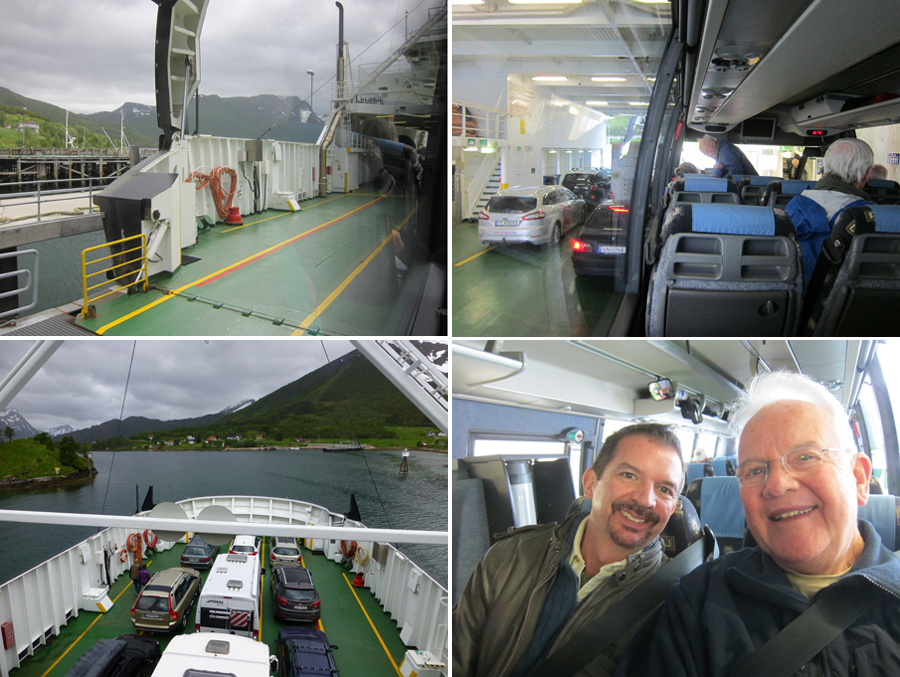
We are going to cross that bridge below, but we sit parked here for about 15 or 20 minutes. We are waiting for our ship to appear. This is a popular event, to cross the apex of the bridge at the exact moment that our ship passes under the bridge beneath us.
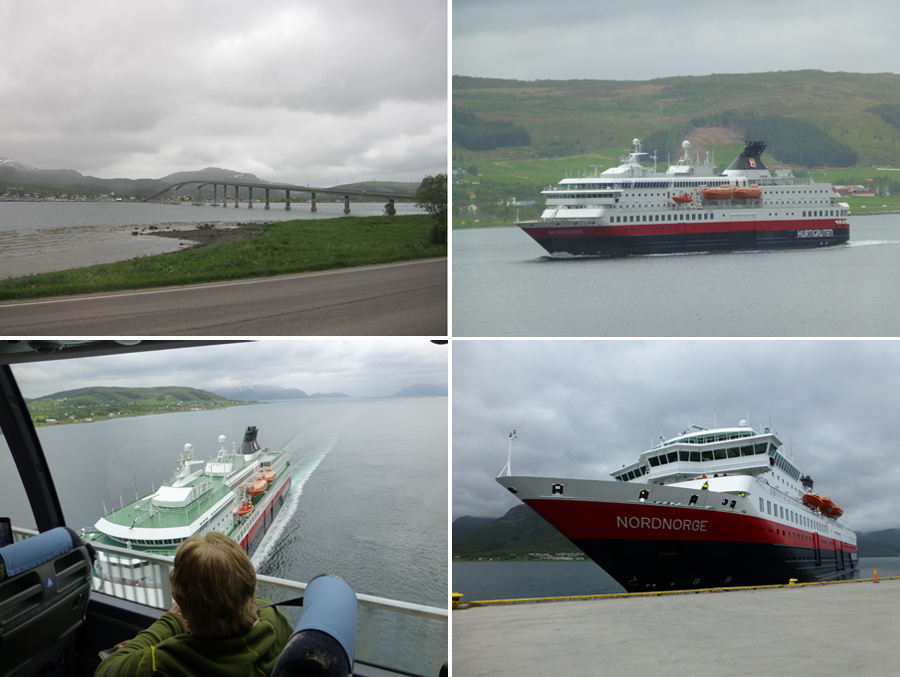
Well that was certainly exciting. ;o) Next, in Chapter 8, we will visit a huge collection of ice sculptures.
|