|
|
|
|
|
|
|
|
|
|
|
||||||||
|
||||||||||||||||||
|
Email us at: |
||||||||||||||||||
 |
||||||||||||||||||
 |
 |
|||||||||||||||||
|
Click the sun to see the |
||||||||||||||||||


 |
||||||||||||||||||||||
|
|
|
|
|
|
|
|
|
||||||||||||||
|
||||||||||||||||||||||
|
We return to Cancun Mexico for our 28th anniversary |
||||||||||||||||||||||
|
Text and photos by Ron. This is the final chapter. I'll bet you are wishing by now that I wasn't quite so verbose. I have these delusions that one day I may try to write my memoirs, and hence I try to capture the details that will fade from my memory with time. Here in my travelogues, the details will remain for as long as my disk drive holds up. LOL On the 22nd of June we had a rather excellent adventure to Cobá, which included not just a visit to discover Nohoch Muul (the very tall pyramid there), but a breathtaking Zip Line ride, canoeing, cenote rappelling, a Maya ritual, swimming in a hidden cenote, trekking into the jungle and an excellent lunch prepared by local Mayan people. Our guide Jorge gave us a very interesting talk when we entered the archeological site of Cobá, with lots of historical information. He is an areologist with a PhD in Mayan culture, so his range of knowledge went quite exetnsive.
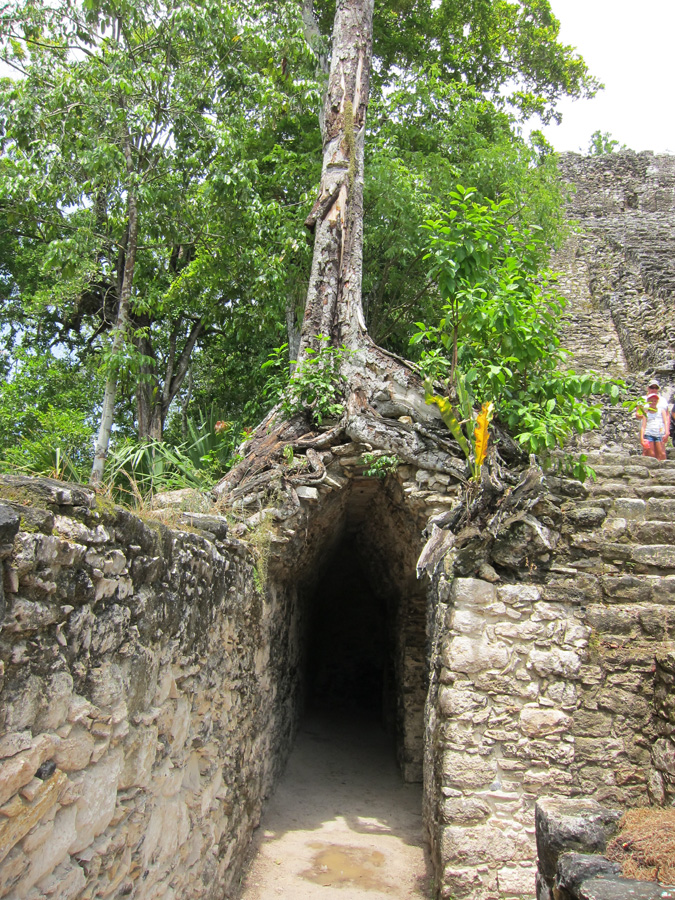
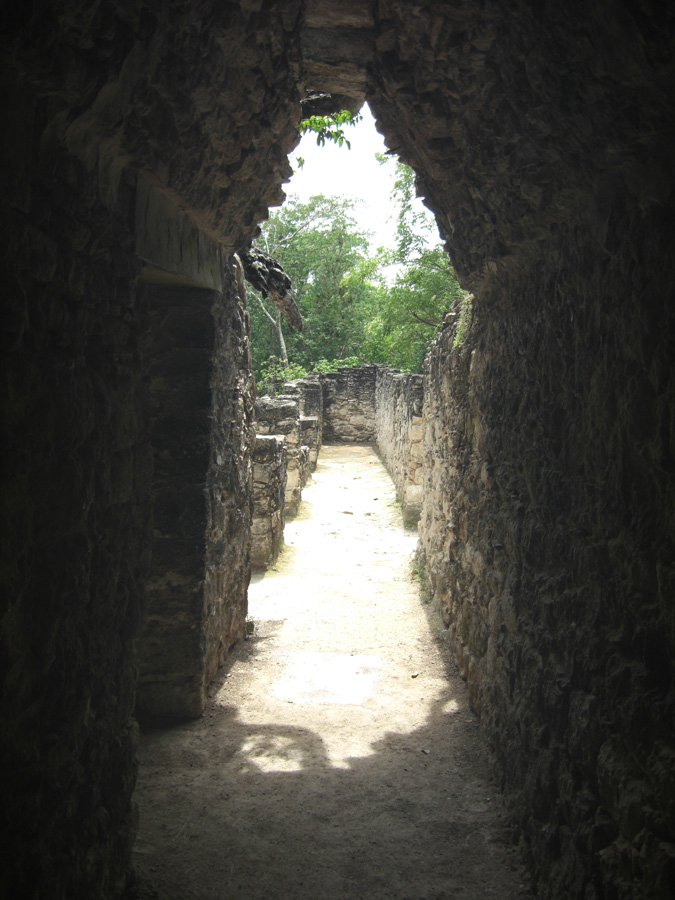
You can see how the jungle had invaded the ruins, nearly removing it from view. Jorge talked about Mayan architecture, and how it differed from the Roman style. In this arch there was no keystone, yet the two sides were constructed in such a way that they were free standing.
The stone at the top of the arch is merely a cap stone, not a keystone. Cobá is a Mayan city dating from 600-900 A. D. with an estimated population at that time of 100,000 people, and it is possibly the largest of all ancient Mayan cities. The unique thing about the structures at Cobá is that they have not been restored, but only uncovered, and at that, only a few of the estimated 6,500 structures have been uncovered. Jorge talked about how the Mayans learned to plot the motion of the stars, and used this information to know when to plant their crops. Their calendar has long been of interest to me. So, I found something on the Internet that removes the mystique. This is a quote which I thought was worth including here. Age for earthlings, in the 22 years since 1986 Argüelles' nonsense has been reconfigured by other pseudoscientists as the END OF THE WORLD! It is usually stated that the Mayan calendar ends on December 21, 2012, meaning that the world will cease to exist on that date. The facts are these. Instead of giving dates in days, months and years, the Mayans used several cyclical calendars giving dates only in days. The most primitive, Tzolkin, cycles in only 260 days. To specify a date unambiguously, the Mayans had a second calendar, the Haab, with a cycle of 365 days; by giving Tzolkin and Haab dates simultaneously, the Mayas could go for 52 years without repeating a date, in a so-called "Calendar Round." To specify important historical dates, however, the Mayas were forced to construct a third calendar, the so-called Long count, with a cycle of 1,872,000 days or about 5125 years. Many other calendars were also used, for example ones based on a 180 day lunar cycle, and a 584 day planet Venus cycle. The original Argüelles nonsense was based on the assumption that the current Long count cycle started on August 11, 3114 BC, meaning that the next cycle would begin 21 December 2012 AD.
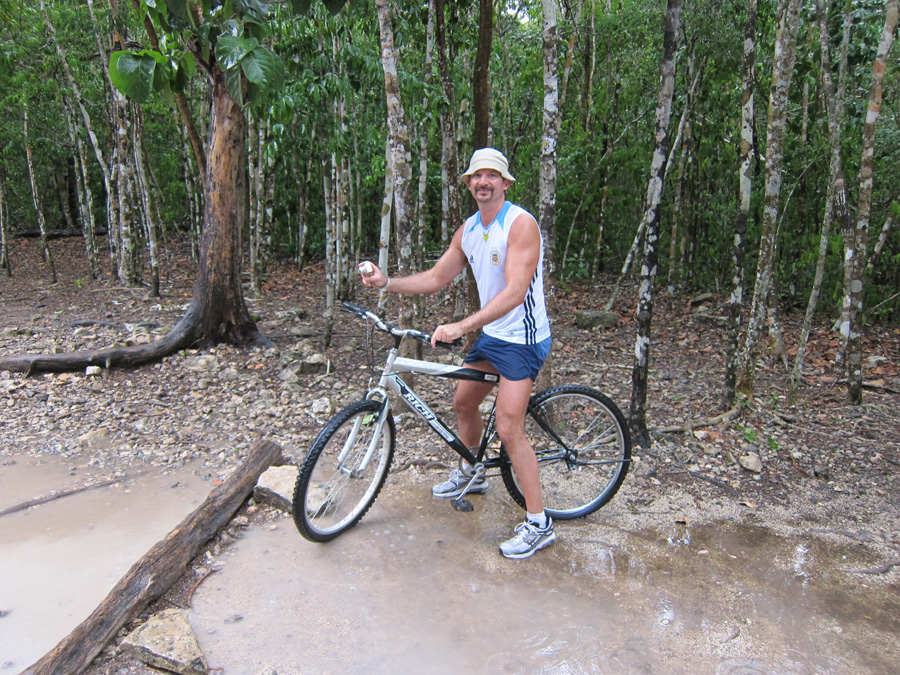
Well, doesn't everyone enjoy a good mystery? I know I like to theorize about such things. Some time ago I read a book by Graham Hancock, "Fingerprints of the Gods". It talked all about the pyramids around the world, from Egypt to South and Central America, and made an attempt at tying them all together in some related way. It also talked about an ancient map that put Antarctica in a more tropical location. It was fascinating, whether true or not, these unsolved mysteries of past events, yet events which are somehow documented in ancient writings. There was evidence that both the Mayans and the Aztecs had written their history on gold plates, which were hidden in temples, and were discovered by the Spanish and melted into ingots and sent back to Spain. If so, wouldn't it have been incredibly interesting to know what was written on those gold plates? When we arrived at Cobá, we heard loud claps of thunder off in the distance. By the time Jorge, our guide, had finished with his very informative talk and turned us loose to go to the Nohoch Muul pyramid, the storm had reached us. We rented bicycles just as it started to pour, to get us to the pyramid which was about a mile and a half away from where we were presently located, near the entrance to the site.
Unfortunately, Pete didn't think to look for a bike with a fender over the rear wheel.
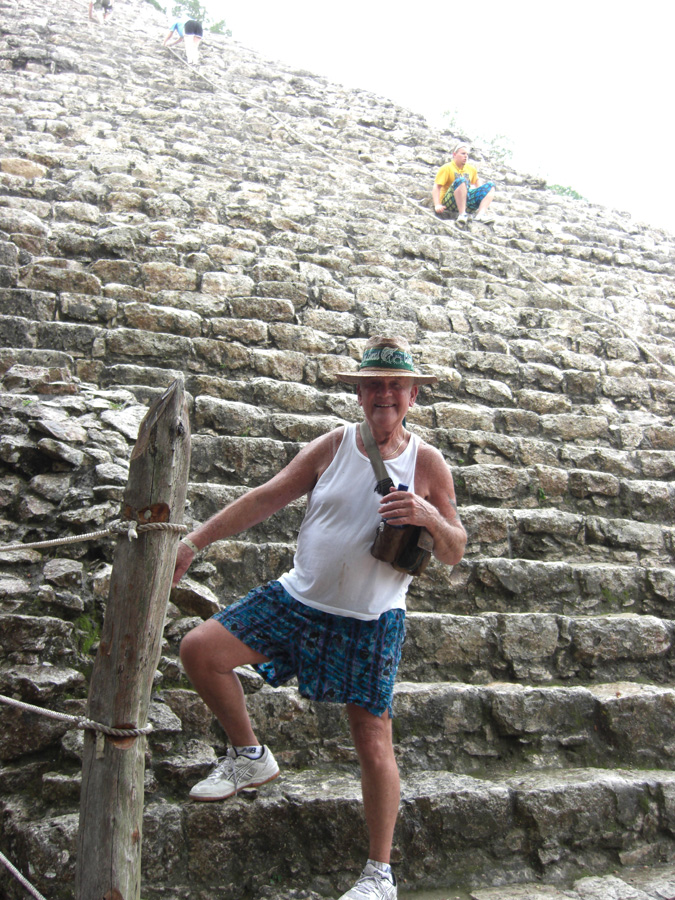
I on the other hand, didn't think about it either, but by chance got one with a fender. LOL By the time we got there, we were soaked through to the skin, but that didn't matter much because all we had on were our tennis shoes, swim shorts from the swim in the cenote, and a tank top. My only worry was about our cameras getting wet. We parked our bikes and joined the rest of the tourists under a thatched roof shelter, to wait out the storm. A bolt of lightening struck very close to us, and in the direction of the pyramid. Some kids were half way up, and their mother, who was under the thatched room shelter with the rest of us, was worried about them. If you used your imagination, you might think the gods were angry, and saying, "Get off my pyramid." LOL The storm finally did let up in about 15 or 20 minutes and we were then able to walk the rest of the way to the pyramid. It was very steep, and since it was wet, Pete thought it would be very dangerous to climb, so he wouldn't let me go up to the top. Grrrrrr! In hind sight, he was probably right, but we had come all this way, and it felt like I had somehow failed. We had chosen the trip to Cobá because it was the only local archeological site where tourists were still allowed to climb up onto the ruins. Chichen Itza was like that in 1989 when we were there, but today nobody is allowed to do that any more.
Nohoch Muul is 138 feet high and has 120 steps to the top, making it the tallest
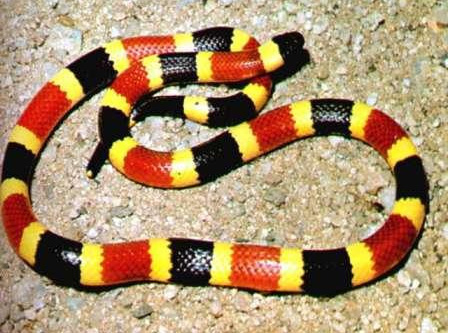
I did go up to the third step just to know I had at least set foot on it. LOL Cancun is a Mayan word, and it means Snake Nest. The guide gave us some rules to follow, and one of them was NOT to kick the snakes. We actually saw a snake, and I'm positive it was a young coral snake. It was dead on the trail. I suppose some tourist stepped on it unknowingly. The guide picked it up, and asked us, "What is the rule, red next to yellow?" I took a photo of it after he threw it off the trail.
Like I said, it was a young snake, but the yellow was definitely next to the red. I also checked out the false coral snake, and it doesn't have any yellow bands at all. This one definitely did. I wanted to take the photo so I could compare it to a shot of a real coral snake from the Internet. Here is the Internet photo, but of a mature coral snake.
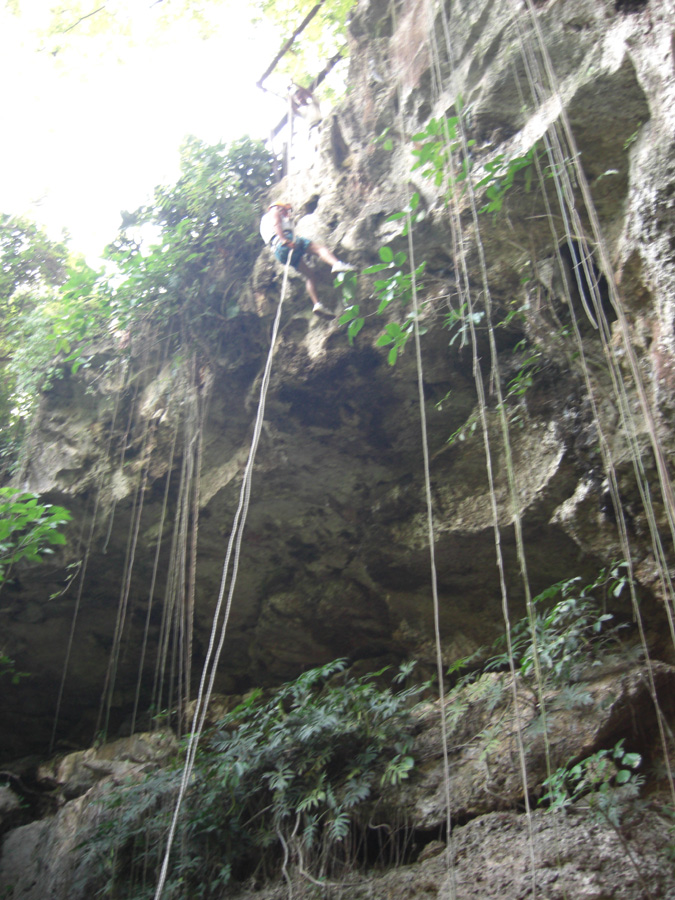
This is a true coral snake which is deadly poisonous This is the Mexican milk snake often mistaken for a coral snake We repelled into a canote (I think canote is the Mayan word for a sink hole). The one we repelled into was really cool.
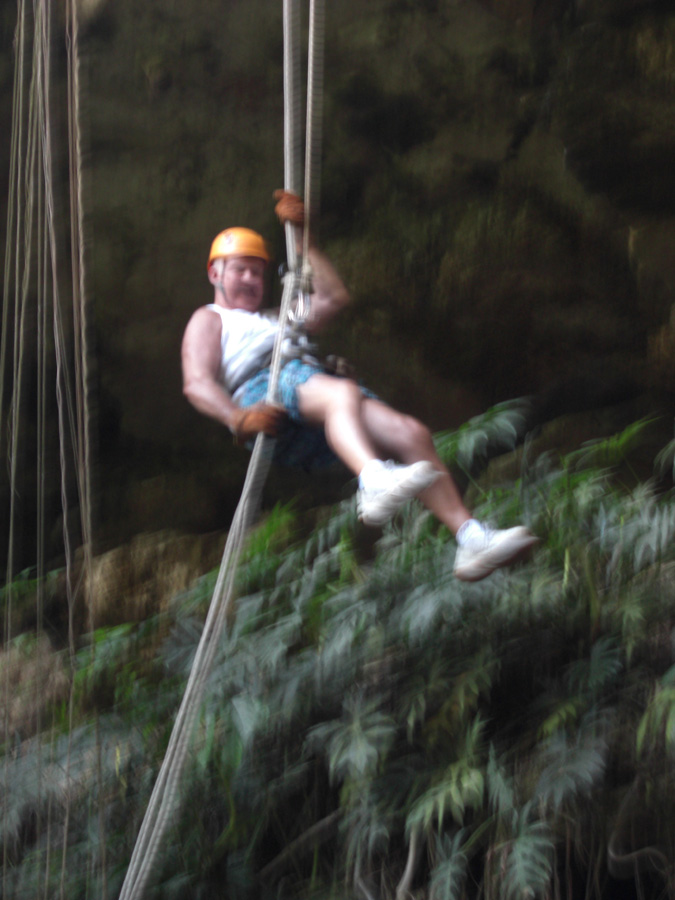
This is me, starting down the cliff face. This is the first time I'd ever repelled.
It was actually a lot easier than I thought it would be.
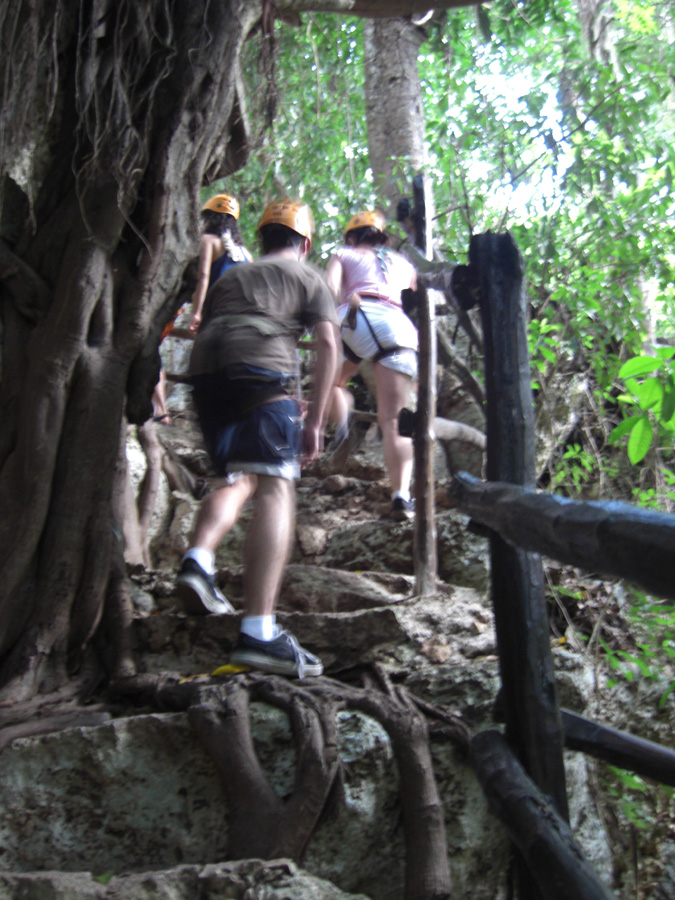
We had both survived the repelling, and were now ready for our trek through the jungle. Our guide told us that some 40 million years ago the Yucatán peninsula was actually the sea floor. When the meteor struck in the Caribbean and ended the reign of the dinosaurs, it pushed the earth up to form the Yucatán, which consists primarily of limestone. This limestone is very porous, and there are many underground rivers. We saw lots of fossilized sea shells as we trekked through the jungle.
This is at the bottom of the canote we had just repelled into, and from here we will
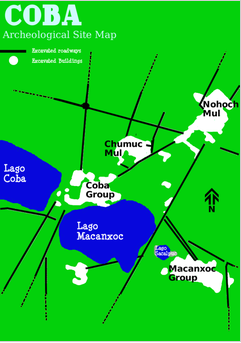
The jungle has a way of really taking over things. The city of Cobá was almost completely taken over by the jungle after the Spanish had conquered the Mayan people. The first mention in archeological circles of its existence was in 1841, but without roads it was too difficult to get to it, thus it was not examined by scholars until the 1920s. Today it thrives on tourism. While Cobá is the present name of the city, it's Mayan name is actually 2 words, Cob Há, Há meaning water, and Cob meaning between. Looking at the map of the archeological site it appears obvious, as it is situated between two large lakes.
Next came the Zip Line ride, but not until the local shaman purified us with smoke as we emerged from the jungle.
They outfitted us with a harness earlier, and it was used for both the repelling and for the Zip Line ride.
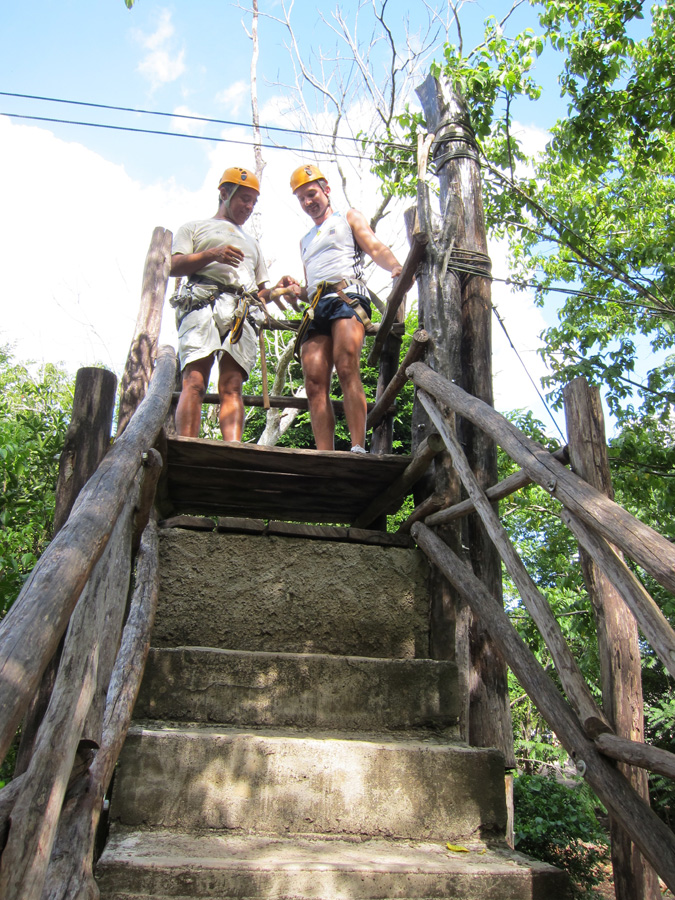
Here is Pete being attached to the Zip Line by Jorge, our guide.
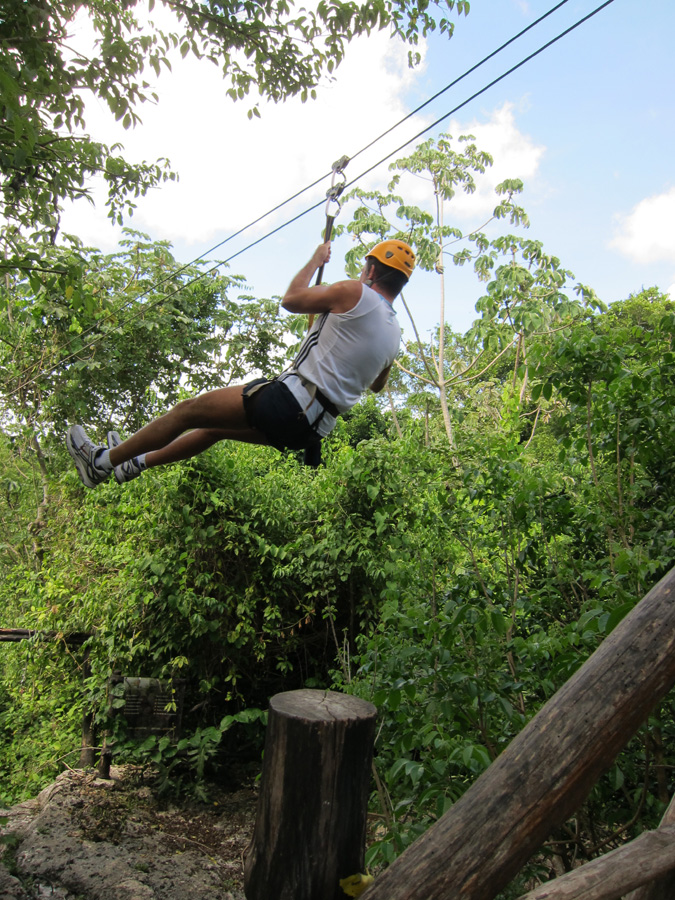
And there he goes! Perfect form, like he's done it a thousand times. We were very fortunate in that our group was only 6, and the van used to transport us could actually hold 12 passengers, but that would make it rather close, and the ride was nearly 2 hours each way from Cancun, so having the extra room was a godsend. The other members of our group were a mother and her 17 year old son from Huntington Beach, CA, and a young couple from Albuquerque, New Mexico on their honeymoon, but two years after their wedding.
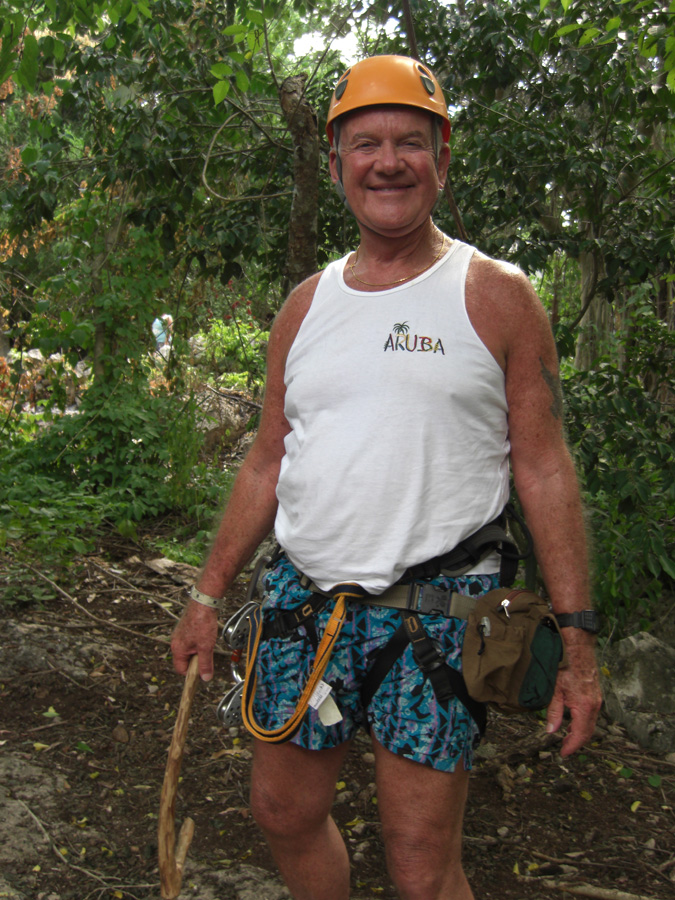
I was eager and ready to go on this Zip Line ride. The hooked stick in my hand was given to us to use as a break. LOL My first attempt was a little disorienting because I kicked off the platform with one foot, and this caused me to spin around, and I arrived at the end point backwards, not knowing how to turn myself around, and I couldn't see how close I was to the end, and when to apply the brake, so I crashed at full speed into the guys waiting to catch me on the end platform. In an effort to redeem myself they told me to follow the trail around the rim of the canote and try it again. The second time Jorge showed me how to keep myself straight, and he gave me a good shove as I pushed off with both feet this time.
And here I come in for a landing, applying the brake and facing the platform with near perfect form. ;o)
Our canoe trip was in these plastic boats, and we paddled down this narrow channel, ending in a small lake, which we crossed, and then had to hike to the next activities, a blessing by a local shaman, and a swim in an underground canote.
Our guide Jorge is explaining how to enter this canote. We back down the stone steps, and when we reach the wooden steps, we count 7 steps, then turn around and walk down the rest of the way.
It was quite a ways down to the water. This was one of two photos I took. The rest of the time we were enjoying the wonderful cool water which was crystal clear, and was connected to the sea by the underground river, and the tides made the level of the fresh water rise and fall.
This is the view up, as the group before us leaves the canote. After the wonderful swim in the canote, we go for a most welcome lunch, prepared by local Mayan women. There were clay pots filled with black beans, chicken cooked Mayan style, refried rice, some empanadas and a salad, among other things. And on the tables were dishes with hot home made tortillas which were the best I have ever eaten. The couple in the photo are the honeymooners from Albuquerque.
Except for the fact that it was a long hot ride getting to and from, the Cobá adventure I can highly recommend. I think I'd happily do it again when we next visit Cancun. I'm sure there are many more adventures available here in Cancun, so this may become a favorite return destination for us. This concludes our adventures in Cancun. There are lots more things to try on future visits. I highly recommend this as a wonderful vacation destination. Cheers! Ron |
||||||||||||||||||||||
|
||||||||||||||||||||||