 |
|
|
|
|
|
|
|
|
|
|
||||||||
|
||||||||||||||||||
|
Email us at: |
||||||||||||||||||
 |
||||||||||||||||||
 |
 |
|||||||||||||||||
|
Click the sun to see the |
||||||||||||||||||


|
 |
|
|



|
|
|||
|
I must apologize for taking so long in getting back to writing this chapter of our Antarctic adventure. We were away from home for a month (12th of February through 12th of March) and spent time in California, visiting with family and friends, and meeting with our Tax Consultant, an inescapable annual chore. We also spent 2 weeks at our timeshares in Los Cabos, Baja, California. The photos I’ve been presenting of Antarctica are taken in summer there. We were now in Baja, California in their winter. The contrast is staggering, ignoring the position of each on the globe, but not the season.
Ah! The Westin Club Regina, our favorite place of all. This time of year you can look out But now we are back home, and I have been doing catch up on all the things that had piled up while we were away. I have once again found time to think about, and write about our wonderful adventure in Antarctica. DAY ELEVEN (continued) DRYGALSKI FJORD If you will remember from Chapter 5, I left off with us taking an excursion via Zodiac in Cooper Bay. We were originally planning to make a landing there, but the beach was deemed unsafe for landing by the staff, because of the heavy Fur Seal population there at the time. Cooper Bay is named after Robert Cooper, First Lieutenant on board James Cook’s HMS Resolution during the voyage of exploration that charted the coastline and waters in the vicinity of Cooper Island in January 1775.
It was close to noon, and the weather was starting to move in. It can change rapidly
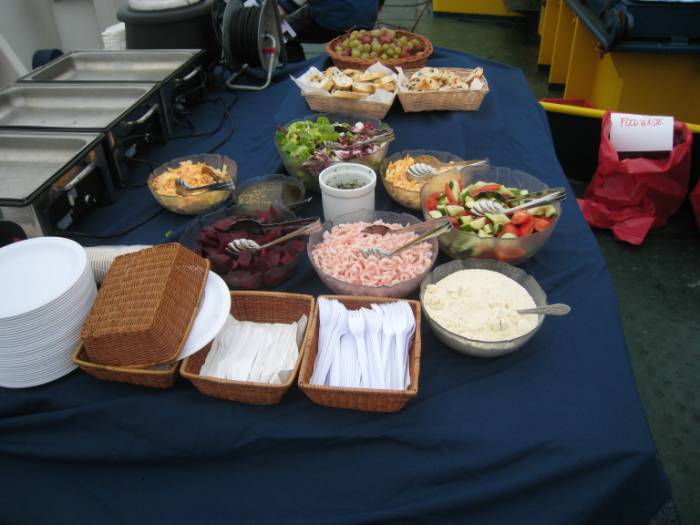
We returned to the ship (it was lunch time anyway). The kitchen staff was well prepared
After lunch we went up on deck to view the scenery as we headed for Drygalski Fjord.
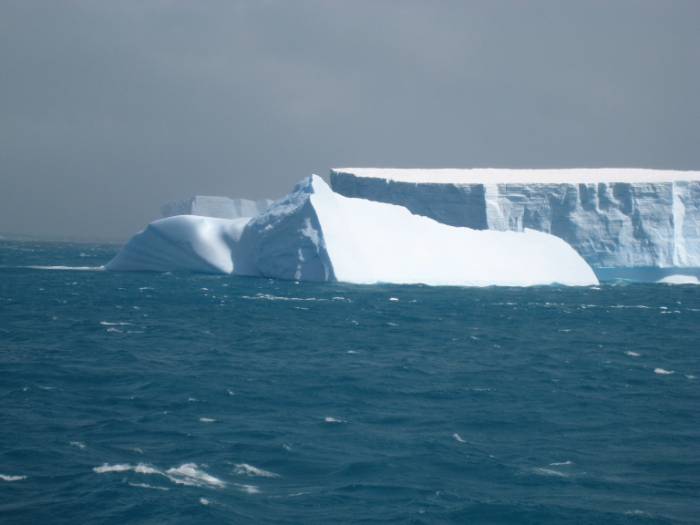
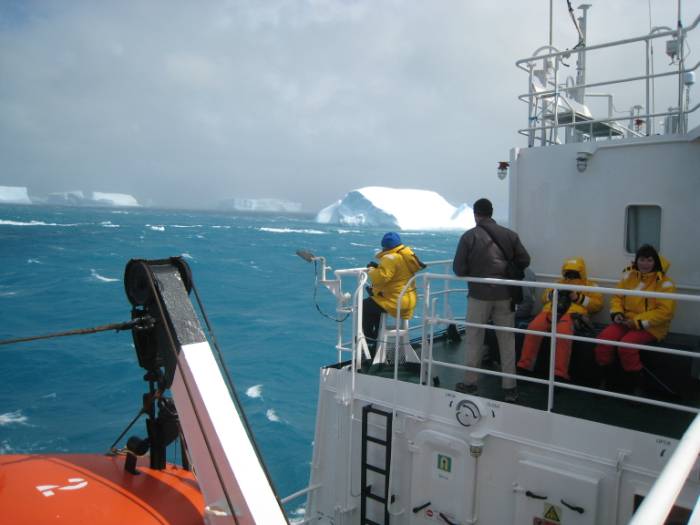
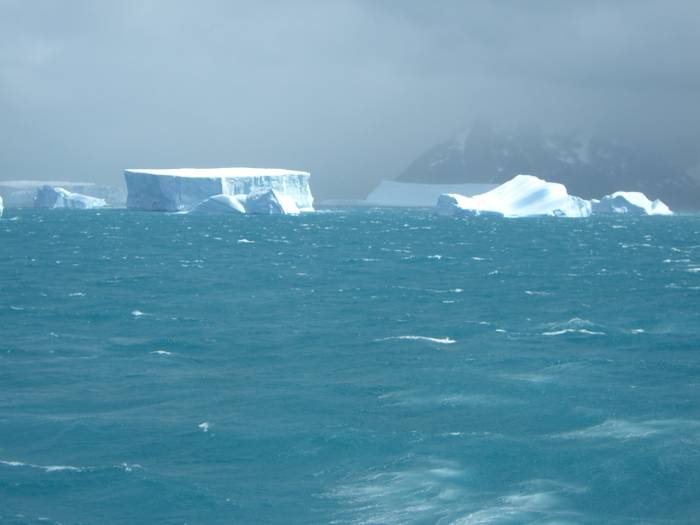
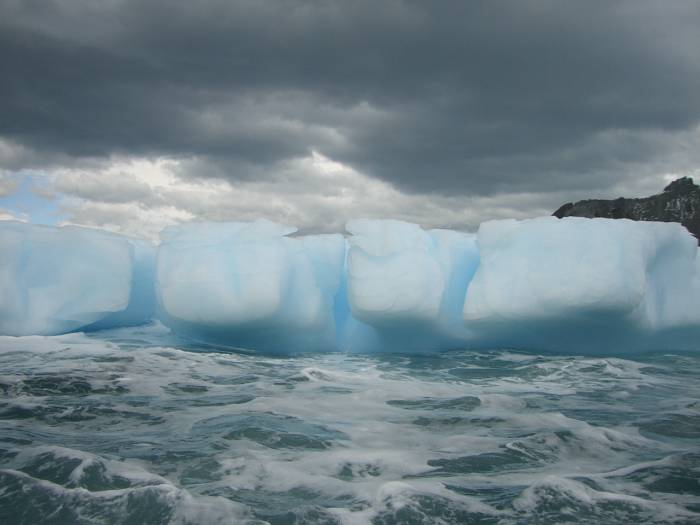
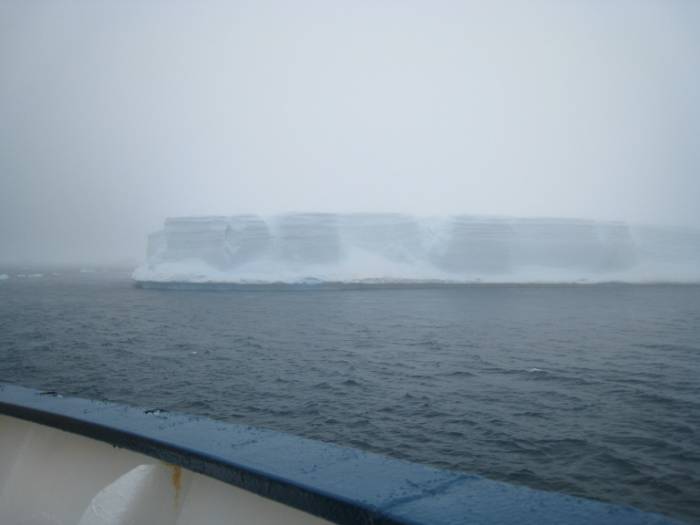
Along the way the views of the tabular ice were certainly awesome.
Everyone was just trying to find a place out of the wind. It was blowing at gale force.
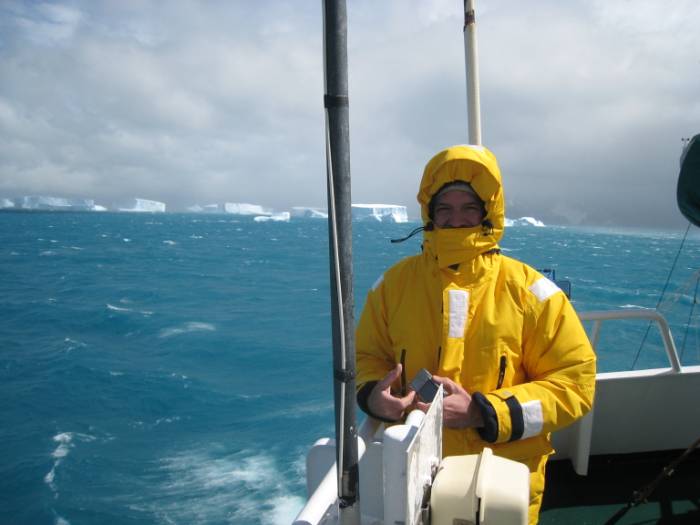
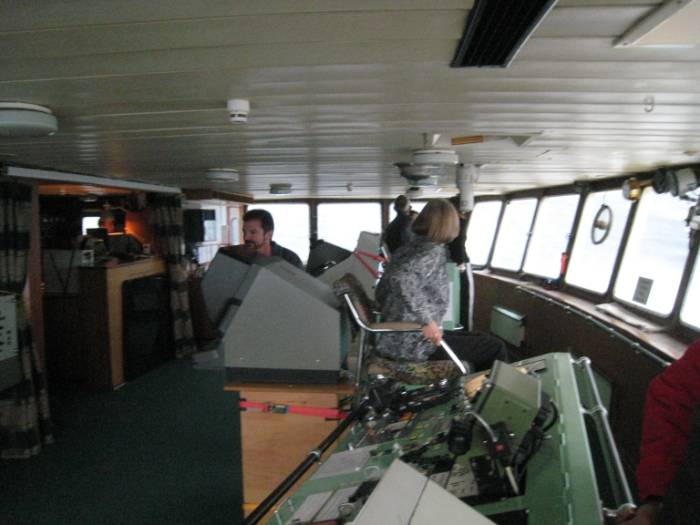
The safest place to be was on the bridge. It was warm, and it had lots of handrails.
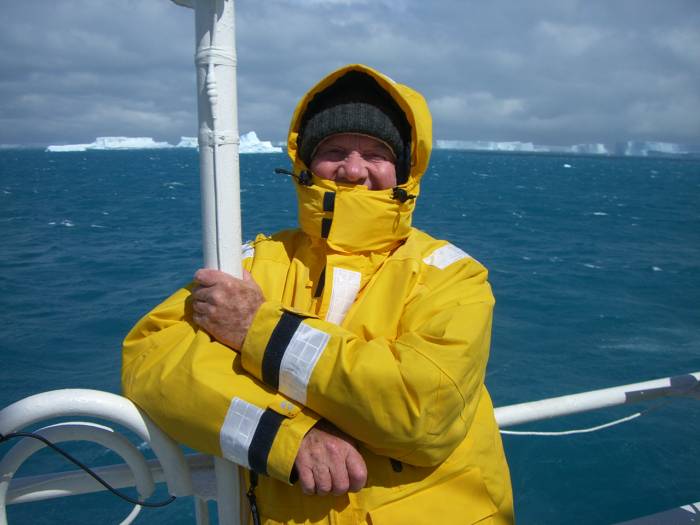
You can’t actually see the wind blowing here, but believe me I’m hanging on for dear life.
We were just on the fringes of THIS looming weather! We were slowly coming up
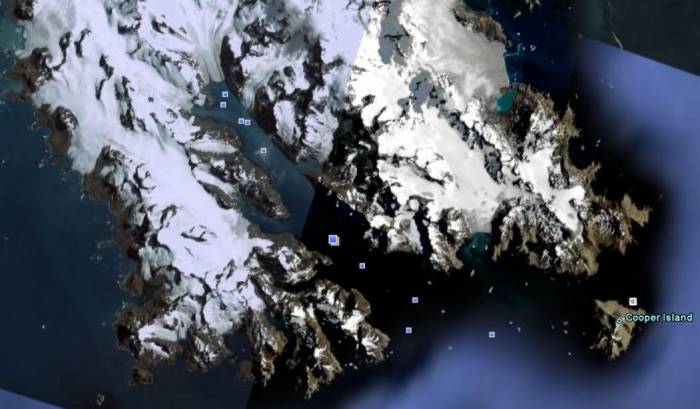
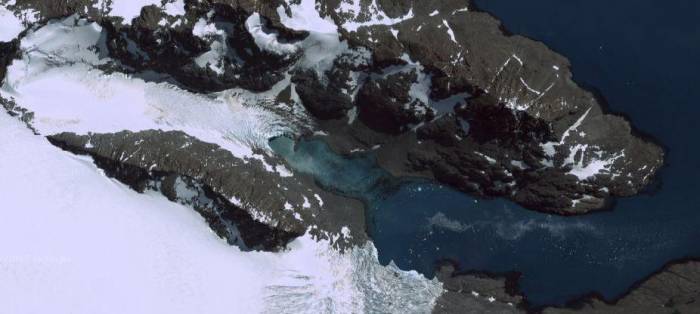
Drygalski Fjord as seen from an orbiting satellite. I did not get any photos from our trip inside the fjord itself. The wind was so strong coming down the fjord from the north that I think the captain turned the ship around at about mid way into it. It was narrowing fast, and I think it may have been hazardous to proceed much further.
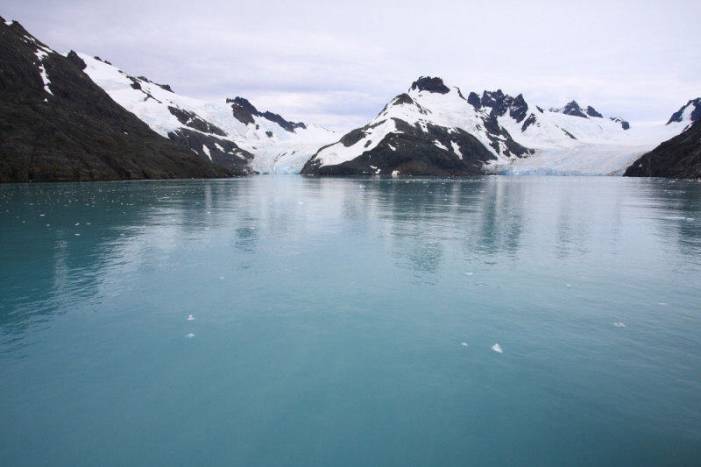
We were still on our Zodiac ride at Cooper Island here, and that weather was The Internet comes to my rescue, again. On 27 December 2008 Howard Banwell took the following few photos, so we thanks to him I can show you what the fjord actually looks like in good weather.
The Jenkins & Risting Glaciers are brilliantly captured here. Can you believe the fantastic luck with the
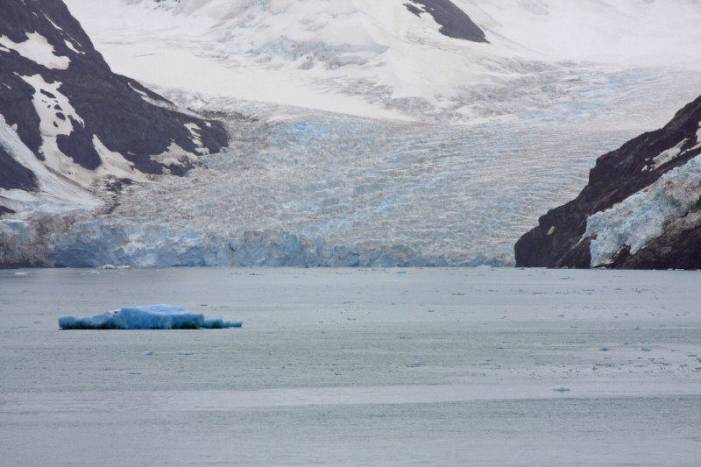
This is the massive Phillipi Glacier. With all the talk about global warming, it’s comforting to see
A good satellite shot of Drygalski Fjord and the Phillipi Glacier at the bottom of the photo.
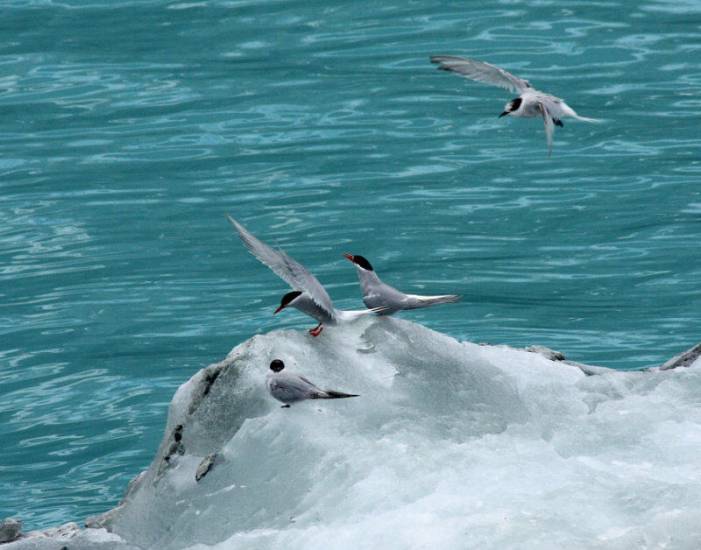
Arctic Terns in Drygalski Fjord find a place to rest. Ice and rock dominate the alpine landscape with spectacular peaks rising out of the sea to over 1000m (3250 ft) in height. The geology of the fjord is complex and some of the oldest on the island, with glaciers still actively carving out its shape. This rat-free zone of the island is a stronghold for sensitive species such as the pipits and burrowing petrels. Snow Petrel, one of the most coveted birds for Antarctic birders, also has a stronghold here.
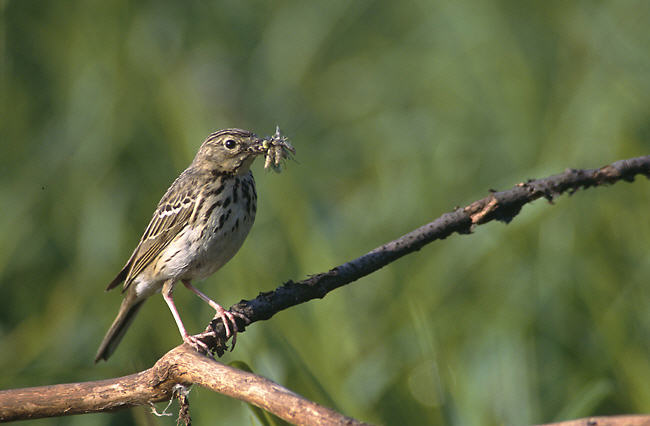
A pipit with a tasty critter in it’s beak. It’s a very delicate looking little bird.
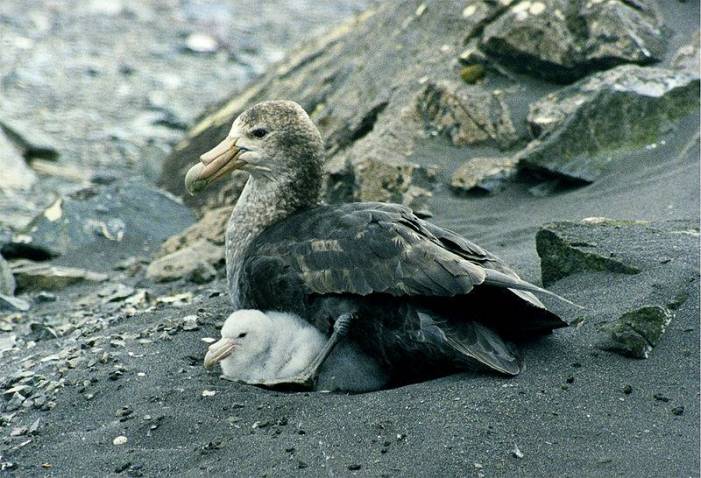
A Giant Southern Petrel brooding it’s chick in it’s burrowed out nest on a rocky ledge.
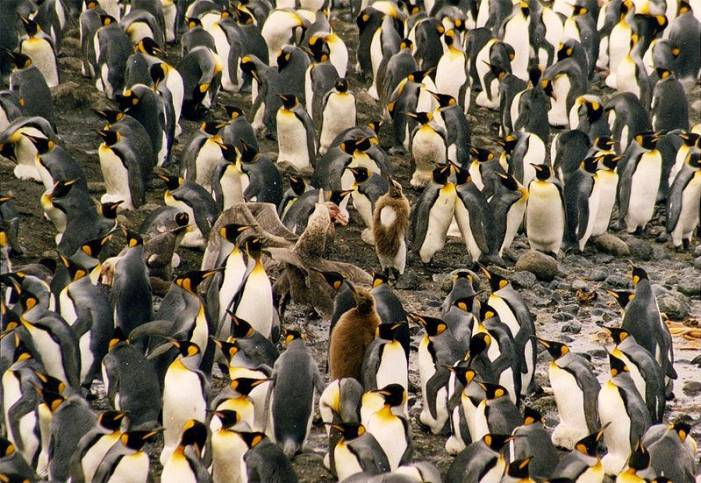
Southern Giant Petrels are opportunistic feeders. At center you see one who has descended upon this King Penguin colony, and has killed one of the chicks for food. It is a rather large and fierce bird
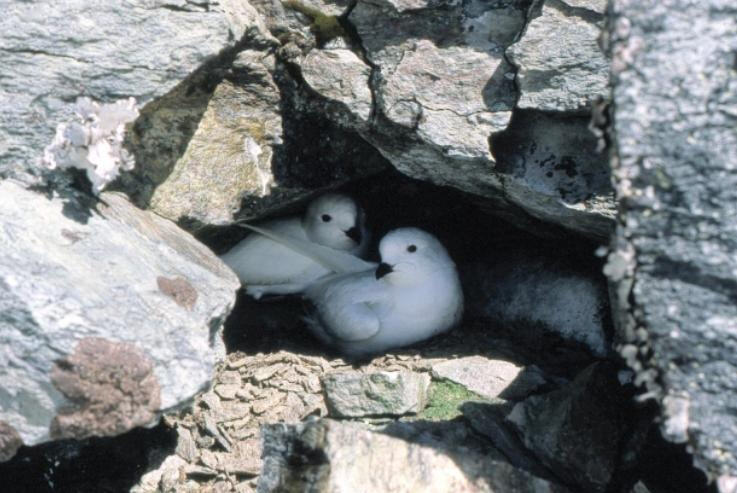
Here is a pair of nesting Snow Petrels. They are a much smaller bird than the Giant Southern Petrel.
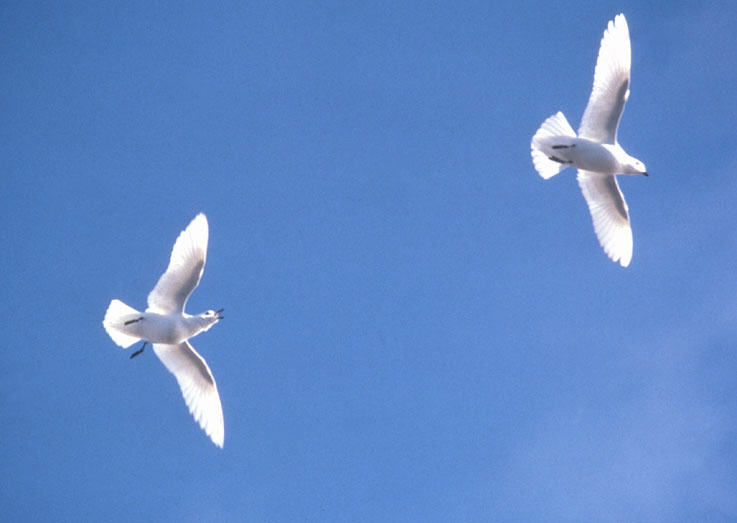
This is a pair of Snow Petrels, courting in flight. They are certainly beautiful I flight. Our schedule for today had this interesting comment. “We set sail for the Antarctic Peninsula! Please secure all valuables for rough weather and clear all hall railings of personal clothing. Dr. Dave will be available for consultation during the afternoon. Keep an eye out for icebergs as we depart from South Georgia.” Day 12 At Sea What outlandish beings are these? Erect as men, but hardly as symmetrical, they Herman Melville Russian words of the day: “Svettit solnze” — “sunshine” This day at sea was filled with lectures and films. Tony’s talk was Real Birds Eat Squid: the Albatross –Nature’s Ultimate Flying Machine. Next was the documentary The Blue Planet: Frozen Seas. After lunch Phil gave his talkShackleton: Part 2: The South Georgia Years. And after dinner we watched the documentary Race To The Pole. All of these activities were excellent, and we didn’t mind being at sea at all. The time went very quickly. I comment Quark on putting together such a great staff for our voyage. The trip from South Georgia Island to the South Orkney Islands in the Scotia Sea normally takes about 2½ days for our ship, but since we were fighting a 40-knot headwind the entire way, it took us more than 3 days. This put us off schedule for making a landing at the Orkneys, and instead we took a more direct route towards the Antarctic Peninsula.
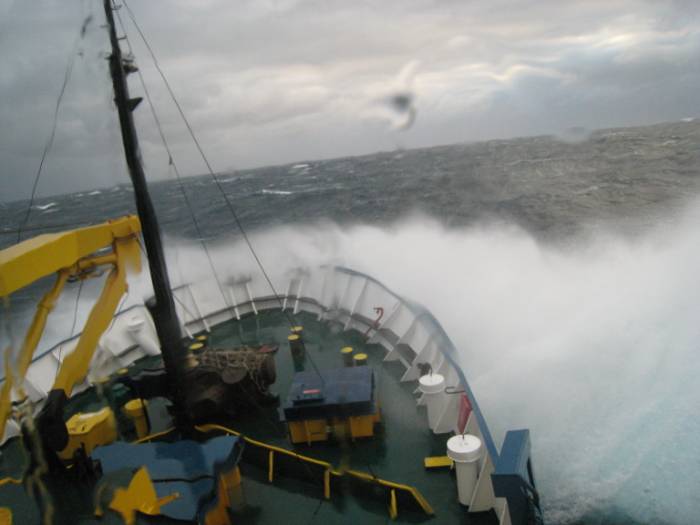
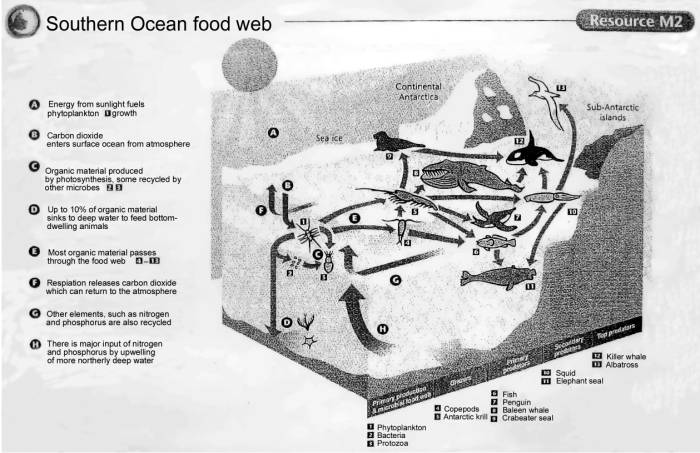
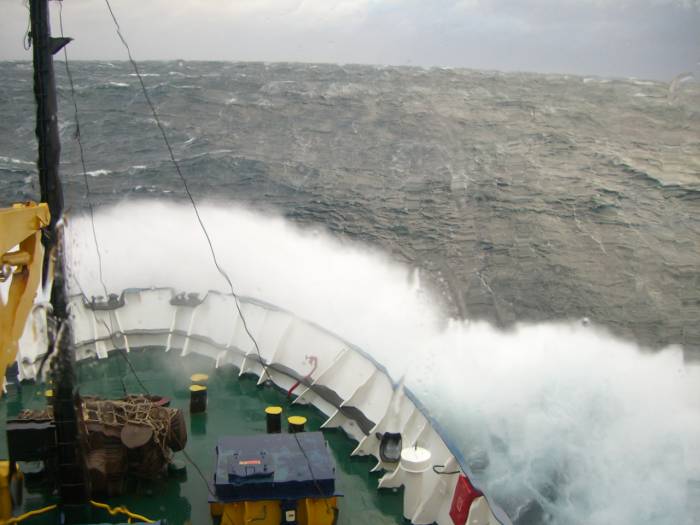
This is what it’s like with a 40-knot headwind in the Southern Ocean. Our progress west We had extra free time in this passage, to see movies and attend lectures by the staff. One of the more interesting lectures was given by a gentleman who came onboard the ship in South Georgia, enjoyed lunch on deck with us, and that evening gave a talk on the South Georgia Island fishing industry, and how it is very strictly controlled by the British government. But here I digress a bit, because he gave his lecture before we left South Georgia, and we dropped him off again before we departed the island. The sea is so rich with fish of various types that ecologists do not want to allow it to become over-fished as has happened in so many other places in the world. There are scientists here who have been on the island for years, studying the food web that sustains the many and varied species of wildlife, under the sea, in the air and on the land. The chart below does a very good job of explaining this food web. It is easy to see how every creature relies on the function and survival of their food source to survive. Take away any one of them and everything above that food source, parishes. Take away the sun, and everything parishes. NOTE: This chart is much easier to view at 150%
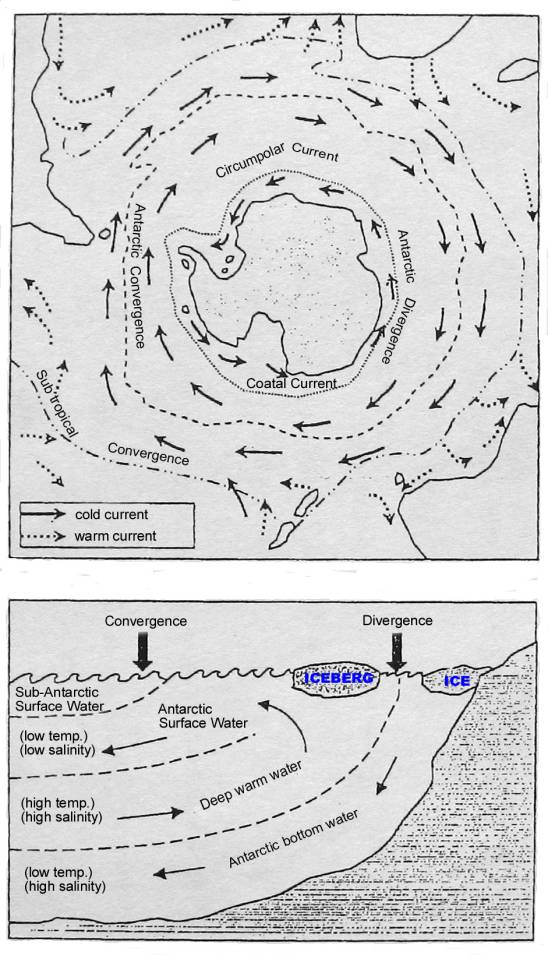
The mechanics that drives this food web of the Southern Ocean was explained very well in the lecture. If you are interested, as I was, read on. The following is from one of the documents we were given. It is quite an education. One of the nicest things about these Quark Expeditions is that it is very much a learning experience, and well worth every penny paid. You may wish to refer to these diagrams as you read the text below.
The Southern Ocean The Southern ocean consists of a broad band of generally turbulent water surrounding the continent of Antarctica. The northern limit of this ocean is about 40° S latitude. Westerly winds and the associated West Wind Drift, or Antarctic Circumpolar Current, are outstanding features of the Southern Ocean. They cause massive amounts of water to move constantly from west to east around Antarctica. This involves water from the surface down to about a 3,000 meters (9,843 feet) stretched over a distance of some 24,000 km (14,913 miles). This averages some 130 million m3 of water per second, continuously on the move. Further south, however, easterly winds cause a westward-flowing current close to the continent – the East Wind Drift. Along much of the coast, particularly East Antarctica, this is a relatively narrow band, but where deflected by deep embayments, such as the Waddell, Bellingshausen and Ross Seas, it circulates in the form of clockwise gyres. A ship sailing south to Antarctica will encounter a sharp drop in temperature between 49° and 55° S latitude. At this point one can detect subtle changes in both the ocean and the atmosphere. This delineates the “Antarctic convergence” zone that surrounds the continent. Antarctic Convergence The Antarctic Convergence is a natural boundary between the relatively warm Sub-Antarctic Surface Water and the cold Antarctic Surface Water. The location of the convergence is not a precise line but varies slightly throughout the year, from year to year, and from century to century. This convergence zone is an important biological phenomenon influencing the distribution of plankton, fish, birds and mammals. The species found are quite distinct as one travels across it. The water south of the convergence is often referred to as the “Antarctic Ocean”. This covers an area of approximately 35,000 km2, or 10% of the world’s oceans. It contains the coldest and densest water on Earth and is notable for its high biological productivity. It plays a major role in influencing oceanic circulation in the southern hemisphere, and in governing the climate of the planet. The Antarctic Ocean The Antarctic Ocean comprises three distinct layers of water mass, which differ in their temperature, salinity and direction of flow. The three sandwiched layers are driven by westerly winds in constant eastward-flowing spirals around Antarctica. The upper and lower layers also move gradually northwards, carrying cold waters from the Antarctic to the tropics. In contrast, the middle layer flows southward bringing nutrients and warmer water from temperate and tropical regions. The three layers are as follows: (1) Antarctic Surface Water This is the top layer of the Antarctic Ocean. It directly affects Antarctic plants and animals. This water mass originates at the Antarctic Divergence, a narrow zone close to the continent. This layer is constantly cooled by ice and cold air from the continent and is characterized by low temperature and low salinity, caused by the melting of sea ice and icebergs. At the Antarctic Convergence this water sinks below the warmer, saltier sub-Antarctic Surface Water and continues spiraling northwards as the Antarctic Intermediate Current. This current cools the coasts of New Zealand, southern Australia and many oceanic islands. It is even detected north of the equator in the Atlantic Ocean. (2) Warm Deep Water This middle layer is a southward flowing water mass originating from the surface waters of the Atlantic, Pacific and Indian Oceans. This current swells up at the Antarctic Divergence, and is characterized by high salinity and relatively high temperature. Some of this water takes on a lower salinity and moves northwards as the Antarctic Surface Water. (3) Antarctic Bottom Water The remainder of the Warm Deep Current is pushed towards the continent, becoming colder and sinking down along the continental slope and along the ocean floor in a northward direction. This Antarctic Bottom Water has a low temperature (-0.5°C) and high salinity. It spreads far into the Pacific and Atlantic Oceans, carrying south polar water into the northern hemisphere.
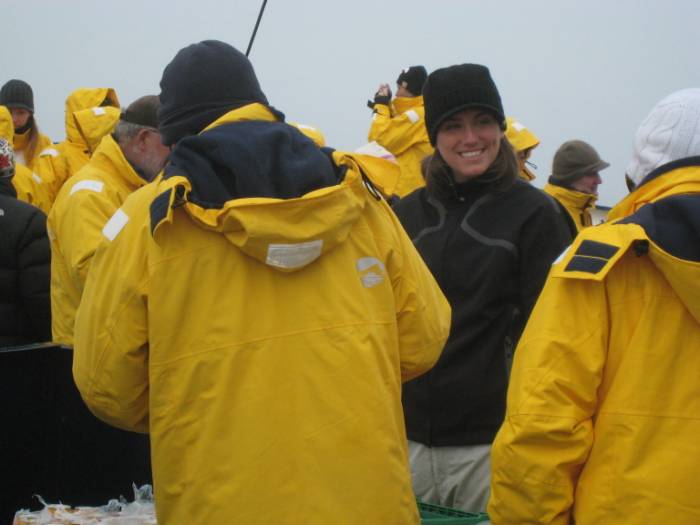
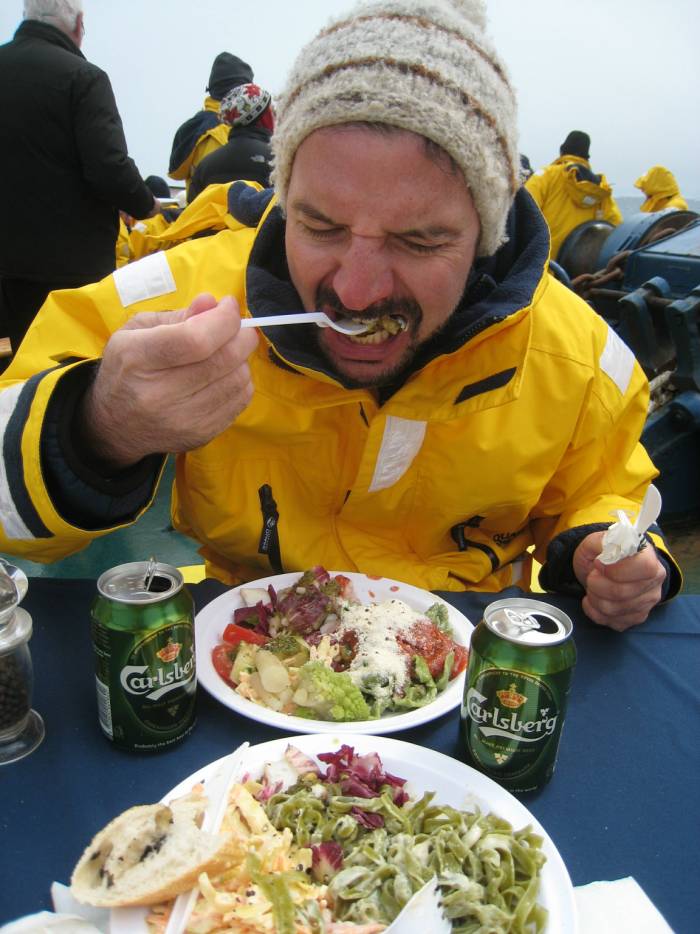
This was our second lunch served on the foredeck. The galley staff put on quite a spread.
We could have asked for the weather go be a bit nicer, but then we WERE in the
As cold as it was, Hanna was still gleefully handing out free cold beer, and of course
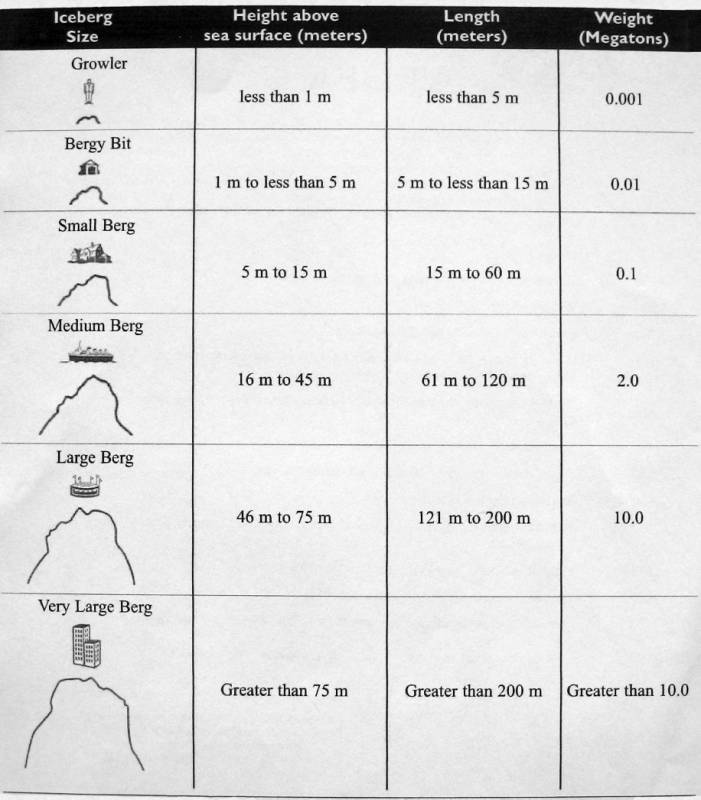
It was almost too cold to enjoy the meal, but hunger and the good comradery drove us on. The back of our schedule for today had a table showing how Icebergs are classified.
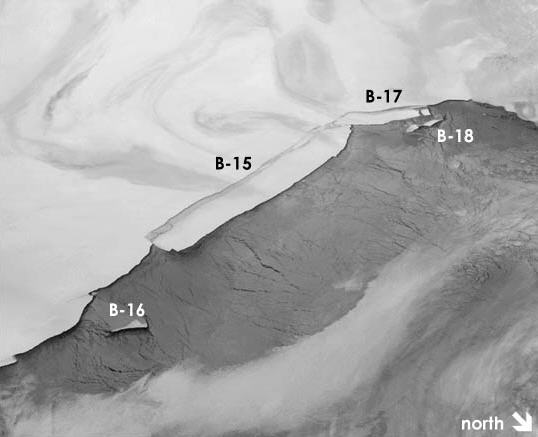
Of course B15, which broke of the Ross Ice Shelf in late March of 2000 is very far off the scale here. It was 170 miles long and 25 miles wide. Its 4,250 square-mile area is nearly as large as the state of Connecticut.
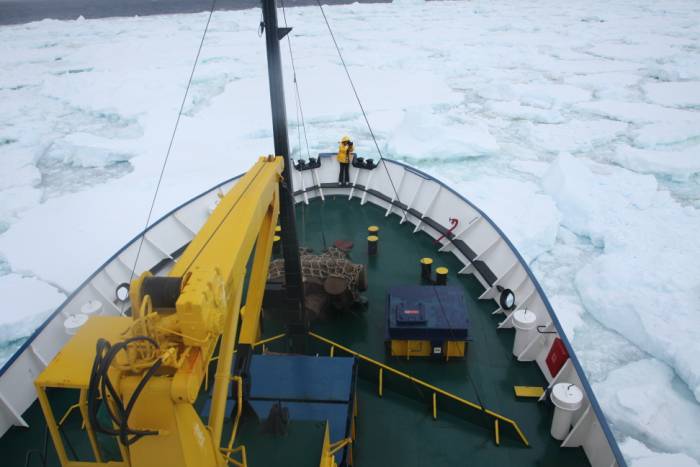
Day 13 Scotia Sea / Shingle Cove This grand show is eternal. It is always sunrise somewhere. The due is never all John Muir Our Russian words of the day: “Kak eta pa Ruski?” — “What is that in Russian?” Unfortunately we hit some pack ice, and after a futile attempt to pass through it, the staff conferred with the captain, and the decision was made to back out and go north around the pack ice, taking us close enough to the South Orkney Islands to at least see them.
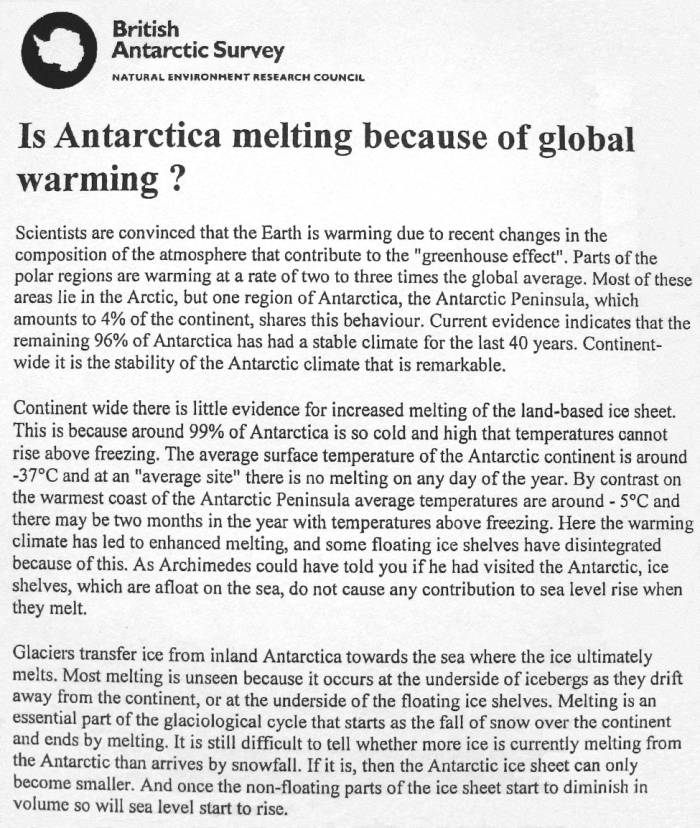
This is the pack ice we encountered on our way to the Antarctic Peninsula. Had the staff In the morning we saw the documentary IMAX Antarctica: An Adventure of a Different Nature, followed by Phil’s talkIce: Glacier and Mountains. As I have already said, Phil was perhaps the most knowledgeable member of the staff, and had a broad range of topics on which he could easily claim expertise. I wish I could have videotaped his lectures. After lunch Tony gave a talk on Birds of the Antarctic Peninsula — from Petrels to Penguins. I’ll have to hand it to Tony; he did know a pile of information about birds. We then had afternoon tea, and then Shanti gave a talk on Exploring The Antarctic Food Web. Day 14 Southern Ocean The first view of Antarctica is always an iceberg. It may be a monolith hovering Mark Jones — Wild Ice Russian word of the day: “Zdrastvutye” — Good day There were more lectures and movies on this, our third day at sea. An interesting and provocative topic of discussion is always global warming. Scientists have varying opinions, as to the politicos and the corporations. An interesting question is, what would happen if the ice in Antarctica were to melt. Antarctica contains 90% of the world’s ice (and 70% of its fresh water). Antarctica is covered with ice an average of 2,133 meters (7,000 feet) thick. It all of the Antarctic ice melted, sea levels around the world would rise 61 meters (200 feet). Could that happen? The article below was on the back of our schedule for this day, and I think it sheds reasonable light on the subject.
So, it appears to me that we have nothing to fear from what is being reported as “Global Warming”. This next article gives a much more plausible explanation of why our climate is changing, than the one that sites man and his industrial pollution as the primary cause. What causes ice-ages? Fluctuations in the amount of insulation (incoming solar radiation) are the most likely cause of large-scale changes in Earth's climate during the Quaternary. In other words, variations in the intensity and timing of heat from the sun are the most likely cause of the glacial/interglacial cycles. The Serbian scientist, Milutin Milankovitch, neatly described this solar variable in 1938. There are three major components of the Earth's orbit about the sun that contribute to changes in our climate. First, the Earth's spin on its axis is wobbly, much like a spinning top that starts to wobble after it slows down. This wobble amounts to a variation of up to 23.5 degrees to either side of the axis. The amount of tilt in the Earth's rotation affects the amount of sunlight striking the different parts of the globe. The greater the tilt, the stronger the difference in seasons (i.e., more tilt equals sharper differences between summer and winter temperatures). The range of motion in the tilt (from left-of-center to right-of-center and back again) takes place over a period of 41,000 years. As a result of a wobble in the Earth's spin, the position of the Earth on its elliptical path changes, relative to the time of year. This phenomenon is called the precession of equinoxes. The cycle of equinox precession takes 23,000 years to complete. In the growth of continental ice sheets, summer temperatures are probably more important than winter. How does the ice build up? Throughout the Quaternary period, high latitude winters have been cold enough to allow snow to accumulate. It is when the summers are cold, (i.e., summers that occur when the sun is at its farthest point in Earth's orbit), that the snows of previous winters do not melt completely. When this process continues for centuries, ice sheets begin to form. Finally, the shape of Earth's orbit also changes. At one extreme, the orbit is more circular, so that each season receives about the same amount of insulation. At the other extreme, the orbital ellipse is stretched longer, exaggerating the differences between seasons. The eccentricity of Earth's orbit also proceeds through a long cycle, which takes 100,000 years. Major glacial events in the Quaternary have coincided when the phases of axial tilt, precession of equinoxes and eccentricity of orbit are all lined up to give the northern hemisphere the least amount of summer insulation. What makes the ice melt when the glaciation is over? Major interglacial periods have occurred when the three factors line up to give the northern hemisphere the greatest amount of summer insulation. The last major convergence of factors giving us maximum summer warmth occurred 11,000 years ago, at the transition between the last glaciation and the current interglacial, the Holocene. During the late Pleistocene, the Rocky Mountain regions of Canada and the regions farther west were almost engulfed in the Cordilleran Ice Sheet, while the Laurentide Ice Sheet covered most of Canada east of the Rockies and the north-central and northeastern United States. The divide between the two ice sheets lay east of the Rockies, with the two ice bodies meeting near the U.S.-Canadian border in eastern Montana. The Laurentide ice sheet is thought to have been as much as two miles thick at the center. Extract from “Ice Age Explanation” ~http://culter.colorado.edu:1030/~saelias/glacier.html I believe we should be more concerned about the next ice age than the melting of the polar ice caps. The changes in the position of the Earth relative to the Sun and the coincidence of events is something that man has no control over. We’re just along for the ride. When, not if, the next ice age appears, it will put an end to all the miniscule sources of man made pollution anyhow, and whoever is around to see this happen will most likely observe that man has done nothing to expedite nor delay the events they are observing. But this is just my humble opinion.
Here we are close to the South Orkneys and you can see that the wind is still coming
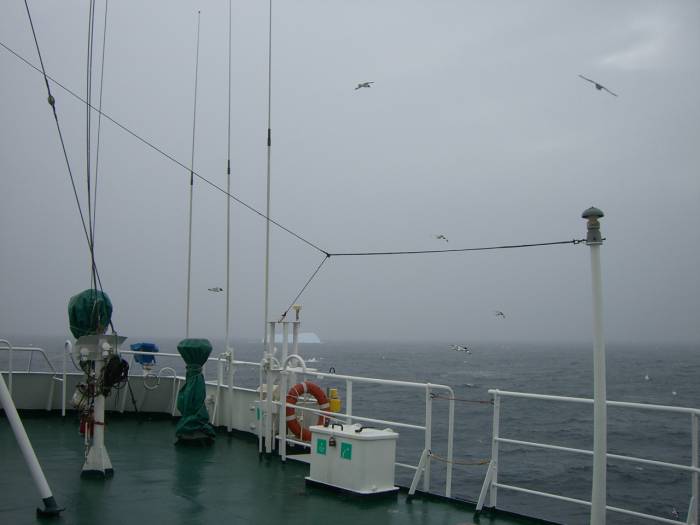
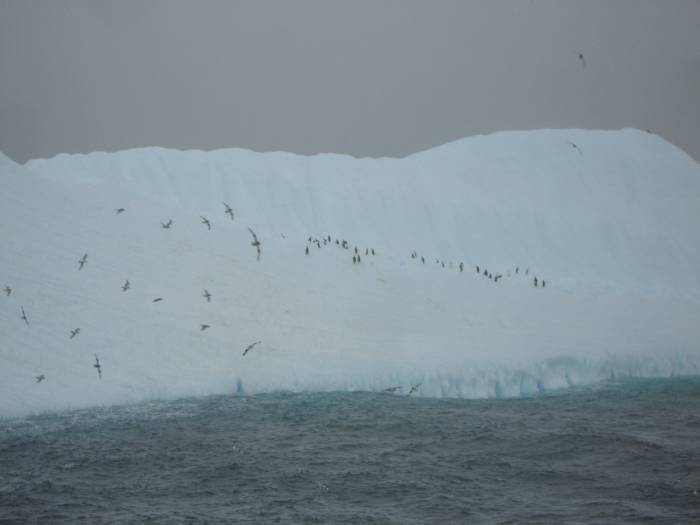
We can tell that we are getting close to land, as we are seeing icebergs and birds.
Both penguins and birds find refuge on this iceberg.
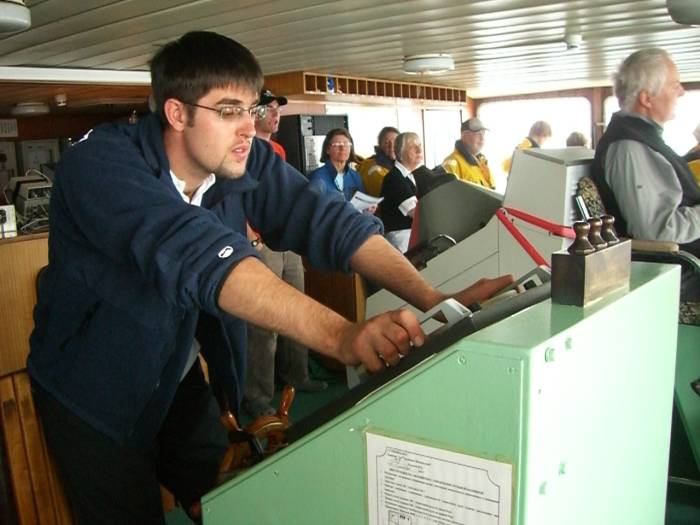
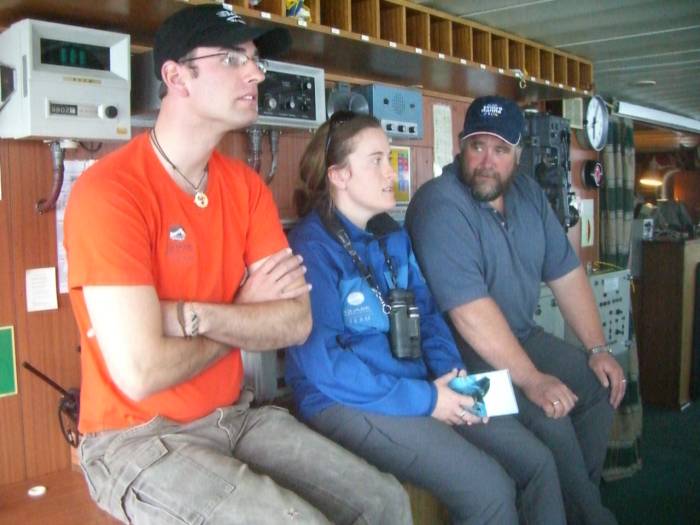
At mealtime, this is our dishwasher. He is now standing watch at the helm.
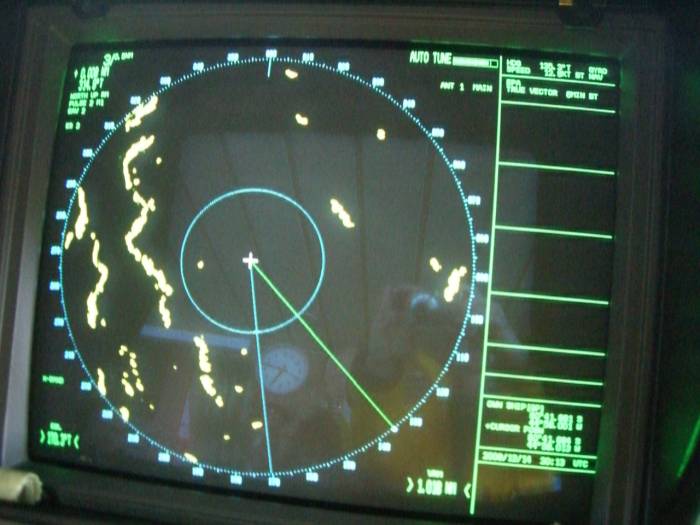
He uses the radar to navigate a safe path through the icebergs which are all around us.
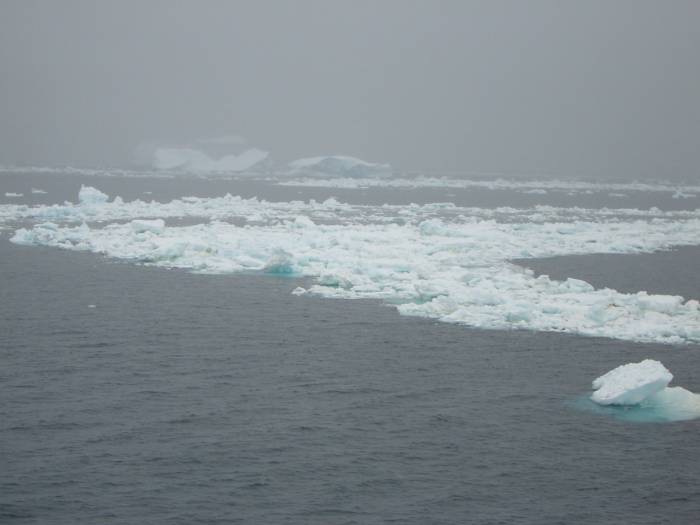
This is the view from up on deck.
The staff, Jamie, Shanti and Shane planning our next move. Here I will end Chapter 7. In the next chapter I will pick up with Day 15, Brown Bluff and Devil Island. |

|
||||
|