 |
|
|
|
|
|
|
|
|
|
|
||||||||
|
||||||||||||||||||
|
Email us at: |
||||||||||||||||||
 |
||||||||||||||||||
 |
 |
|||||||||||||||||
|
Click the sun to see the |
||||||||||||||||||


|
 |
|
|


|
|
|
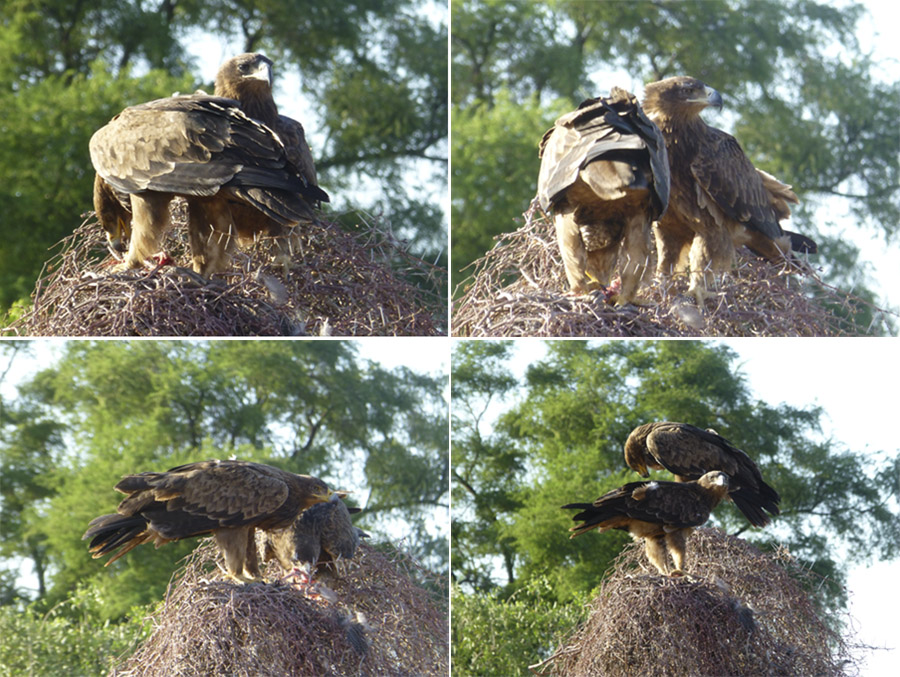
I begin Part 2 with a series of shots Pete got of this pair of eagles enjoying a meal from their most recent kill.
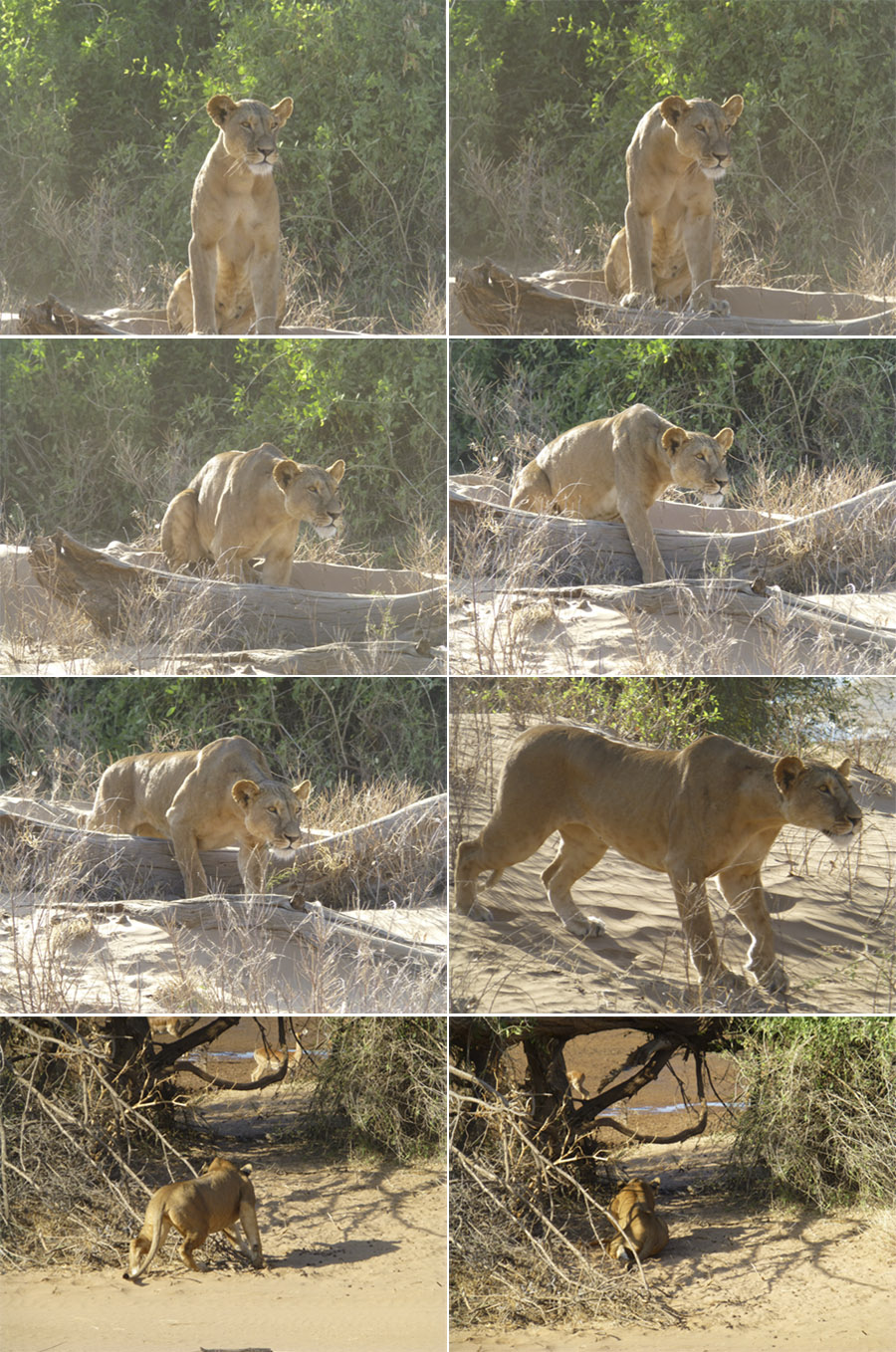
He also got an incredible sequence of shots of this lioness stalking an impala by the river, which did way get away.
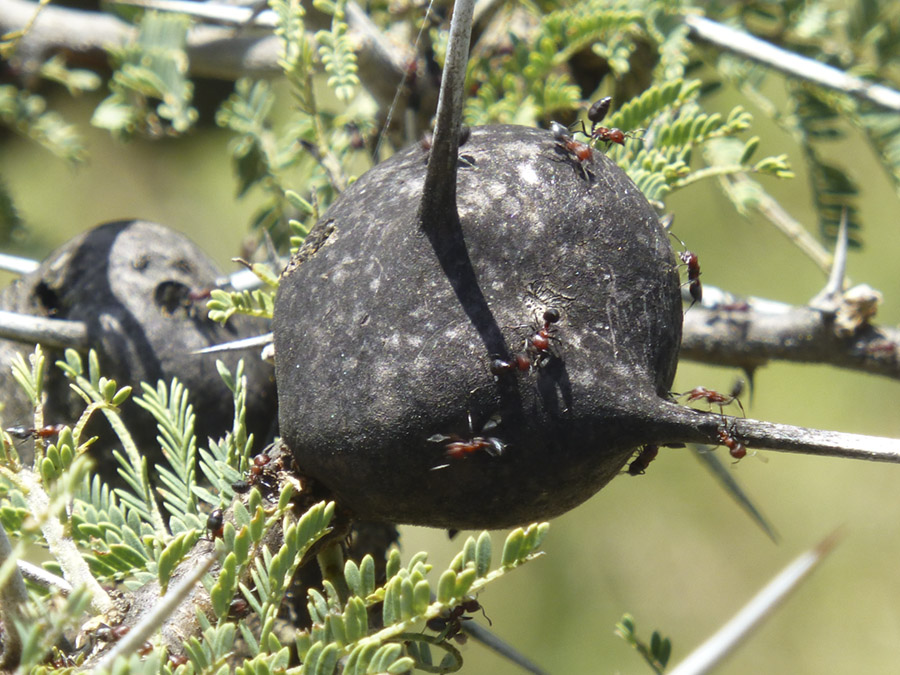
I ended Part 1 with our lunch at the Kicheche Laikipia Camp. After lunch we did a game drive and our guide stopped at a low bush acacia tree to explain about the thorny balls on the plant. The giraffe love the tender green leaves of the acacia tree. Over eons of evolutionary time the tree developed these spiny bulbs to discourage the giraffe from its eating habit. In the end, it really didn’t work, because the giraffe just went for the new soft and tender leaves at the top of the tree. This accounts for the flat top appearance of many of the acacia trees on the African savanna.
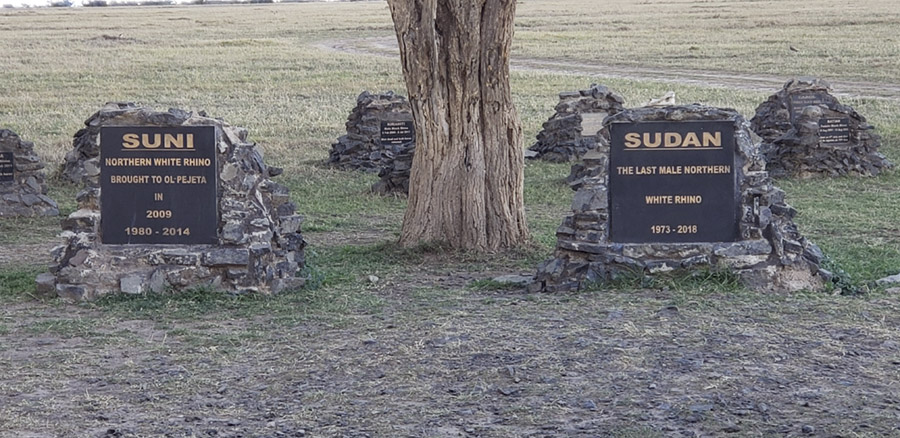
The bulbous thorns are occupied by stinging ants. The ants bore two holes in the gourd-like bulbs and hollow them out for living quarters. They lay their larva inside, and the soft spongy meat inside is a perfect food for the larva. Old thorns which have been vacated by the ants make a whistling sound as the wind blows across the entrance hole. Hence the name Whistling Thorn Bush. When our guide touched the bush, ants came pouring out of the thorny bulbs ready to fight off whatever creature was attacking them. We visited the Northern White Rhino & Grevy Zebra endangered species enclosure in Ol Pejeta. There was a northern white rhino cemetery where the last male northern white rhino, SUDAN, was buried. They have frozen his sperm and are attempting to get one or both of the two existing female northern white rhinos pregnant.
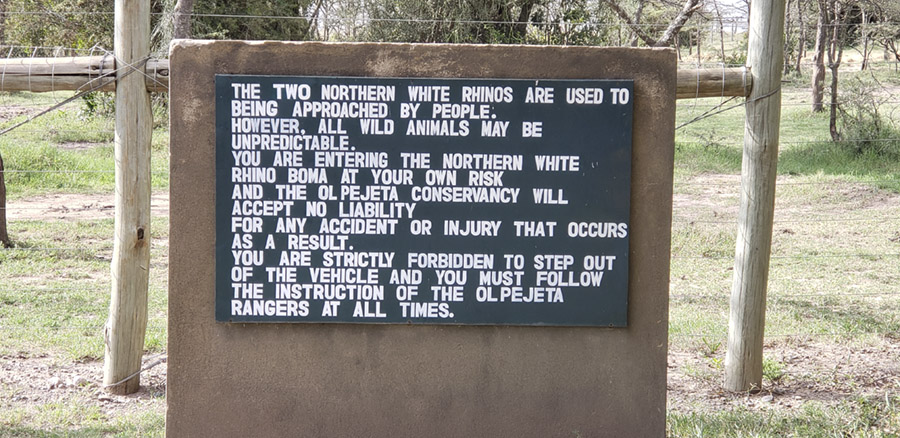
It is evidently more difficult than it sounds, or they would have accomplished it already. It sounds like they only have one shot at it, and if they blow it, the species is gone forever. They are also considering cloning as an option. The sign as we entered the white rhinos enclosure made it quite clear that if we were injured or killed, it was totally on us. The Ol Pejeta Conservancy was in no way responsible.
When we saw how huge the white rhinos were, it was easy see how easy it would be for them to overturn our vehicle and rip us limb from limb. I was thankful that they were in a more subdued mood during our visit.
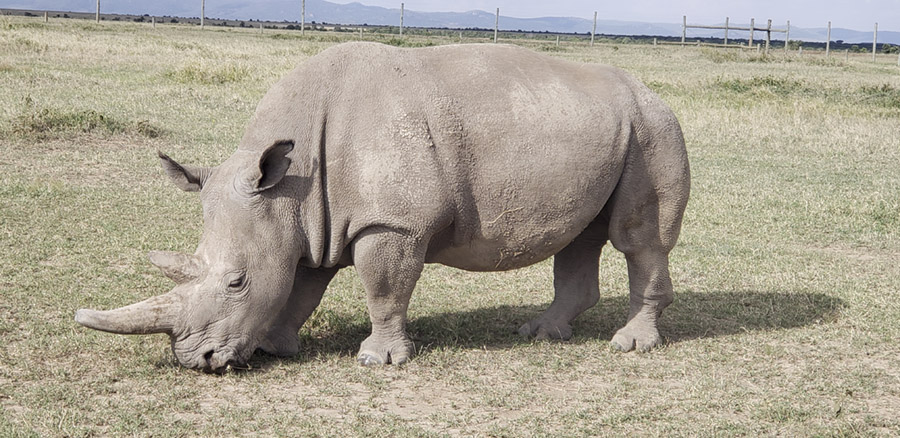
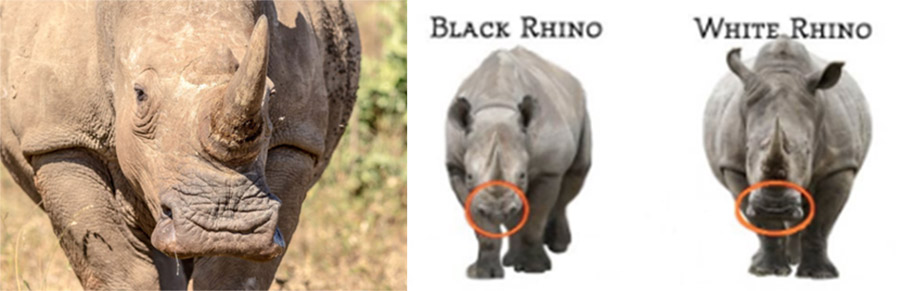
This is one of the two remaining female Northern White Rhinos in existence. Can you imagine the difficulty one might encounter trying to artificially inseminate this huge creature? I’m really happy that I chose a different profession. It’s rather strange how the name “white rhino” came about. There is no actual documented explanation, but there are plenty of theories. The white rhino, or “wide lipped” rhino is the largest of the species, weighing it as a hefty 2300 kg (5,060 pounds), while the black rhino is a mere 1,400 kg (3,080 pounds).
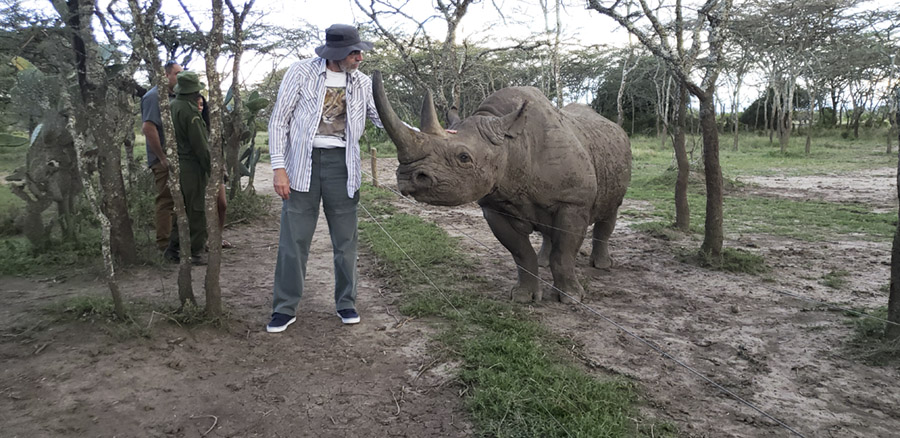
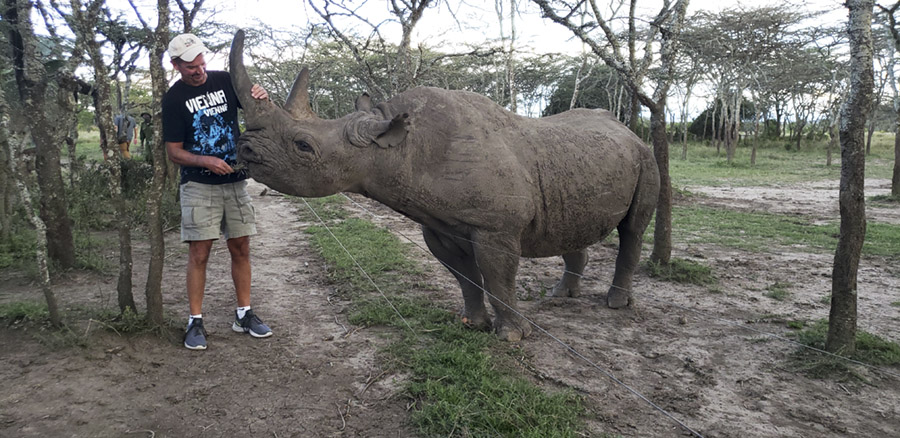
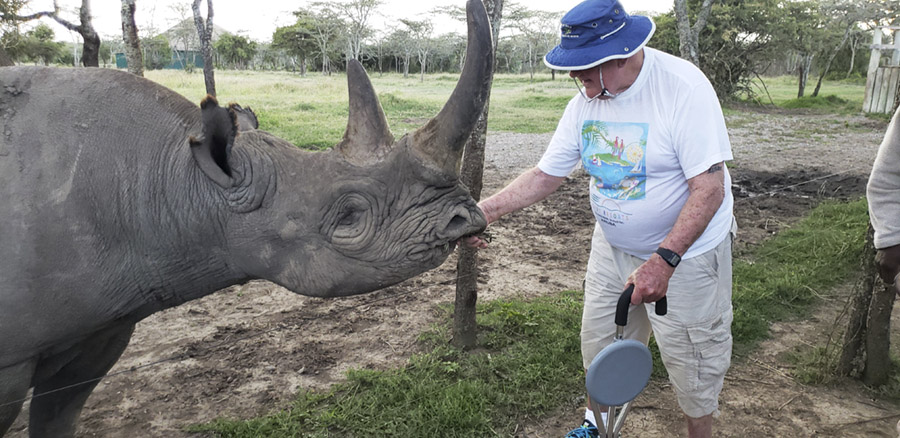
Note the wide mouth of the white rhino, excellent for grazing on the ground hugging grasses that abound in its habitat. On the other hand, the black rhinos mouth is more adept at eating the leaves from low shrubs, hence it is a browser. The white rhino is a grazer. In another part of the Ol Pejeta Conservancy we visited a very friendly black rhino. I don’t see how the few strands of wire could possibly keep him from us tourists, but he seemed to respect it. Charlie was courageous enough to actually pet him on the top of his head.
Pete and I were given some of his favorite food to feed him.
He was very gentle when nibbling the succulent branches from our hands. Having seen how gentle he was with the others, I had no fear of him. What an amazing creature!
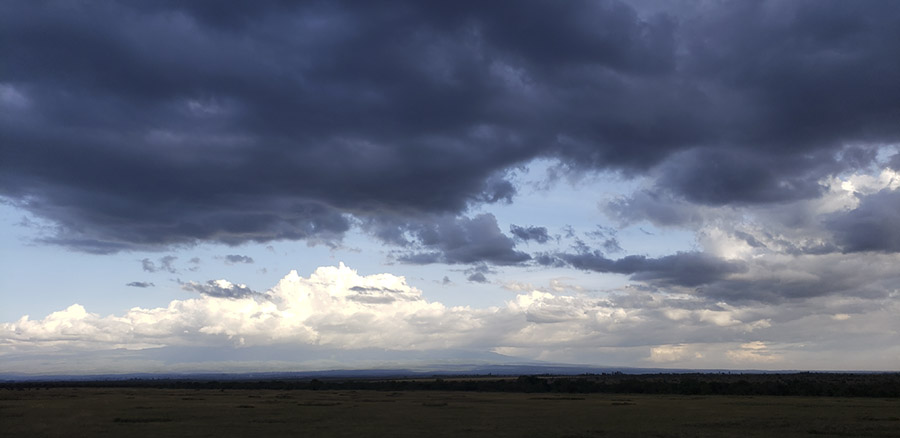
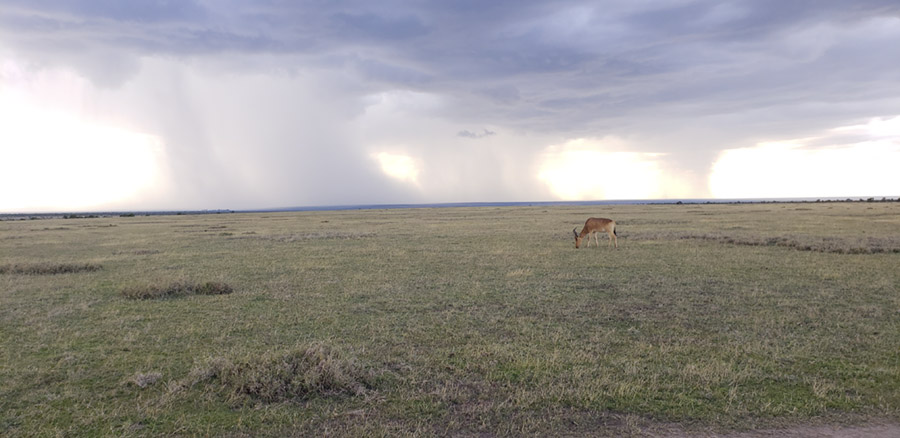
The weather seems to be turning, and a storm is on its way.
In the distance we can see literally thousands of gallons of water dropping from the sky. Our guide said that the rain if falling on our camp, which lies in that direction. We saw the results when we got back to camp, as the roads were barely passable, and the streams quite changed.
I took a panoramic photo with my Samsung Galaxy S9+. This phone can do so much, and I only know a few things. My grandson Jon has a Samsung Galaxy, and he is an expert at all the tricks it can perform. His showing me what a great phone it was is what prompted me buy one for myself.
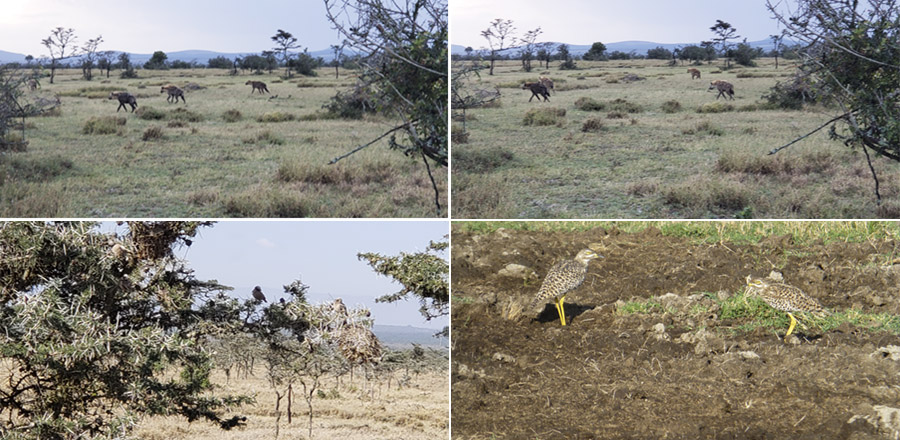
Kenya is so vast, and quite flat. Our driver/guides thought nothing about going off-road any time they saw something that they thought would be of interest to us. On this drive we came upon a large pack of hyenas, all headed purposefully in one direction.
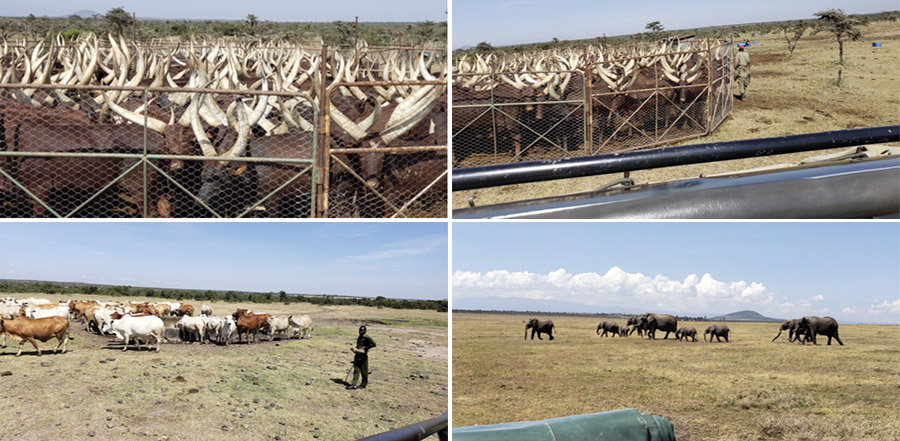
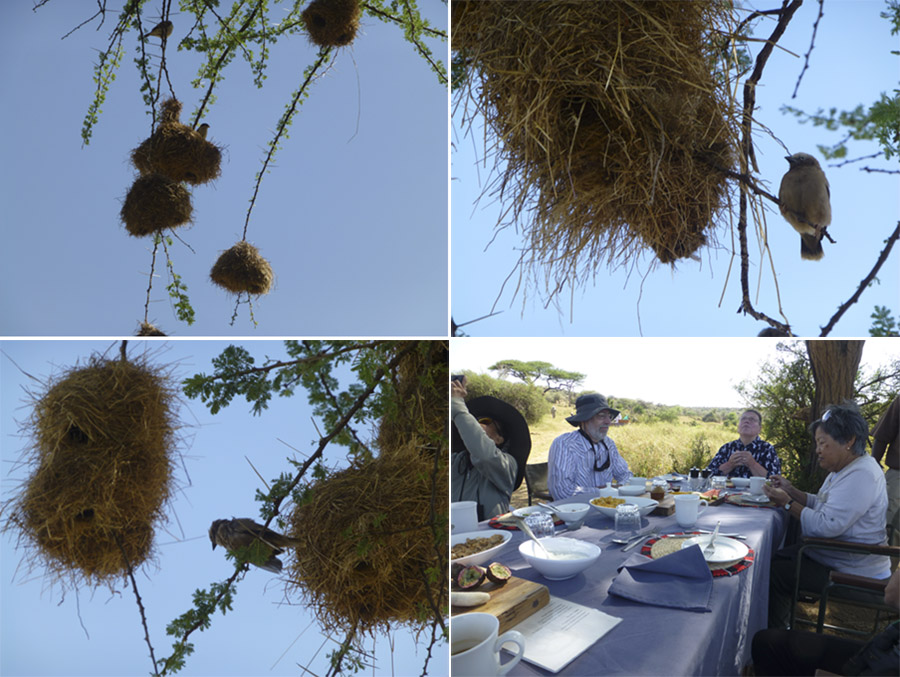
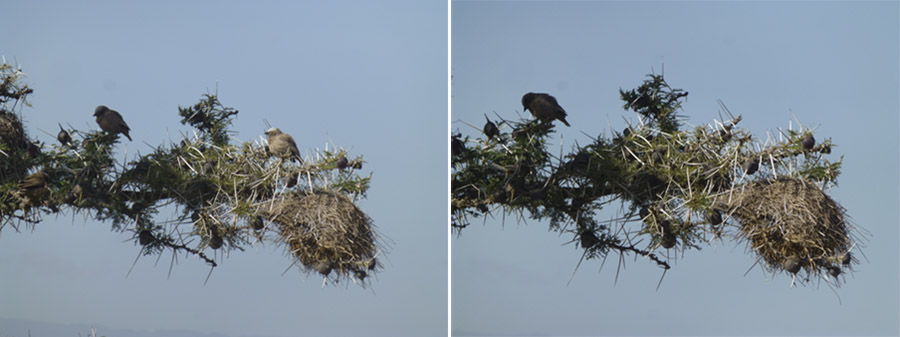
This acacia tree is full of weaver bird nest, and weaver birds. If it wasn’t for their bright yellow legs, you would not have seen these two birds. Their feathers blend in so well with the surroundings. Squat little birdies, hide those bright yellow legs. This corral of long horned steers looked positively freakish. I’ve never before seen steers like these.
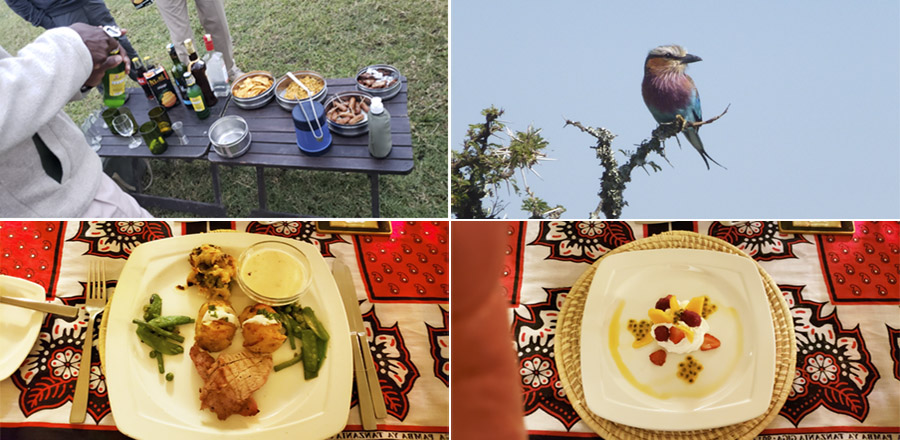
Even the regular cattle looked so out of place in this land that had such magnificent beasts, like the African elephant. It was getting late so we stopped for a “sundowner”. Pete got a great shot of this little bird in an acacia tree.
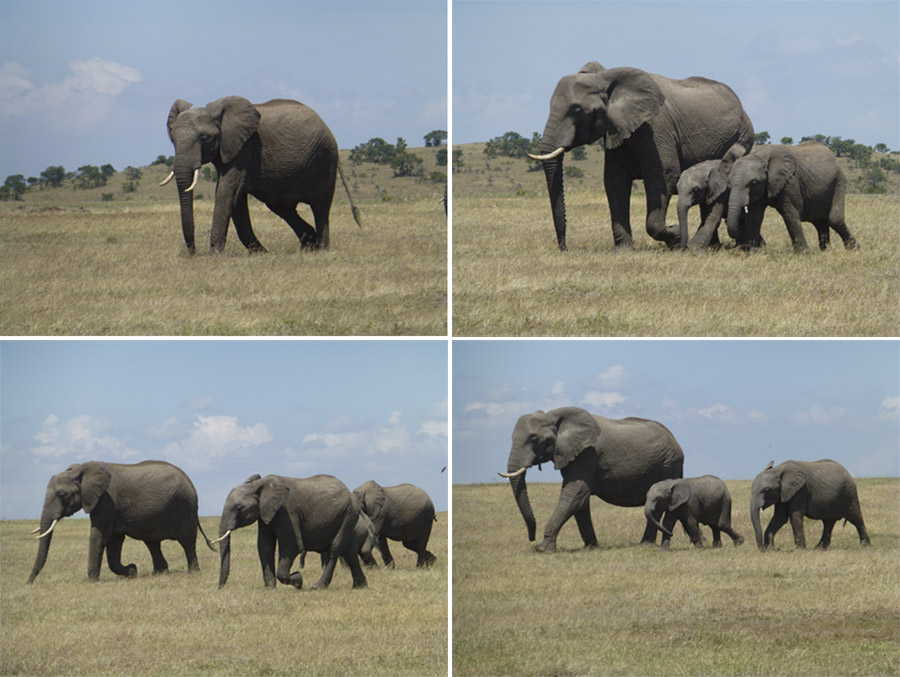
And back at camp, dinner was a few cuts above our sundowner fare. Our hosts obviously take great pride in our meals. The next day we did another animal drive, and followed this group of elephants roamed across the savanna.
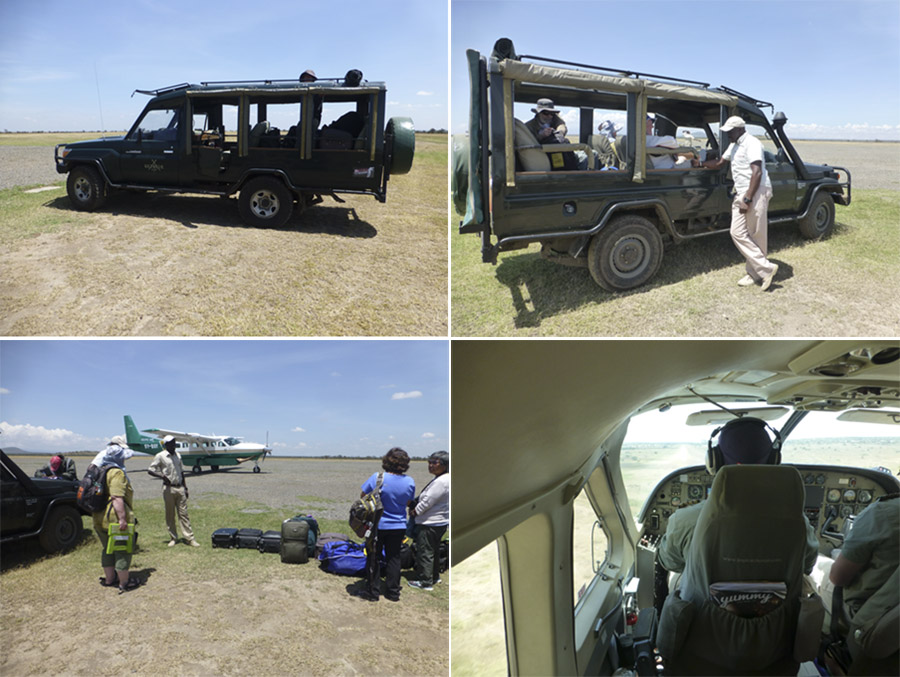
They were obviously very protective of the baby elephants. The more familiar I became with the elephants the more I realized how caring and protective they were of each other. Remarkably intelligent creatures. We arrive at the Nanyuki airport and patiently await the arrival of our plane. While we are waiting one of the airport staff takes a motorbike out on the runway to chase off the game that was resting there.
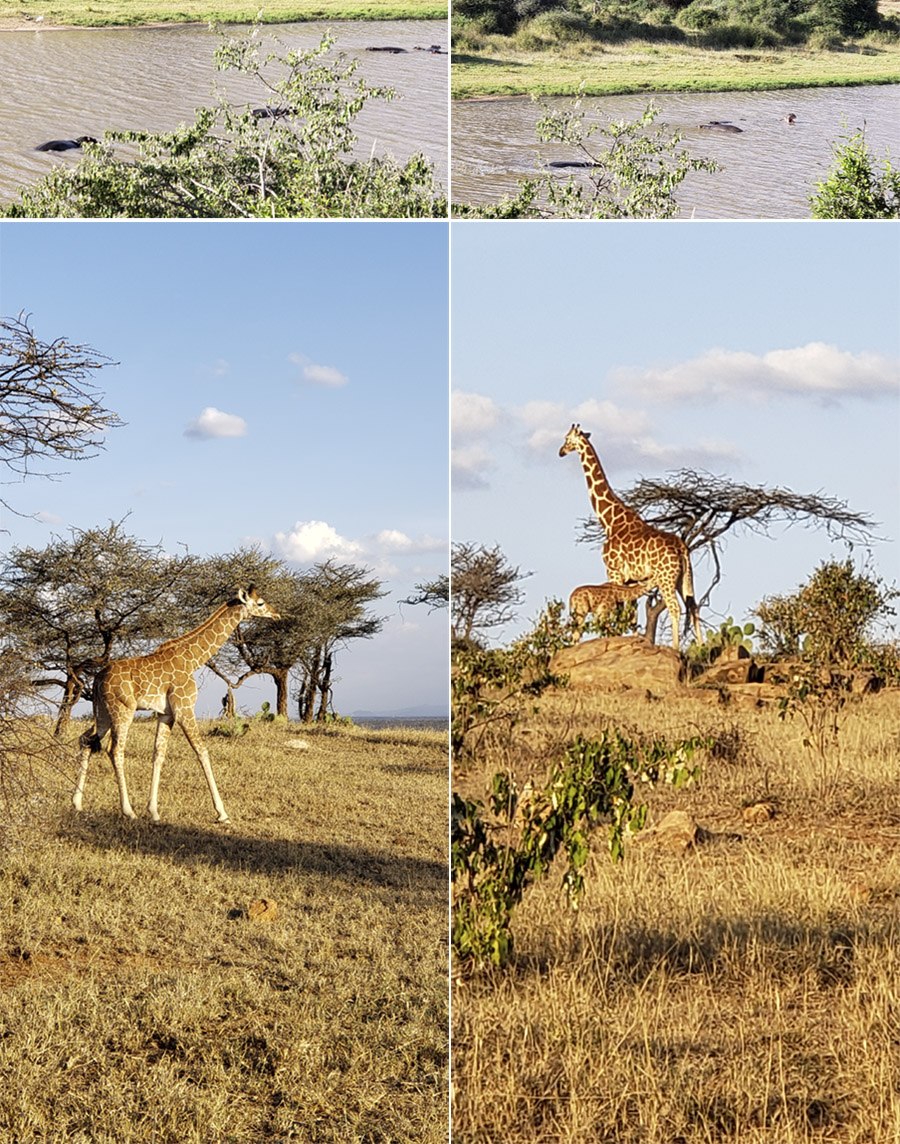
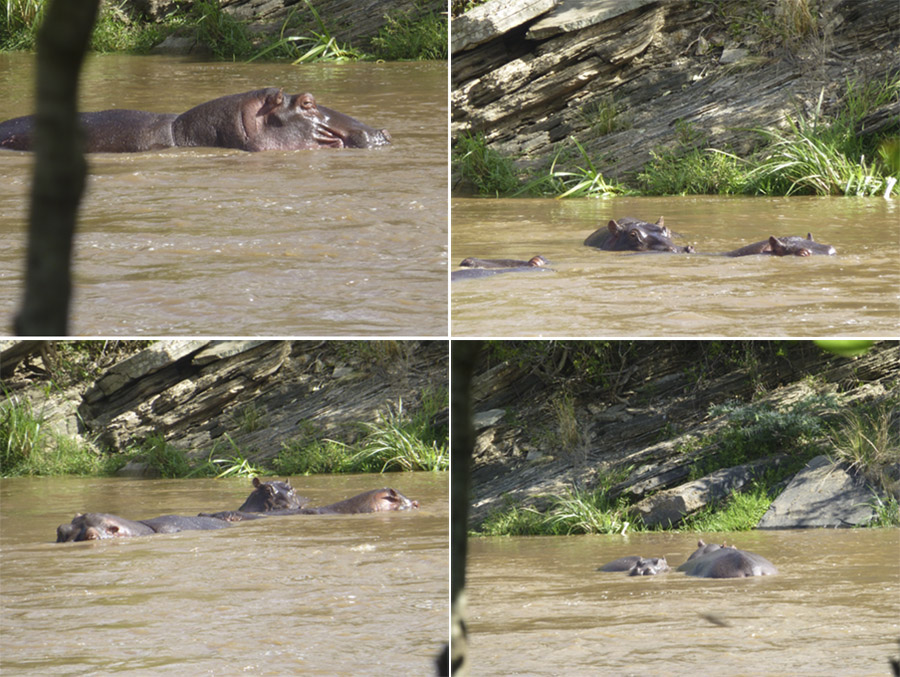
The plane arrives, and we fly to Loisaba, where we will enjoy the Starbeds. Loisaba Starbeds Camp is located on the bank of a large river that is teaming with hippopotami, and at night they come ashore. You can hear them grunting and roaring throughout the night They even come ashore on our side of the river.
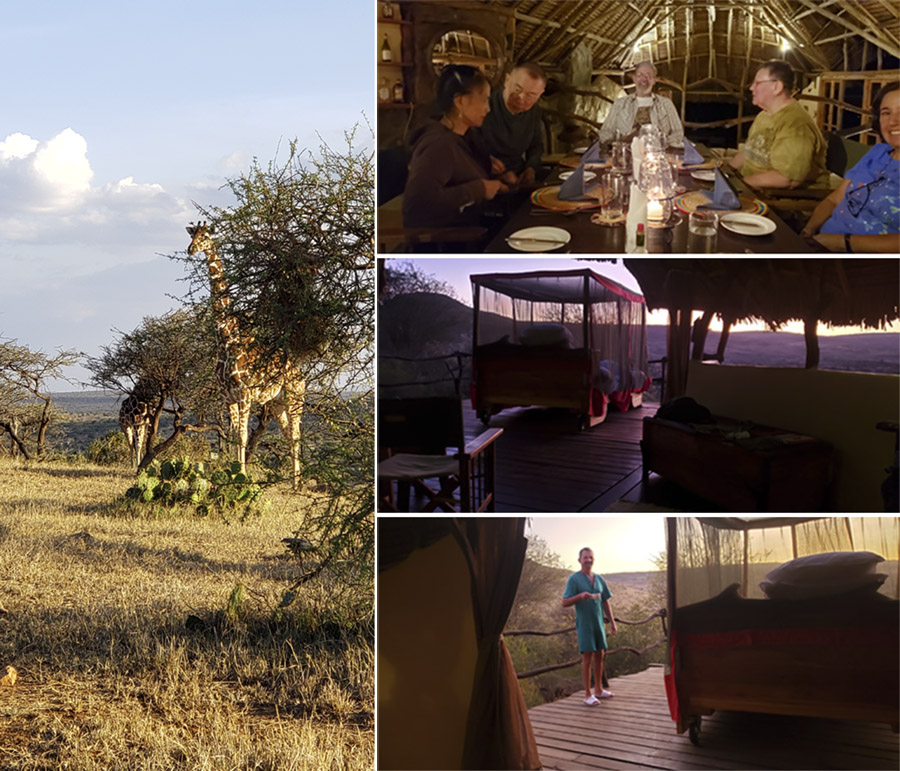
We came upon this baby giraffe, and while we were watching him, mama & papa were intently watching over him. He is so young that he is still nursing. You can see how attentive mama was in the first frame below. In camp, we were ready for dinner. Especially me, because it was a long and tiring day, and I was really looking forward to my first night in the Starbed. Christine had scheduled our stay here for the night of a new moon, so when the sun set, all we could see were a heaven full of glowing orbs of light, and of course, an amazing view of the Milky Way.
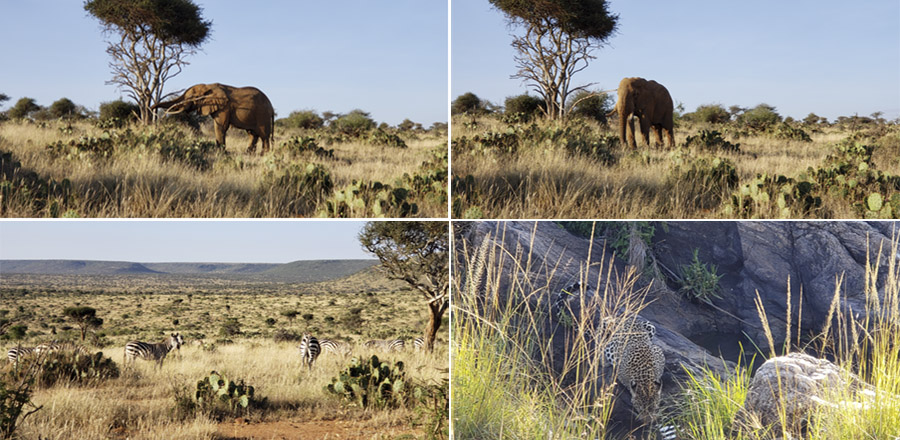
Reveille was at 6 AM, and the sun wasn’t even up yet. Mercifully they brought us a tray with hot coffee and a few cookies. We needed the mosquito netting over the bed, but it didn’t really obstruct the view of the stars all that much. As tired as I was I just lay there, eyes wide open, taking in the awe inspiring view. I don’t even remember falling asleep. Before breakfast we were off on a morning drive. I was surprised to see this elephant awake and active. And even the zebras were happily grazing already. The sun was barely up.
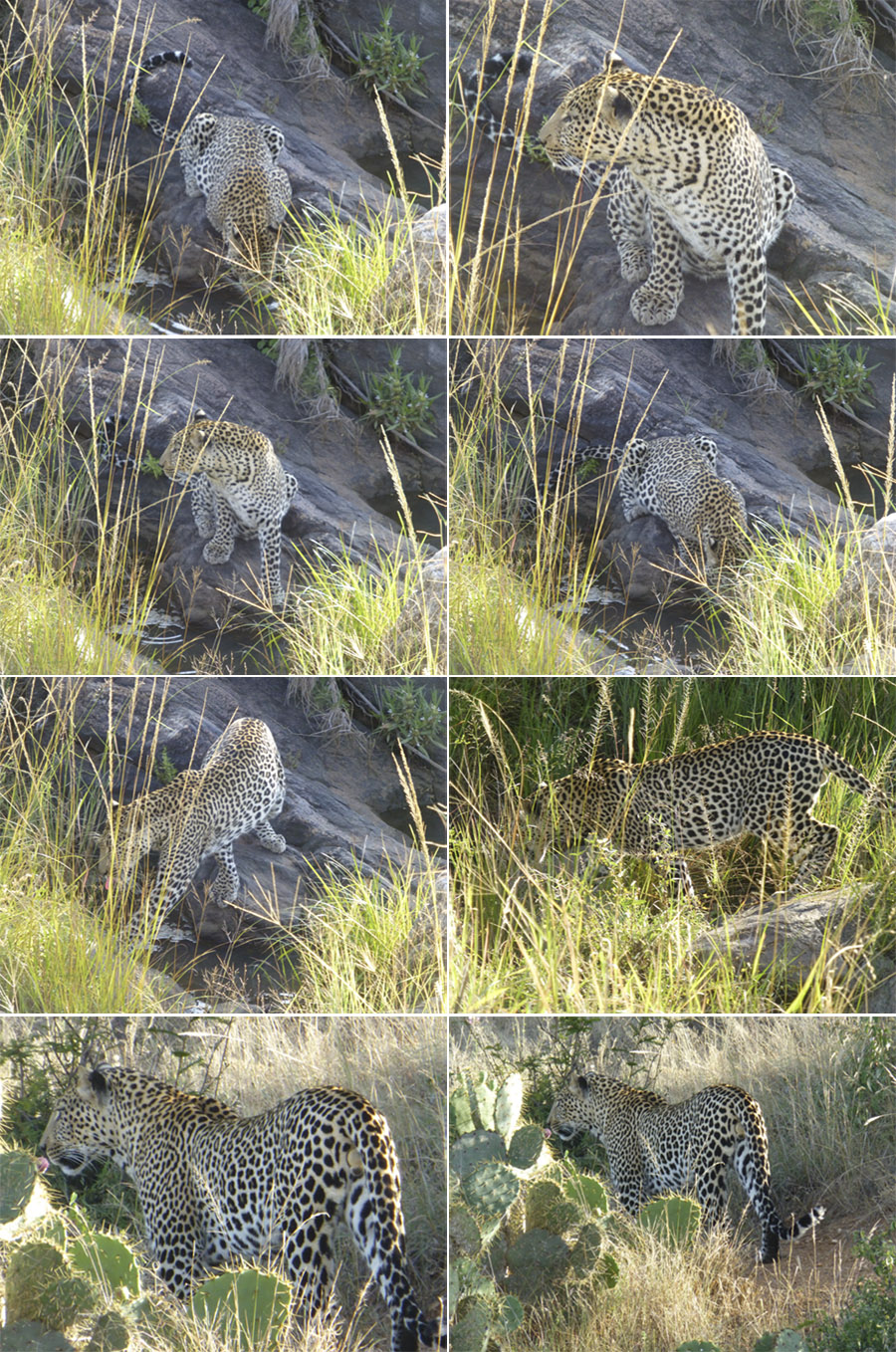
We happened to come upon this beautiful leopard getting a drink at the spring. He was very cautious, but was not concerned by our vehicle. He came up for a breath, and a quick look around, then went back to drinking.
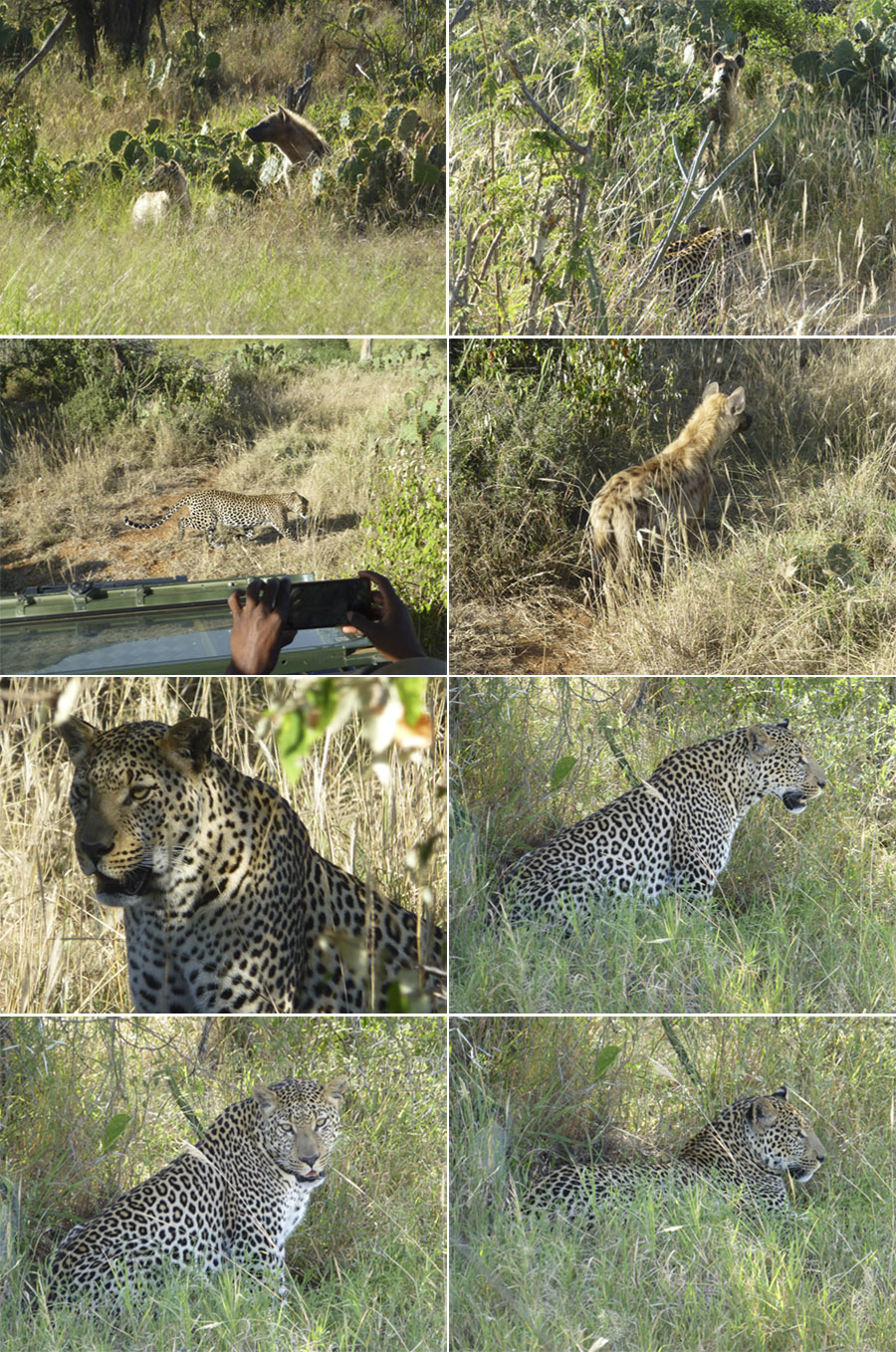
When he’d had enough, he turned and wandered off. What a beautiful animal he was. I just wanted to scratch his chin. He did not go unnoticed by the neighborhood hyenas. They stared each other down, but neither made an aggressive move. He walked directly in from of our vehicle. The hyenas were on high alert, ready to bolt at the slightest threat from him.
He finally found a nice plush area to lay down in and rest, maybe even take a nap.
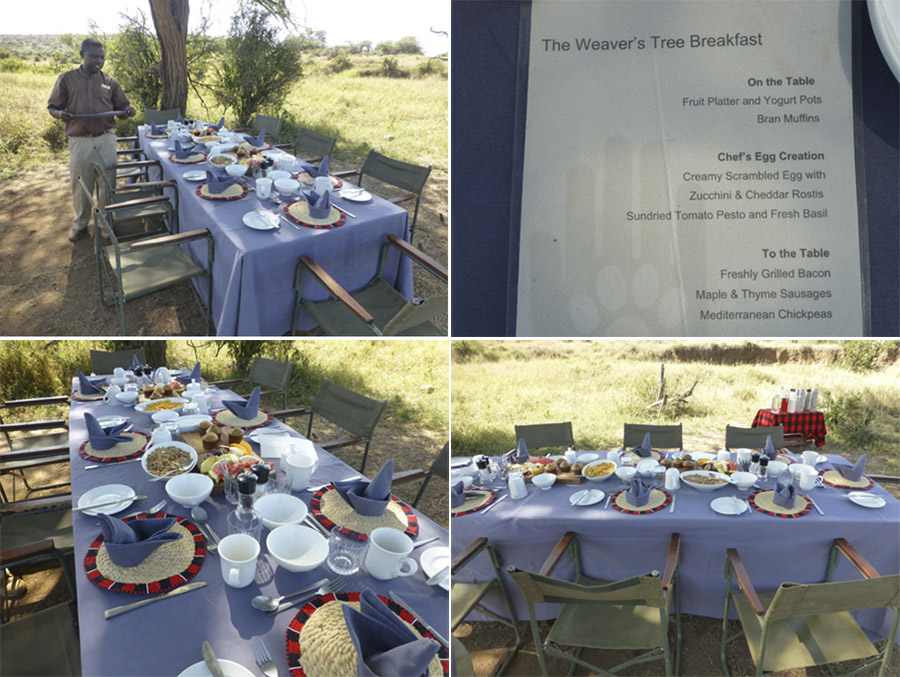
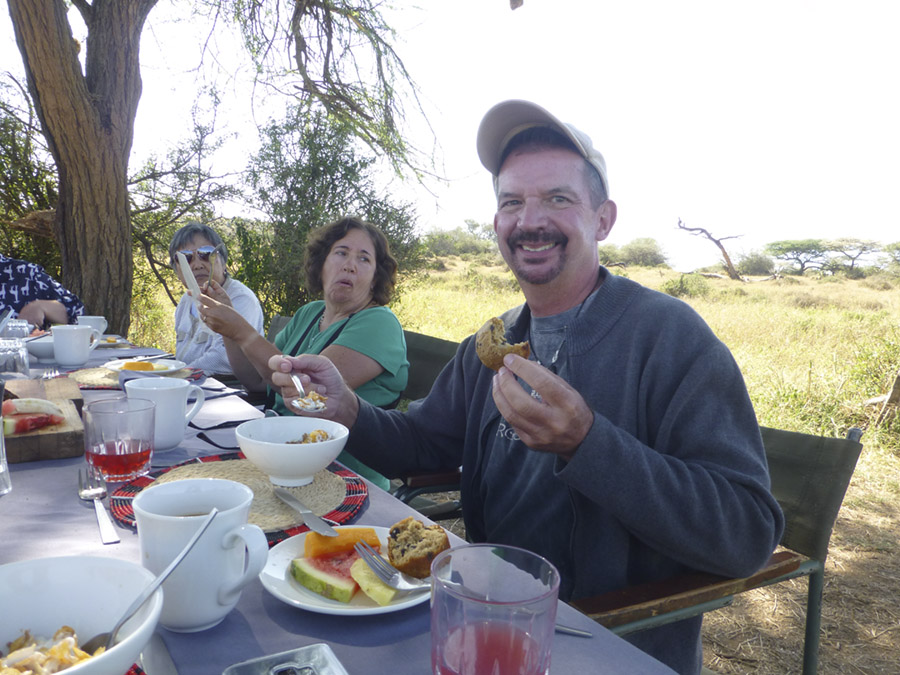
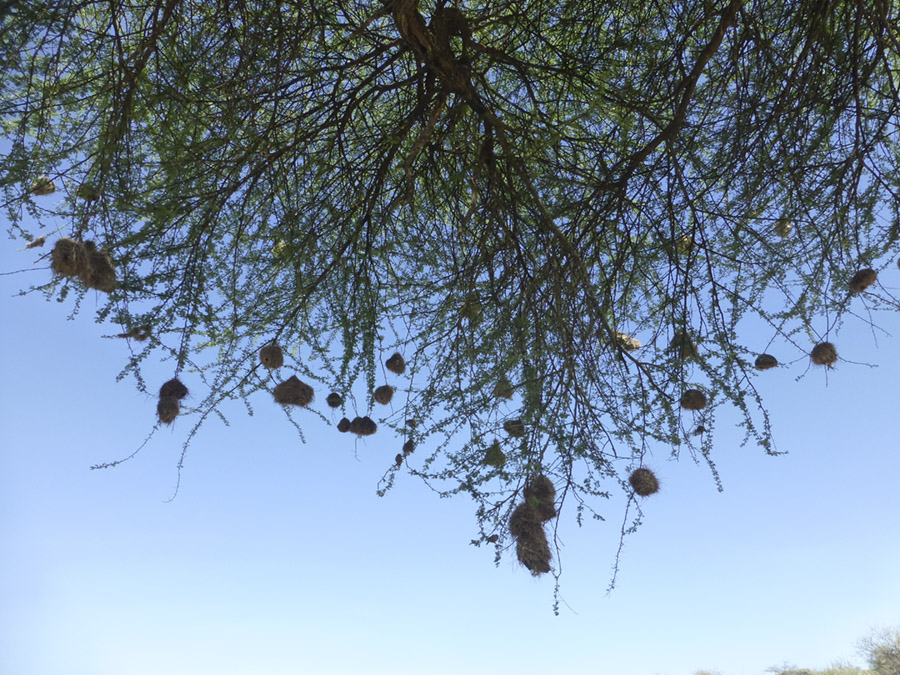
It is now 9:00 AM and our guides have set up a table for our breakfast in the wild. It was under a huge acacia tree that was full of weaver bird nests, and weaver birds. Pete was enjoying his blueberry muffin and cereal. You’d never know we were out in the middle of the African bush.
Our breakfast table was set up directly in the shade of the acacia tree. You’d think that bird dropping might pose a problem, but I don’t remember seeing any birdie poo anywhere on the table. These were very respectful weaver birds indeed.
And there were a lot of nests up there.
If you want to see something really interesting, Google Weaver bird nest and watch a weaver bird actually build a nest from scratch, or copy this link into your browser: https://www.youtube.com/watch?v=qbWM1QAVGzs Enjoy!
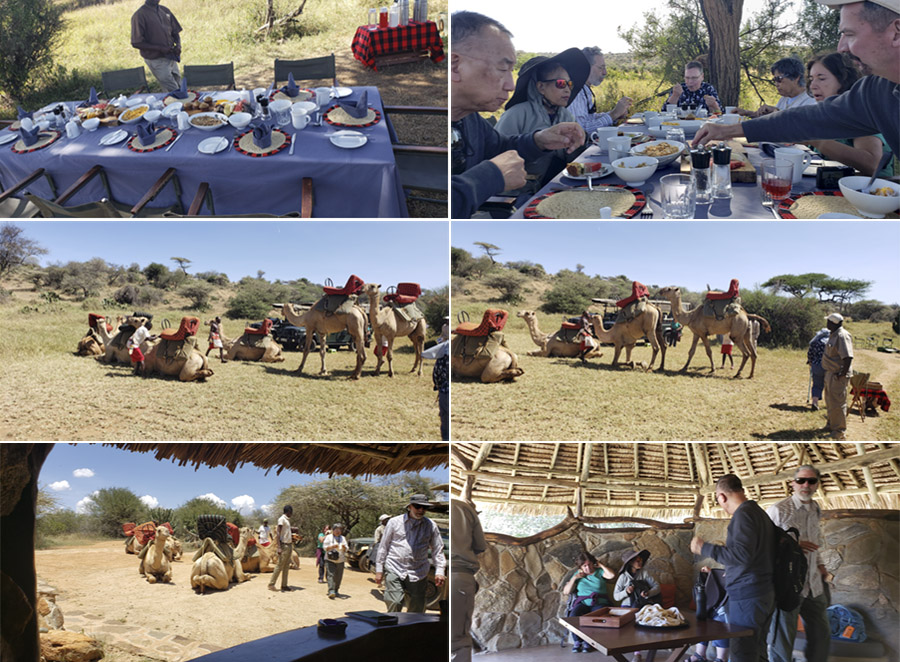
The breakfast was actually pretty good, or was it that I was just starving? Everyone dug in with gusto.
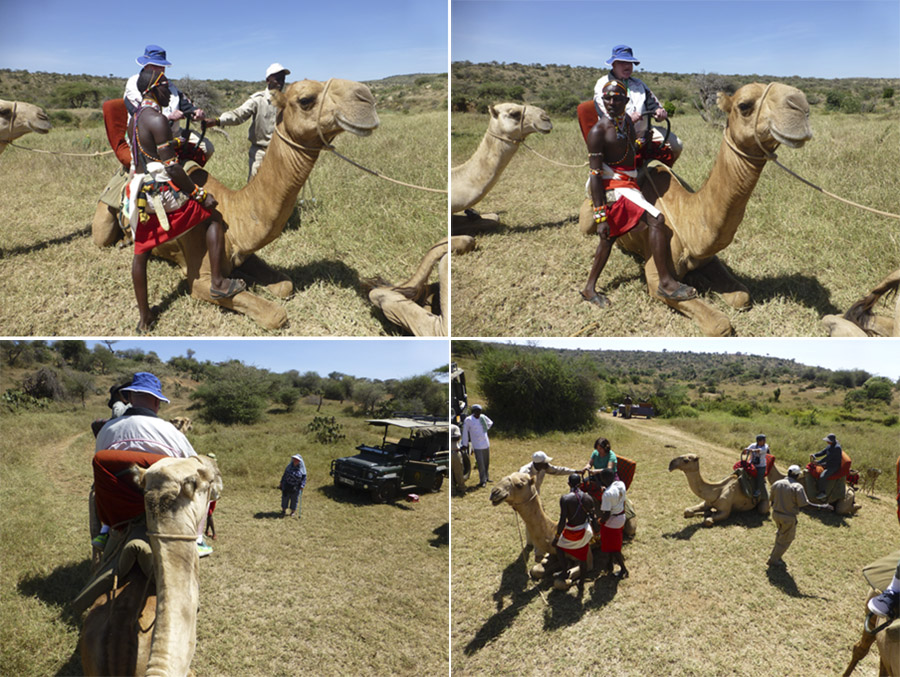
After breakfast we were “treated” to a camel ride back to camp. I mounted my steed like any other greenhorn, not knowing what to expect next. The camel was still sitting on the ground.
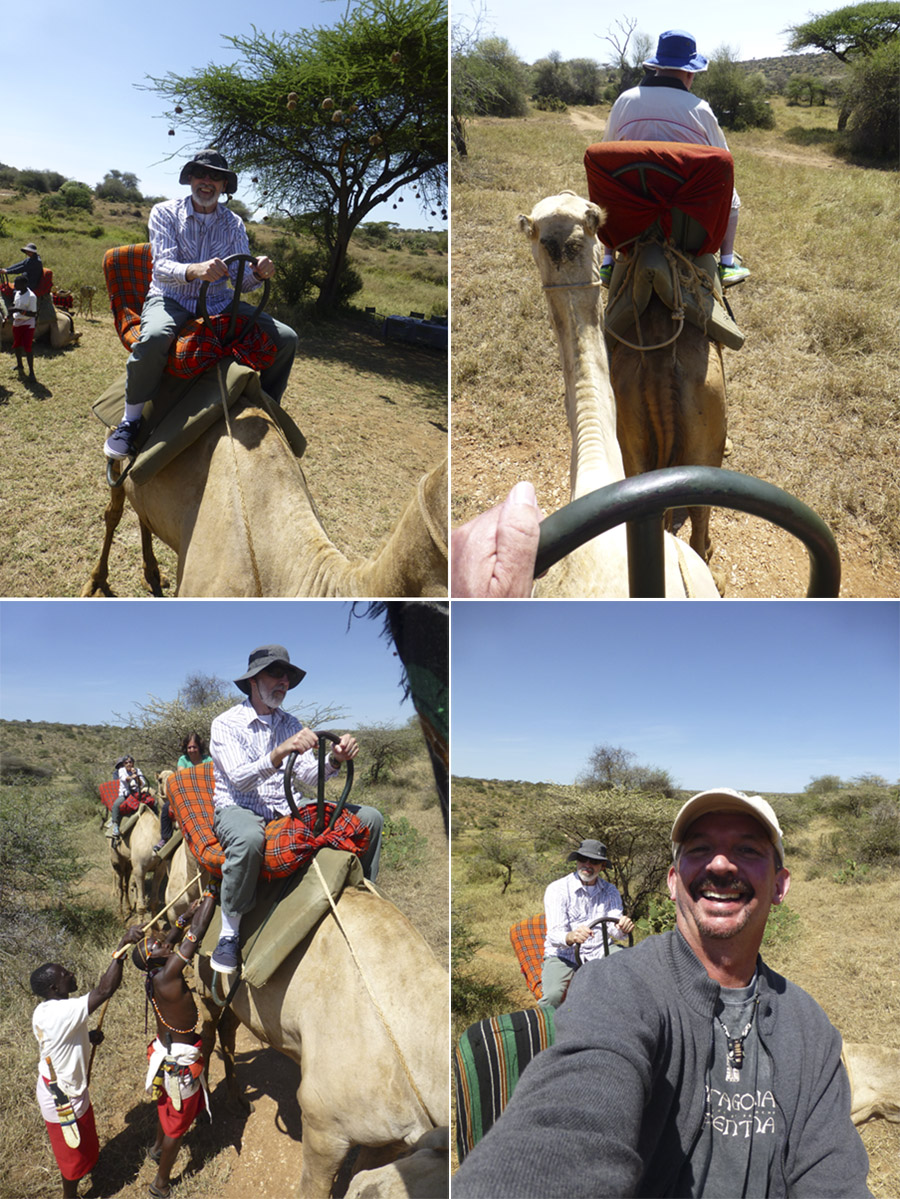
My camel driver told me to hold tight as he took his foot off the brake (the camel’s upper fore leg, (frames 1 & 2 above). First I lurched forward as his rear legs unfolded. Then I was thrown backwards as his front legs straightened out. Once he was up on all fours things settled down. Then he started walking, and I had to move with his body to keep from being ejected from my seat. Boy, I can see why these things never took over the transportation industry. Half way into the ride I realized why there were only seven camels, and Christine was riding back to camp in one of the vehicles. Having done this before, there is obviously no earthly reason why she would want to do it again. Smart girl. I didn’t get a single photo on the ride because I was too busy holding on for dear life. I think I was riding the clumsy oaf of the bunch because he kept tripping over some irregularity in the path, and would stumble and have to catch himself before he tumbled to the ground, and several times I thought I was going to be dumped by this crazy camel. Fortunately, Pete was able to take some photos on the ride.
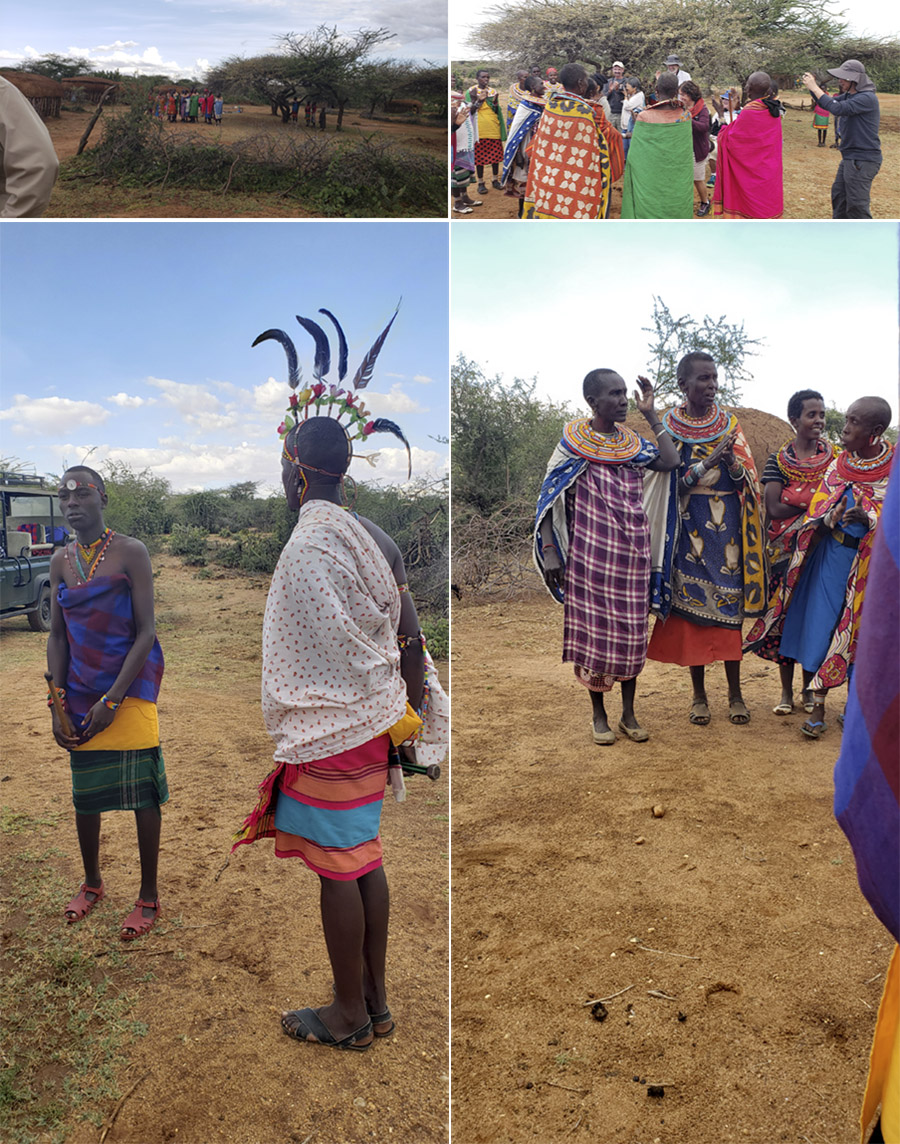
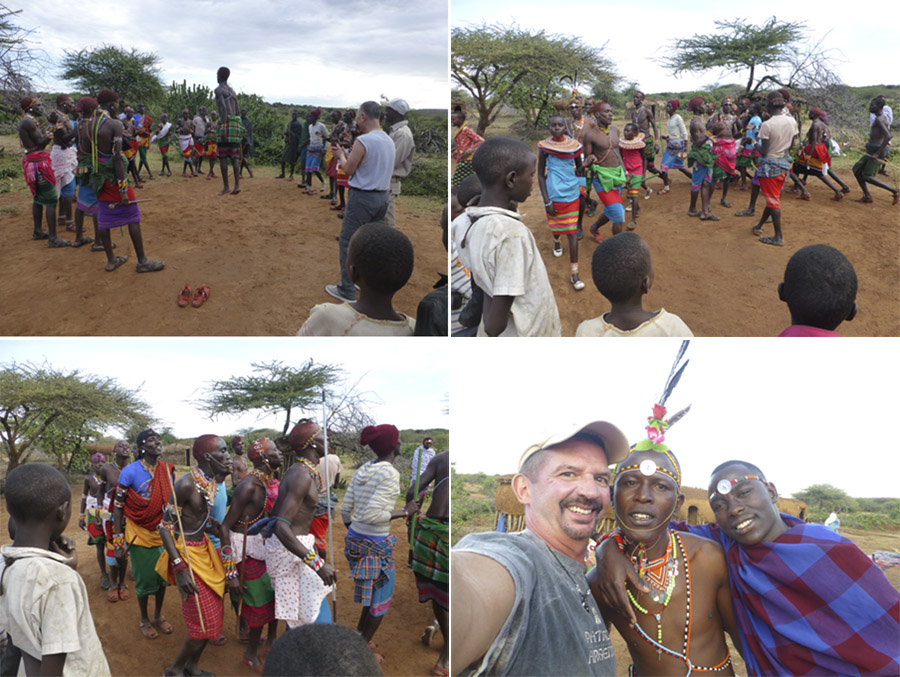
It looked like Charlie’s saddle was coming loose. Pete smiles as he takes a selfie. You just have to flow with the experience. The next day we visit a Masai, or Samburu village. These people love to sing and dance. They put on quite a show for us, and pulled many of us into the dancing as well.
Have you ever seen such colorful clothing? And I thought the feathered head dress was over the top. Fortunately I was able to sit on my cane and just observe the festivities.
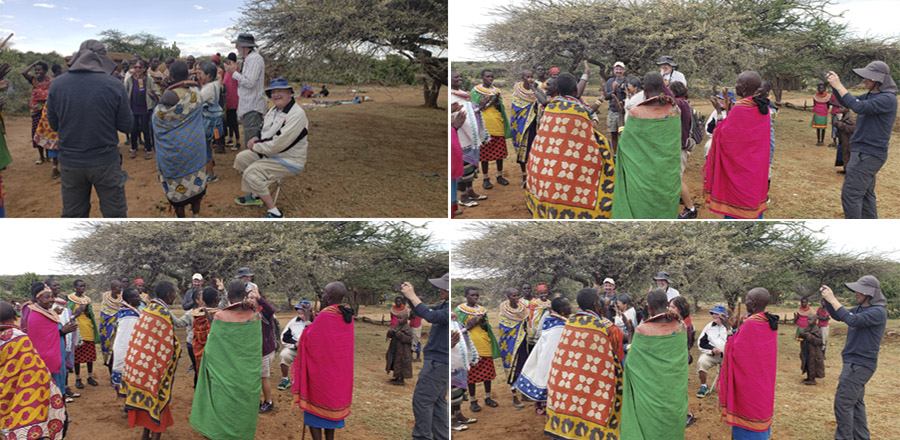
The young warriors did a special dance, part of which involved jumping high into the air, twice (see frame one below). After he did this double jump, he did it a second time and all the worriers in the circle would do the same with him. In hind sight I wished I had taken a short video, as it was quite impressive.
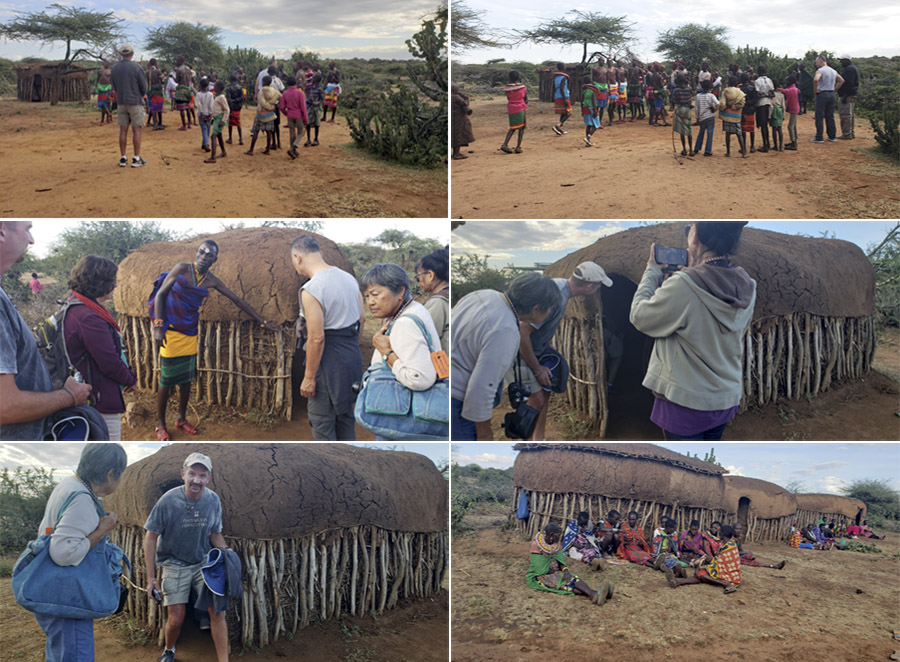
I was glad we came to this village. It was quite an experience seeing how these people lived. No traffic lights in this village.
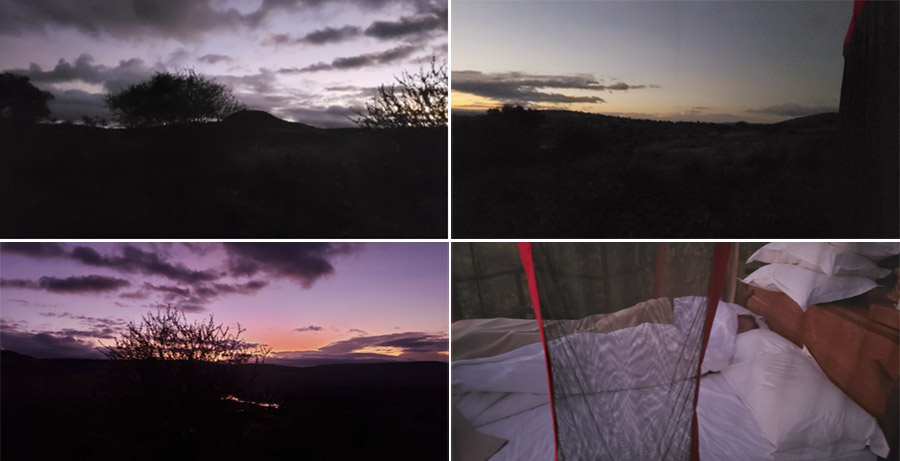
We were invited to see the inside of their huts. The ceiling was very low, so there was no way I was going to be able to manage that. Pete did go inside, and he said they had a fire going, and there was no place for the smoke to escape, so it was very smoky. I was glad I missed that. After a good nights sleep I rise early, as the sun was inching its way towards dawn, to take a few photos. Pete was still snuggled down and warm. A tray of coffee and cookies was delivered to us, which was a most welcome treat.
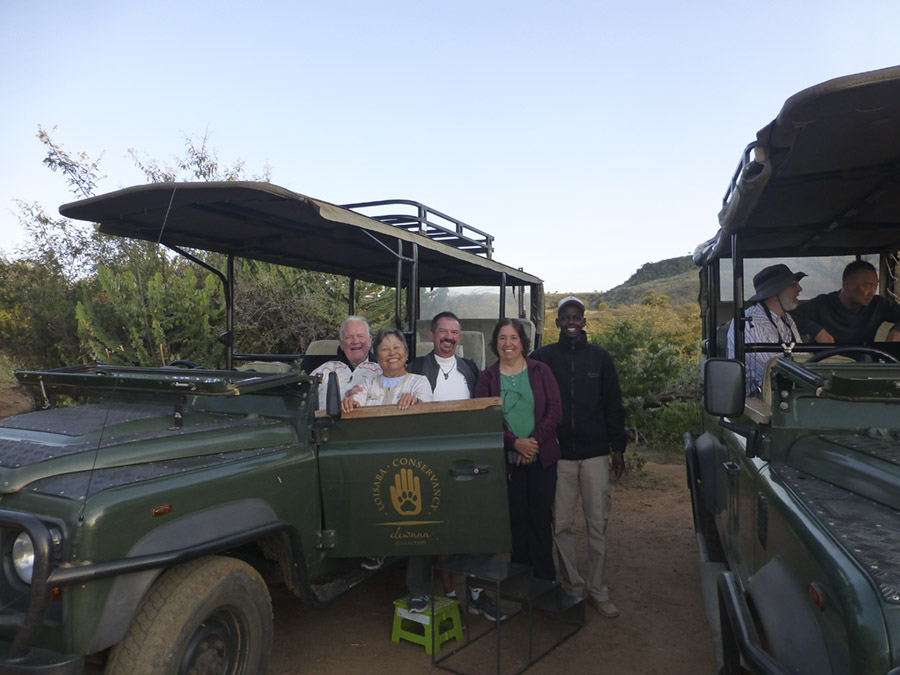
We all had big smiles on our faces as we prepared for the early morning game drive.
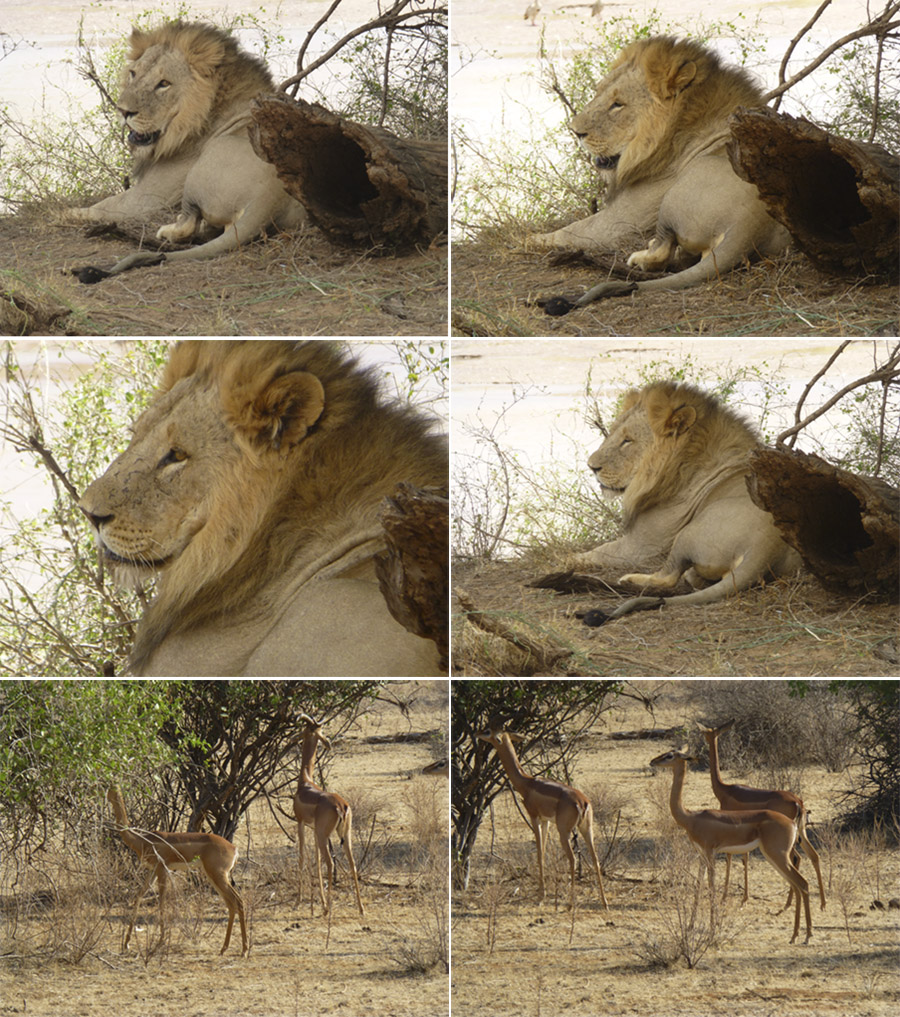
We had come upon a small pride of lions, and we followed this huge old male, and he found a shady spot under a tree on he edge of the river. He was so comfortable that he started to drift off, and it made me sleepy as well.
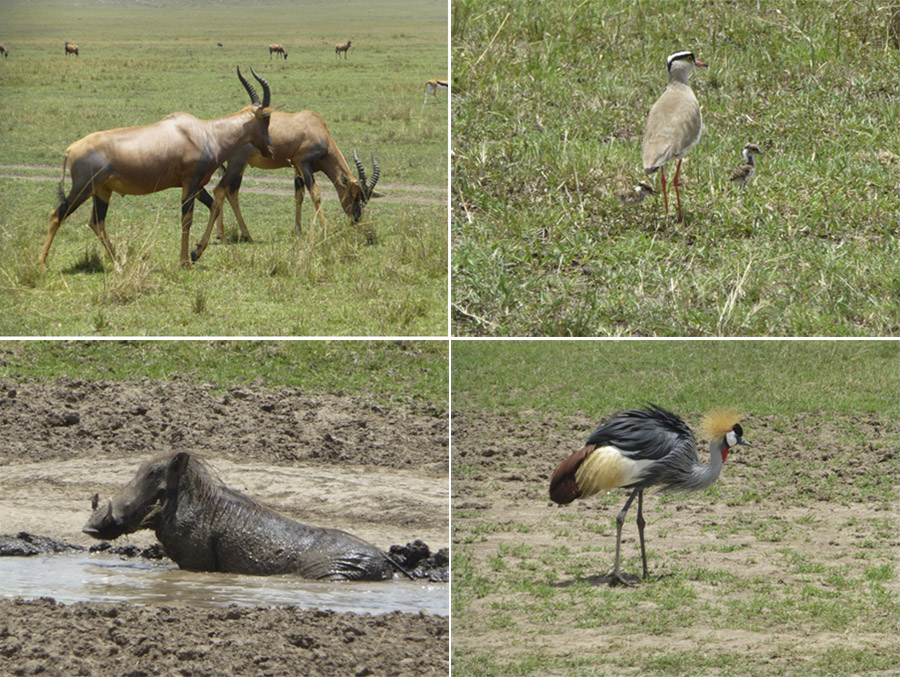
We eventually moved on, and saw these Gerenuk. They are so fragile looking. It never ceases to amaze me how evolution has brought such a broad array of creatures into being. Africa is the place to go if you want to see just how diverse nature is. We continue our game drive and are not disappointed. The bird with two chicks reminds me of the western Killdeer so common throughout the U.S.
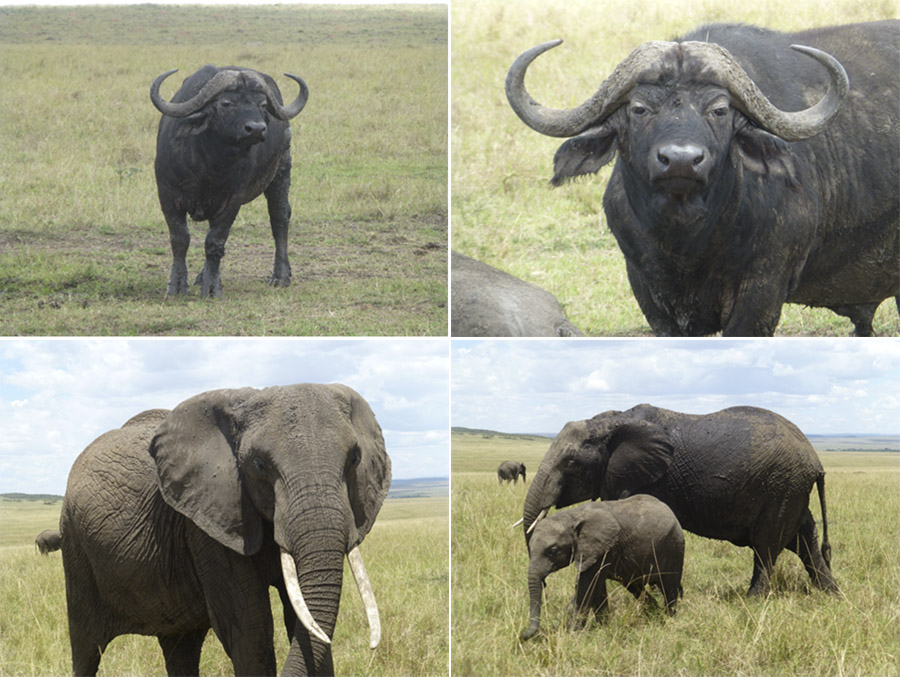
A warthog wallows in a water hole, and a grey crowned crane stalks an insect to eat. The cape buffalo doesn’t look threatening, but he is certainly holding his ground.
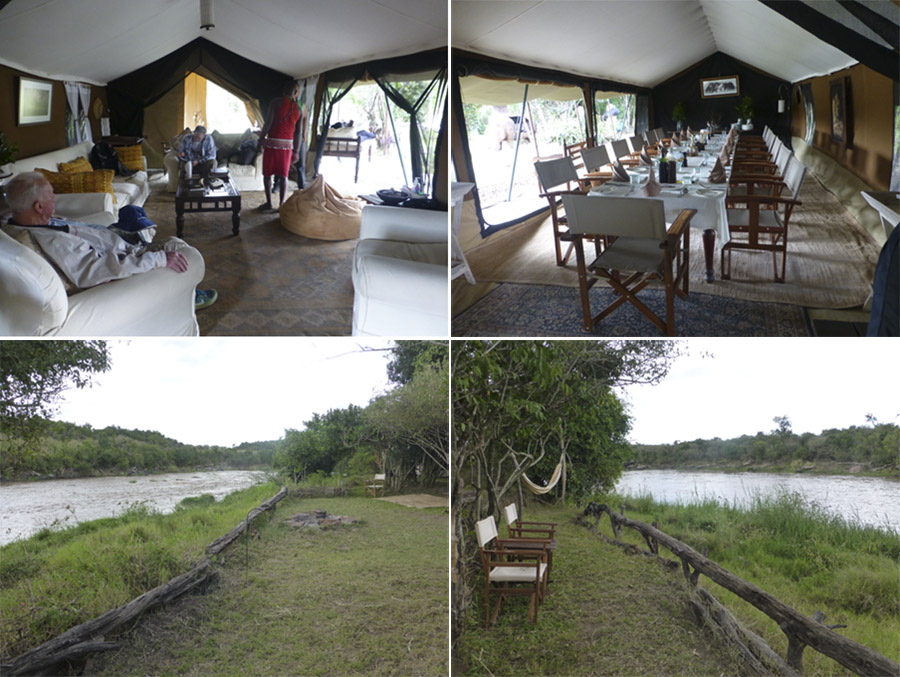
The elephants are enjoying an unlimited supply of food. What a magnificent time of year to visit this part of the world. Back at camp we rest up a bit, and prepare for a lovely lunch.
The camp is on the edge of a hue river, and besides crocodiles, it is teaming with hippopotami. You hear them all day long, and then at night when they go ashore, you hear them even louder.
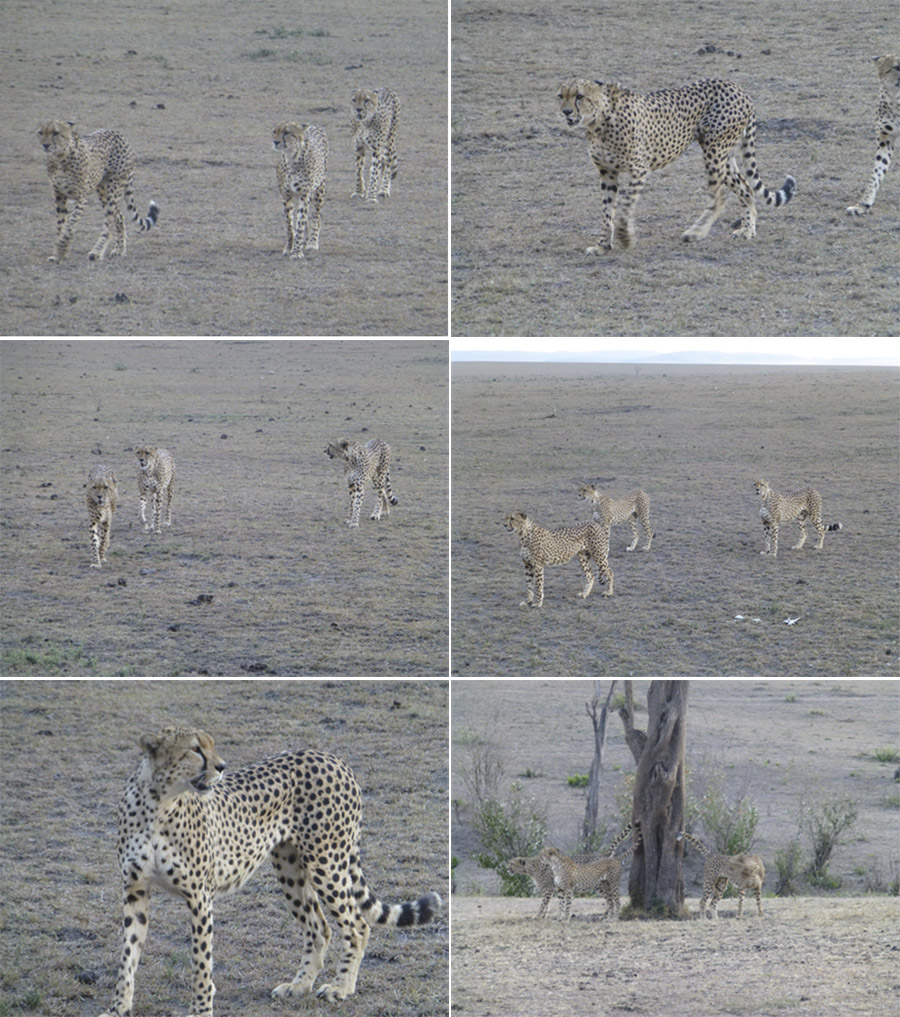
We came upon this group of cheetahs as they crossed the wasteland. They are such beautiful animals.
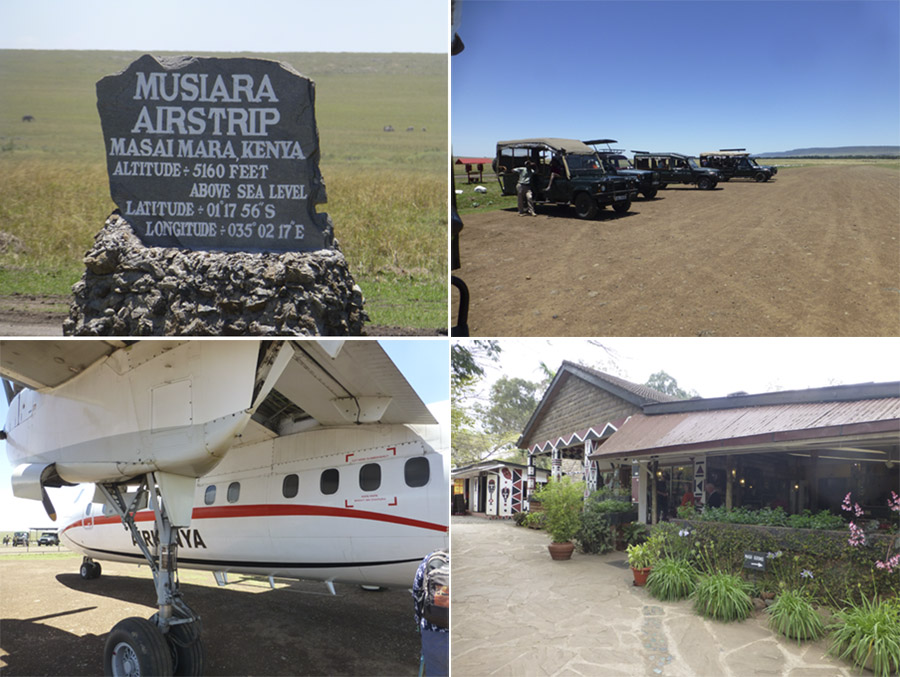
The Cheetah is the fastest animal on the earth, running at 70 miles per hour for short sprints. At the end of this game drive we ended up at the Musiara Airstrip for our flight back to Nairobi. The plane was a little bigger.
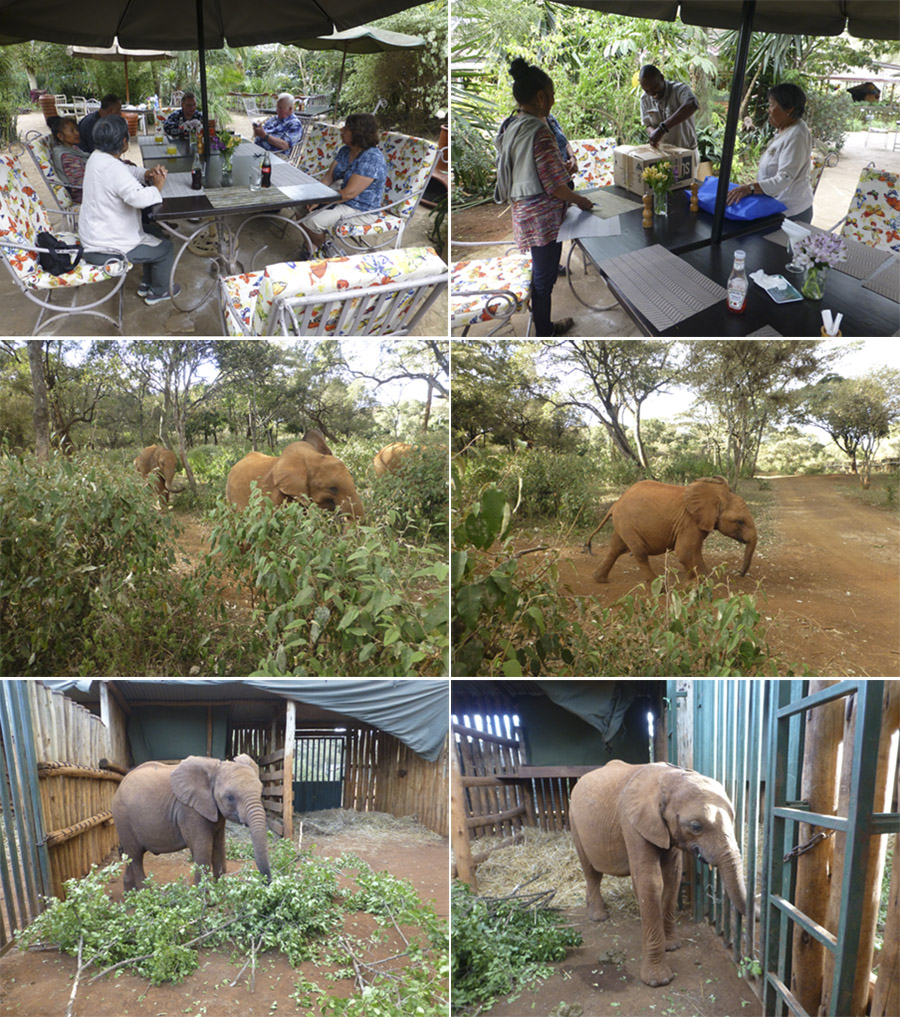
Back in Nairobi we landed at the Nairobi-Wilson airport and were transferred to Utamaduni for shopping. There was also a cafe there where we could have lunch or a refreshing soft drink. Those who wanted to shop, did so, and got their treasures boxed up for transfer back home.
At 4:30 in the afternoon we transferred to the Sheldrick Elephant Orphanage, when at 5 PM all the elephants return from the forest to their sables. It was quite a treat to see these little guys running through the street, and each one knew exactly which stable was his/hers. We got to choose a baby elephant or rhino to foster, and we will receive a photo and monthly email updates for a year. From there we transferred to the Crowne Plaza Nairobi Airport Hotel for a wonderful farewell dinner. This was the end of our Kenya adventure, and we flew back to London Heathrow for our respective flights home. I hope you have enjoyed our photos and my dialogue of our adventure. Finishing this travelogue was a little rushed because tomorrow night, 6 January 2020, we fly to Hawaii for a two week vacation and mini family reunion with members of my mothers branch of the family tree. It should be great fun because these relatives I have not seen for around 40 years or more. |

|
|||
|