 |
|
|
|
|
|
|
|
|
|
|
||||||||
|
||||||||||||||||||
|
Email us at: |
||||||||||||||||||
 |
||||||||||||||||||
 |
 |
|||||||||||||||||
|
Click the sun to see the |
||||||||||||||||||


|
 |
|
|



|
|
|||
|
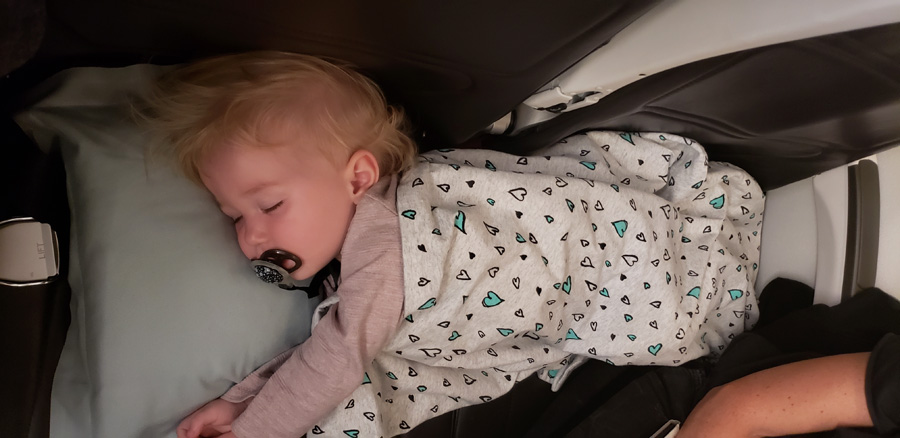
There has been a bit of a delay in publishing this episode, due to our annual trip to California to pay taxes, and to visit our timeshares in Cabo San Lucas. I had hoped to finish it on that vacation, but obviously that didn’t happen. Sigh! Our flight from Lisbon to Heathrow, with a 7 hour layover waiting for our flight to Athens, got us into Athens at 2:25 AM on the 22nd of August. Connections in Europe seem to be mostly inconvenient. While we were waiting at the gate for boarding to begin, I noticed an attractive young woman with an infant. I thought to myself, gee, I hope she doesn’t have a seat directly behind me. Screaming kids drive me nuts. Thankfully, I had an isle seat in a row of three seats with the other two seats unoccupied after the door was closed, and this young woman was well behind me somewhere else in the bowls of the plane. We took off, and after the seatbelt sign had been turned off, this same young woman came up to me and asked if she could use the two empty seats next to me. What else could I say but ‘sure'. She lifted up the arm rest between the two seats and laid the infant down, and most thankfully she slept the entire flight, with never a peep out of her, even during the decent and landing. I was obviously very relieved. She was a pretty cute kid. Don’t get me wrong, I love kids. I just feel really sorry for them when the pressure in their ears builds up on the decent, and they haven’t a clue about how to use the valsalva maneuver to release the pressure. They invariably end up screaming in pain.
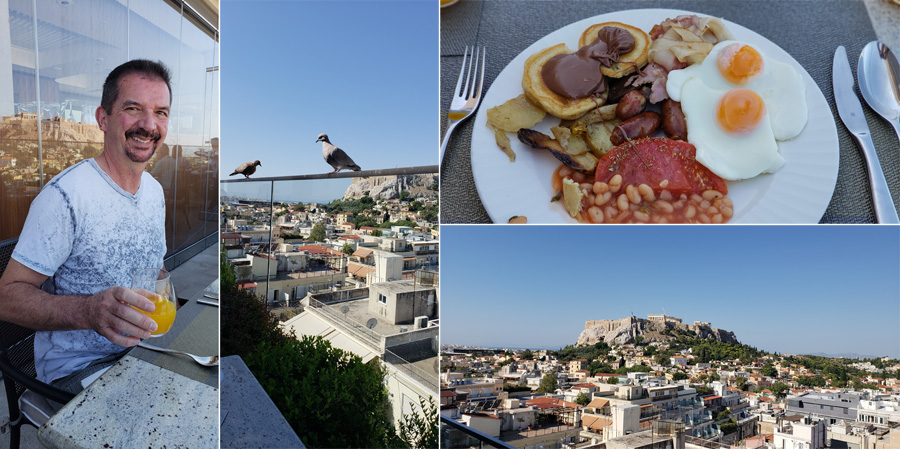
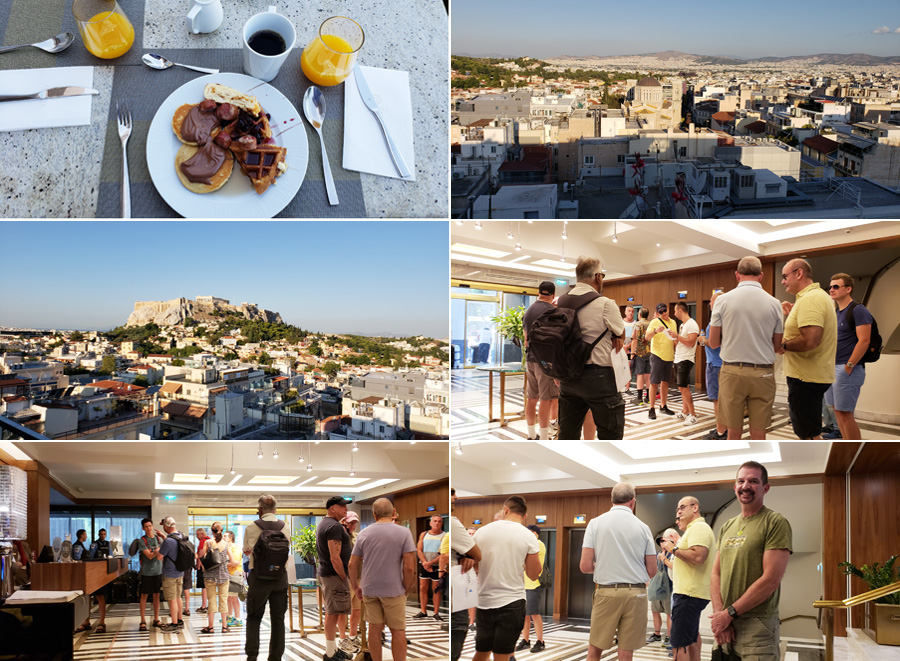
As I recall, the first day was on our own, giving us time to recover from jet lag, etc. We got in so late that we did not get a meal last night, so after minimal sleep we went to the roof top terrace for breakfast, because we were both famished. There was no shortage of turtle doves who kept eyeing our food, just waiting for an unguarded moment to swoop down and steal a bite.
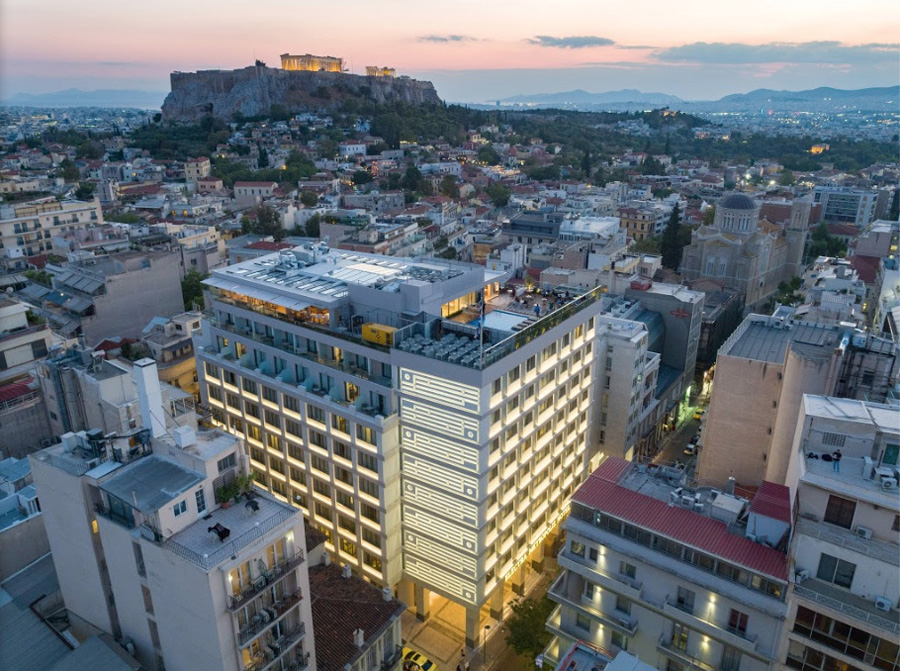
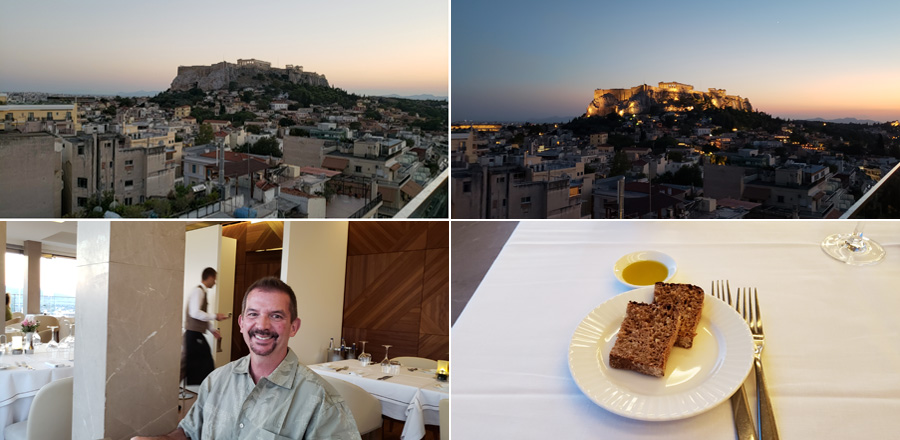
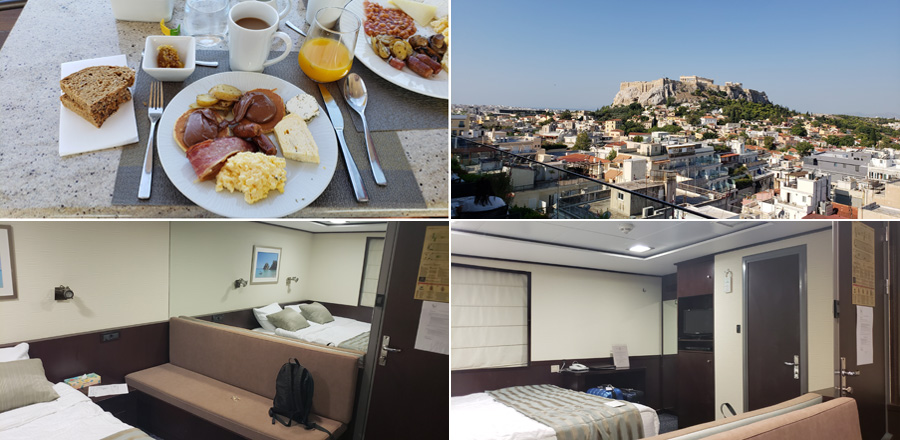
The buffet was excellent, and we had the most fantastic view of the acropolis from this rooftop terrace of the Electra Metropolis Hotel, which was located not far from the acropolis, and the views of the city of Athens were breathtaking.
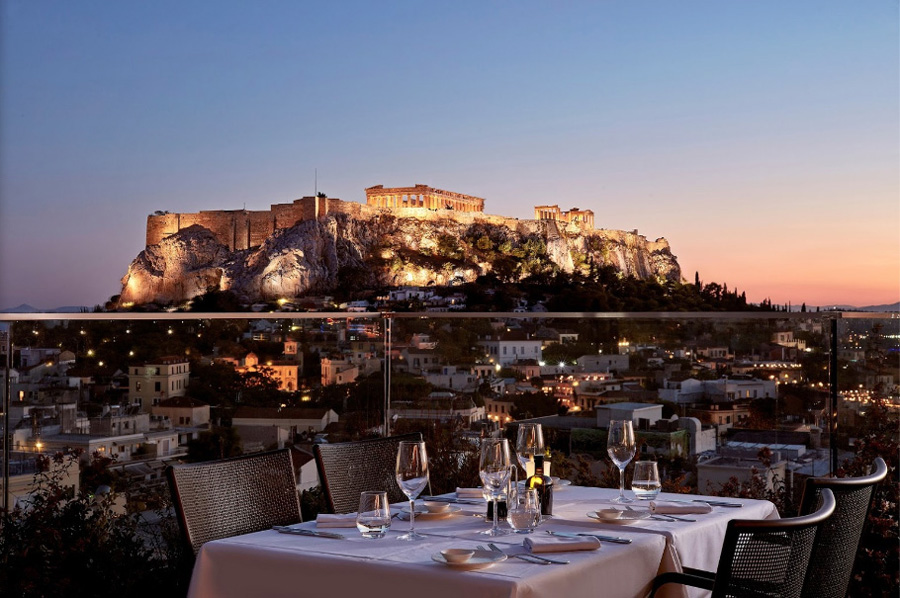
Dining there in the evening was a special treat as you could watch the lights come on as the sun went down, lighting up the acropolis in a manner that the ancient Greeks would have found to be spellbinding to say the least.
Believe it or not, the Parthenon was not damaged until as recently as 1687, when during the siege of Athens the Venetians did great damage with their bombings. The Muslims used the Parthenon as a powder keg, and a direct hit by a mortar caused an explosion that tore it apart and caused the roof of the temple to collapse. In the ensuing years there has been millions spent on restoring the Parthenon to its original look, and there is still a very long way to go before that can be accomplished. We pretty much spent this first day resting up for our first day of the tour, which would begin tomorrow with a tour of Athens, which would also include a hike to the top of the acropolis.
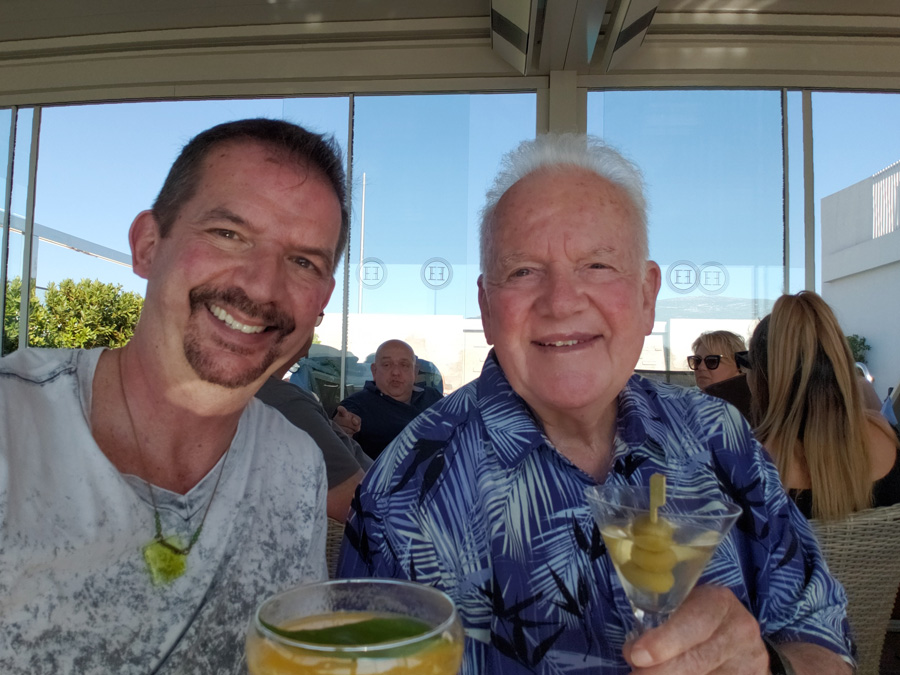
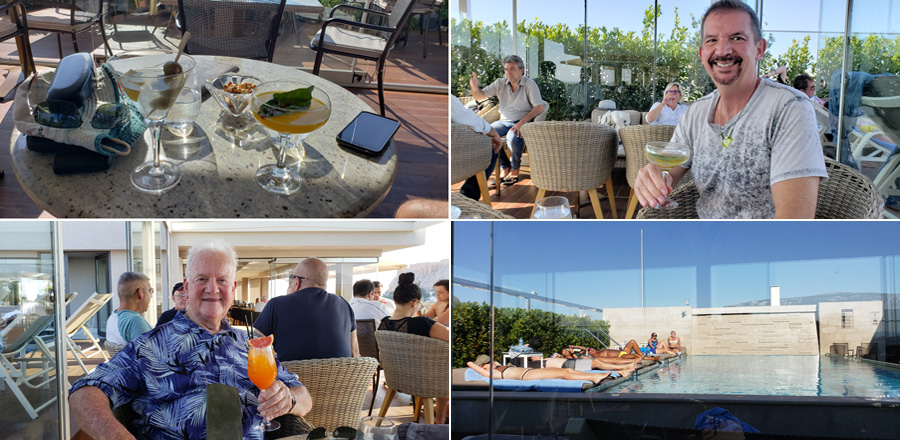
Lunchtime involved a couple of cocktails to start with. We were thoroughly enjoying this peaceful afternoon on the top of one of the most beautiful hotels in Athens, just observing the city from this magnificent vantage point.
Also, there were several sun bathers soaking up the rays at the pool adjacent to the restaurant. We arrived for dinner at dusk, and while we sat at our table, the sun slowly set in the west as the lights flickered on at the acropolis, revealing a dazzling monument to human endeavor.
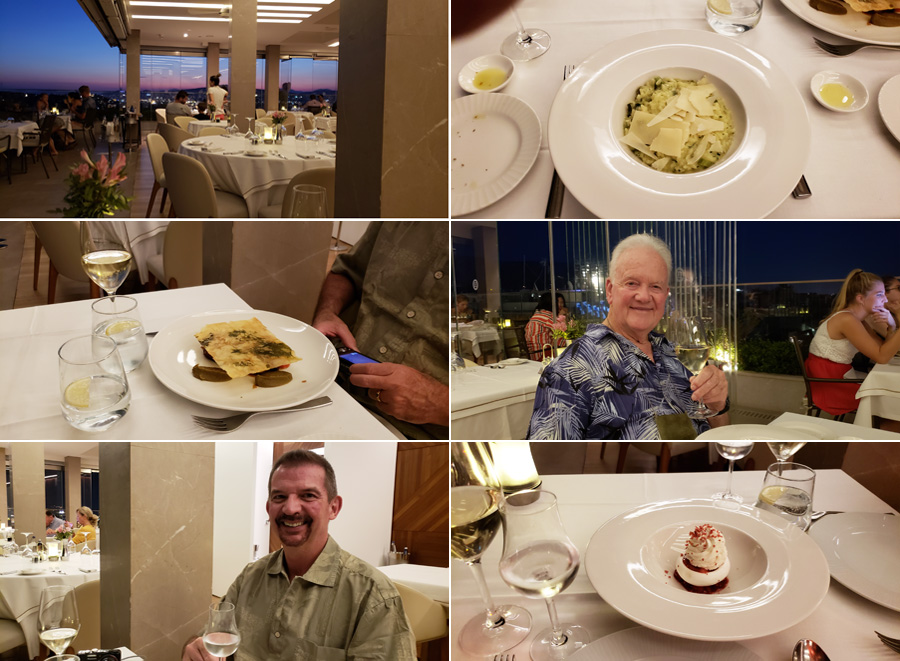
The bread they served with olive oil was a delicious multi-grain bread, the kind I enjoy the most. It was a perfect evening with not a cloud in the sky. I ordered the risotto and Pete ordered something else. The wine was very good.
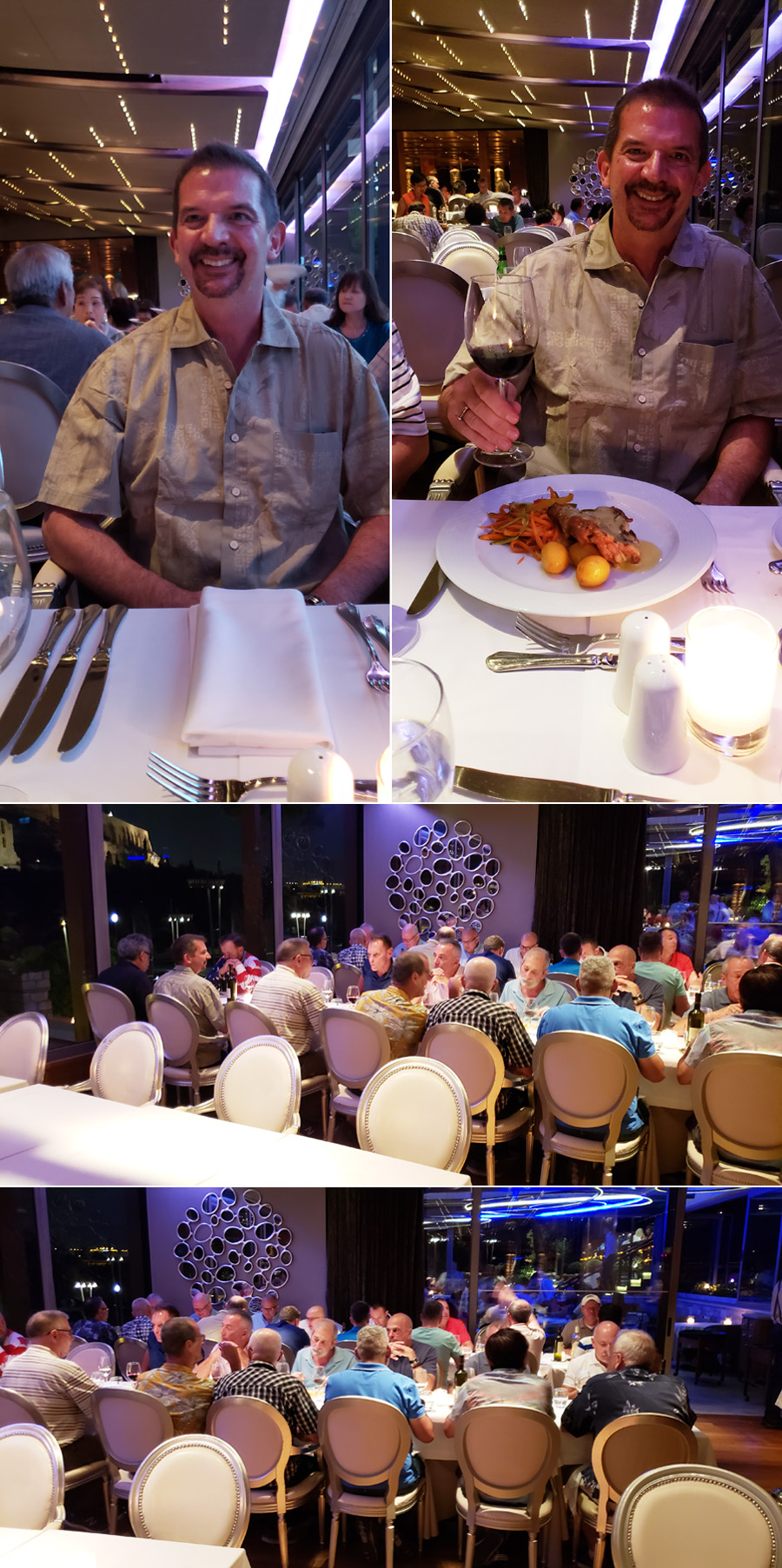
And of course we finished off the meal with a tasty dessert to share. I’m the one with the sweet tooth, and Pete isn’t normally much interested in sweets. He will have a couple of bites, and I’m left with finishing it off, much to my delight. We got up early the next morning and enjoyed another amazing buffet breakfast on the rooftop terrace. I loved the pancakes with chocolate sauce on them, and the waffles with real maple syrup, with sausage and a bit of omelet. Did I mention that I have a sweet tooth? On the morrow I shall try to compensate a bit by having only a fruit plate. I realize that I’m too old for deprivation, so I indulge my cravings when on vacation and the opportunity presents itself. The morning sun lite up Athens and the acropolis beautifully. We met the rest of our tour group (of which there were a total of 24 I believe) in the lobby.
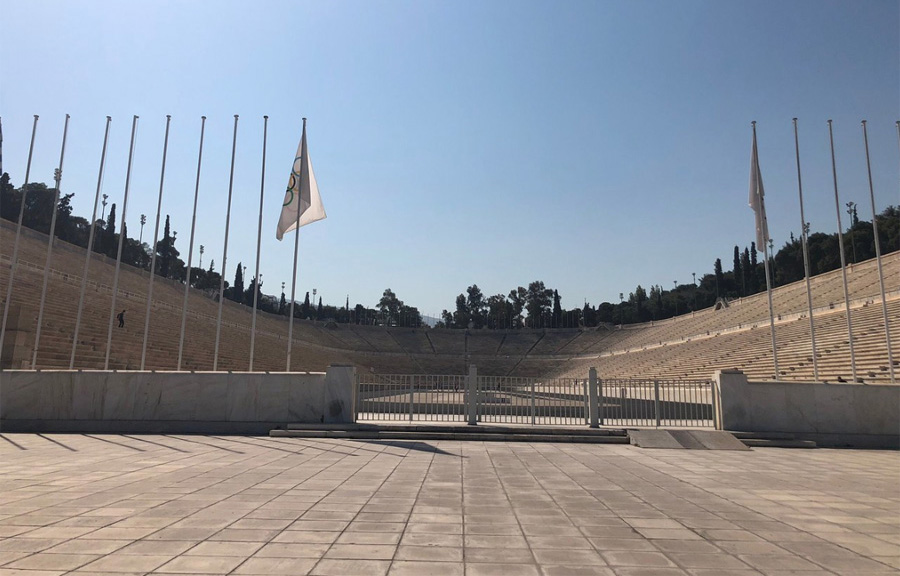
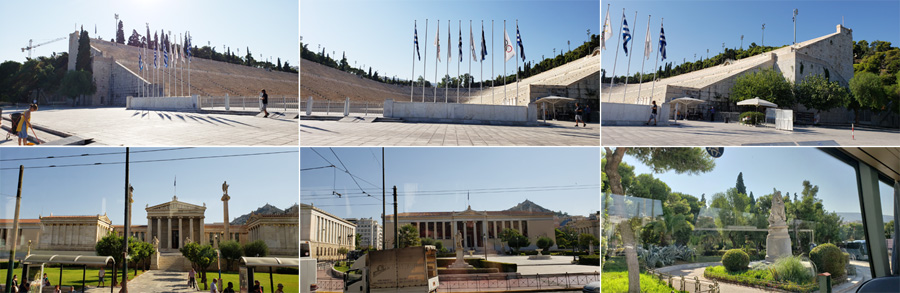
Our tour director, Jim Smith was chatting with members of the group as we waited for everyone to gather. The best place to start a walking tour in Athens is the Panatenaiko Stadium, a multipurpose stadium, and is the only stadium in the world built entirely of marble. It has a total capacity of 60,000 spectators. The first modern Olympics began here more than a hundred years ago, in 1896, and every 4 years, a torch is lit here at this stadium, and carried by runners to the new host city, often a very long journey, and the flame of the torch is kept alive the entire way, until at the new site of the Olympic games, a cauldron is lit and kept alight for the duration of the Olympic games. The Olympic flame was first introduced into our Modern Olympics at the 1928 Amsterdam Games, and it symbolized “the light of spirit, knowledge, and life." The Torch Relay also began in Ancient Olympics and was revived at the 1936 Berlin Games.
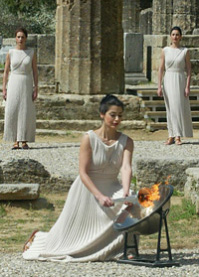
I was curious as to how the torch was lit, so I googled it. The torch is lit several months before the start of the actual games, and is lit in Olympia, Greece, at the Temple of Hera. The torch is ignited by the use of a parabolic mirror that focuses the rays of the sun to a single point. The priestess holds a torch in the center of the parabolic mirror, and the intense heat ignites the fuel in the torch, sparking a flame. I thought that is so cool, using our Sun to ignite the Olympic torch.
The volume of the marble comprising the stadium is 1,040,000 ft³, weighing 85,100 metric tons. There are 107 steps to the top of the stadium, and the total length of the seat rows is 14.8 miles. Just in case you ever find yourself on the game show “Jeopardy” and these questions should come up, now you have the answers. (smiley face emoji)
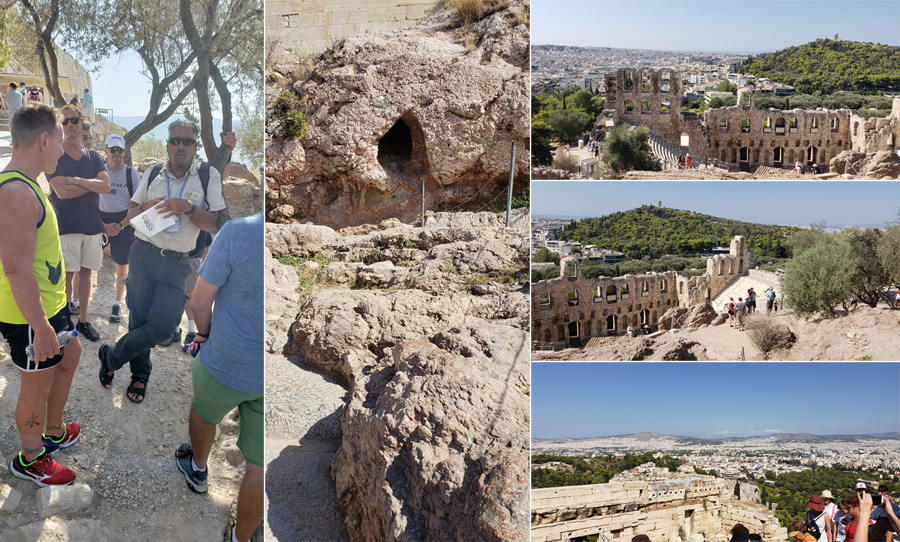
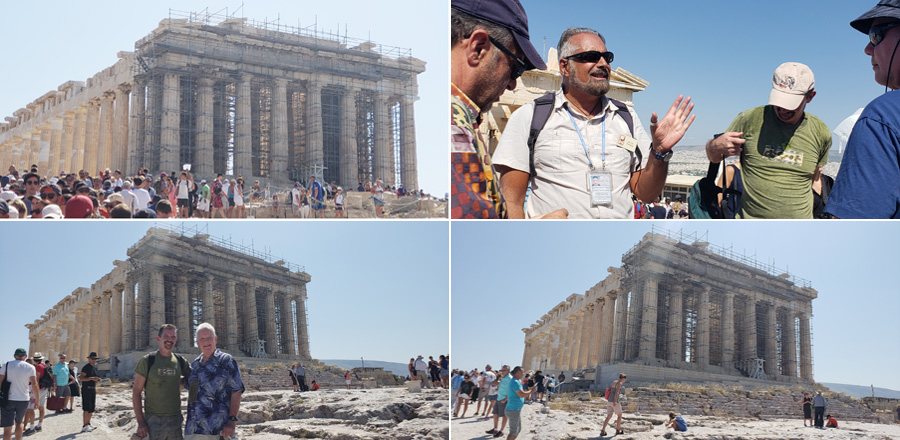
Our city tour took us by motor coach past several beautiful buildings, but I haven’t a clue as to what they were. Thankfully we were heading for the acropolis, and from there we would be on foot. Our tour guide (in the white shirt) was a real laid back kind of guy. Full of information, but obviously he has done this tour a few thousand times. The first thing you notice as you start up the trail to the acropolis is this cave. My grandson Jon sent me a photo of him inside this cave. I would have included the photo here but I have been unable to locate it. My filing system really sucks.
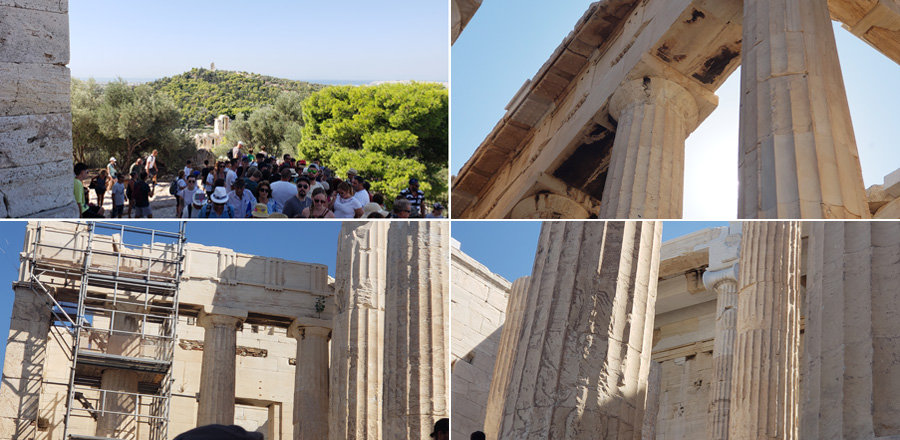
The views of Athens from the acropolis are pretty spectacular. My photos hardly do it justice. The entrance to the Acropolis is called the Propylaea, which is defined as the structure forming the entrance to a temple. It’s a long slog up the hill to get to the actual entrance.
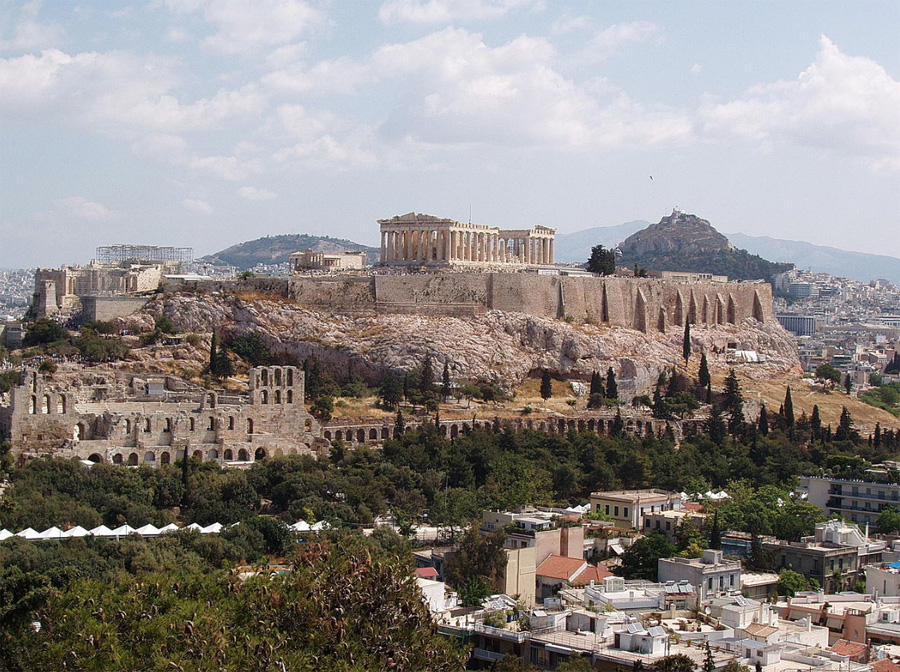
In this photo, borrowed from the Internet, it shows the Propylaea at the extreme left of the photo.
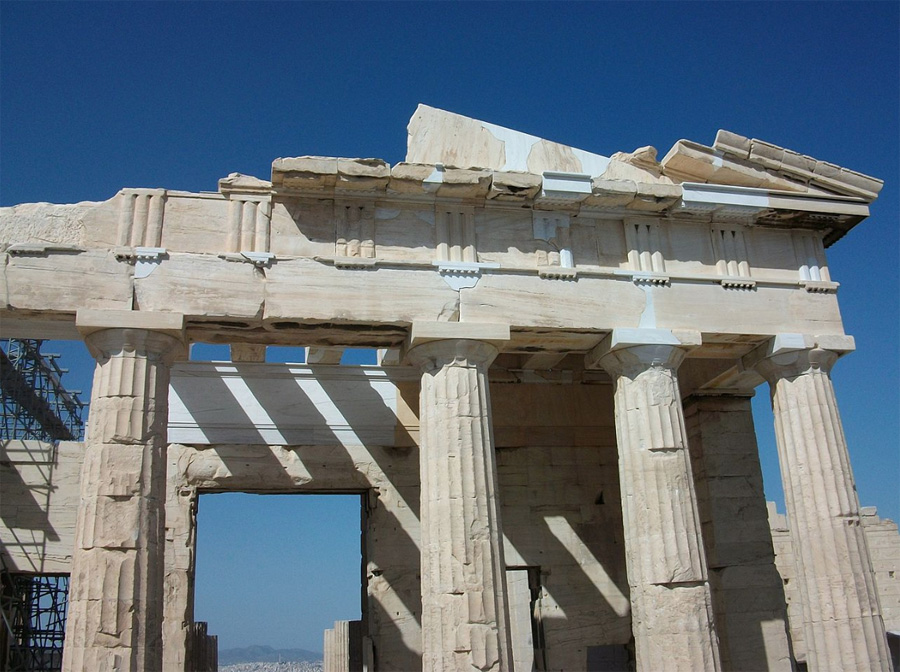
Our climb began and ended at those white canvas shelters for the vendors along the way, at the lower left of the photo. As you can see, it’s a rather long climb to the top of the acropolis. This is the eastern facade of the Propylaea. During the reconstruction work, some pieces of marble could not be found, so they had to me manufactured from new marble. The whiter areas are these new pieces, and with time they will age and change color to match the original marble in color.
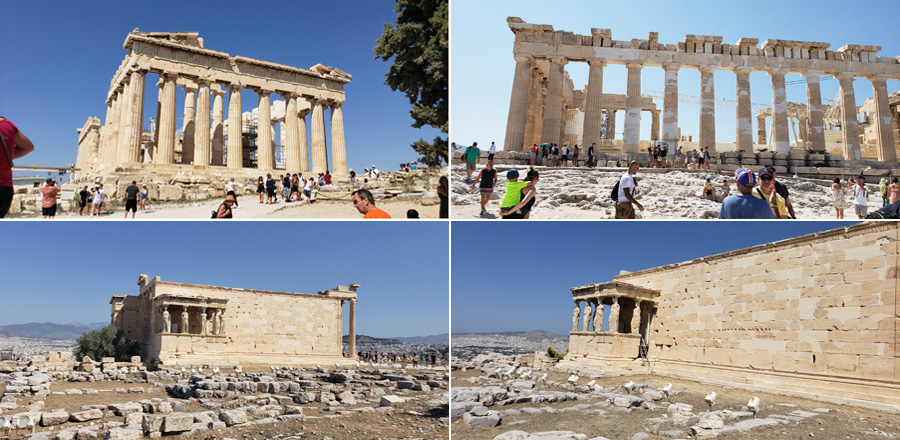
The building of the Parthenon began in the year 448 BC and was completed 16 years later in the year 432 BC. It served two functions, it was build as a monument to Athena, and it was also a part of the state treasury.
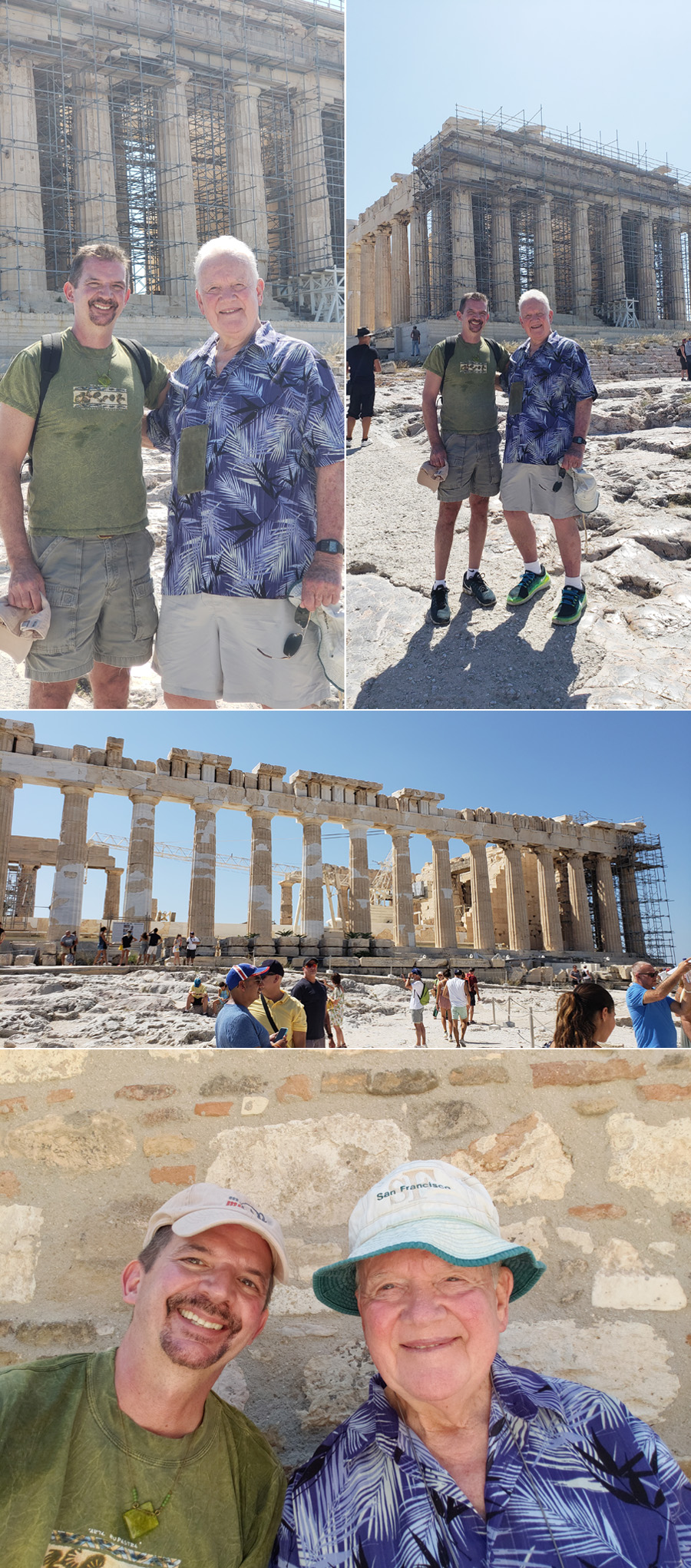
If you look closely you can see the whiter new marble which was constructed as an exact replacement for the original marble that could not be found. With all the scaffolding, it is clear that the Greeks are working hard on restoring the Parthenon to it’s original grandeur.
In the middle of the Parthenon you can barely see the huge crane that is used to raise the massive blocks of marble into place. It certainly makes you wonder just how the Greeks in the 4th century BC were able to place the huge blocks without the use of a modern day crane. Walking around the Parthenon it is clear that there is a lot of work yet to be done in this Herculean restoration project.
The Erechtheion was build between 421 and 406 BC, and was a temple dedicated to both Athena and Poseidon.
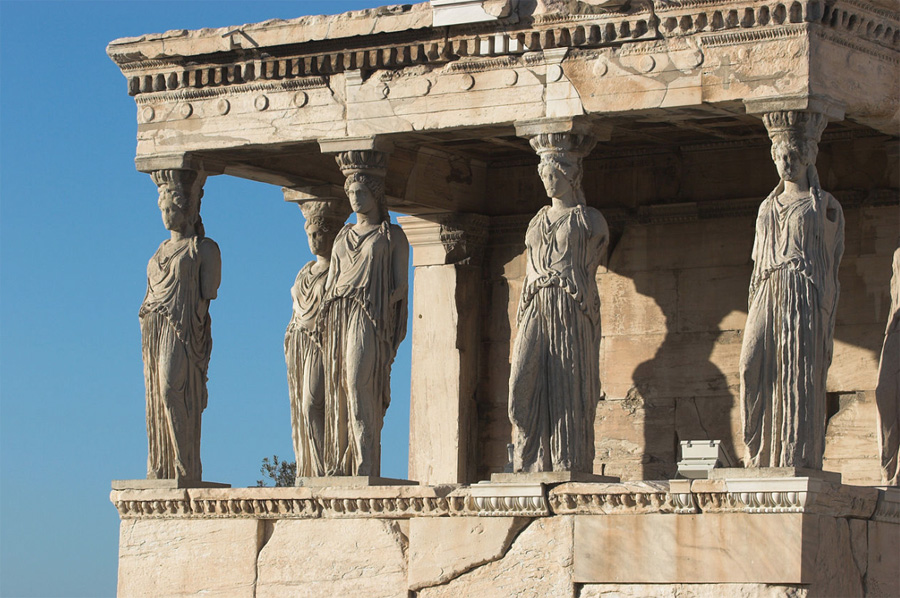
These figures are called caryatid, which are defined as sculpted female figures serving as an architectural support taking the place of a column or a pillar supporting and entablature on her head. You’ve got to hand it to the Greeks, as they certainly had a way of creating works of art that seem to last forever, and are always playing the senses, no matter what age. As I looked at these sculptures, I thought about the ancient Greeks who viewed them on this very spot. This temple of Athena was very important to their culture. The contribution of Greece to the world in general is one of the wonders that are little noted or appreciated. It was a long day of touring Athens and the Acropolis, that ended with a wonderful dinner for our group, sponsored by Coda, a get to know each other dinner, before boarding out vessel the following day.
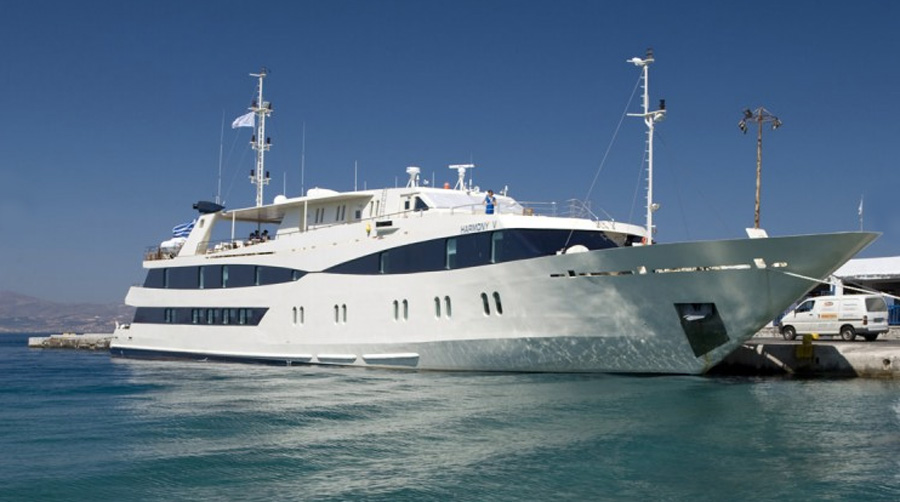
It was a very pleasant evening, and a wonderful way to end a magnificent day of sight seeing in Athens. Tomorrow we will be heading to the Marina Zeas to board our vessel, the Harmony V.
In the morning before departing we enjoyed our last breakfast on the terrace restaurant, and the scene of the acropolis.
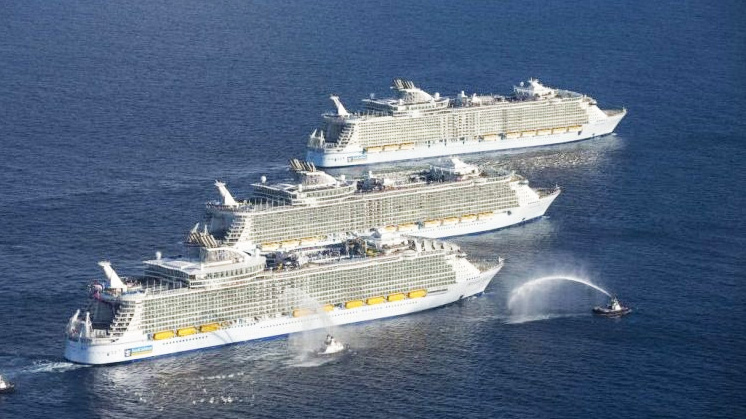
Before long we were in our spacious cabin abroad the Harmony V. The mirrors no doubt helped to make it appear more spacious than it actually was, but still, it was larger than the cabins we’ve had on the larger cruise ships we’ve sailed on., where they pack in over 6,000 passengers on the largest of the big cruise ships, think Harmony, Allure or Symphony of the Seas.
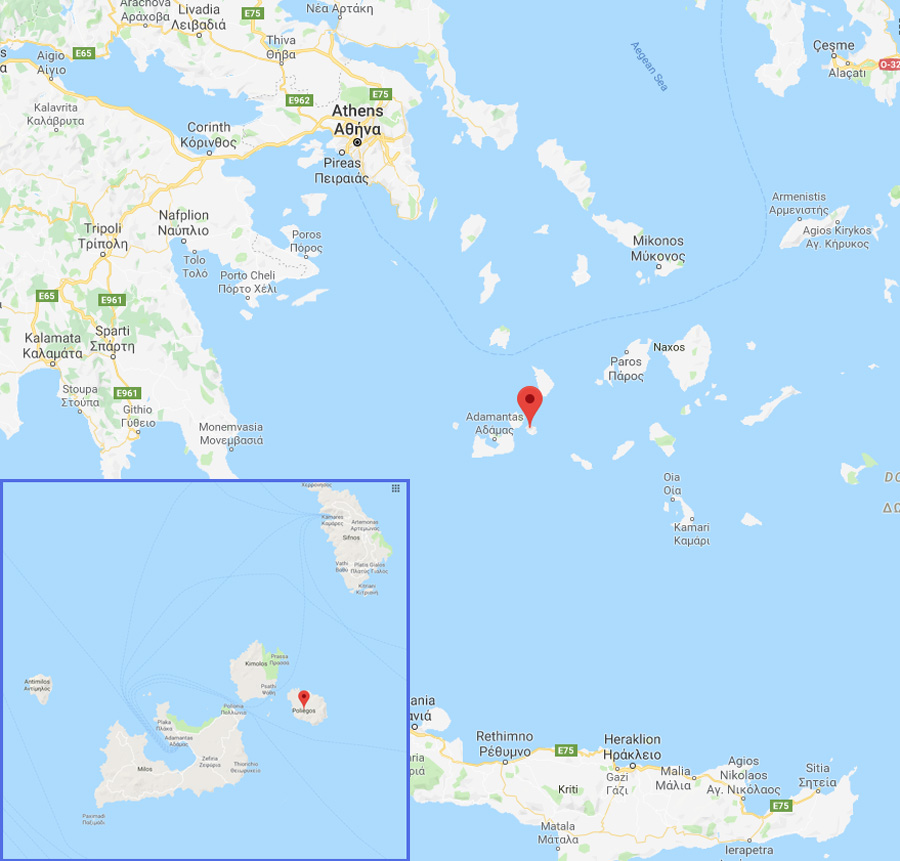
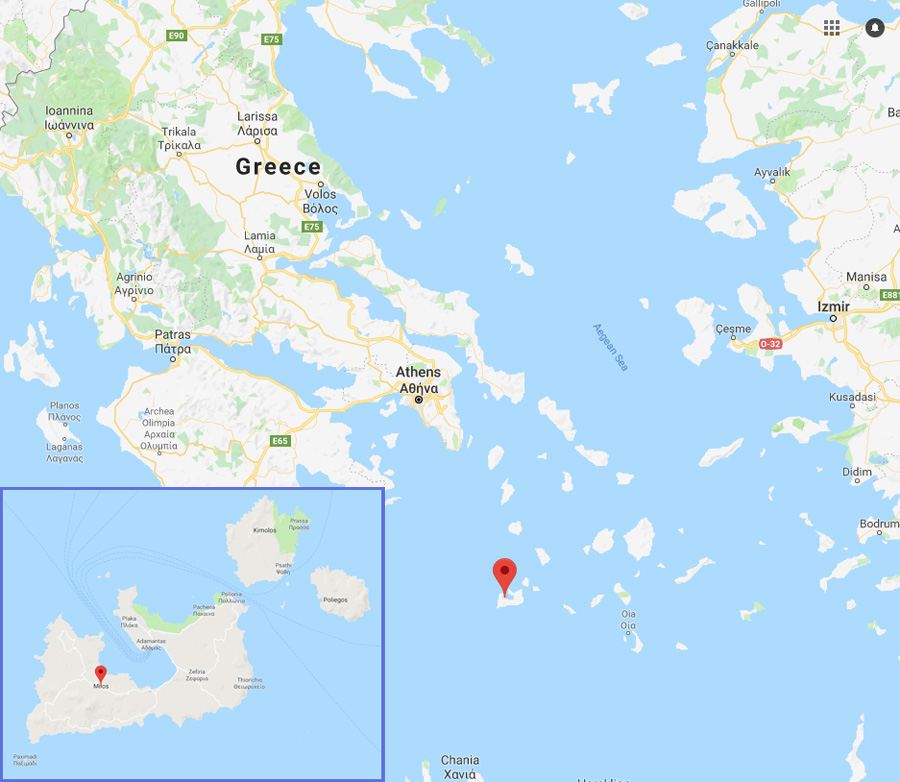
We departed Athens at around 4 PM bound for Polyegos, a distance of approx. 188 km. We arrived there at around 7 AM the next morning.
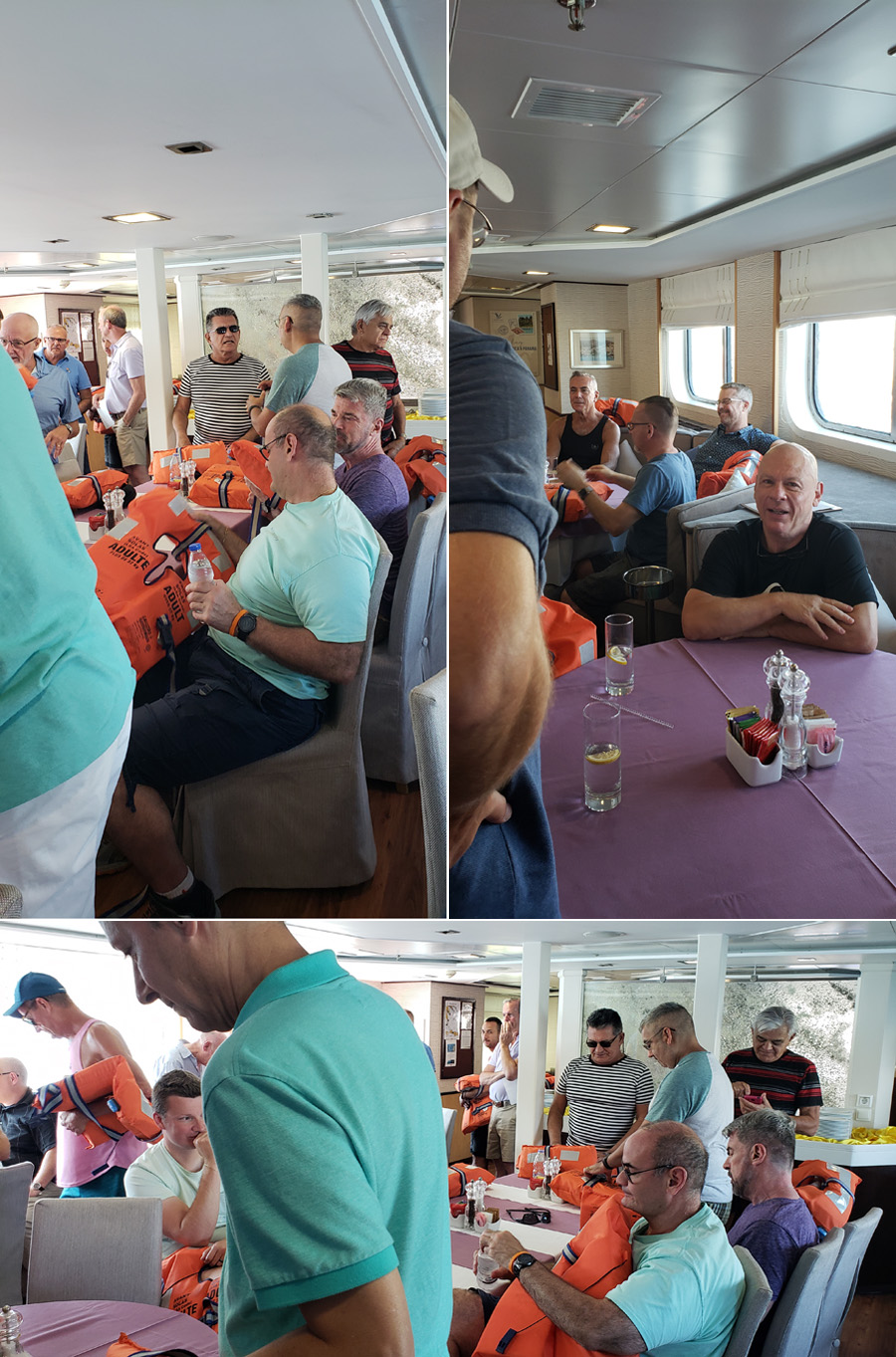
Of course there is always a mandatory safety drill before we set sail, and everyone was good natured about it as we gathered in the dining area with our life jackets, and listened to the captain perform his duty.
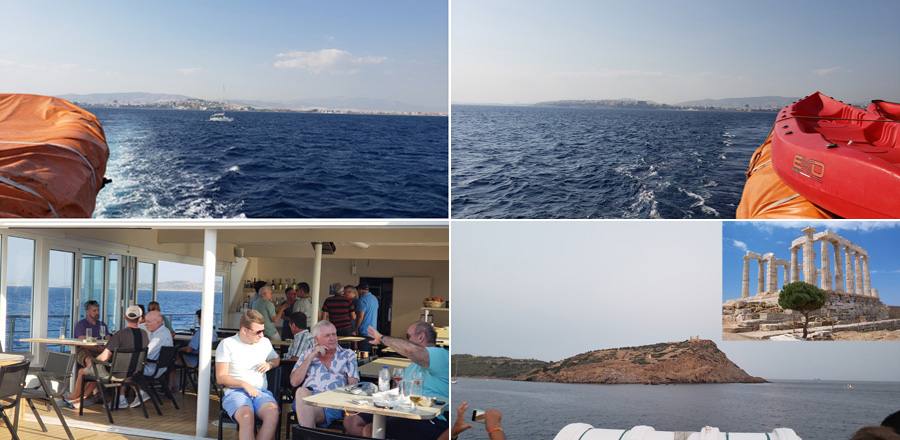
You always recognize that these things are important, and at the same time you hope you will never need to use them. With Athens swiftly disappearing in our wake, we enjoy the very open dining/bar area on the main deck . . .
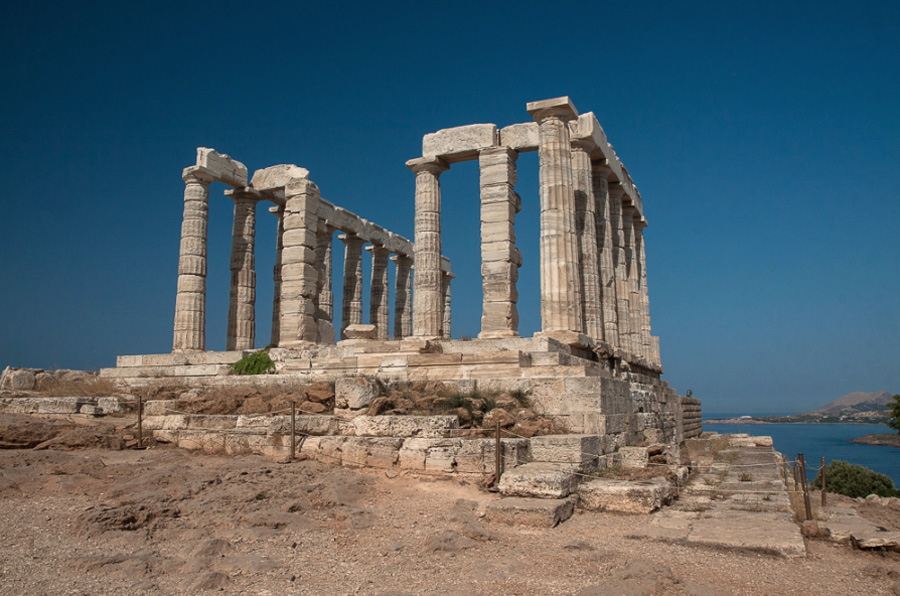
. . . as we approach our first islands, Polyegos & Milos, we see the Temple of Poseidon on Cape Sounion. This temple, the Temple of Poseidon, was built between 444–440 BC, about the same time as the Parthenon in Athens, on top of a previous structure that was destroyed by the Persians during the Greek Archaic period in 480 BC.
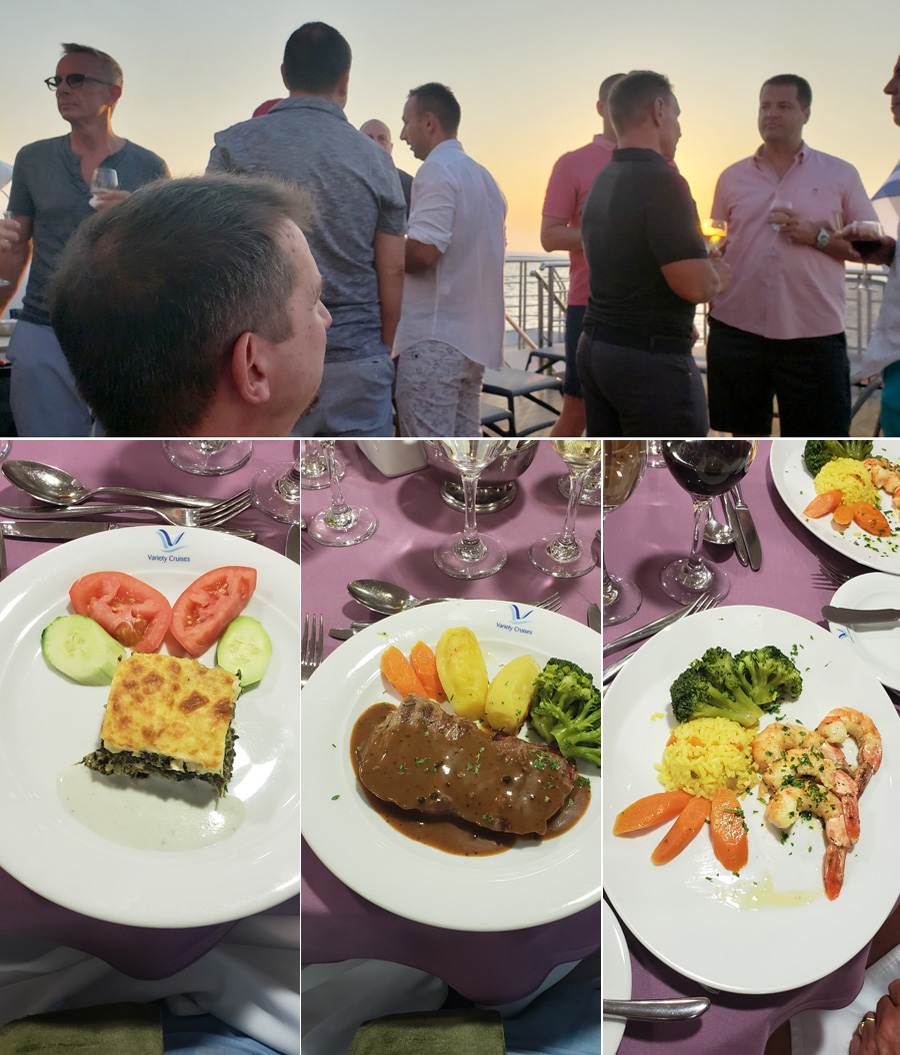
As the sun was setting in the west, we enjoyed cocktails on the aft deck before dinner, our first dinner on Harmony V.
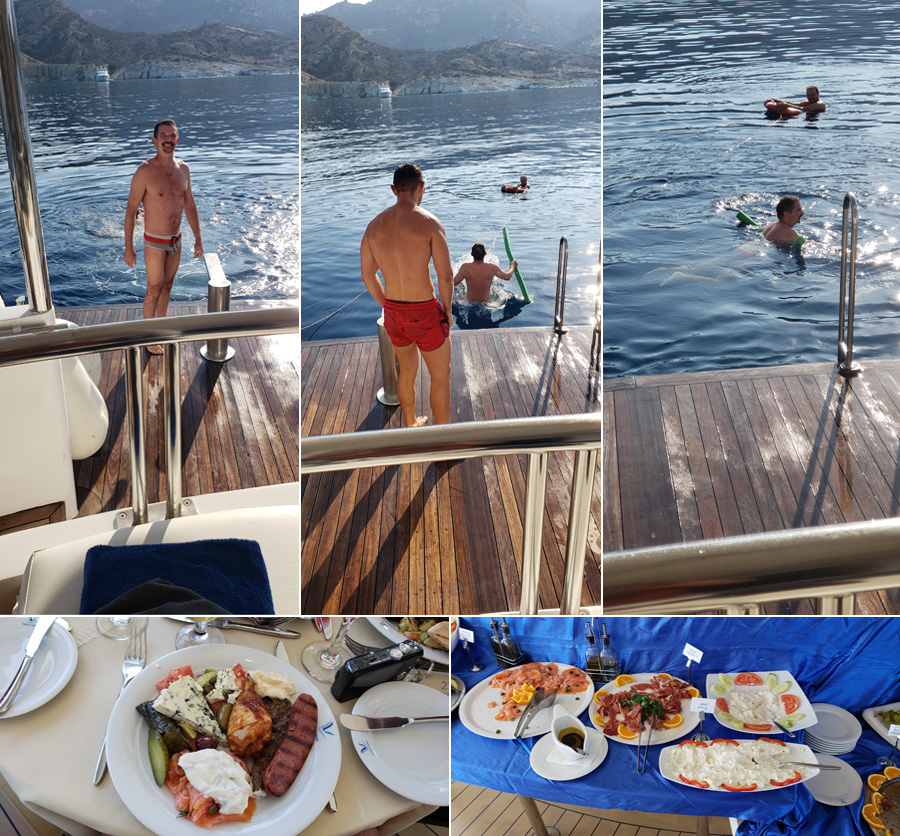
And what a splendid dinner it was. The variety was amazing, and we could see that we were in for eight days of fantastic eating. The next morning we were given the opportunity to swim off the fantail. The water was a very comfortable temperature.
The swim was followed by a fantastic lunch prepared by our chef. Smoked salmon, Polish sausage, chicken, and wonderful cheeses. All that was missing was a track so that we could run laps after this wonderful meal.
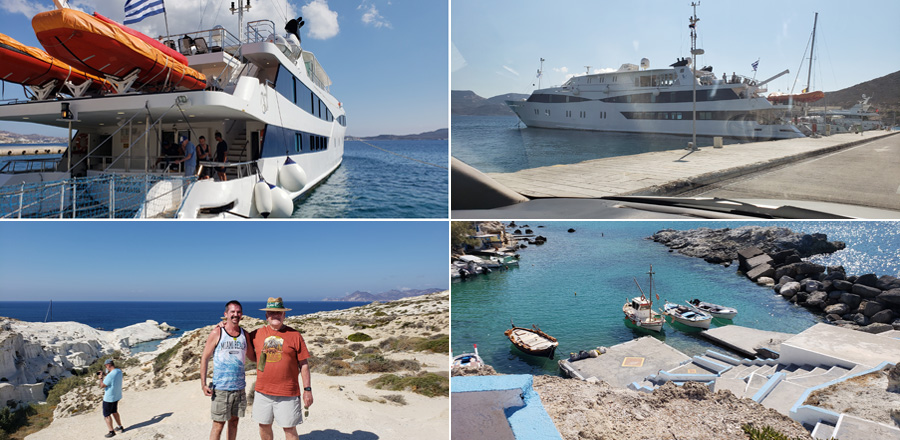
At 2:00 in the afternoon we departed Polyegos for Milos, arriving at around 4:00 PM, and we tied up at the dock on Milos and went ashore for an excursion.
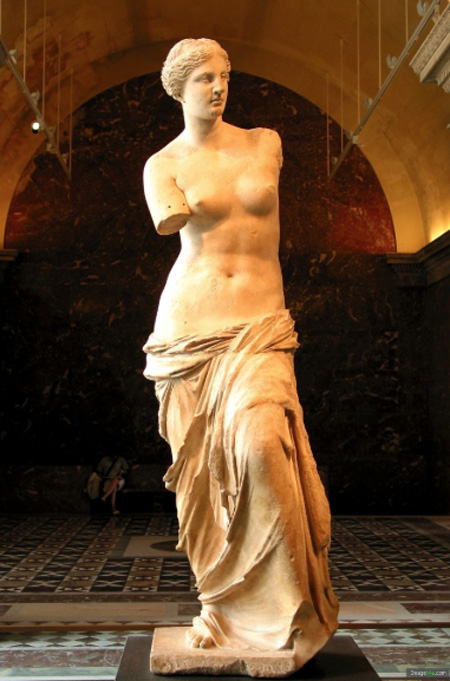
If it wasn’t for the Aegean Sea in the background, I’d swear we were hiking in my old stomping grounds in the Mojave Dessert near Barstow. This volcanic island is quite arid. This famous Greek statue of the goddess Aphrodite was carved of marble about 100 BC. It was discovered in 1820 on the island of Milos. Venus De Milo is on display in the Louvre Museum in Paris today.
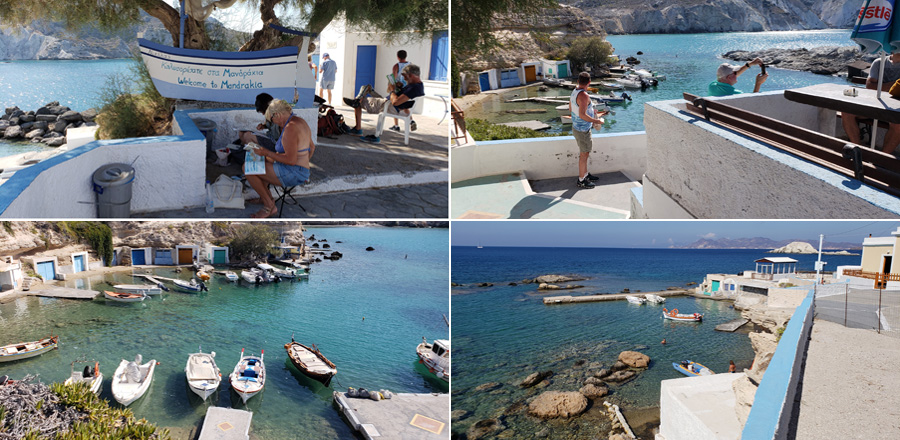
This small village on the island of Milos is called Mandrakia, and it is said to be one of the most beautiful fishing villages in all of Greece. The two ladies below were deeply engrossed in their maps and guide books.
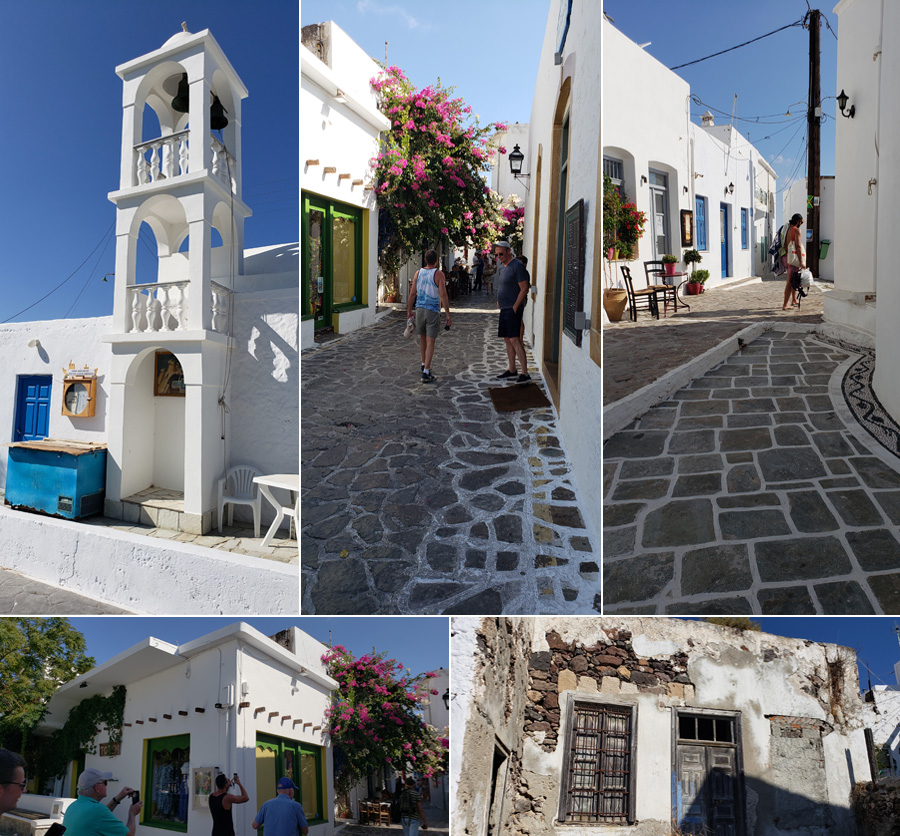
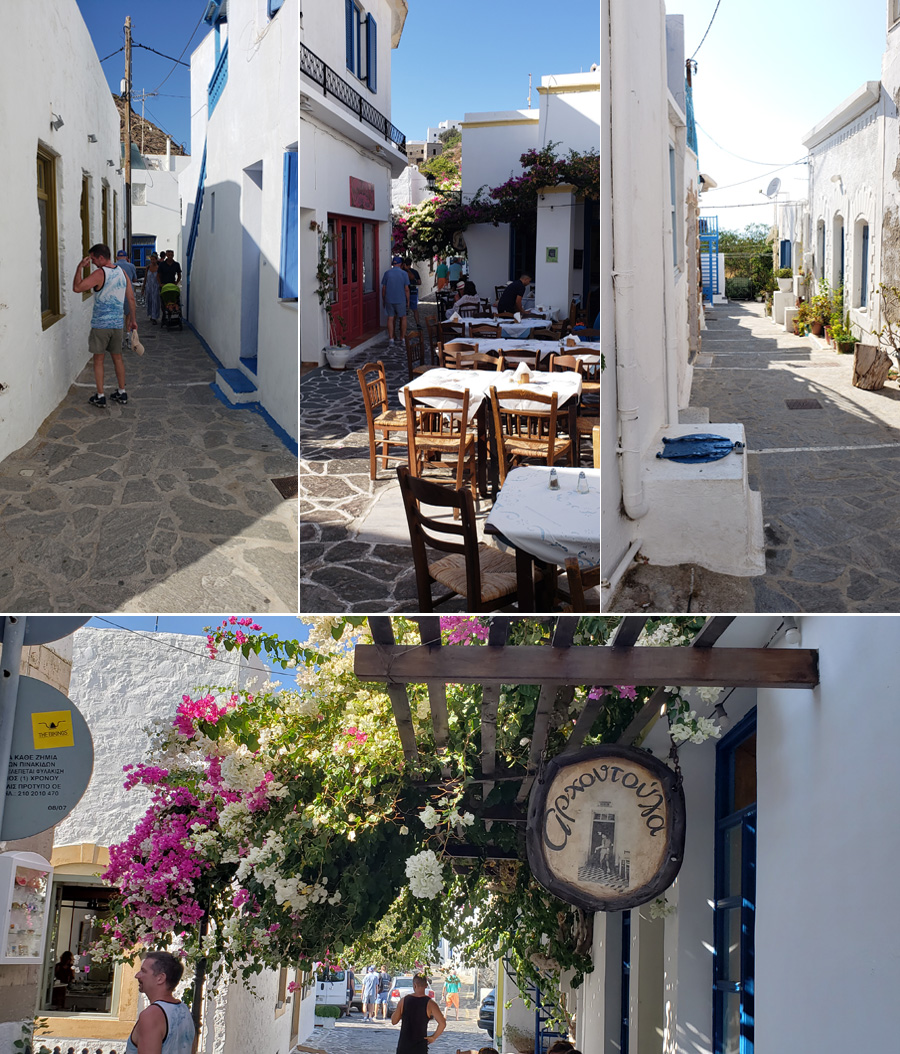
The ‘buildings’ at the waters edge seem to be carved into the mountain side, and are mere inches above the sea level. I suspect that these will be the first to be flooded when the sea rises just a foot or so as the sea ice at the poles continues to melt. Perhaps they can build a sea wall to prevent flooding. But then, perhaps the ‘buildings’ are used to store their boats during the winter months when there is no fishing, in which case a sea wall would render them useless. It appears to be a troublesome conundrum. Walking through the narrow streets of the village was quite an experience. The buildings are painted white to help the inhabitants to cope with the extreme heat from the summer sun. White paint reflects the heat, a darker color would absorb it.
This last building appears to have been abandoned. Its decaying condition allows us to see how the buildings are constructed from the volcanic stones available in abundance on all the Greek islands, whereas wood is not available at all. I must say, I don’t think I have seen a cleaner city. Not a scrap of paper or trash to be found anywhere.
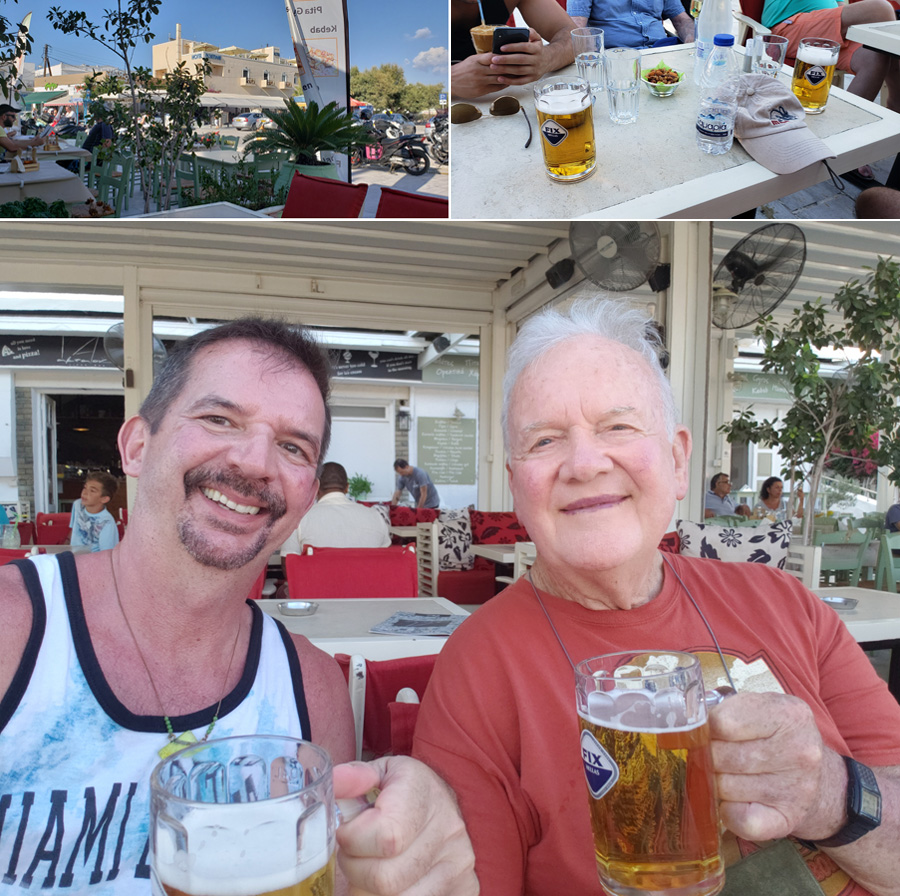
The little shops and restaurants were very inviting. We found a great place to have a refreshing drink down near the wharves. And have a beer we did. It was so refreshing after all the walking we did in the heat of the day.
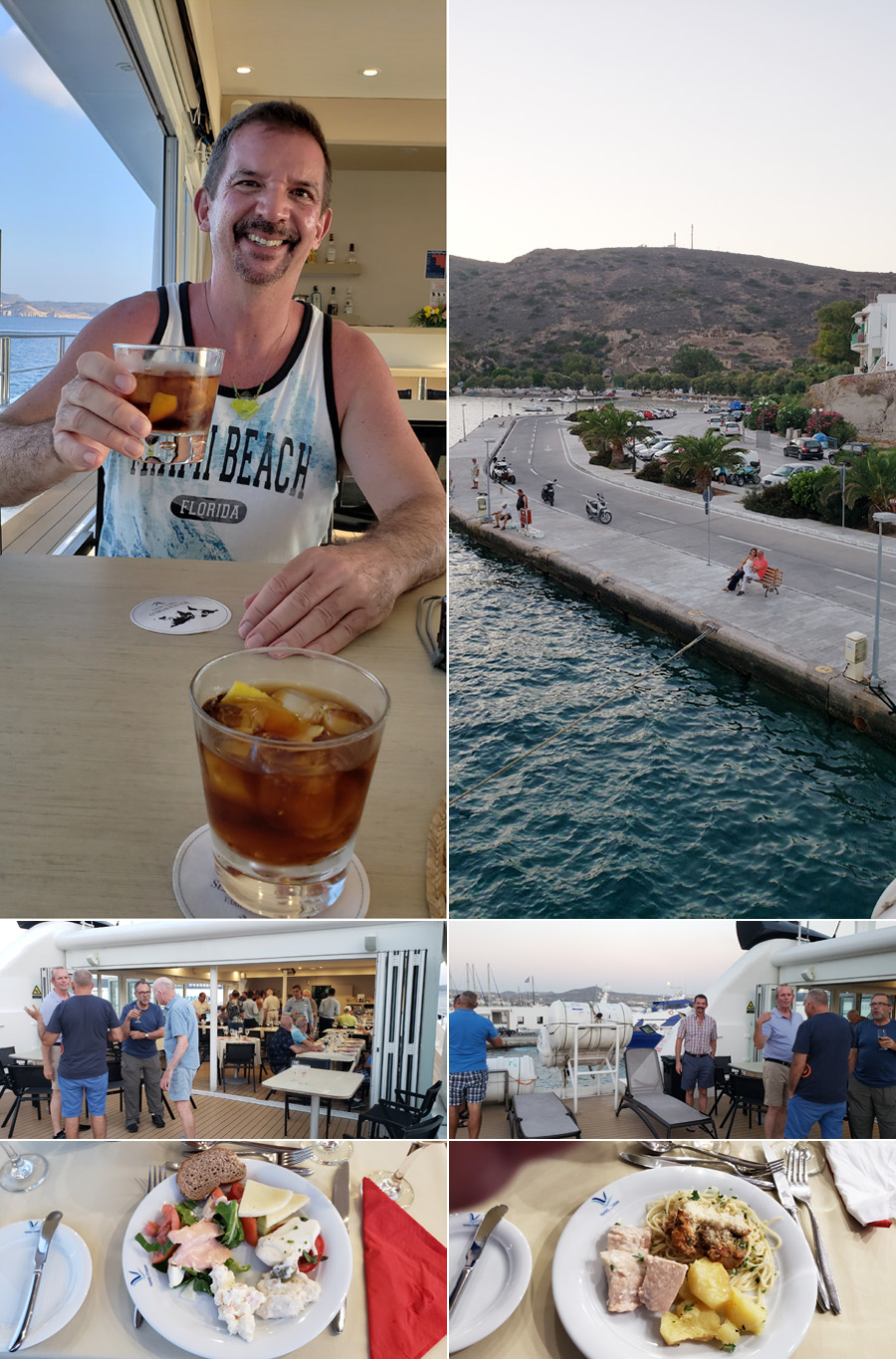
Pete takes a selfie of us enjoying our rather large mugs of delicious Greek beer. As soon as we got back on board we had our great bar tender make us each a manhattan. We would be staying tied up at this wharf until 2:00 am, when we would leave for the island of Santorini. In the meantime wee enjoyed a cocktail party before dinner, and got to know our fellow passengers a little better. It was a great group of guys.
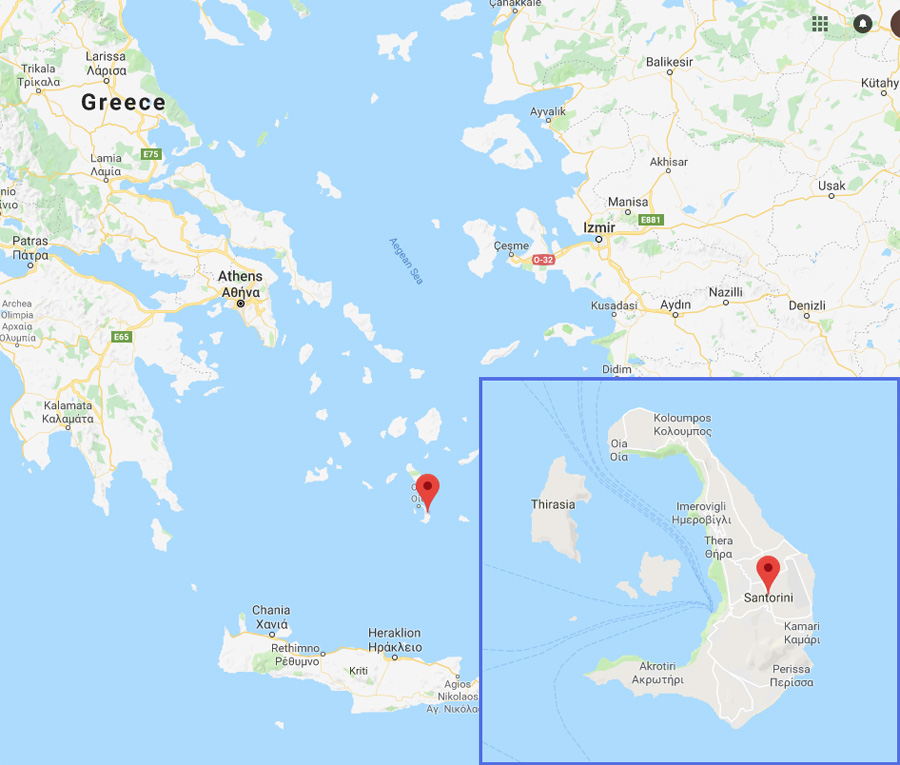
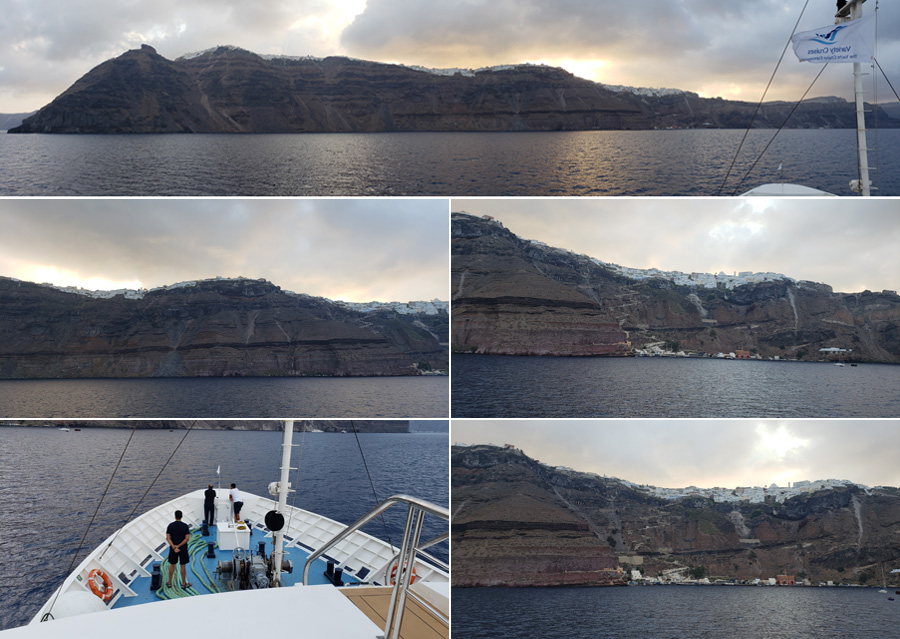
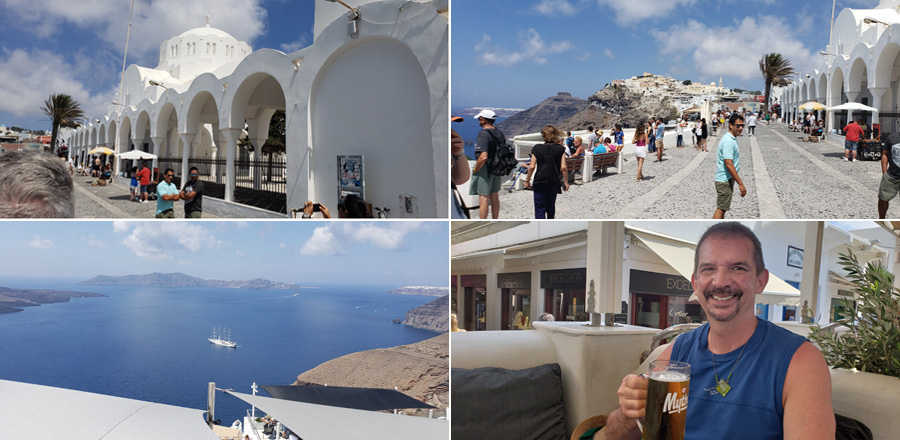
Dinner was proving to be a fantastic event on board the Harmony V. The ships staff were truly amazing. We arrived at Santorini at around 10:00 am. It is obviously a volcanic island. It lies 300 km from Athens. It was devastated by a volcanic eruption in the 16th century BC. The whitewashed houses of its 2 principle towns, Fira and Oia, cling to the cliffs above an underwater caldera (or volcanic crater).
The whitewashed homes do actually cling to the edge of the cliffs. The views are fantastic from these cliffs.
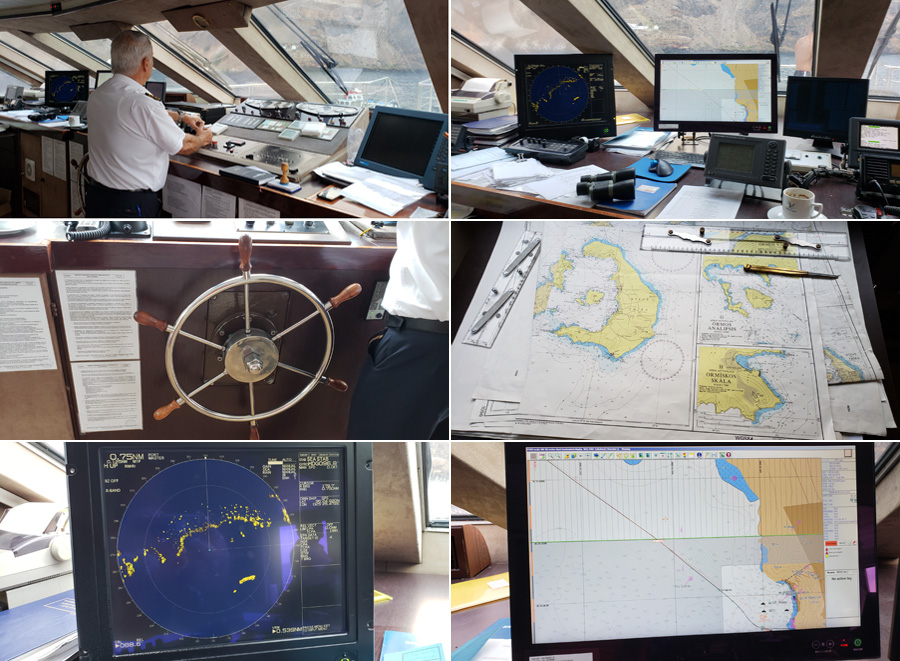
Deck hands ready the mooring lines and stand by as we approach the port. With the captain’s permission, I enter the wheel house, from where this huge yacht is controlled. The mass of electronic equipment is staggering. If only Jason and the Argonauts could see this ship, they would be overwhelmed with awe.
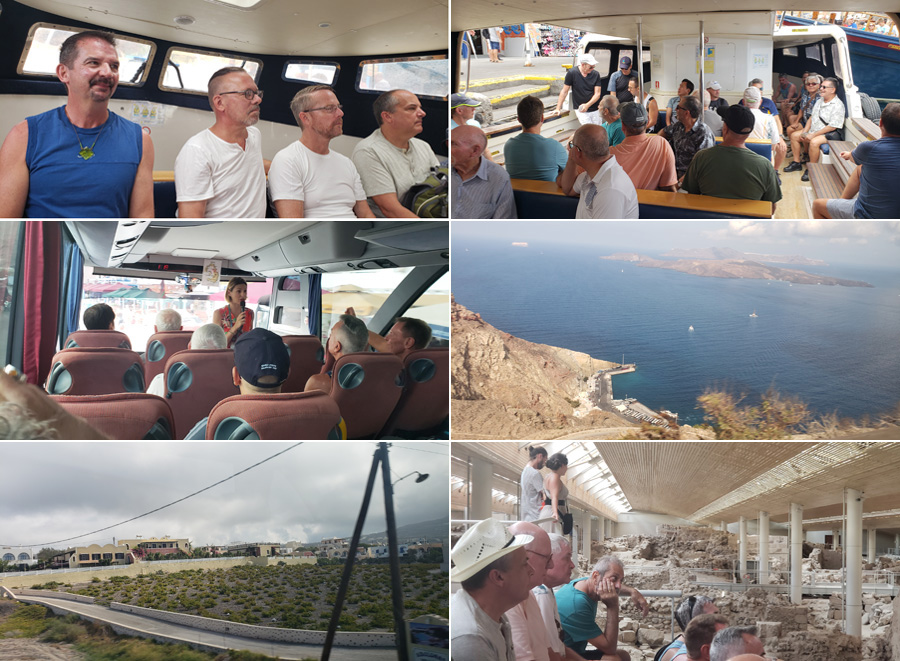
We’ve come a long way from wooden ships and iron men. Don’t you just love technology. ;o) A tender came from shore to port us from the ship to the shore. On the shore we were met by a young lady who was to be our guide, and we boarded a motor coach which ported us to the top of the island, up a very narrow and windy road up switchback after switchback until we reached the top. The view of the port below was a little breathtaking.
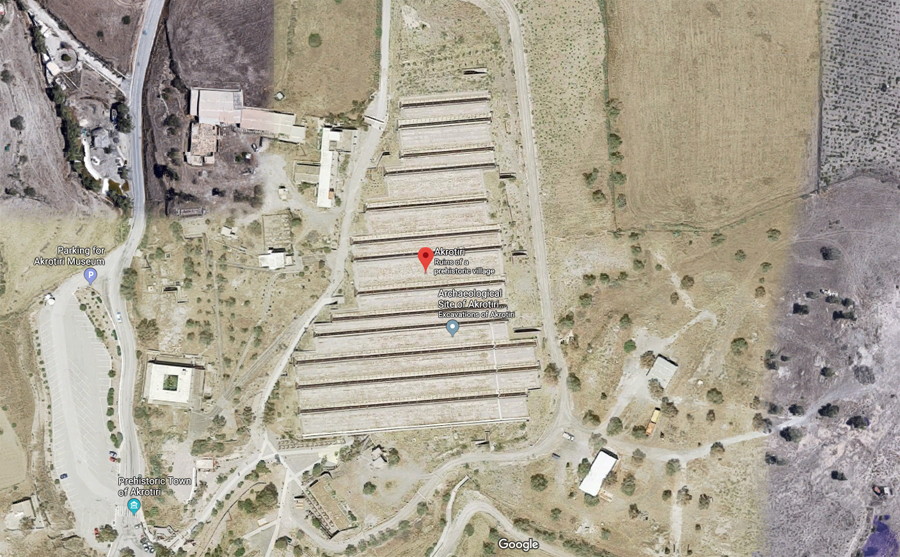
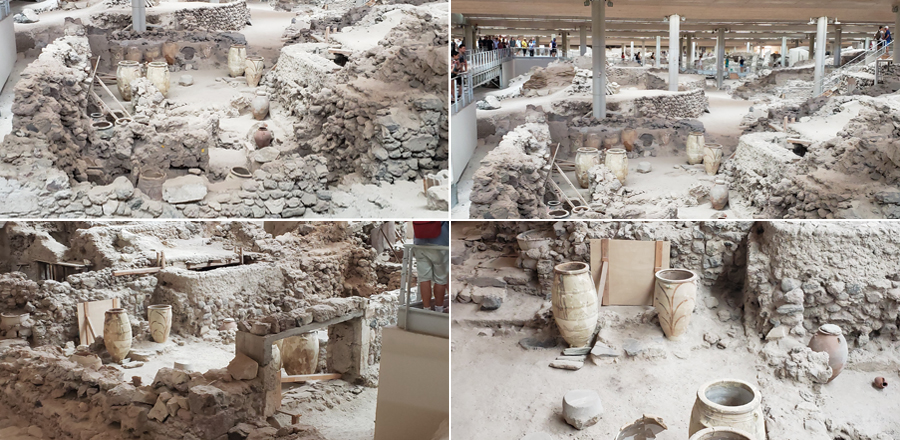
We drove for what may have been half an hour, but could have been shorter. Time seems to drag when you are on a motor coach. We arrived at the very important archaeological excavation site of Akrotiri. At first, on the surface, it didn’t look like much, but these excavations have uncovered one of the most important prehistoric settlements of the Aegean. This satellite photo of the site gives you an idea of the magnitude of this excavation, and it has just barely scratched the surface.
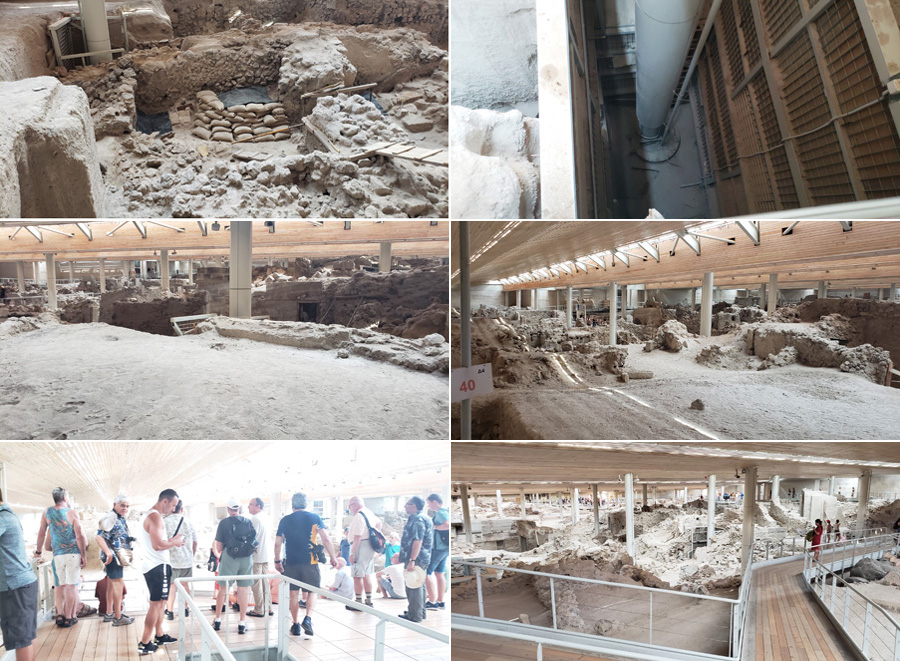
The first inhabitants of the site dates from the Late Neolithic times (at least the 4th millennium BC). During the Early Bronze Age (3rd millennium BC), a sizable settlement was founded and in the Middle and early Late Bronze Age (circa 20th-17th centuries BC) it was extended and gradually developed into one of the main urban centers and ports of theAegean. Deep holes were dug down to bedrock at strategic locations to support the massive structure which protected the dig from the elements and provided plenty of natural light so the archeologists could do their work, which goes on continuously.
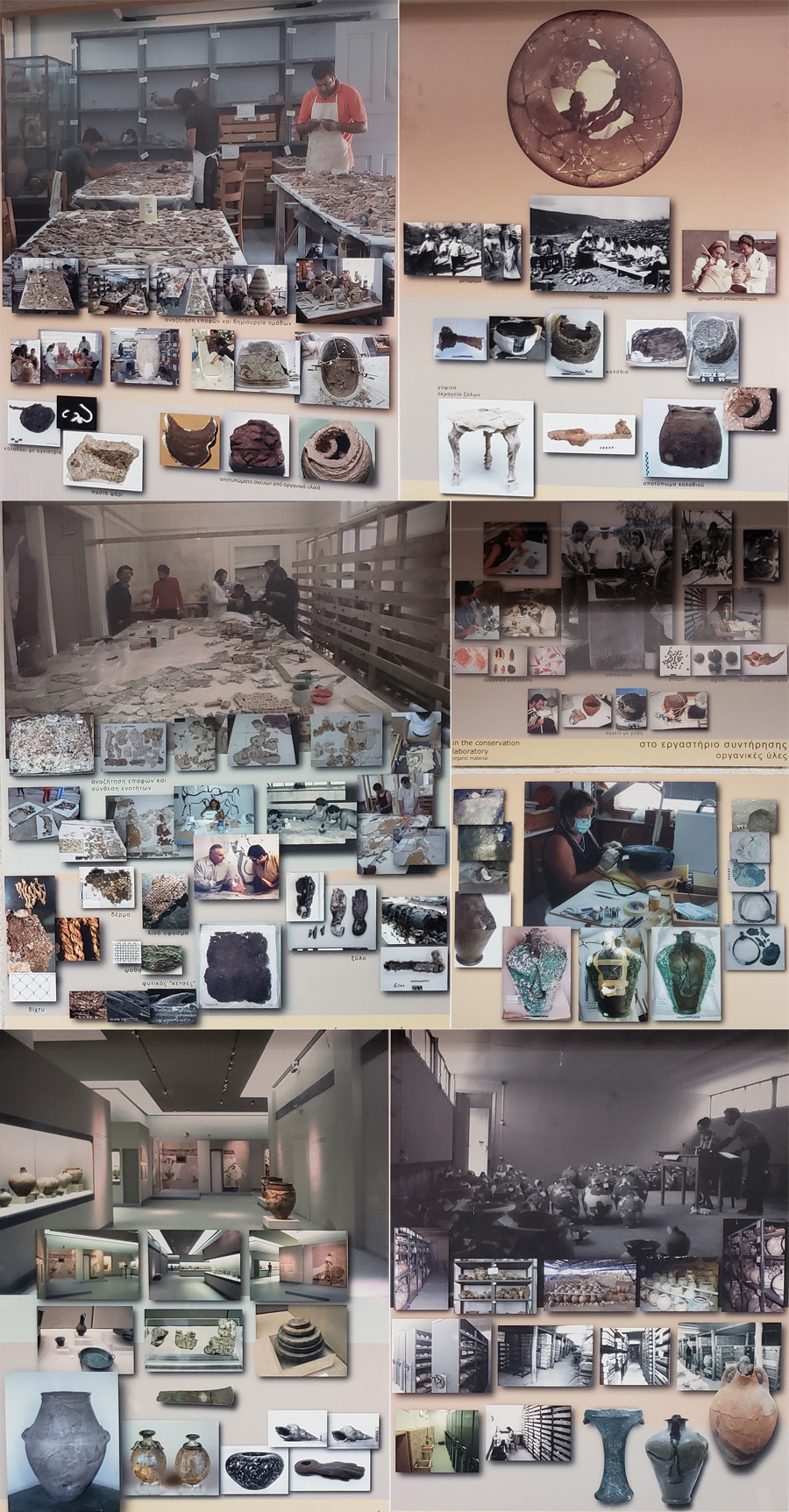
More artifacts are found every day as the earth is removed grain by grain to uncover more of the city beneath.
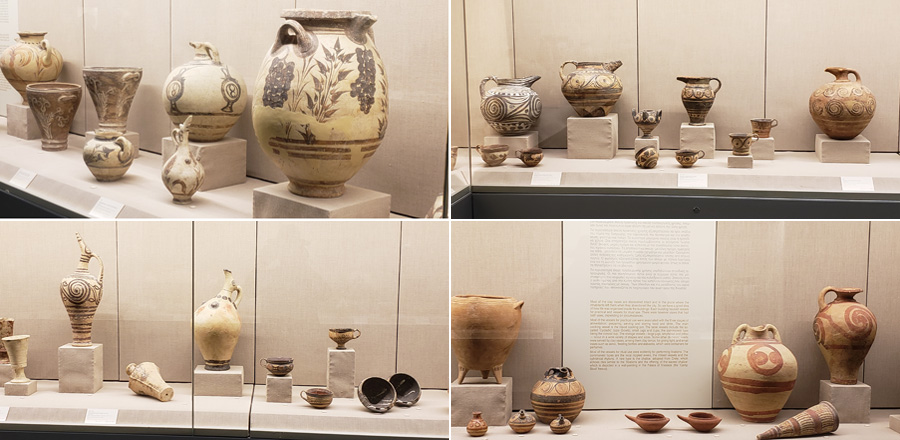
These pots and vessels are displayed in the exact spot where they were discovered. These are just some of the artifacts which have been discovered and catalogued from this archeological site. Amazing!
This certainly does tell us a lot about the culture that inhabited this city before the volcanic eruption that buried it, and preserved it, that we might discover it, uncovering its secrets.
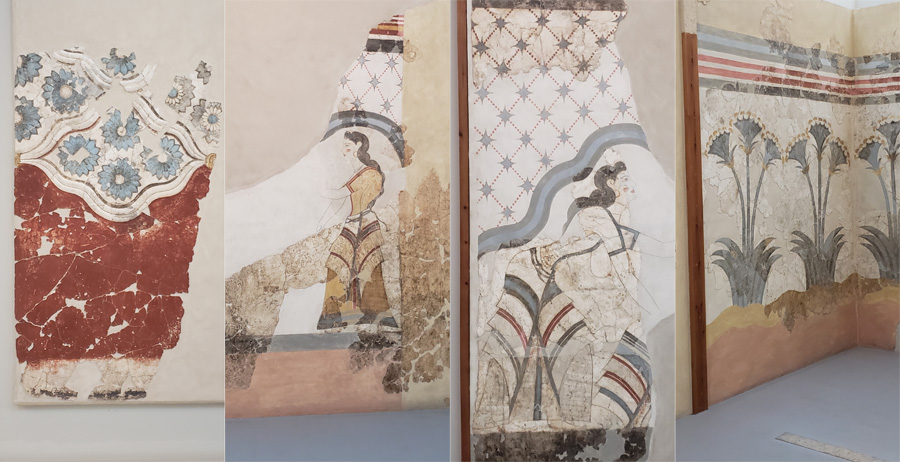
These are some of the beauty frescos that adorned the walls of some of the rooms, and have miraculously been preserved over time. These frescos are far more durable than our modern day wall paper, and they are much more beautiful. The overwhelming majority (about 85%) of the clay vessels at Akrotiri were produced locally. There are also vases (about 15%) from Crete, Mainland Greece, other Cycladic islands, the Dodecanese and southwest Asia Minor, Cyprus and Syria, which bear witness to the city’s wide network of external relations.
No pottery workshops have yet been found at Akrotiri, probably because the excavation is confined to some central neighborhoods of the city whereas the workshops were more likely to have been on the outskirts. Most of the clay vases are discovered intact and in the place where the inhabitants left them when they abandoned the city. So we have a good idea of how life was organized inside the buildings. Having left the archeological site we venture into the small town on the cliffs above our boat anchorage. We enjoy lunch and a beer at a pleasant outdoor cafe.
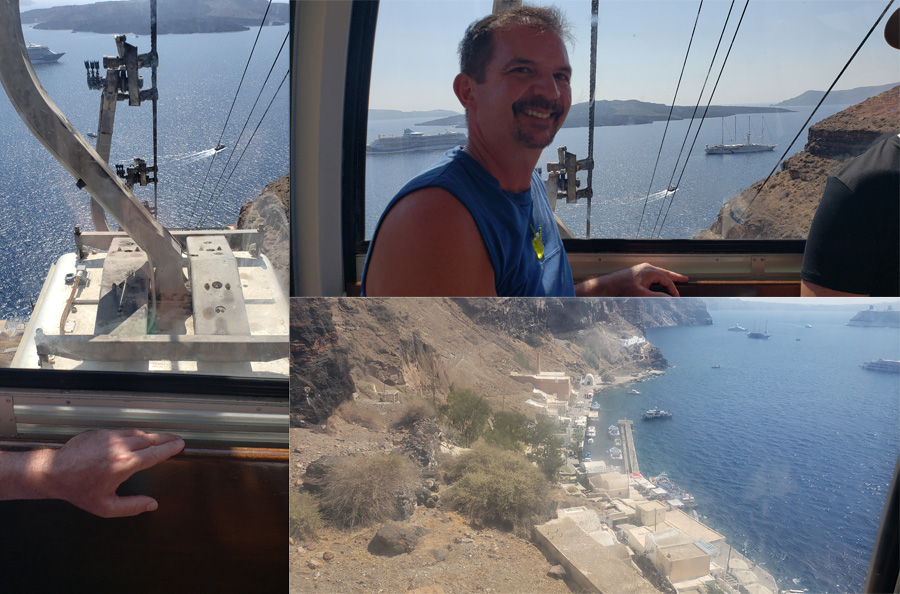
There is a cable car that takes us down the cliff to the port below. It is quite a drop, and the views are spectacular.
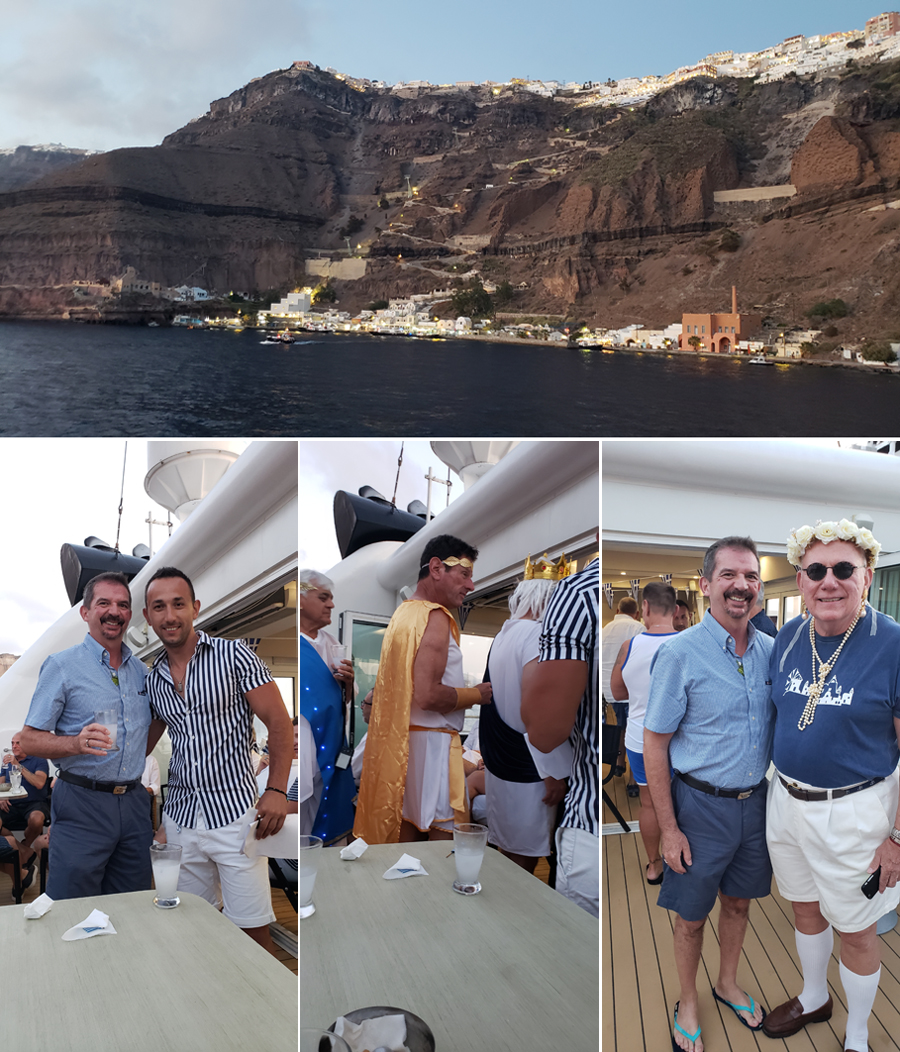
We return to our ship, and looking back at the island of Santorini, we see the switchback road that took us to the top of the island that morning, and just to the left of that are the cable car towers. It was a wonderful day had by all.
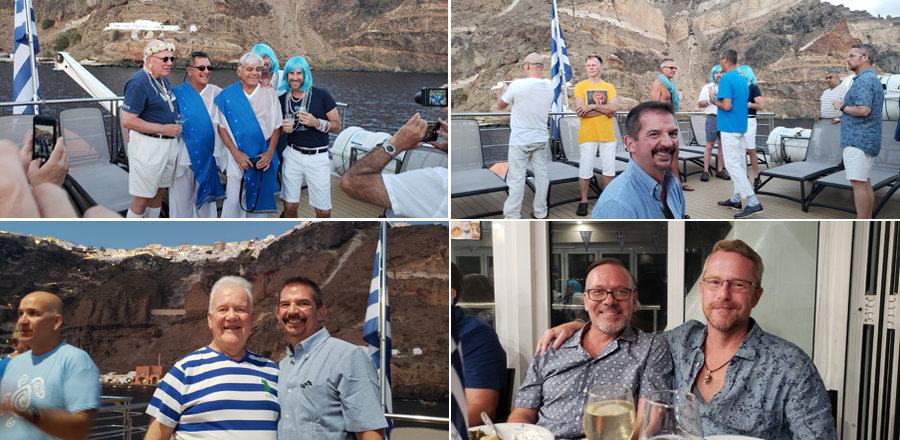
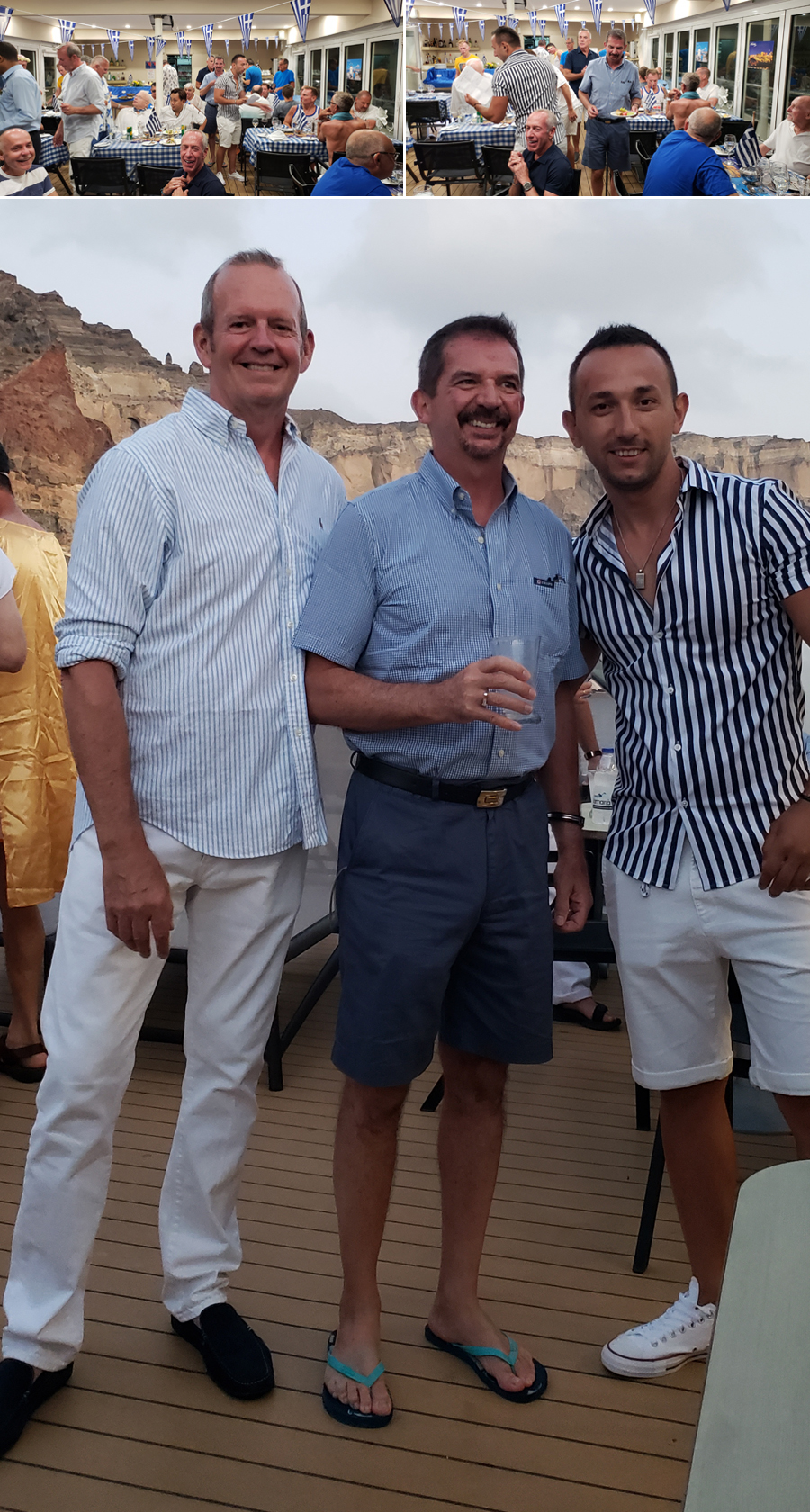
We board the Harmony V in time for the “Blue & White” party. Give a bunch of guys a theme for a party and they go crazy. Posing for photo ops was the order of the day. Pete and I were among the more conservatively dressed.
The party was a fun time for getting to know our fellow passengers even better. Everyone had such interesting stories to tell. We enjoyed another fabulous meal prepared by our excellent chef. It’s a mystery to me how they are able to consistently prepare such interesting and varied meals.
Jim Smith and Agron Zyberaj, our excellent tour guides, pose with Pete. The organization and coordination of the tour activities was seamlessly handled by Jim and Agron. They are extremely capable. Kudos to both. Just before midnight the captain orders the deck hands to weigh anchor and we departed for our next island, the island of Patmos where we will visit the cave where St. John purportedly wrote the Fourth Gospel and the Book of Revelations. This will be our fourth island stop, and we still have three more islands and a visit to Kusadasi, Turkey yet to come, but our Patmos visit will be in the next episode, and hopefully my procrastinating will be at a minimum. |
|
||||
|