|
|
|
|
|
|
|
|
|
|
|
||||||||
|
||||||||||||||||||
|
Email us at: |
||||||||||||||||||
 |
||||||||||||||||||
 |
 |
|||||||||||||||||
|
Click the sun to see the |
||||||||||||||||||


 |
||||||||
|
|
|
|
|
|
|
||
|
||||||||
|
Part 11 Burgundy has been inhabited by humans for millennia. Bone fragments found in Solutré suggest settlements sprang up here as early as 18,000 BC. Celts arrived later, followed by Caesar and the Romans. As Rome declined, the empire's Germanic allies—the Burgundians—stepped in to rule a large region that encompassed the borderlands around today's Switzerland and Italy. The 6th century saw the arrival of another, more powerful Germanic tribe, the Franks. They began shaping Burgundy into what we know it as today. The land east of the Saône, however, reverted back to the Holy Roman Empire in the 11th century. The Duchy of Burgundy, west of the Saône, grew in power and territory, stretching as far north as the Netherlands. Of course we all know how small Europe is. Going from Chalon-sur-Saône to Amsterdam is like going from Los Angeles to San Francisco, or from Buenos Aires to Cordoba. That should puts it more into perspective. The mode of transportation back then of course was the horse. Around the turn of the 16th century, Maximillian of Austria married a ducal daughter and so his Habsburg Empire established a power base in Burgundy. The Treaty of Nijmegen gave Burgundy to France in 1678. Today's Burgundy is much smaller than it was in its medieval days. But still, it's beauty is remarkable. Burgundy's regions have preserved their distinct appearance and way of life. Its rolling, centuries-old vineyards, first cultivated by the Romans, have witnessed the rise and fall of rulers and empires. And like the people of Burgundy, each generation of grape proves more refined than the last. Today, the prize-winning wines from Burgundy are among the most expensive and sought-after pours in the world. Burgundy wines are so well-known that the name itself is synonymous with the deep red color of its greatest vintages. Once we reached Chalon-sur-Saône and boarded the Viking Neptune, there was an Embarkation Buffet waiting for us in the Viking Lounge. They were serving salads, sandwiches and soup. After the long bus ride it was a welcome site. This was from 11:00 to 15:00, as arrivals were coming in from many countries, and arrival times varied a bit. The Program Manager offered us a little exercise with a walking tour through Chalon-sur-Saône, an interesting little community with lots of history. We arrived back on board in time for the Cocktail Hour at 17:30, and a welcome aboard briefing by the Hotel Manager at 18:15, then dinner at 19:00. We spent a very pleasant night on board, and following breakfast we had a shore excursion by motor coach which took us to the Wine Capital of Burgundy, the town of Beaune.
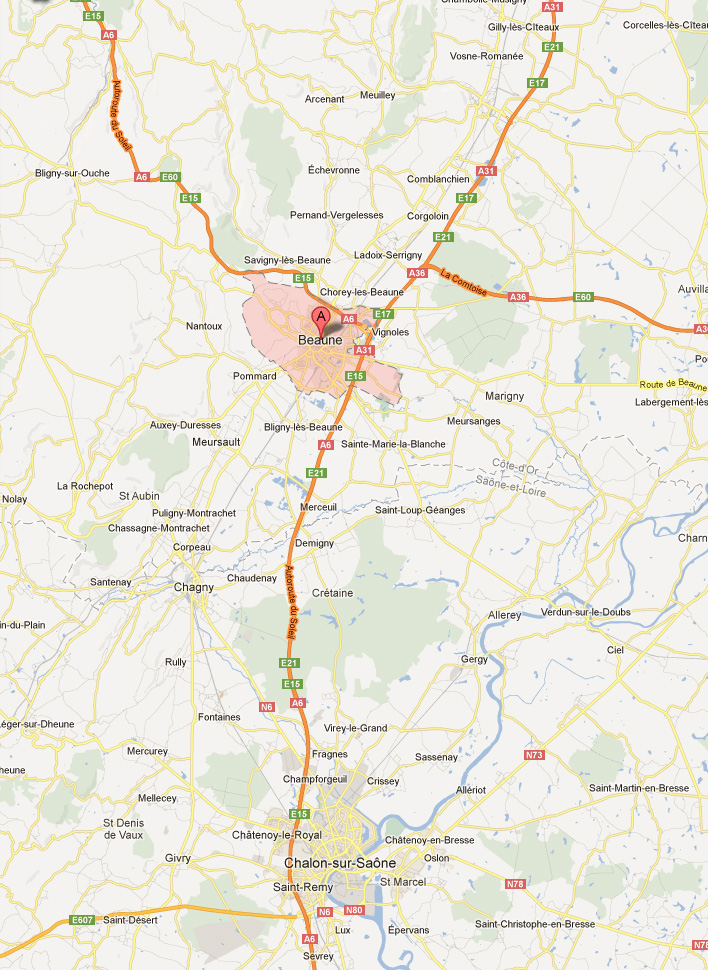
It was a 17 mile (27.3 km) bus ride to Beaune from the ship, still docked where we had boarded her. The purpose of this excursion was wine tasting, and a visit to the Hôtel Dieu.
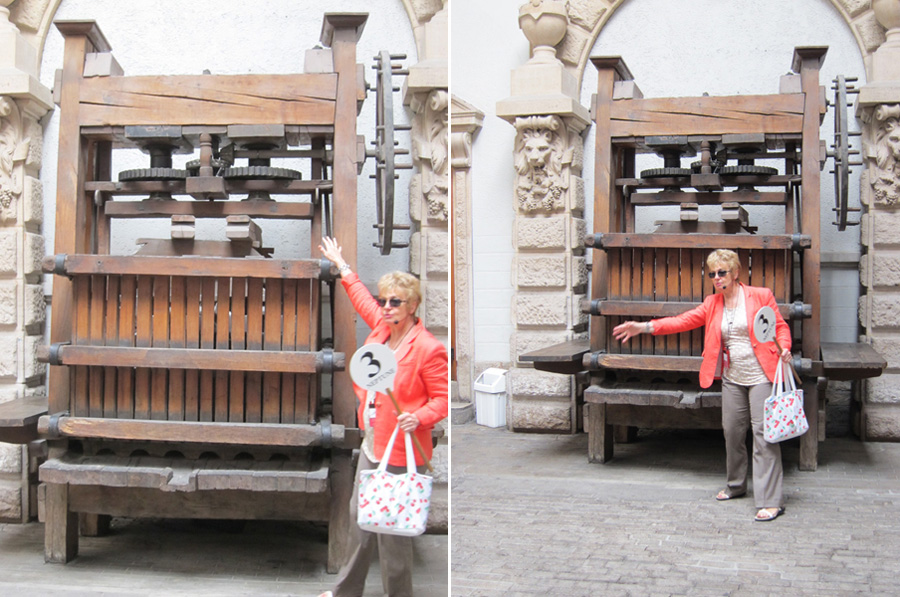
Our tour guide explains the workings of the wine press. There's no stomping on the grapes with your bare feet here. By turning the wheel on the right, through gears that produce a huge mechanical advantage, the grapes are pressed, and the juice flows into barrels from the trough at the bottom.
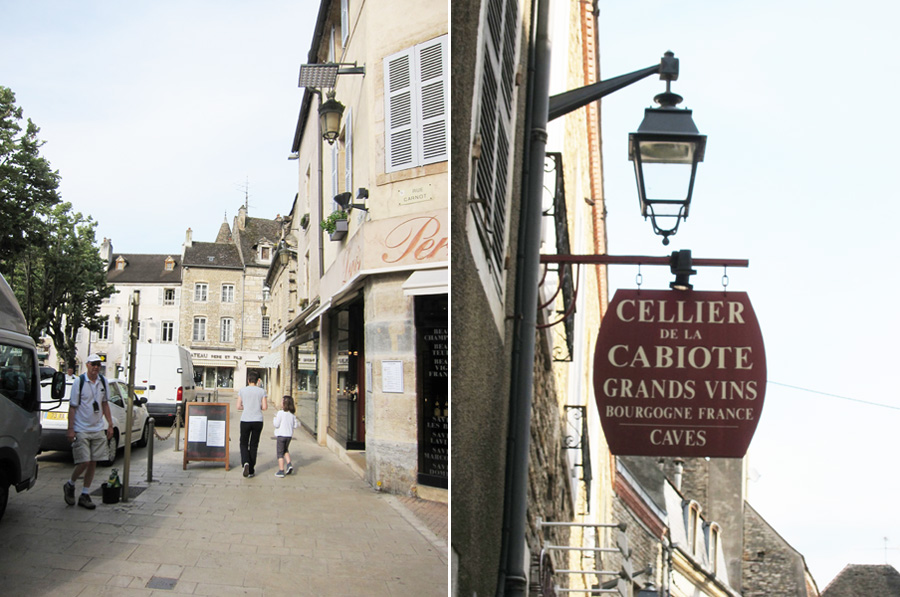
We head for a wine cellar, the Cellier de la Cabiote, to taste of their wines, and get a little tutorial on wines & wine making.
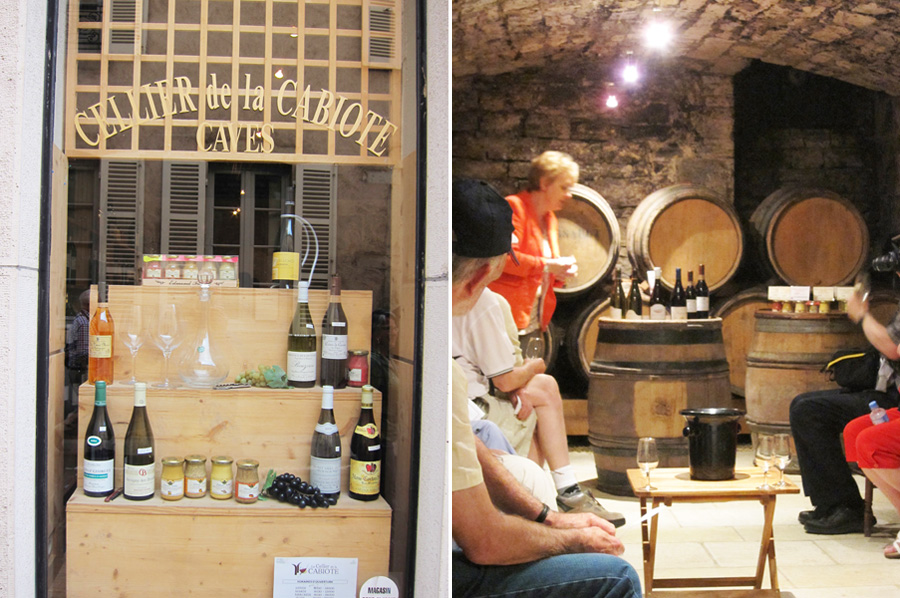
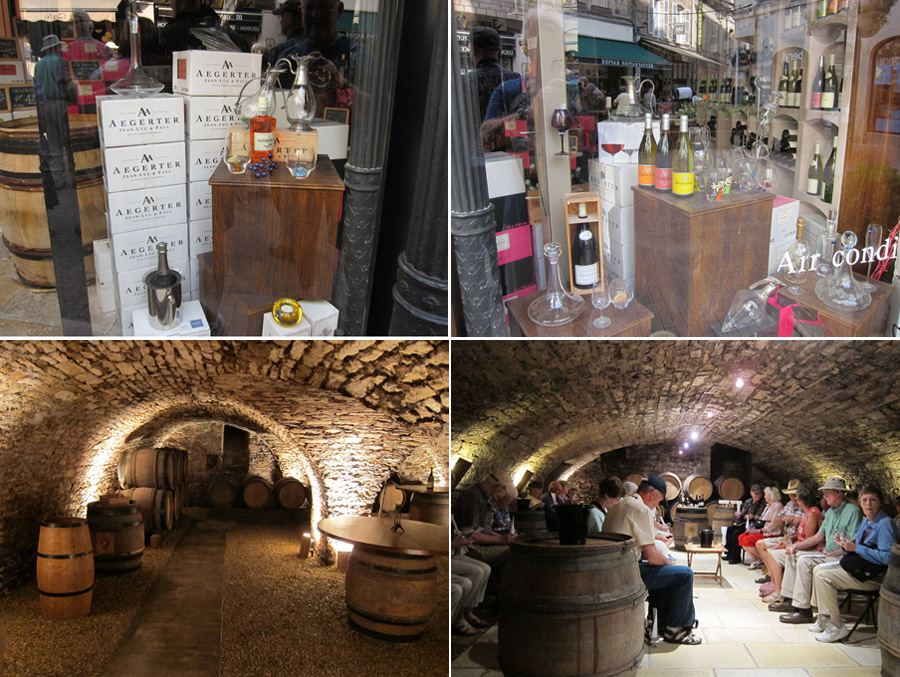
Their window display was impressive . . . . . . and their cellar was deep under ground.
The shop keepers were eager to ship wines home for us, by the case. Yeah, right, with all the wonderful wines
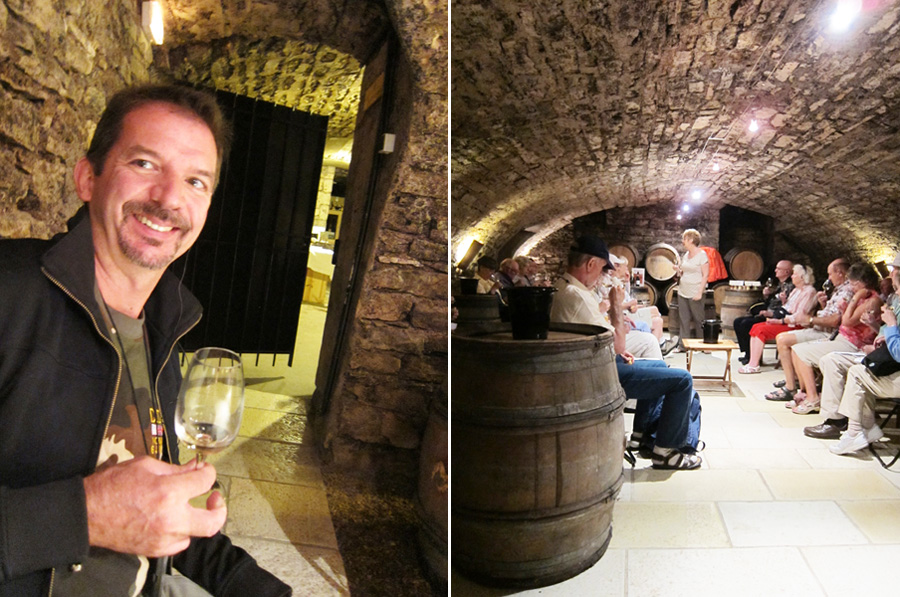
Off hand, I'd say that Pete was enjoying the experience. All the chairs were taken near where the vintner was giving Of course, when you are tasting wine, you are only supposed to taste it, so they put an urn in the center of the room for you to pour the remaining wine from your glass, to make ready for the next wine. We sat far enough away that it would have been a real inconvenience to cross the room and toss the wine, so we were forced to drink all of it, also not a problem for us. ;o)
Emerging from the wine cellar refreshed, and ready to see more, we head for the Hôtel Dieu.
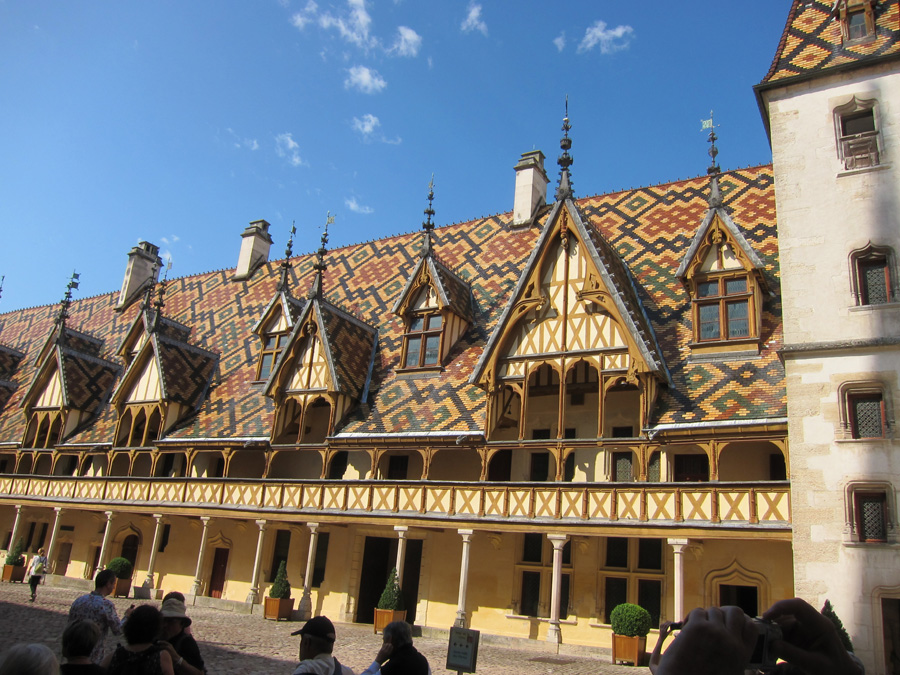
This colorfully tiled building is the Hospices de Beaune, a hospital founded in 1443.
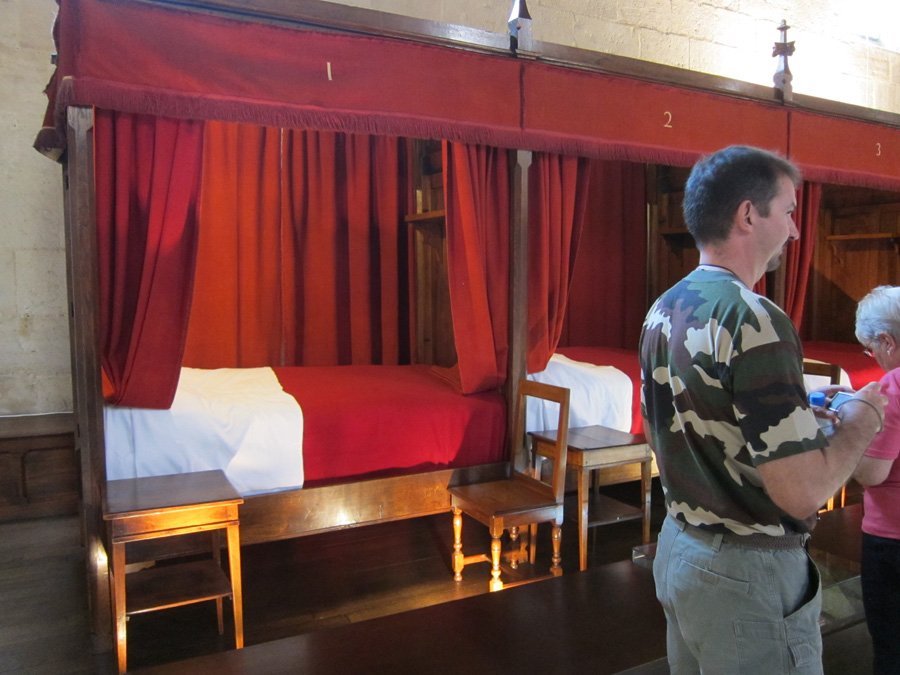
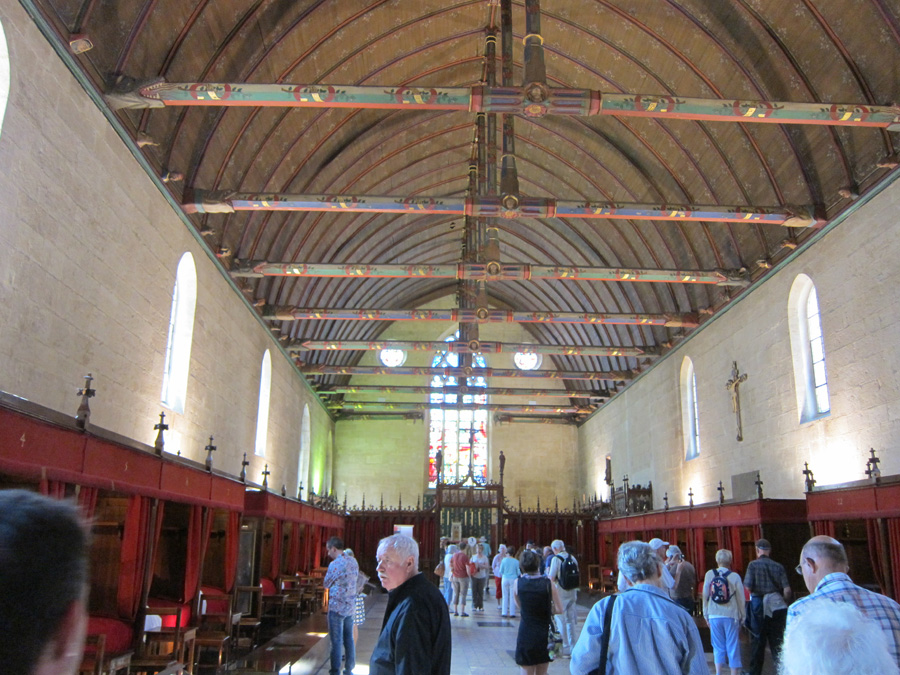
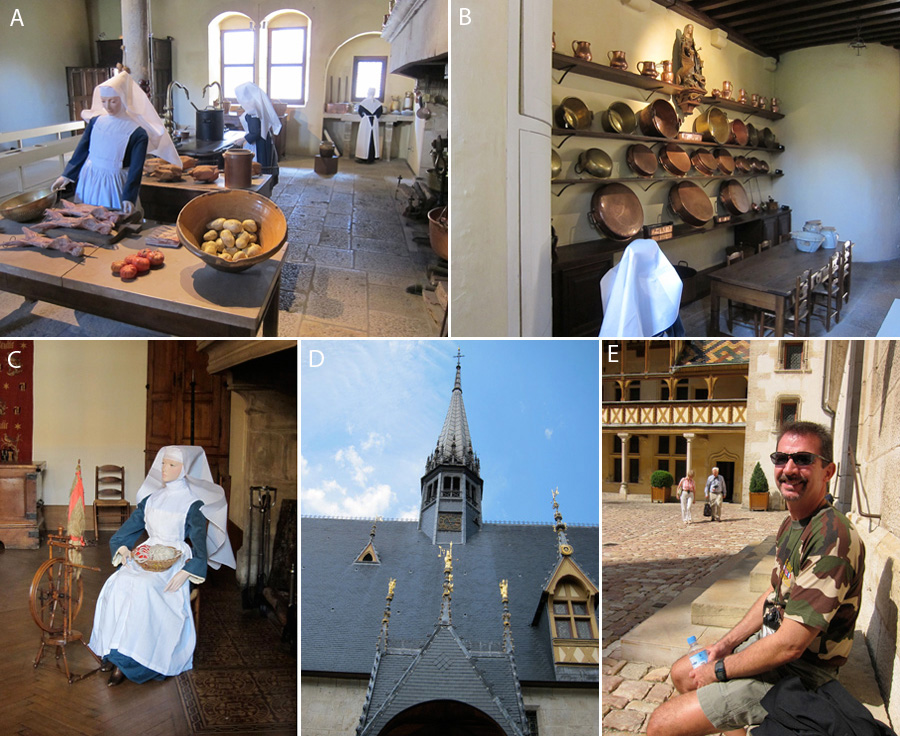
Inside we discovered that the beds were all lined up on each side of a great hall. No such thing as a private room here.
I don't know how, or IF they heated this huge space, but my guess would be that in winter in the 1400s it was mighty cold.
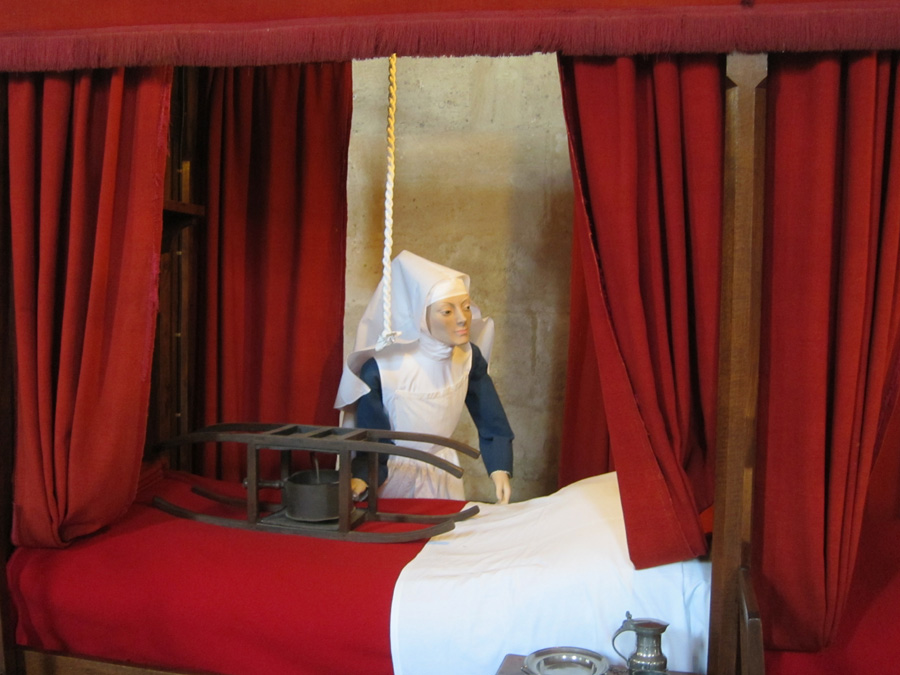
Today it is a museum, so there are wax figures showing what life was like in this hospital when the beds were all full.
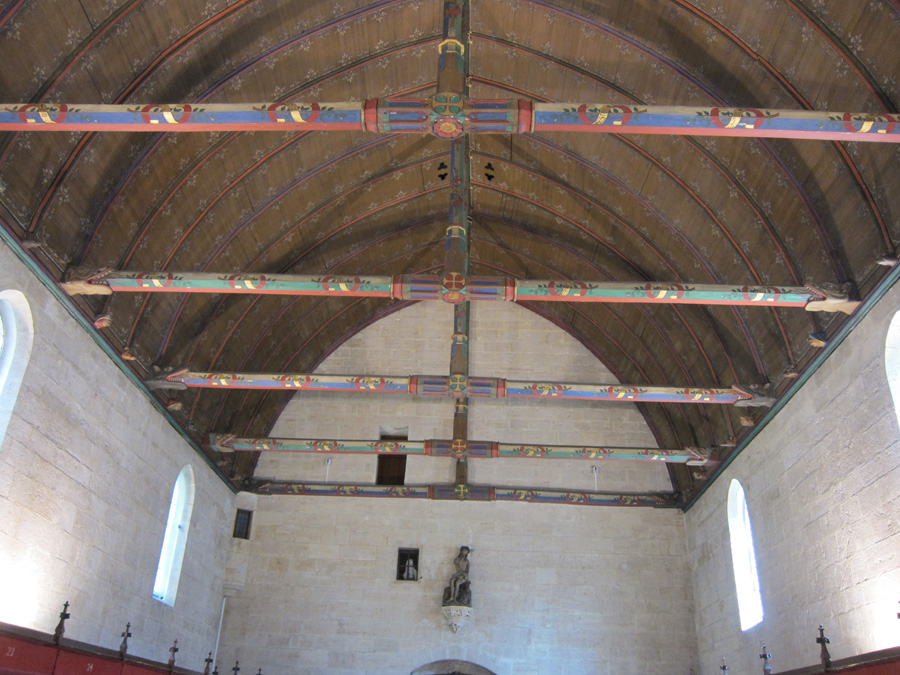
The ceiling beams were brightly colored, which must have given the patients something else to
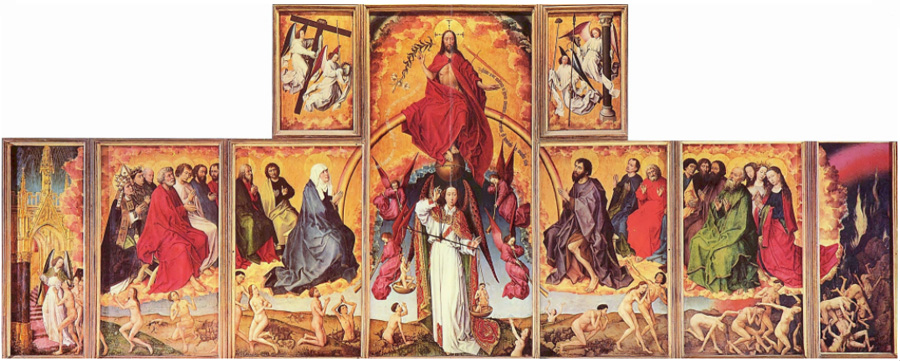
This is The Last Judgment by Rogier van der Weyden (which is the Flemish name he adopted when he came to The Hospices de Beaune was not a hospital where one would come to be healed. It was for the poor and needy, and they came here to die. The Last Judgement shows Christ siting on a rainbow, with Michael, the Arc Angel, at his feet and holding the scale of judgement, weighing the amount of sin each resurrected soul had taken to the grave with them, and those on the right side (or the left side of Christ) were ushered into hell and purgatory, for their souls were heavily weighted down with sin, while those found without sin (on the right side of Christ) were sent to heaven and glory. The idea was that for those about to die it gave them a chance to repent for their sins and possibly to escape the fires of hell. Once you die your fate is sealed, as the painting shows that it is too late to plead for mercy. Notice how Christ and Michael look straight ahead as judgement is passed, not leaning one way or the other. Religion is scary stuff. ;o(
A-B-The kitchen at the hospital ~ C-Things were simpler then, spinning yarn and knitting garments ~ D-the ornate exterior of the hospital ~ E-we are outside, and Pete is thinking 'isn't it about time for lunch?'
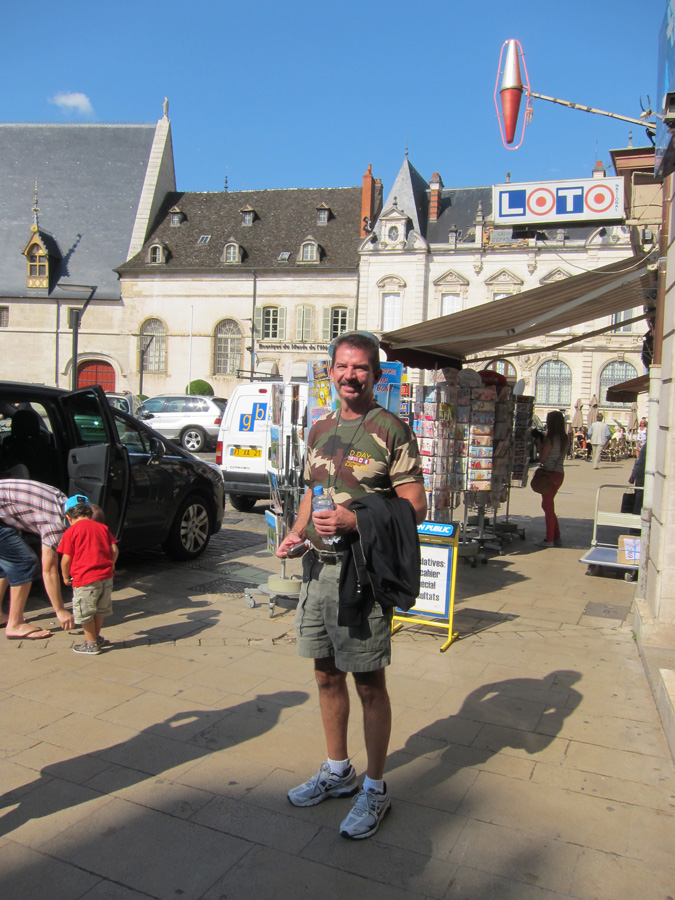
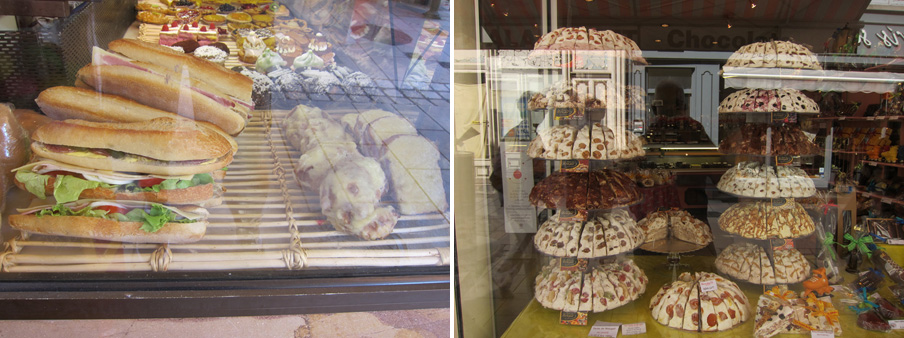
We checked out the shop windows on our way back to the bus. The sandwiches looked really good, as did these cakes. But, we knew that a wonderful lunch was waiting for us back on board the Viking Neptune. We arrived back at noon, and weighed anchor and departed Chalon-sur-Saône bound for Tournus.
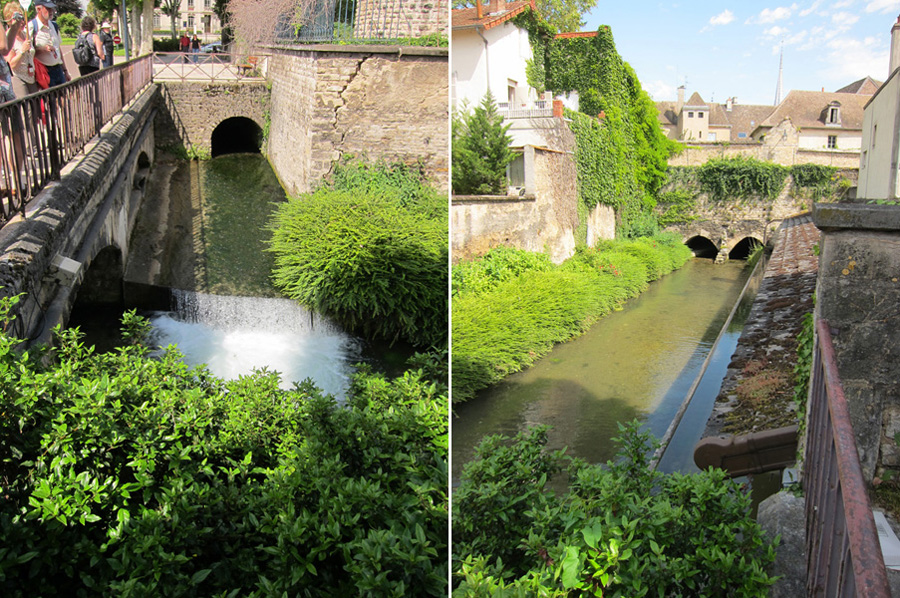
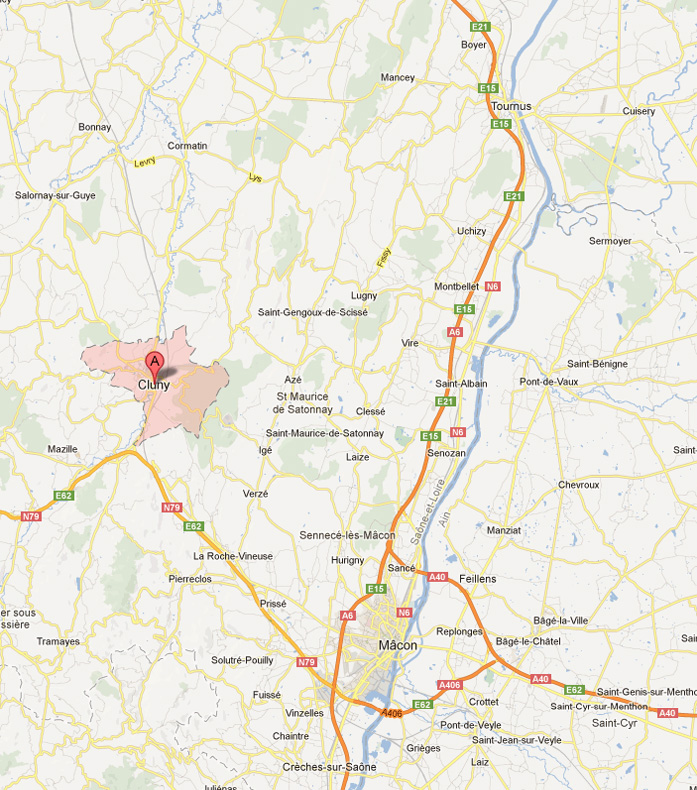
On the way back to our bus we passed these interesting and beautiful canals that run through the city. There was an optional tour to Cluny, which we purchased for €41 each, and our stop at Tournus was to drop us off there for this Cluny tour, and we would rejoining the ship at Mâcon.
We leave the ship at Tournus (upper right), and go by motor coach to Cluny, and after a walking
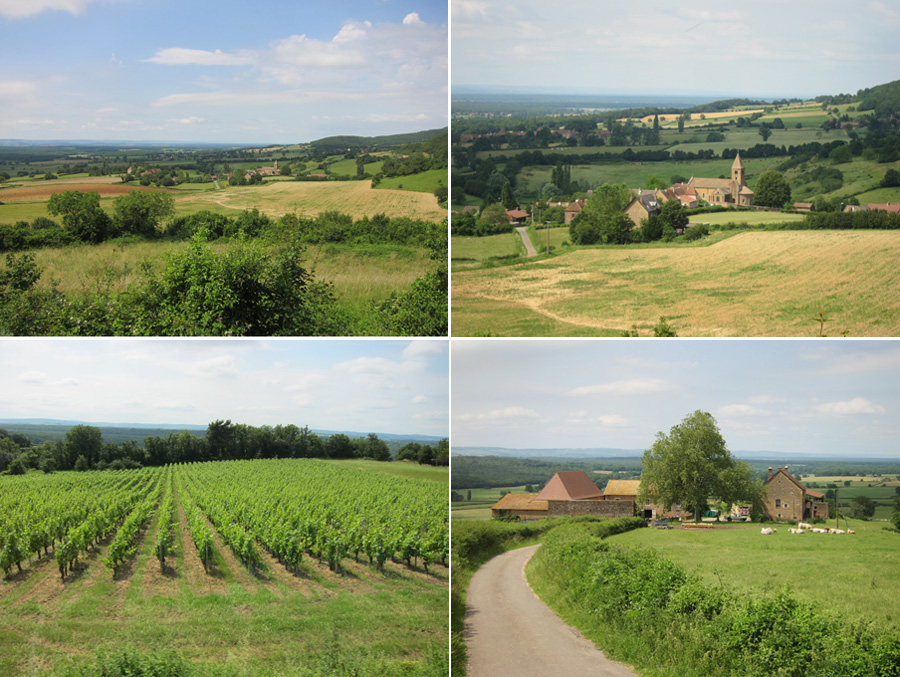
As we traveled from Tournus to Cluny the country side was quite peaceful and beautiful. In Part 12 you will see what is left of the Benedictine Abbey at Cluny. It is quite amazing. |
||||||||
|
||||||||