GREECE
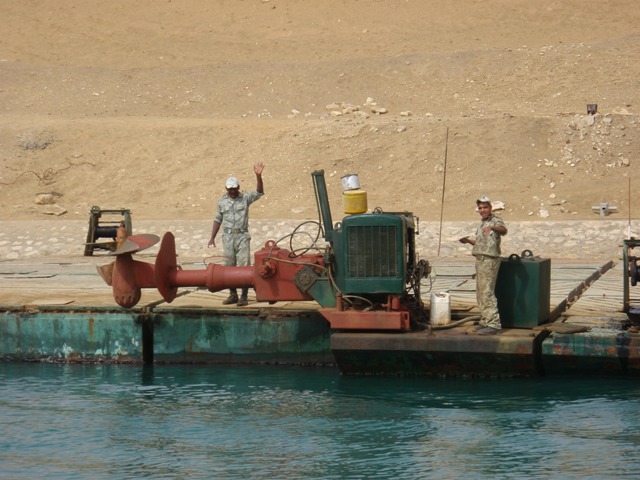
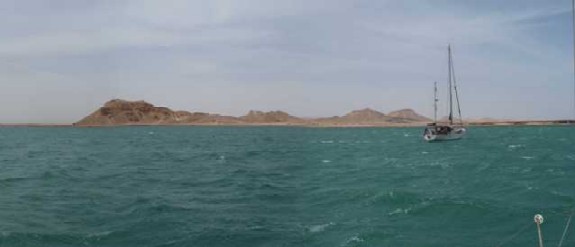
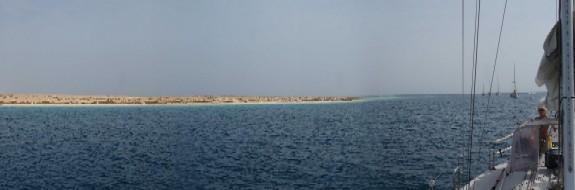
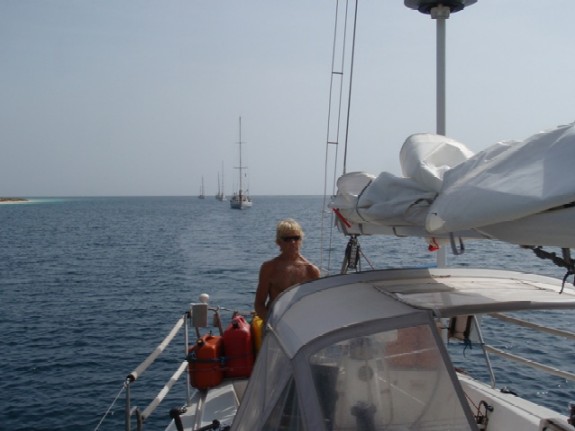
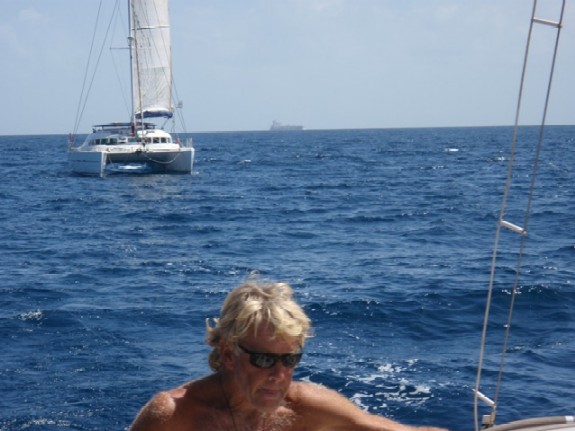
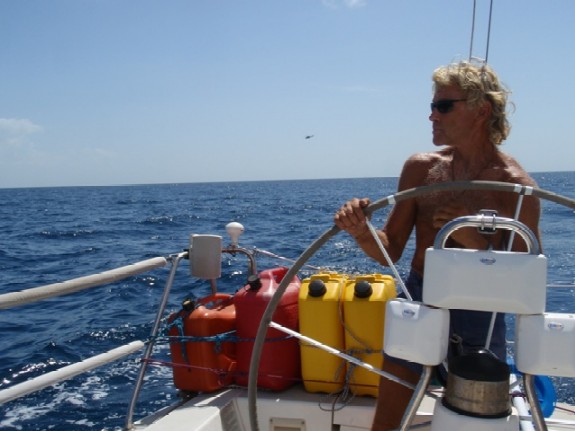
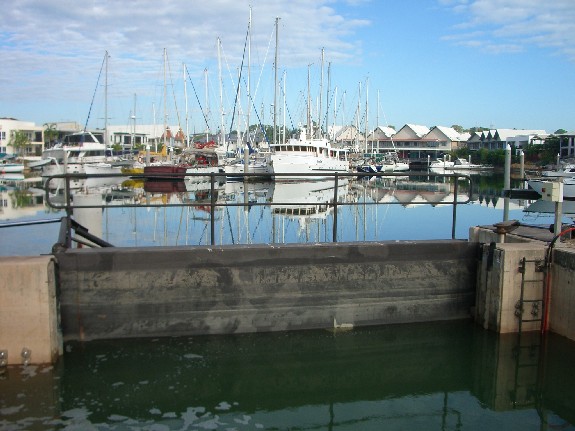
May 23 - 31, 2009Skipper Bob, his brother Jim and I ran amok doing some last minute provisioning and taking him to our favourite hole in the wall in Crete, Sammi's for gyros. How funny we have been in Crete for 5 weeks and neither Bob nor I have had the American Greek specialty gyros. At 3 pm we headed out of the harbour at Angios Nikolas and Jim was constantly asking about all the gear that he doesn't have on his fishing boat in Alaska.
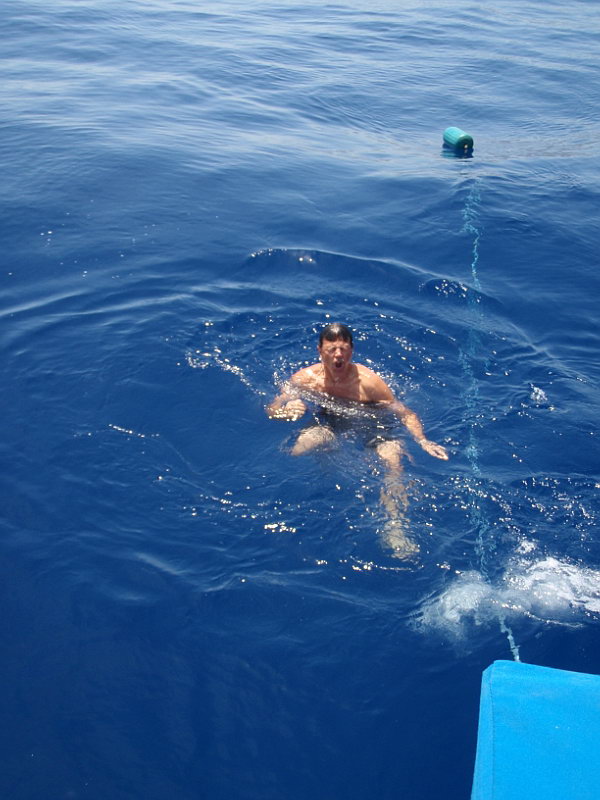
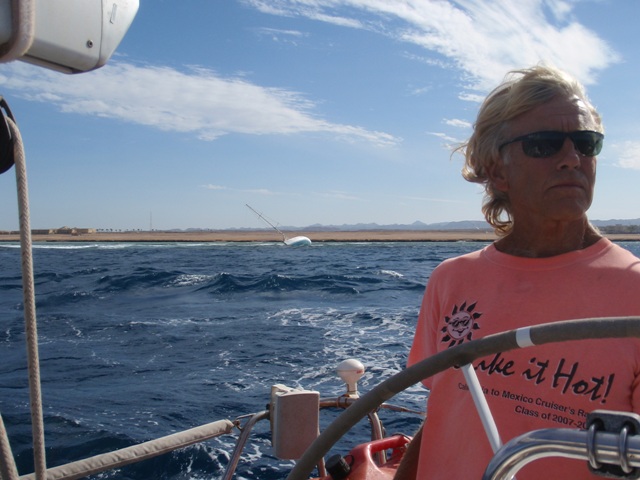
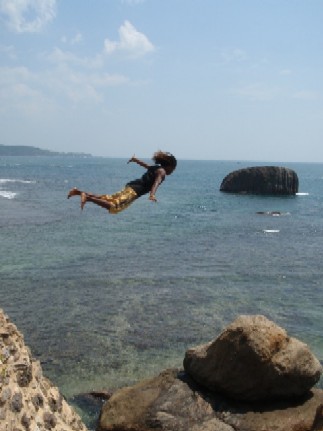
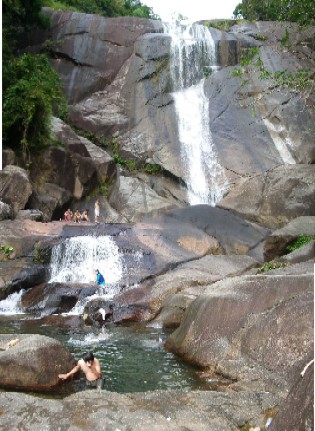
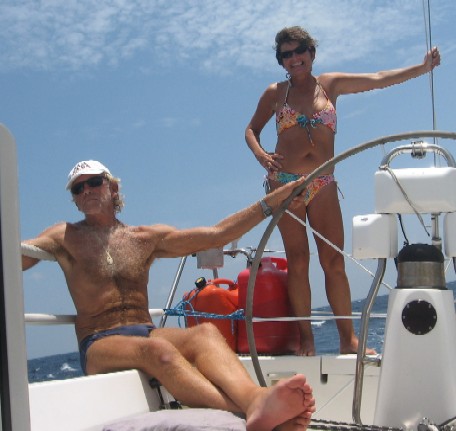
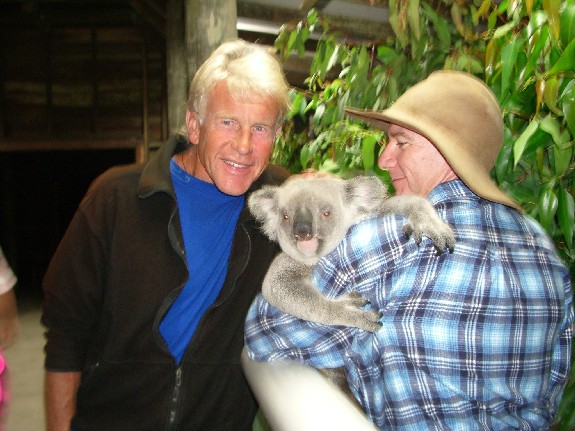
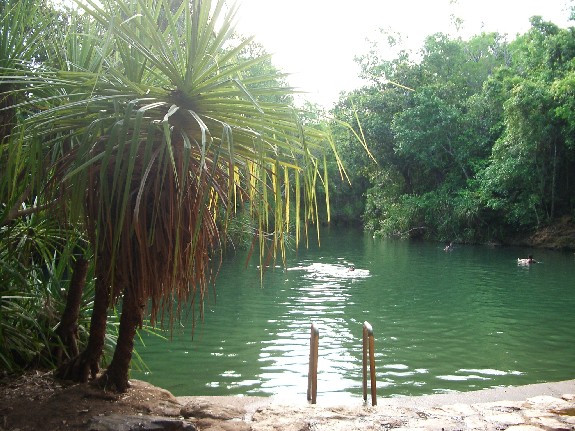
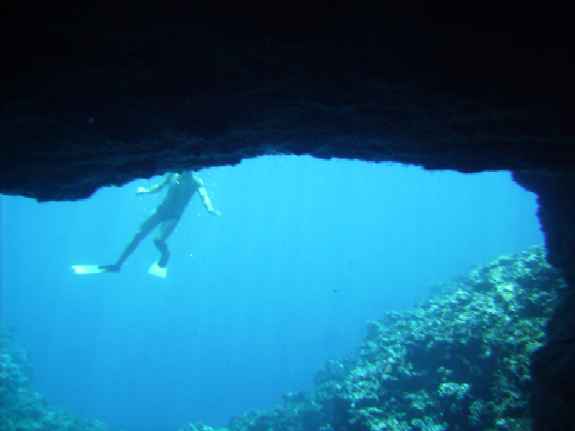
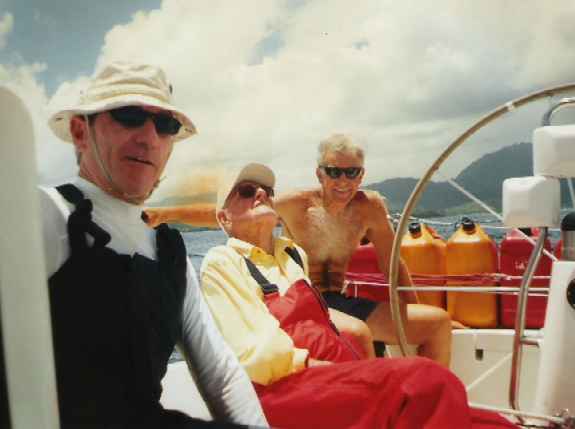
Speaking of Alaska, Jim is leaving for the fishing season in Bristol Bay, Alaska in several weeks and he talked us into stopping midway for a dip. You can tell by his expression that neither he nor I stayed in the water very long.
Bob had spent hours pouring over the charts and comparing them to the finicky weather patterns and he decided on 75 miles north to the great island of Santorini. Jim had been there on a Windjammer cruise with his wife in 1995. We asked him if he would rather go someplace else and he said, No, we were going to love it.
SANTORINI - THERA
May 24 - 25, 2009
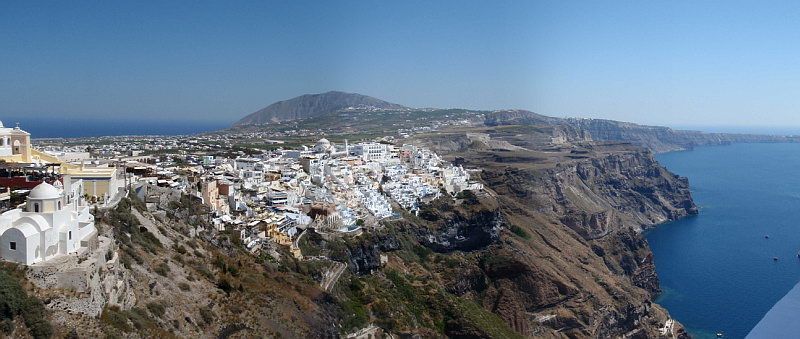
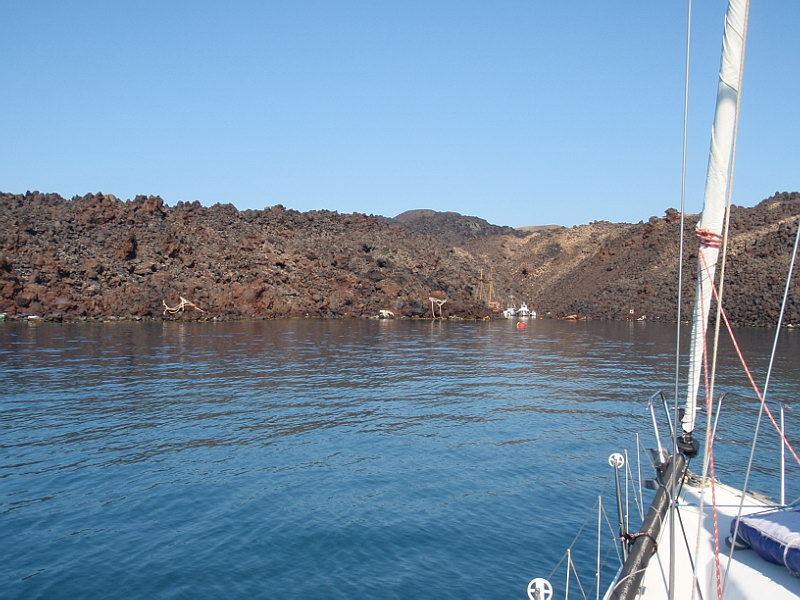
The majority opinion is that this island had the great city of Atlantis on its shores when the mountain blew and obliterated most of the eastern half of the Mediterranean. To look at the topographical map it is easy to see how much of the island disappeared that fateful day in antiquity.At 10 am we sailed into the epicenter of the crater and up to the edge of the caldera. It was too deep to anchor and there were no mooring buoys. The cruise liners were in the bay and where they dropped off their patrons you had choices; take the donkey ride to the top of the cliff, walk, or take a cable tram.
We opted to find an anchoring place so we wandered over to the plug and it was quite undesirable for landing or anchoring. Surely we would get the anchor wedged between the rocks and there it would stay. Left with no choice we went to the marina and stern tied to the dock.
In the marina it was quite the walk to the facilities and we didn't get much for our $20US per night. No electrical, water, showers, and we shared the jetty with stinky fishing boats.
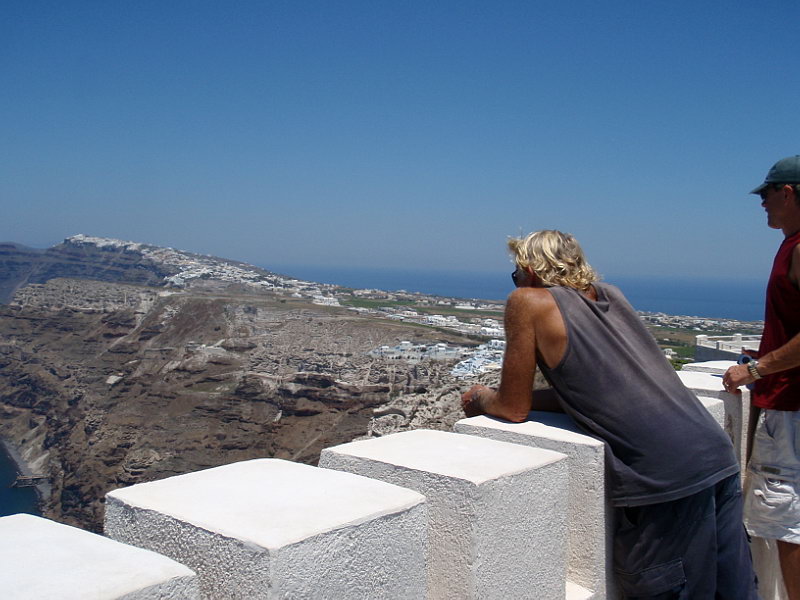
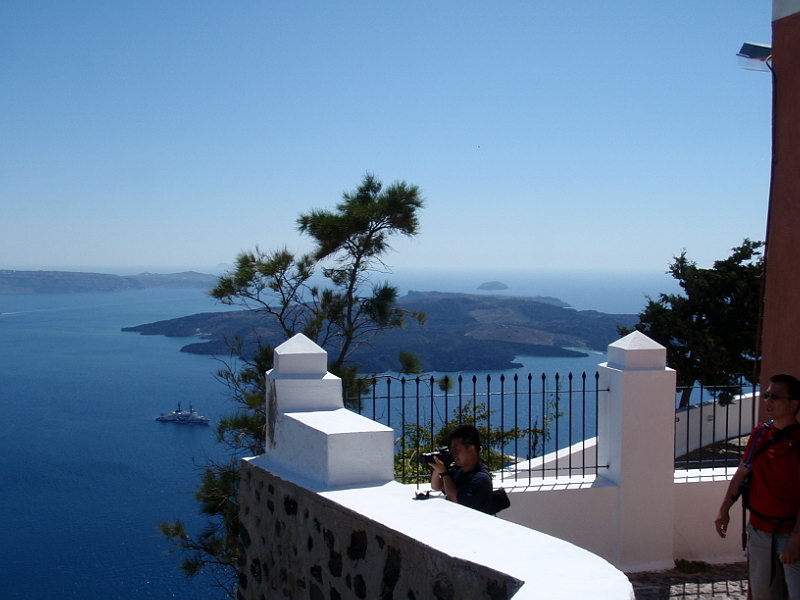
The boys had rented a car and now it was Jim's turn to drive. We were trying to get to the city of Thera but there on the crest of a hill was a very beautiful building and…it was a winery!
We didn't care for the wine but the view was breathtaking.
We found a place to park at Thera and walked the many winding trails between the buildings. You would wind around buildings looking over the roof of the buildings in front of you.
After traveling up and down and all around we got thirsty and stopped for refreshments and ice cream and soaked up the view.
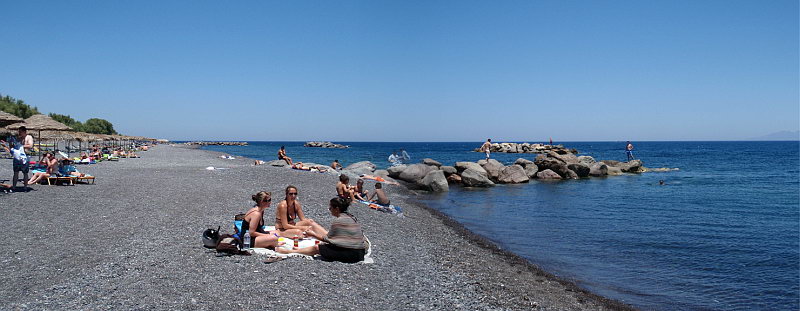
Exploring further along the coastline we found a beach and lunch. We were not too impressed with the gravel beach. It was hard to walk on the beach and the bathing beauties were anything but beauties.
We hated leaving because this place deserve a lot more time sitting in a café 100's of feet in the air but we took our time and left for more adventure at 11:00am
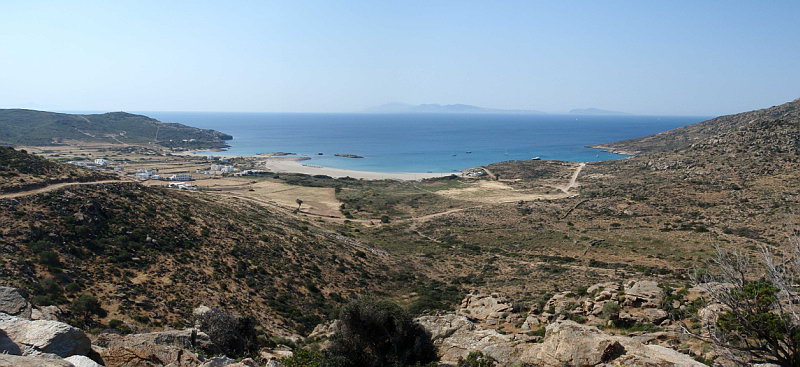
IOS
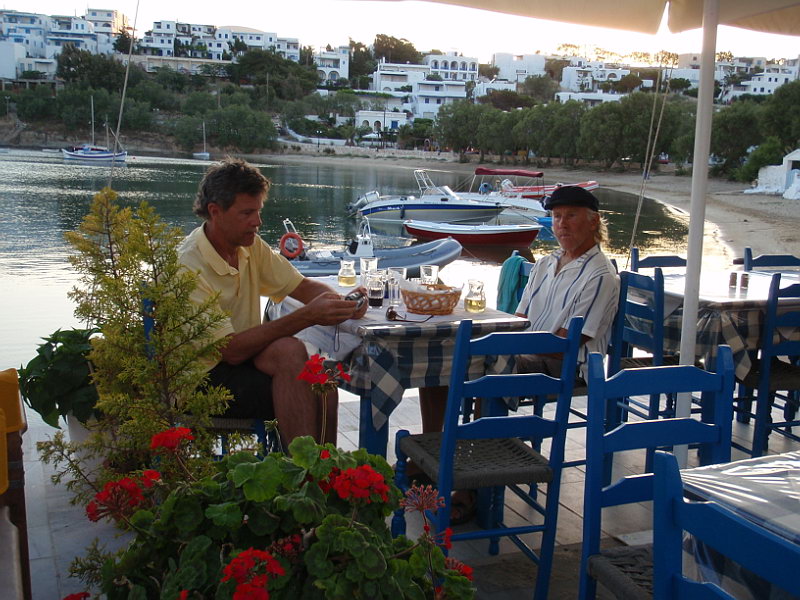
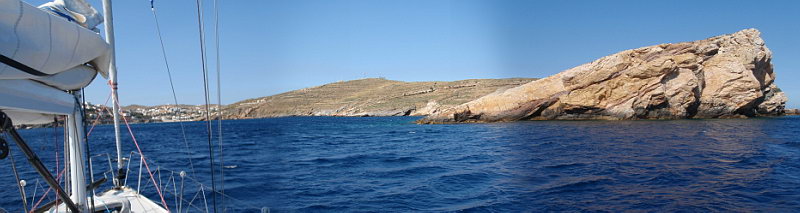
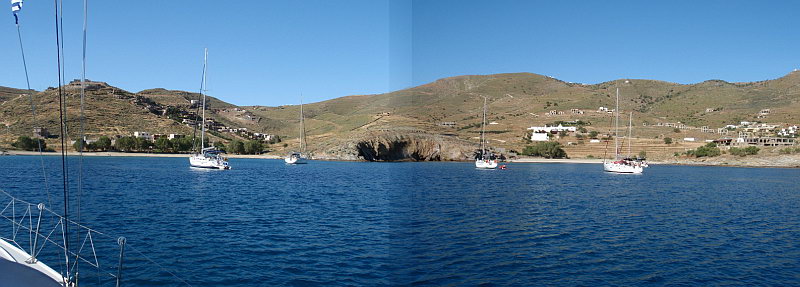
May 25 - 26, 2009We timed all our islands for a good sailing day and this one turned out perfect. 4 hours of sailing and Jim with his binoculars was determining the best place to anchor. This was an interesting island in that the buildings along the Ormos Manganari bay could not be called a hamlet, village, or resort. For that you needed to go over hill and dale to the other side of the island.
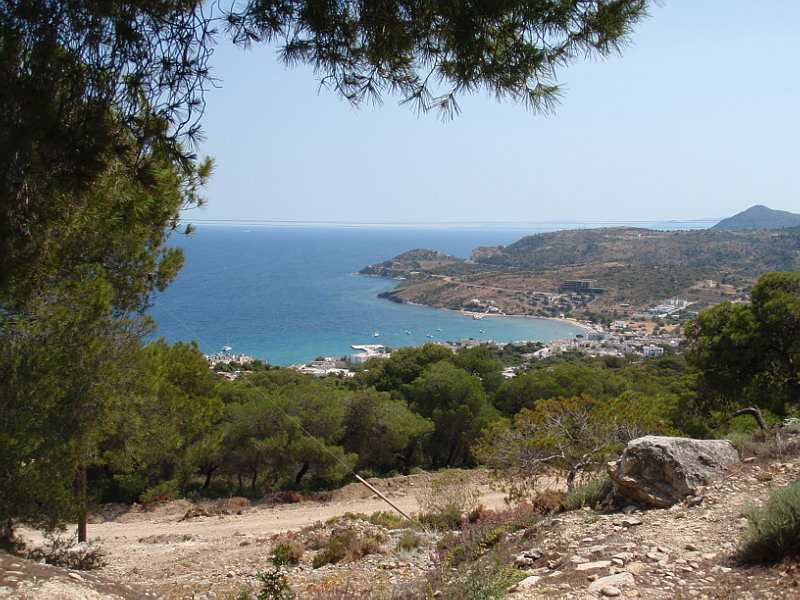
Jim scanned the countryside and spied an old forgotten road that climbed through the hills and out of sight. Looked like exercise so we quickly blew up the dinghy and went to shore. Climbing all the way to the top of the ridge was not easy as it was heavily eroded and full of ankle-breaking rocks. At the top there was the new road that winds all the way down to the shore. We passed old windmills, herds of curious goats, and many rock fence type walls going nowhere. There was an abandoned home site and we explored how the family must of lived in the not too long ago past.
After the hike we needed a break so we stopped at the only restaurant on the beach. To our delight Mom and her cheery band of locals fixed us some excellent Greek meals.
After kissing Mom on both cheeks (the local custom) we headed off in the dinghy for Gaia and a good nights rest. Wait! Not so fast! Jim didn't have his binoculars and trying to act like General Washington on the Delware he lost his sunglasses overboard (yes, it was dark for several hours now). Bob forever the skipper who knows what to do went to the boat and rigged up a fender with the dinghy anchor. He and Jim motored out to where they thought was the spot and dropped the anchor and fender. Next morning I woke up and saw that the fender was about 100' off the starboard side of Gaia in 22' of water. No way were they ever going to find those sunglasses. I bet he wouldn't find them but Jim grabbed a snorkeling mask (the fins were too small for his gunboat feet) and into the fridged water he dove and Eureka! I lost the bet. He found the glasses like 5' from the anchor.
We had a very quite night, went back to Mom's for lunch and left Ios at 1:00pm.
PAROS
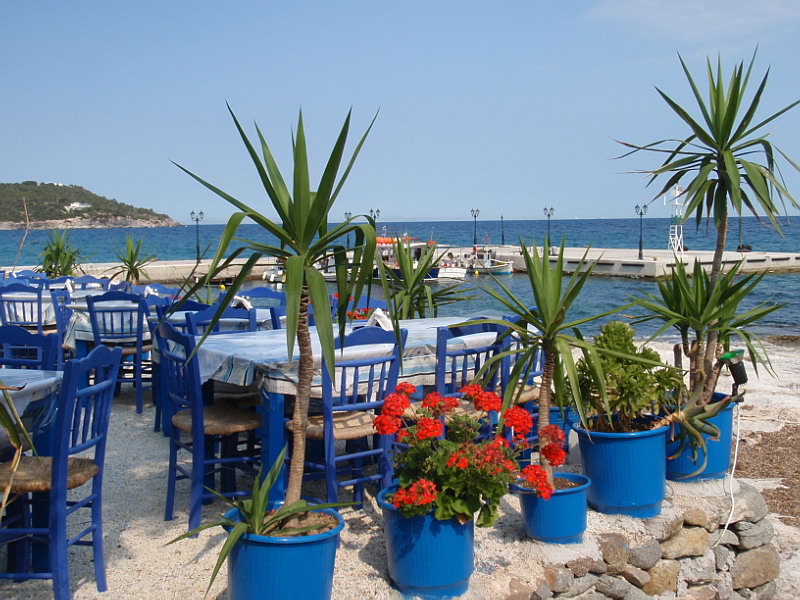
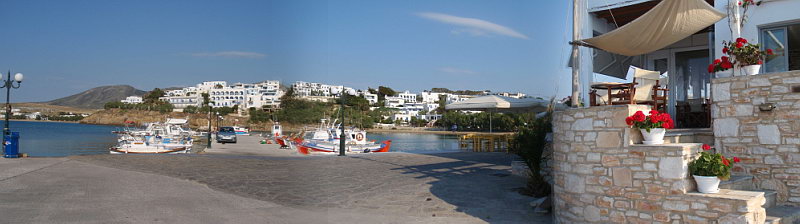
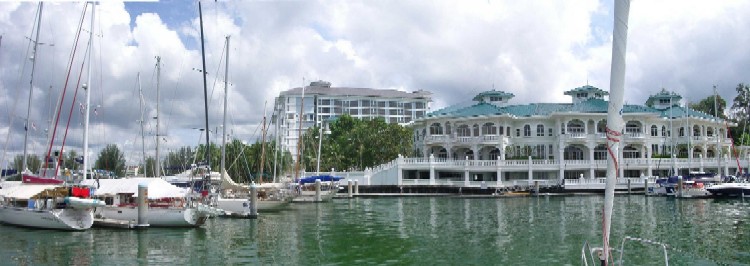
May 26 - 27, 2009This inviting little harbour in Piso Livadh wrapped around the beach with typical Greek architecture, fishing boats, and lots of bougainvillea. We had arrived at 6 pm and in case you haven't noticed we have not had a shower since we left Crete. We were really looking forward to a marina with a shower. Even though we have a watermaker water is a big conservation and frankly, Jim would never fit into the boat's head for a wash down. The jetty looked new and inviting and
there was a larger, newer building at the foot of the pier. We were disappointed to find out there were no showers but then again there was no charge for the dock or the electrical hook-up. Jim took off on a mission. He returned with a huge smile, a motel key, and a story about talking to the local lady about a discount for just using the room a couple of hours for showers. You would have thought she would be upset when he returns with two scruffy friends but she turned out to be very friendly and treated us like family.
We took our time getting ready in the morning as we didn't have far to travel and there was no wind. The next morning at 10:45am we said good bye to the cutest little bay yet.
SIROS
May 27, 2009Bob was checking the GRIBs regularly but we were not prepared for a tough sail. We had a long windy close hauled sail and at 5 pm we were glad to finally anchor in the bay Ormos Varis.
This was perhaps the least mountainous island and had a sizable bay to anchor. Too tired to blow up the dinghy we opted to not go to shore. The night was a little rocky with swells in the bay but the wind eventually died down during the night.
The next morning we had our usual yoghurt and fruit and left at 10 am for our usual 6 hour crossing to the next island that was directly in our path.
KEA
May 28 - 29, 2009Arriving at Ormos Kavia Bay I was still feeling the effects of the rough crossing of yesterday and since we didn't arrive till 5 pm I opted not to dinghy to shore for dinner. Bob and Jim climbed a hill and became the guest of a bunch of local boys enjoying the usual Greek night out without the girls. Needless to say they were quite happy and loudly exclaiming how much fun I had missed. Then they promptly fell asleep. There were 5 Sun Sail charter boats in the bay and I enjoyed watching the French and Germans frolicking in the water. Later I saw all the dinghies going to one boat and there the real party began. Someone thought they were pretty good on the trumpet but he only knew several songs with the death taps being one of them. This went on till 3 am.
For some reason we were up and ready to leave at 7:45 am so we had breakfast on the go.
ANGINA
May 29 - 30, 2009All too soon we were at the last island stop before getting to the mainland. At 2:00 pm, we entered the bay and anchored out at Ayia Marina. All three of us had been totally confused about the marina part of the bay till we figured out that was the name of the bay not a marina in the bay.
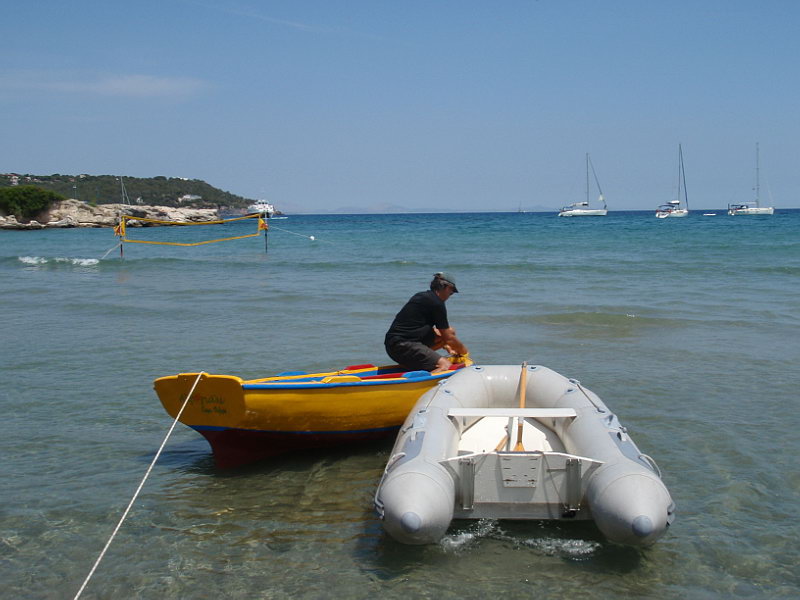
This is the local resort town for the city of Athens. Jim, with his ever faithful binoculars, spied a temple high up the mountain. OMG! Another heart exploding climb was in store for us. The beach was full of small resorts and as we were motoring the dinghy towards shore we bantered where to land. Bob wanted to head for the small yellow local dinghy planted right on the beach in front of the umbrellas. I thought we should be polite and land off the edge of the resort's beach. So we headed for the yellow dinghy. The surf was dicey so we didn't see the waiter heading in our direction as we were pulling the dinghy past the surf line. Oh, Oh.
Big grin and lots of gesturing he told us to tie to the yellow dinghy and let the boat caress in the surf. He gave us the local greeting with lots of information about the island. When we inquired about the temple on the hill he told us we could hire a car or taxi or motorcycle and switchback up the hill. When we said we wanted to hike up he thought we were thoroughly mad but gave us some shortcuts to make the climb.
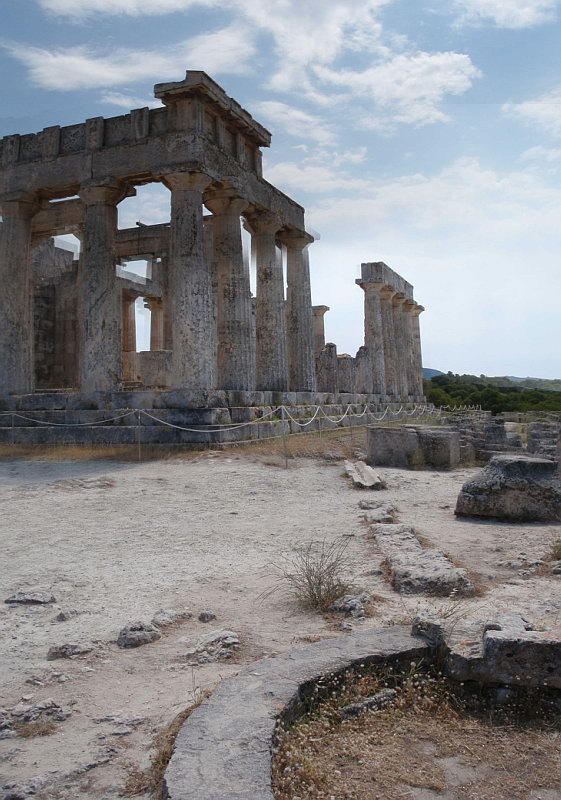
We were totally mad to walk the hill but we made it and what a sight to behold.
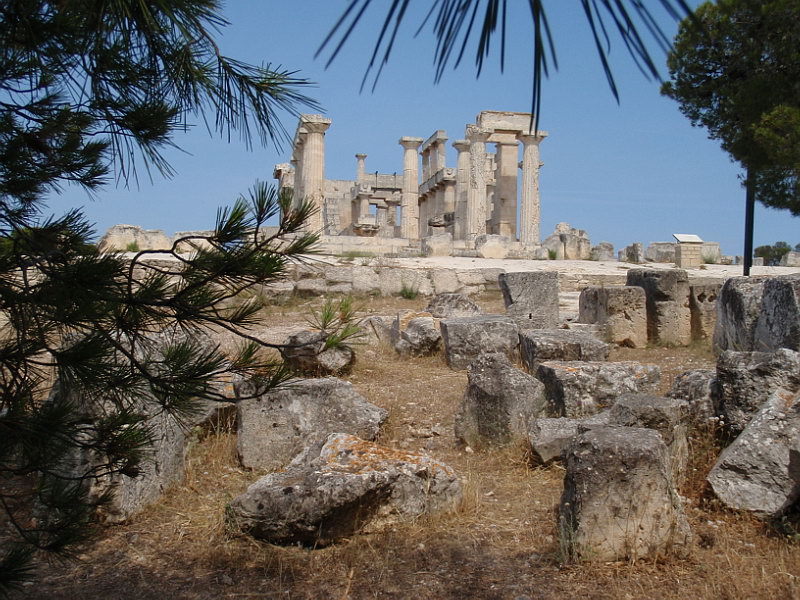
THE SANCTUARY OF APHAIA
There was not much renovation because it had been renovated many times over the centuries. Bob did his usual wandering away for a meditation session. Jim and I canvassed the place reading all the signs and imagining how it must have looked to the ancient population. Jim was surprised to find out that the limestone columns originally were covered in plaster and the walls were plastered over and painted in really gaudy colours. Now the plaster has disintegrated off the columns and the original marble is beautifully natural and still has a shiny patina. It looks so pleasing.
The Romans put their spin on the place by adding the cistern for the local resident priest.
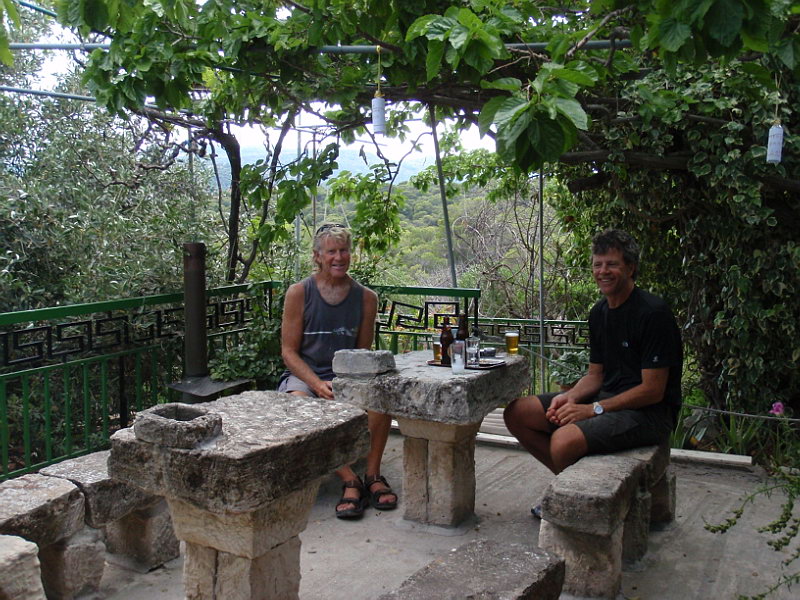
After exploring we rested up for the walk back down the hill. We stopped in to the restaurant of our friendly guide for appetizers and libations and retrieved our dinghy and went back to the boat to freshen up. We went back to shore for dinner and an early night.
The next day we left for the mainland at 9 am contemplating the final leg of our journey.
ATHENS
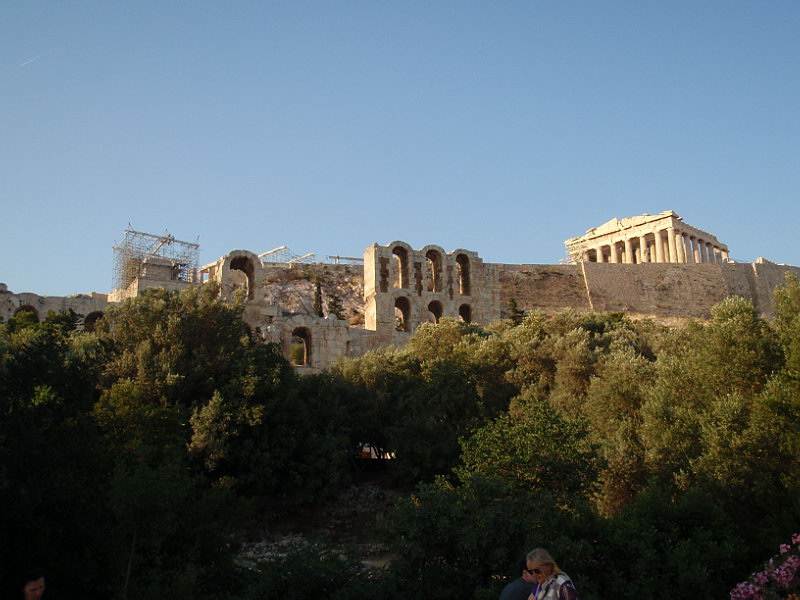
May 30 - June 1, 2009This short little 3 hour jaunt was all motoring on smooth seas. Jim was in force with his binoculars scoping out the countryside and quickly found the Parthenon. White buildings and green trees covered the entire coastline for as far as we could see. This is quite the change from small hamlets or lone buildings on rocky scrub terrain but they all had the shimmering blue Mediterranean at their doorsteps.
We docked in the marina and quickly cleaned up the boat and went exploring. Jim and Bob took off for the customs/immigration/port captain and I took off the large Wal-Mart type store and bought the largest collapsible suitcase on wheels that they had... in stock. I found that even though in all the lands we had explored I kept saying I couldn't buy anything because we had no storage space I just had too much stuff. So I practiced a procedure I have done when I go backpacking. I laid out everything I wanted to take and then cut it in half. I still had too much stuff. The next day, in between cleaning the boat for the new crew, I again cut my stuff in half and packed it as far away in the bowels of Gaia as I could. I will have to deal with it later.
Jim had finished his 1995 Windjammer tour in Athens so he knew some of the areas to visit. Marinas usually are not in the hippest part of town but we found a friendly cabbie and we went to the large market square down the hill from the Acropolis.
When we exited the taxi there was loud new wave music playing and kids doing knee cracking antics in a makeshift skateboard park. The music was coming from a stage that had major equipment and amateur DJ's taking turns spinning the jive. Many people were milling around waiting for the medics to have to be called and we enjoyed walking around the pristine mosaic-floored shops. We hopped onto a motorized mini-train and got the tour around the Acropolis. We had dinner at an outside café and as night settled on the city the Acropolis was lit up with a light show all its own.
After we returned to Gaia it dawned on me that we were getting ready for a changing of the guard. Both Jim and I were packed and leaving the next morning for the airport.
At 6 am I was ready for the taxi. Bob and I talked about some of the funny things that had happened to us over the last 20 months and it was a reminder of how much we had experienced and grown during this adventure. With a big bear hug
we said Goodbye and we were both anticipating our futures with a new adventure.An all new chapter has begun.
~~~~~~~~~~~~~~~~~~~~~~~~~~~~~~~~~~~~~~~~~~~~~~~~~~~~~~~
CRETE - CRETA
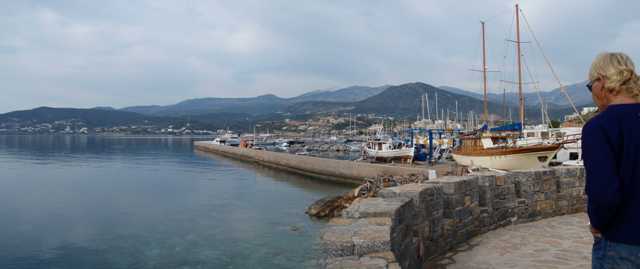
April 19, - May 21, 2009We rounded the furthest point to the east (Pt. Stiros ) and still had 30 miles to go to Angios Nikolas and the marina of the same name. As we entered the port there were horns blaring and people were standing on the docks cheering.
We have made it to the end of the Rally!
There was much merry making with birthday parties on the dock, boats cashing in their chips with parties, and the large BWR party with Cretan dancing, singing original songs of the voyage, and lots of local foods.
SPINAGONGA - SPINALONGA
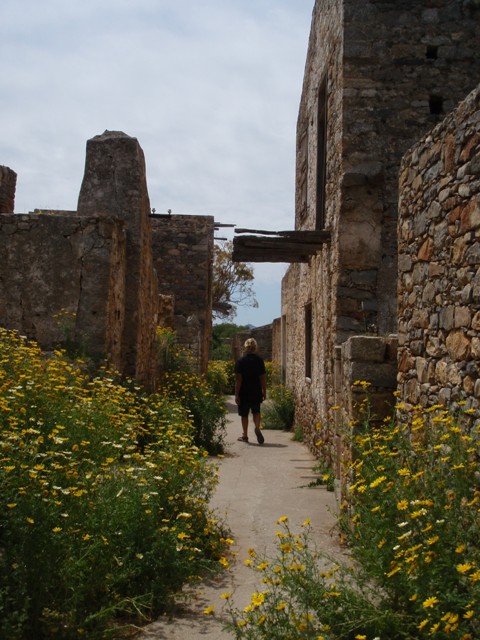
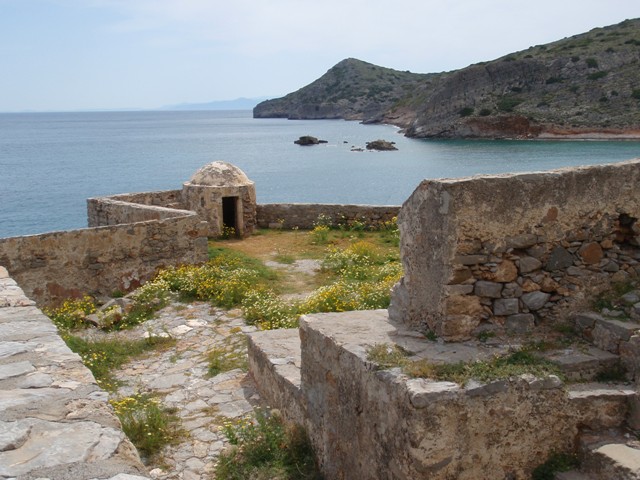
Our last outing with the rally was to an island with a long history. Starting with the Minoans (1200BC) using it for protecting the harbour of El Gounda it fell to the Venetians who built a huge fortress. After Crete fell to the Ottoman Empire it still took 64 years to take the island from the rebels. 200 years later this was the last stronghold of the Turks when they were being ousted by the Greeks. Lastly, it was used as a leper colony. Somehow I never tire of piles of rocks with lots of history. El Gounda is a fishing village and we had a very delightful seafood lunch where the BWR told us we could have as much of the local wine as we wanted. We over consumed 1/3 more than the restaurant were prepared to serve. A good time was had by all.
On Sundays there is a BBQ at the clubhouse and we smooze with the local yatchies that have been here for a season and one boat has been here for 3 years. They were full of stories about how when Greece entered into the EU they received grants to build marinas. They started them but never finished them because of mind boggling bad decisions and priorities. My perception is the government is not so much corrupt as it is inept. This is probably why the hills are covered with cement supporting structures of buildings that will never be finished. Skeletons of homes with trees and weeds growing in them.
Over the next week boats went on the hard for months, boats sailed away for new adventures with lots of horn blowing, and 3 of us were left. It was sad to watch 2 year friendship slipping away. Gaia was hauled out so we could, once again, drop the rudder and replace the bearings. Bob was in an E-mail frenzy trying to find someone who knew about the rudder bearing and could tell him how to fix it correctly. In the end the manufacturer told him there was no correct part. The correct fixes were to machine off the lip of the bearing and reinsert the rudder into the bearing. We stayed on the boat, 16' in the air, and jiggled in the wind at night.
Bob and I hiked the steep hills, wandered through the resorts and tourist traps and enjoyed the Cretan food. The locals are cautious but friendly. I guess that comes from years of persecution by marauding tribes. We were soon to find out why. This island is self-sufficient growing most of the olive oil for Italy. Strawberries, cherries, and tomatoes are absolutely delicious. Oranges and potatoes are sold on the side of the road and we can't eat enough of them. Every market has a large basket of snails - a national delight. A little boy bent over, picked up a snail, turned it over, and screamed as the critter came out of his shell to say hello. Goats, sheep, and cattle roam between the endless landscapes of olive trees. Feta cheese, cheese, and yoghurt are so creamy with the littlest tasty tang. No wonder this is where Zeus was born. It is a God's paradise.
Evelyn, Penelope, and Gaia rented a minivan and we went exploring the ruggedly individualistic land and its people. Street signs and billboards are scarce.
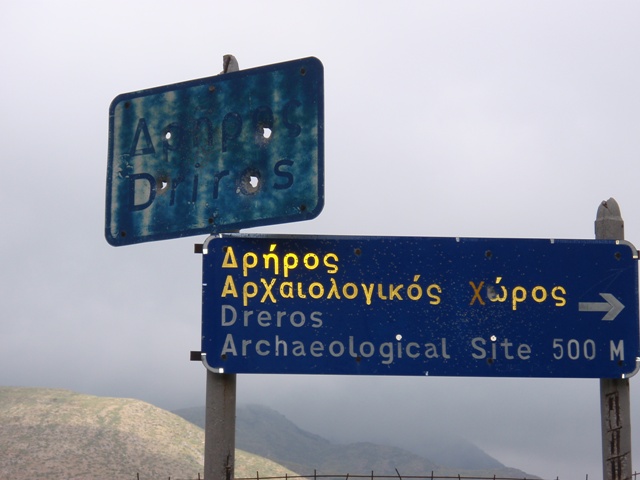
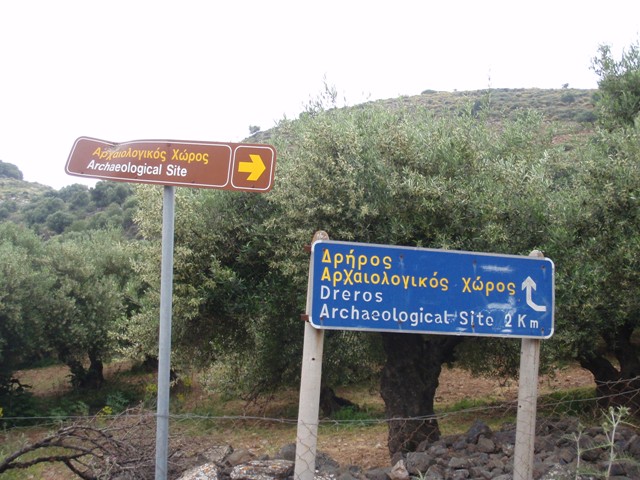
Seems every adult Cretan is allowed to have a gun and they love to show off their skills on the local signs. Following the map was difficult. What was spelled in the guide, written on the map, and the 'roman' spelling on the street signs were all different.
Check out this sign for an archological ruin and tell me which direction we are suppose to go. Now we know how the saying "It's all Greek to me!!" came into being.
HERRACKLION - IRAKIO
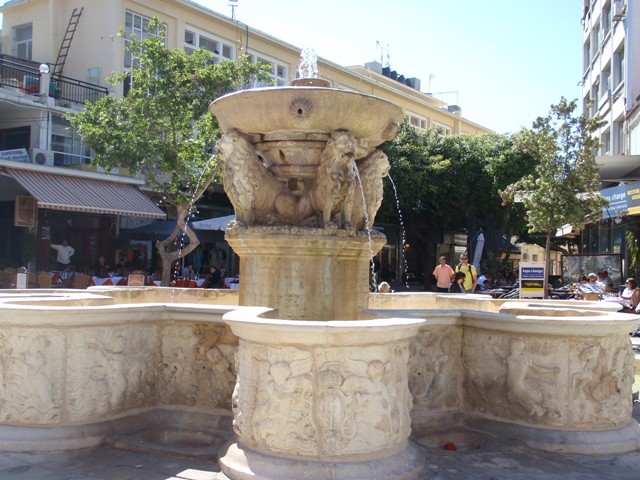
Our first stop was to the capital city of Heraclion. They have found traces of the great Minoan culture but nothing is left. In the 3rd century BC the Venetians had built a large fortress dominating the cityscape along the harbour. It had a town square with a 4th century fountain that was great for people watching. Parking rivals San Francisco so we paid to park. The archeological museum was closed for renovation and we were allowed into a small exhibit of the best.
It was the best. Instead of rooms of broken urns and headless statues we got to view one or two of the finest. From frescos to burial vats to game boards very quickly you got the idea of what life was like for one of the greatest 4th century BC civilizations in the known world. After Egyptian pharaohs to see a parallel civilization (Minoan's) of great proportions put it all into perspective. We must go see the ruins of Knossos - the gem in the crown of piles of rocks.
KNOSSOS
In the 1919's a British archeologist spent his life reconstructing the ruins of a great temple/market/city. With very little known history of the Minoans he did his best to make piles of rocks come alive. They had some very unique building techniques. Yes, they had running water and a sewer system with a population of 30,000 but their columns holding up tons of rock were inverted pillars. The small end was at the bottom.
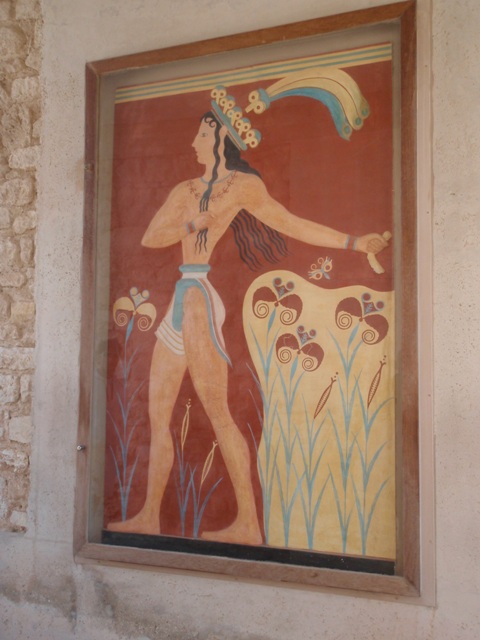
Rust red, ochre, and baby blue were their main paint pigments and they did exquisite frescos of life at the time. There was a small resemblance to hieroglyphics of Egypt of the same age but they were more personable and stylized. They are depicted with very wavy hair and you can see that same hair on a lot of the Cretans.
Heraklion was a day trip and so we three boats got prepared for an overnighter to Chania. We would drive through Herrakelion again for another two hours and end up in the ancient capital of Creta. This was a city of low storied buildings and quite modern.
CHANIA, HANIA, or XANIA
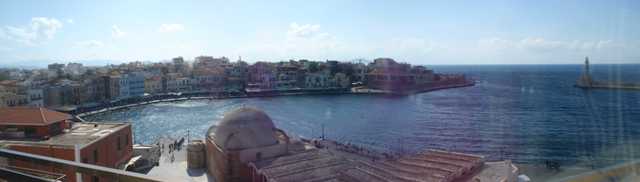
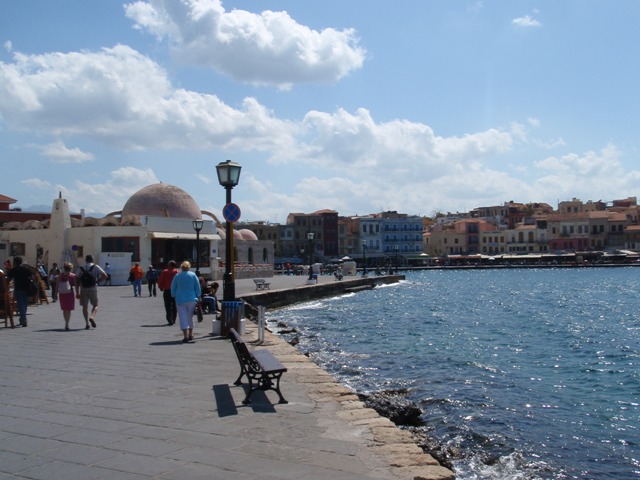
The Venetians once again built a great fortress around the city and many of the buildings are still in use today. In fact we stayed at a Venetian hotel up on the hill. They made this the capital and a great ship building area dominates the harbour.
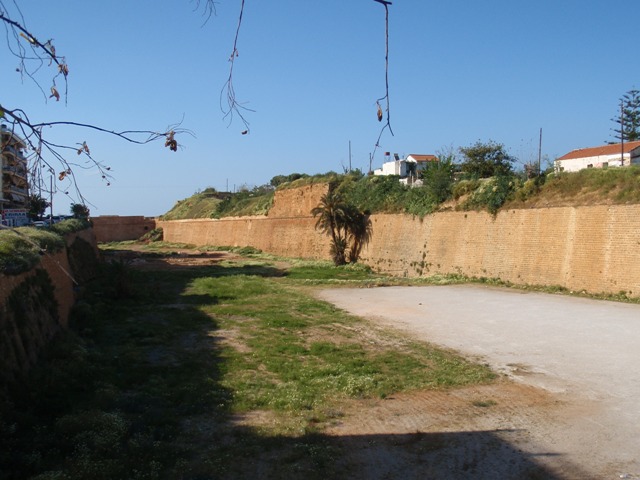
To stop the advancing Ottomans a moat was dug around the city. It took them 3 years to finish the moat and the Ottomans 60 days to conquer the city. At least they tried.
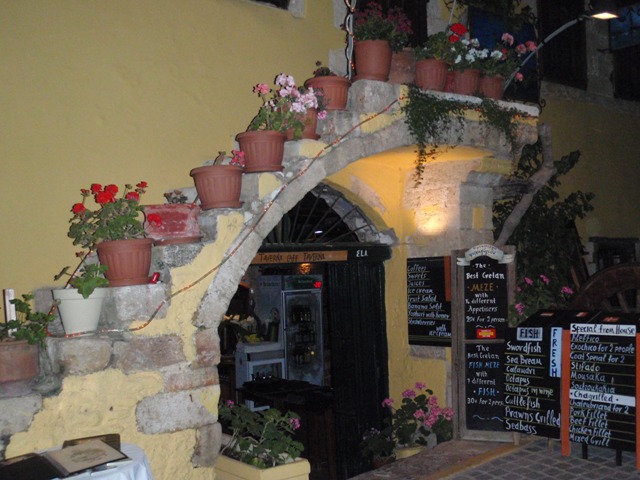
We were wandering around the city square where there were lots of open air restaurants, minstrels playing tunes, kids on skateboards and the proverbial souvenir shops when we wandered down this narrow street and were drawn into the strangest building.
It was two stories high, gutted inside except for the supporting rock beams, and roofless. The menu said it was an old 6th century AD Jewish soap factory. They made their own wine, had cold beer, and the best moussaka I have ever had.
SAMARIA GORGE
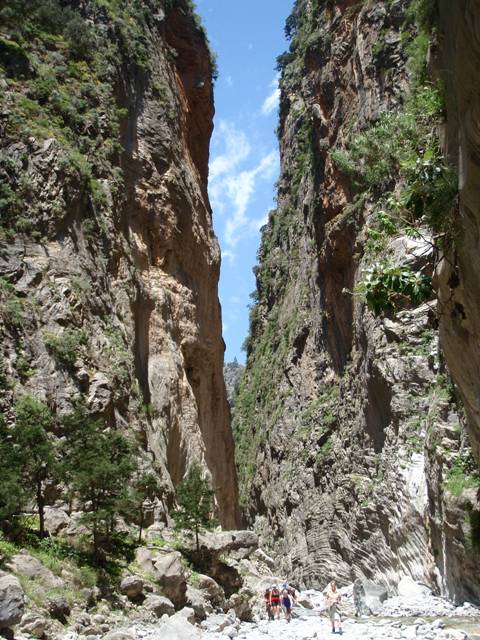
We left early from the hotel and drove to the southern side of the island. This is the easy way to hike and explore the gorge. We boarded a ferry and passed a rugged, steep cliff coastline until there was a break in the cliffs. We off loaded from the ferry in a blowing wind, had some tea to warm up and took off for our hike.
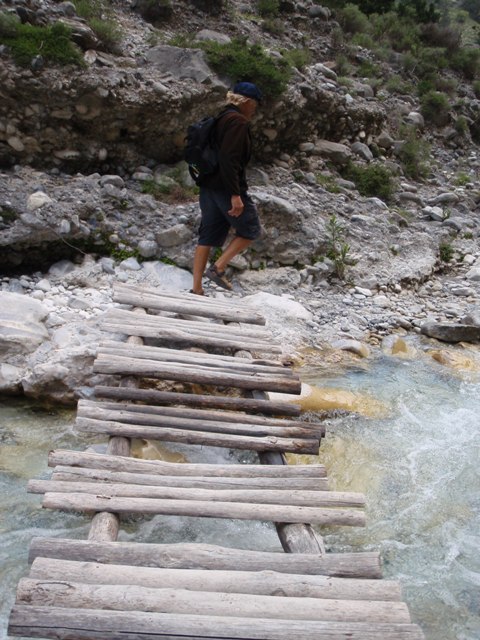
When we came to the first of many wood pole bridges I thought it was not the trail. After all you could easily fall into the icy water. I guess they don't have lawyers in Crete. In our group the Brits gave up first, the Australians gave up at lunch and Bob and I went further up the Gorge until the crowds coming down the path made it not so much fun.
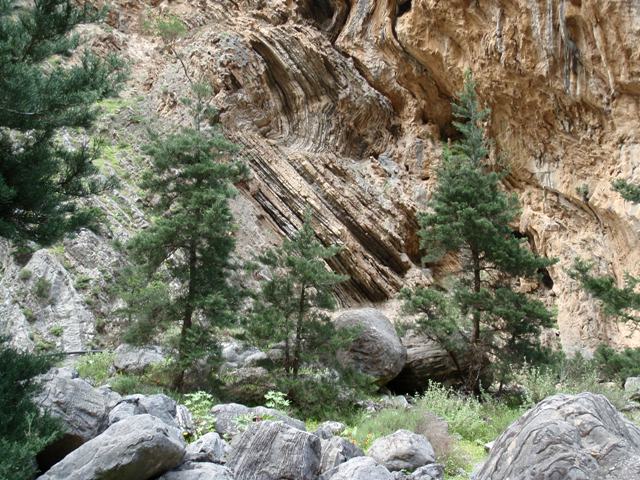
It was beautiful, the forces used to make the rock formations were incredible, and the spring flowers were in bloom.
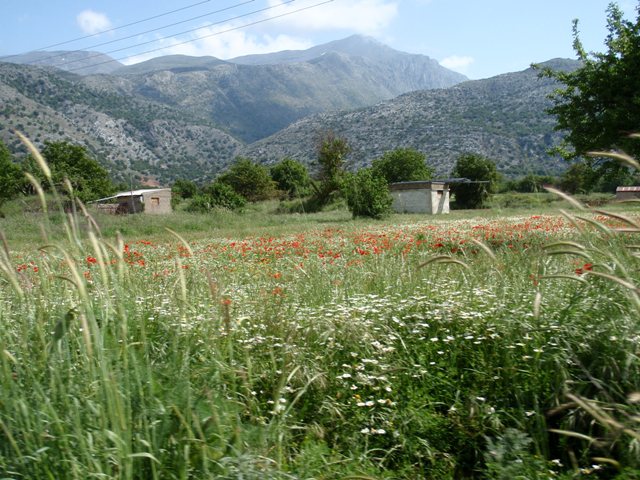
Another day trip took us up into the mountains and around the Lafethia Plateau. It is a fertile valley and green, flowers, and planting fields cram together to grow most of the produce for the island. It took us all day to find the caves and we took a tour of the largest one. It was filled with the usual stalagmites and stalactites and lots of stories about little boys getting lost and herders using it to shelter domestic animals. In another damp and dreary cave Zeus was born. His mother chose this cave to protect him from his father. It worked as his father would have no need to visit such an unsightly place.KRITI
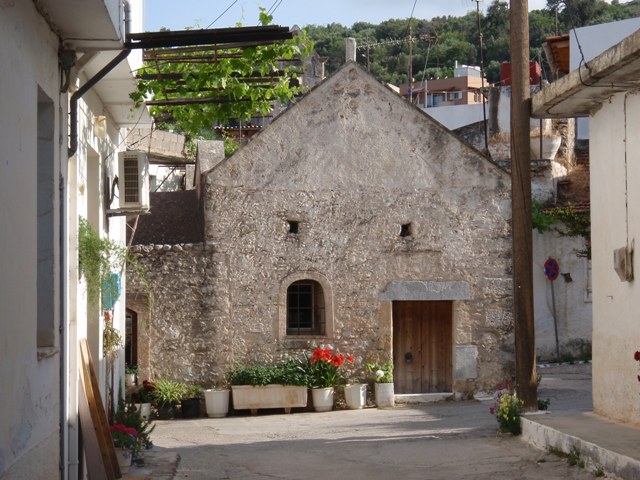
My favourite day trip was to the tiny village of Kriti. It had narrow, curving streets that I was convinced cars could not climb. The buildings were very old and well maintained. Flowers overflowed old oil urns and vines of bougainvillea and grapes covered 2nd story porches.
SITIA
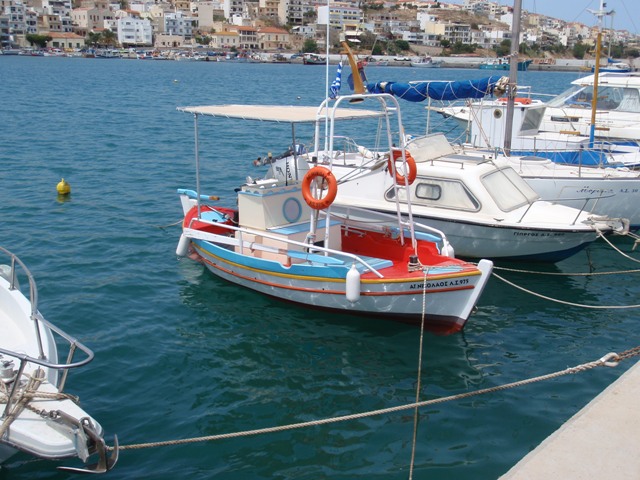
A day trip going east took us through a small fishing village on the northern coast. We thought it was so cute to see these little 7' fishing boats painted in bright colours. Most of them were very well maintained moored in a sleepy little harbour.
PRINA
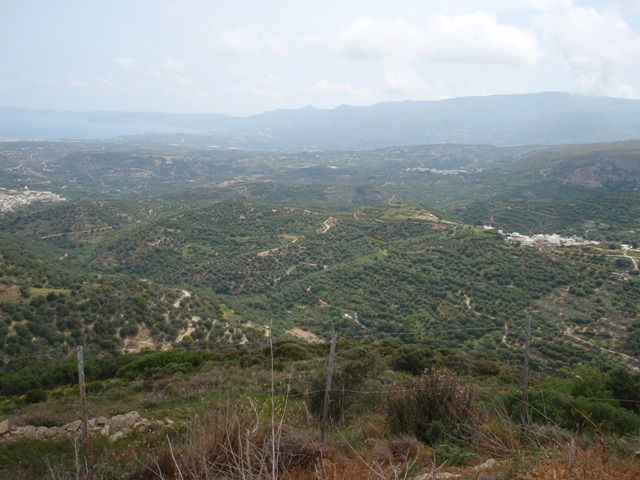
We cruised through many a small village tucked up in the hills. The favourite part was trying to get the minivan through some of the narrow throughfares (can't call them streets).
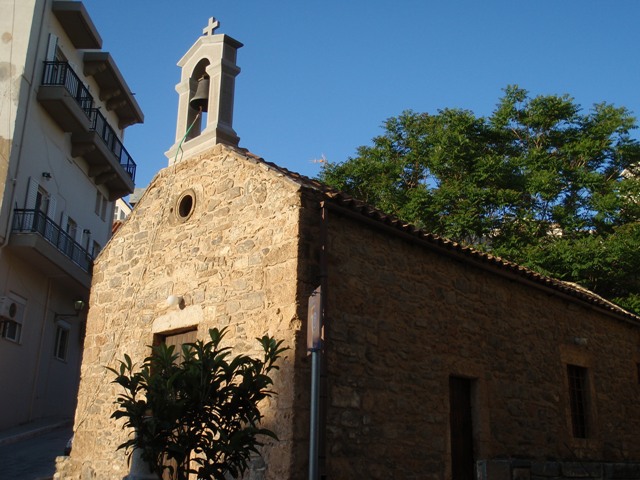
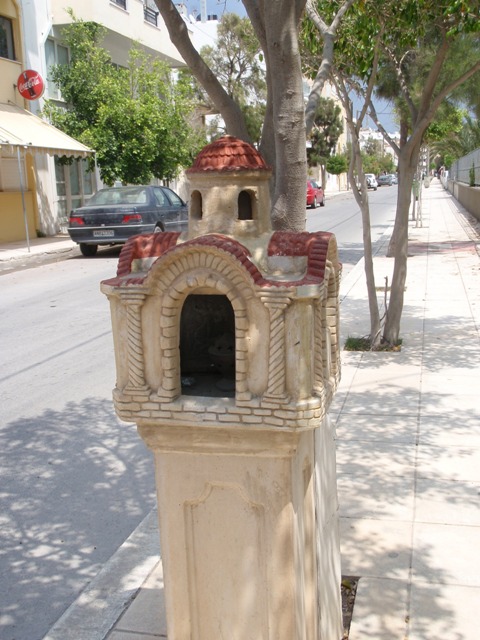
Many times on the side of the road would be these very artistic small chapels (for lack of a better word) in various states of disrepair (or age?). Some would have candles, pictures of someone, or other personal items; others were falling apart and had empty plastic waterbottles in them. Never found out the significance but my guess is roadkill because they seem to be placed at bad curves in the road or at beaches (drowning victims?).Alas, it was time for Penelope to leave and they slinked away in the earliest morning so we could not blow horns and kisses and generally make a fuss.
IERPERTRA
We were getting ready for Bob's brother Jim to arrive for the sailing trip to Athens. It is much cheaper to rent a car for a week so Bob and I headed out to the southern coast and the town of Ierpertra. Most of the resident yatchies don't care for this city. It is not touristy but does have a boardwalk with lots of restaurants.
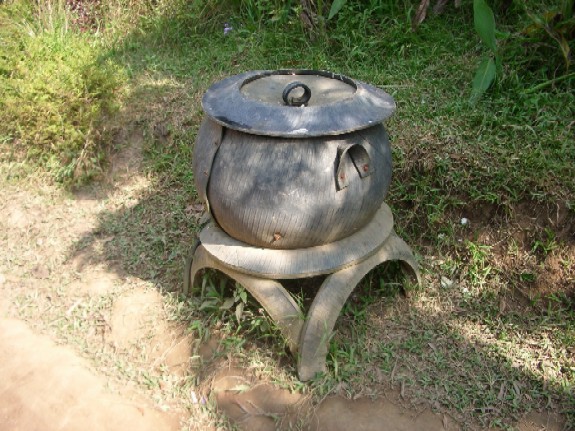
One thing I've noticed is the amount of cooking that is done on a wood burning stove situated on the outside of the home.
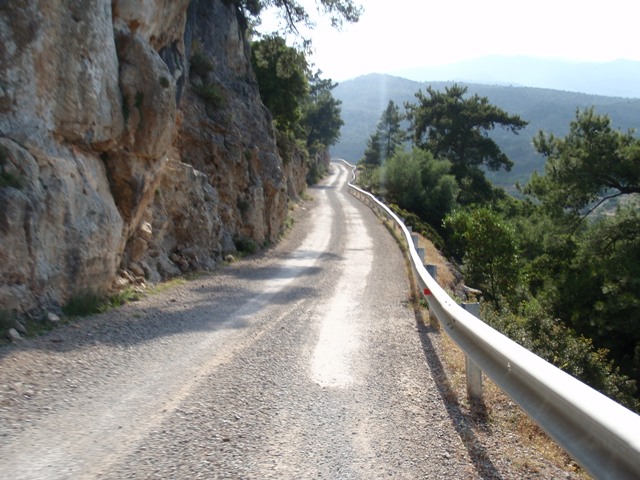
Very large villas dot the mountainside and the curvy, single lane roads linking the small hamlets of the mountains were well maintained if not scary because they single lane for both directions and the rail didn't look like it could stop you from slipping off the highway and over a cliff.
With Jim's arrival we decided on the two penny tour and took him up to Kriti. Although Jim is the younger brother he could convince Bob to bump down some two track trails (the map called them major roads to some hamlets) and we got sufficiently lost.
The smell of wheat fields, spring flowers, and fresh air was invigorating. The countryside is dotted with old stone windmills that were used for irrigation.
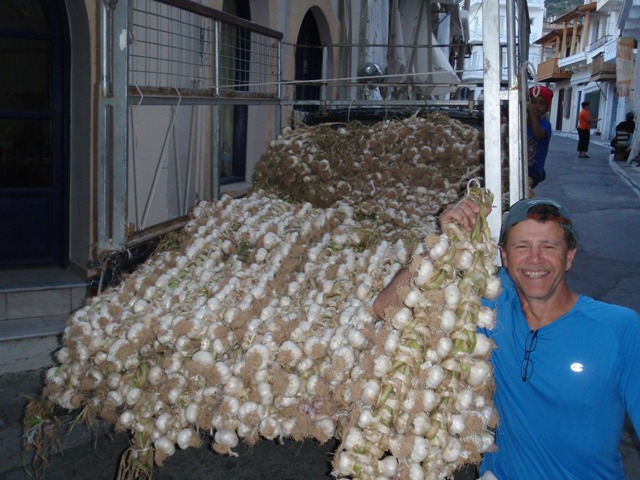
Jim is a curious type and had no problems running over to a truck laden with garlic to find out what was his story.
After several days of waiting for the north wind to stop blowing it was decided we needed to cast off if we were going to visit several Greek Islands on our way to Athens. We would have an uncomfortable ride with the wind on our nose but we were ready to leave God's paradise and go explore more of our ancient past.
___________________________________________________________________________________________________________________________________________
\
EGYPT
March 15 - April 13 , 2009
PORT GHALIBAccording to those in the know Port Ghalib is the place to enter the country. Save $200US, only 60 pages to fill out, and no baskeech (payment for doing anything). Sounds like a plan. Because we still have no engine, we spent the night on the customs dock and in the morning there was lots of discussion on how to get us into the marina slip. We had been starting the engine and had no problems... just in case…a yard boat would escort us to the slip.
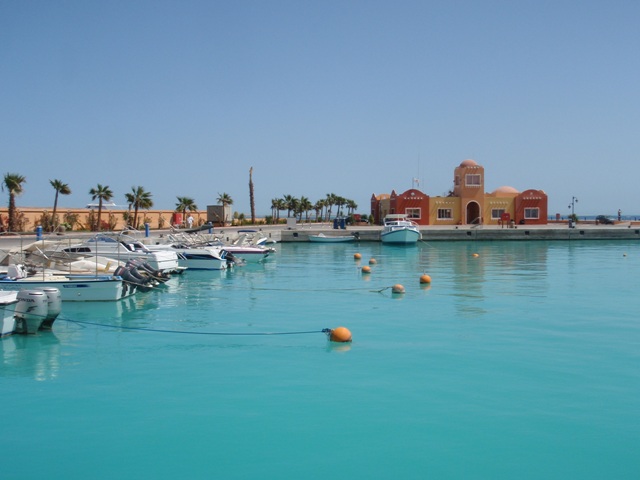
We wound through the canals and I would have not been surprised to see dragons basking in the sun and unicorns frolicking in the greenery of the waterways. This is a 3 hour plane ride from most places in Europe but it hasn't caught on yet. The streets of this resort are empty, the stores filled to the rim but no customers, and everything is brand new.
There is a small mini market that has fewer inventories than a convenience store.
Miles of 1/2 finished condos and parks in a state of developing. In 5 days I only saw one woman and she might have been a tourist in burgha with her designer bag and boots. There is no town and nothing to do. All the yatchies want to leave when a weather window appears in the forecast. These windows are very short and most people regret the decision to leave before it is time. Gaia lingers and cleans away the desert dust layer on everything above and below the deck. Doing nothing means Bob beats me at Domino's and I bake cookies. We each read 2 books. It was a great rest.
Bob gave the thumbs up and we left for the 150 mile trip to Hurghada; another resort along the Red Sea Coast. This time the fairyland will have a town attached to it. We can get work done on the boat, laundry, provision, and go touring, whatever we want to do. The voyage was very pleasant with motor-sailing mixed with sailing. The GRIBs have been steady and we are in luck with our timing. At least there was no gale force winds that would make us duck into a marsa.
HURGHADA
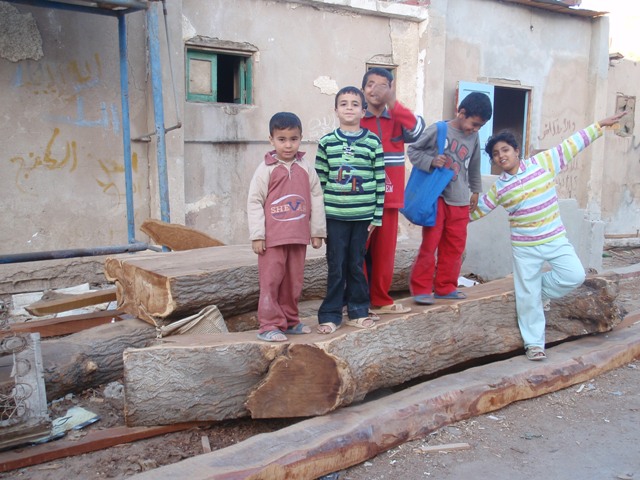
We are becoming experts at the Med tie. Stern to the cement wall; the bow tied to a mooring buoy. This is a good place to work on the boat. Bob wanted a passarelle ( the plank to walk from the boat to the dock ) and so a trip to the lumberyard. Once again the kids are always curious about us and want their picture taken.
This log they are standing on actually goes through the saw to make the lumber. This is truly a family run business as the boys followed their dads around just out of the way. Jenny wanted new cushions so I had a blast going from one 20' X 20' showroom looking at some awesome fabrics. The Arabs do know how to do fabrics. Getting the job done is another thing.
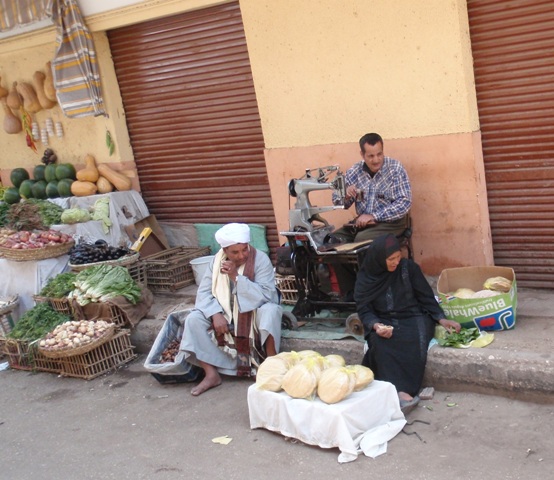
They were upholstering a sofa just outside the shop in the dust of the street and doing a fine job. Men are the ones who do the sewing and the ironing. They are right on the sidewalk so they can talk to friends and work at the same time.
It's the Egyptian Way!
We were starting to wonder what mischief to get into when Lady in White shows up with a brochure. YES! YES! Go-kart racing! Haven't done this in forever! 23 of us hopped into a minivan and drove 20 miles to the next resort area through the desert. In the free-for-all I came in dead last. Bob complained that he had a slow kart. That earned him points towards the cranky old fart trophy. In the ladies final I just needed one more lap to pass the first kart. That earned me a point towards the cranky old fart trophy.
LUXORWe left at 6 am in an air-conditioned behemoth of a bus for the ride through the desert to the west and the Nile River. The sands blew across the highway and drifted up against sandstone cliffs. The sky was brilliant, cloudless blue. There is not a stick, scrub, or blade of grass anywhere. It is desolate and isolated. Yet you would occasionally see where someone had arranged the plastic bottles or stones into an artist pile. Sometimes rocks were arranged in Arabic symbols making a political statement. 19 miles from the nearest mud hut and someone is waiting for a bus? Or workman finished with the job of looking up at the electrical wires that stretch for miles?
We entered a range of basalt and granite mountains; the sand dribbled through the cracks and disappears. The change in the colour of the landscape was dramatic. The landscape changed from pale gold, corals, and faded rust to dark, deep greens, reds, and blacks. Gradually the landscape began to flatten and in front of us was a huge, fertile valley.
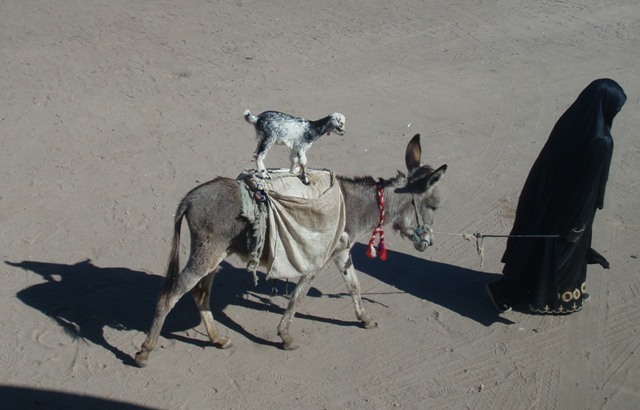
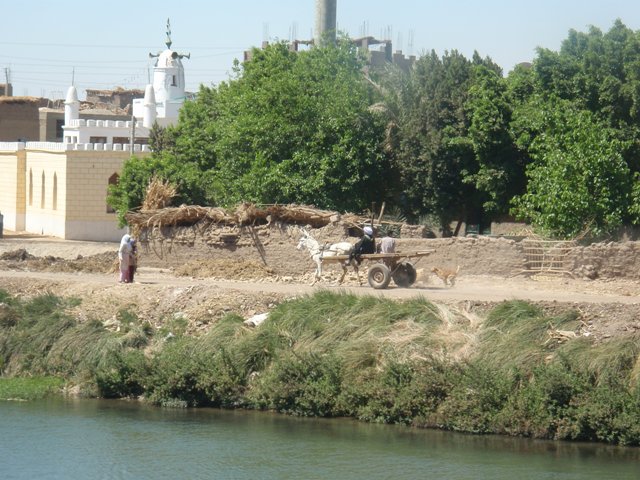
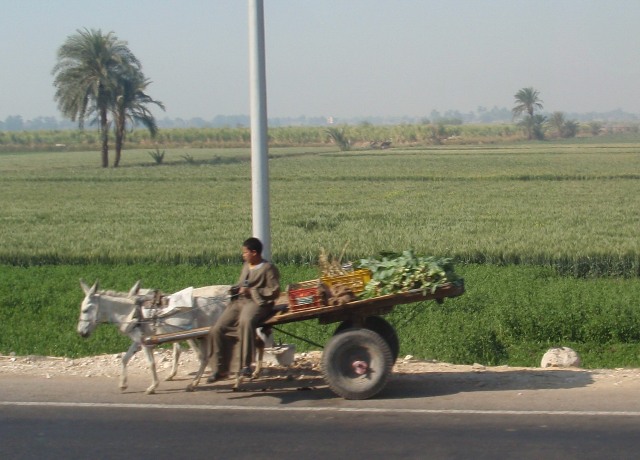
Majestic date palms lined streets and canals. The land was sectioned off and the range of crops created a quilt effect for miles in all directions. Corn and lots of wheat swayed in the breeze. They had these mini trains pulling mini cars of sugar cane to the mills. We passed this donkey that was hooked up to a small cart. He was just switching his tail happily with alfalfa hanging out both sides of his mouth. The irrigation canals that crisscross the land were lined with mud, sun-dried brick homes. Silt from the Nile was sun-harden into bricks. They do not retain heat so are a better choice in this climate. Downside is they melt in water. Can't have everything! To keep the livestock out of the crops, the animals have the access to the canal.
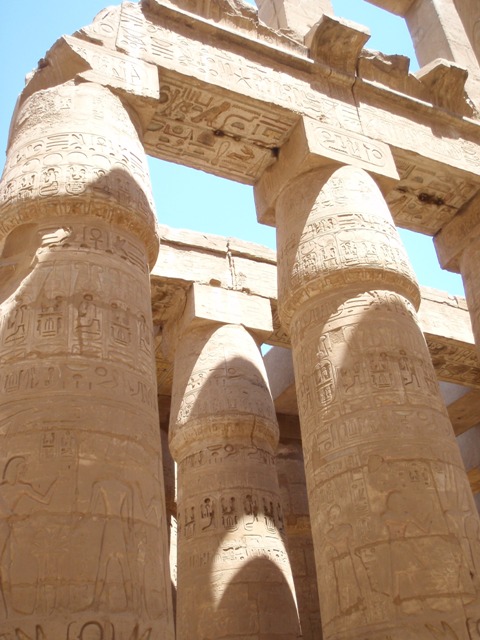
The city of Luxor crept up slowly as the mud huts gave away to two story brick buildings. A median strip cleaved the road into a boulevard that ran along the banks of the Nile. Name hotels and resorts had beautiful stone walls surrounding the property and the river. In ancient times this was the royal capital of Thebes and was known as the City of the Dead. It includes the Necropolis and the Valley of the Kings. The bus voted and decided to see a temple before checking into our hotel. Our first taste of ancient civilization and we see the best first. The largest and most important temple (elevated by the Pharaohs to be Egypt's national shrine) in the largest and most important ancient city in Egypt (Thebes)…
The KARNAK TEMPLE
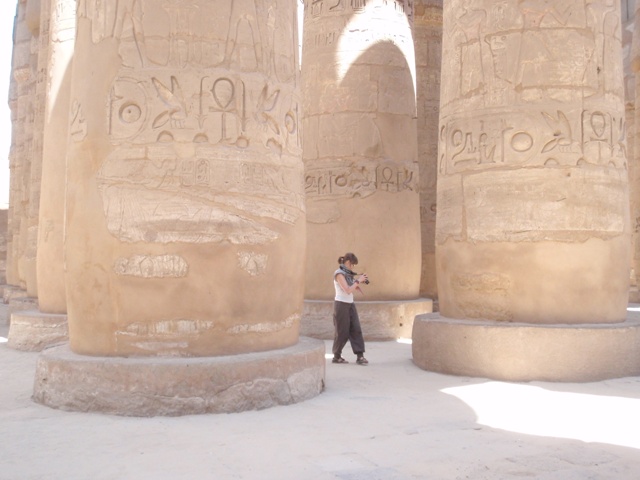
This most prestigious temple was started in 2000BC. Many Pharaohs added their twist to the temple and it grew huge (200 acres) by the time Ptolemy I added his touch in 225AD.
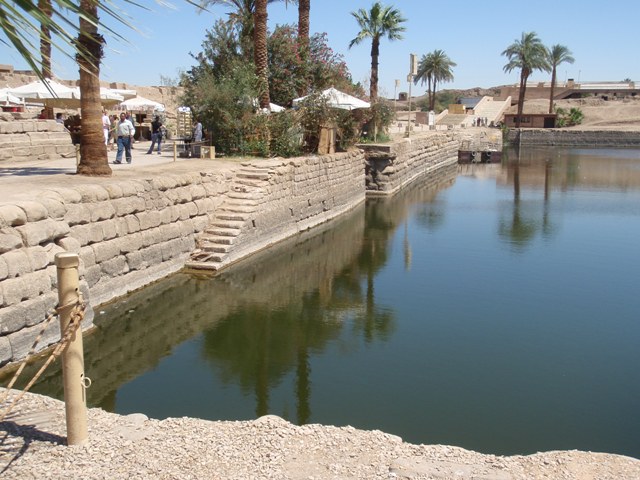
This is the only temple with a sacred lake. As the Nile rose so did the lake level. Pharaohs and priest would bathe here. I won't bore you with all the incredible feats and the thousands of man-hours it took to build these temples so I'll just say one thing. Slaves did not build this Middle Kingdom temple. It is the earliest recorded protest against low wages and substandard conditions. They had a riot, tore up some of their work, and refused to continue. Ramses II caved into their demands and they happily went back to work…for the next 4 centuries.
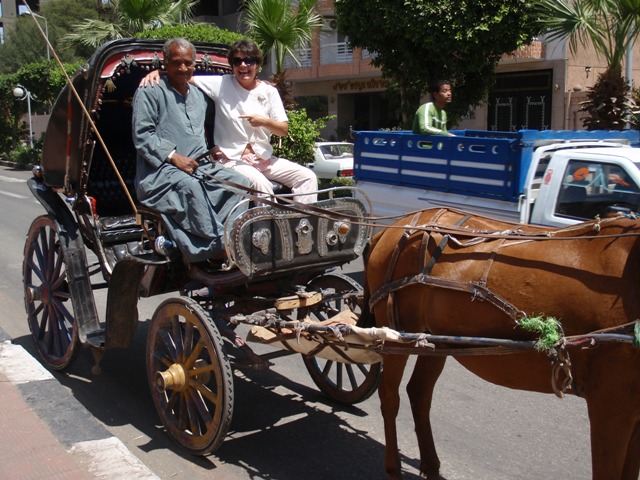
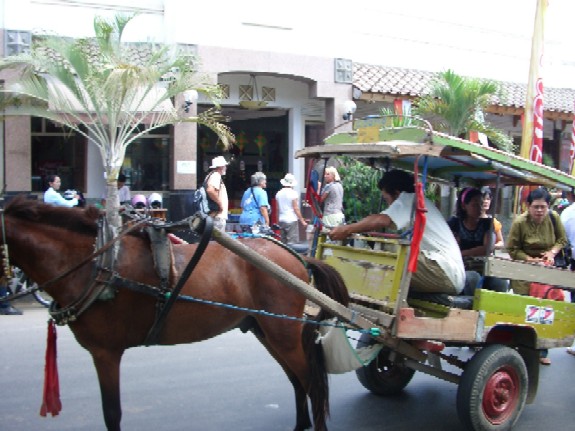
A buggy ride through the town was next and just in time to change the tempo.
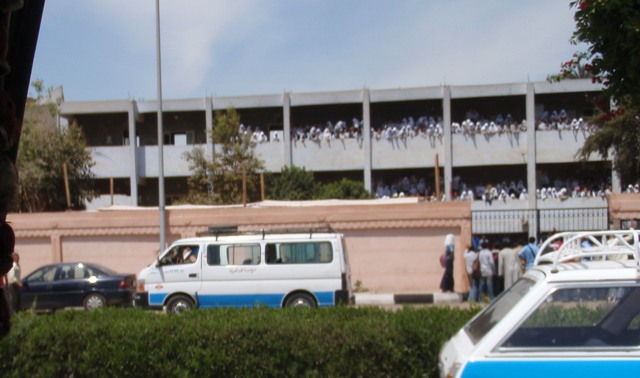
We went past a girl's school during recess, and wound through "The Market". The horse didn't mind all the honking horns and moving cars. We were above the hustle and bustle seemingly looking down on the throngs of people as they plied their wares.
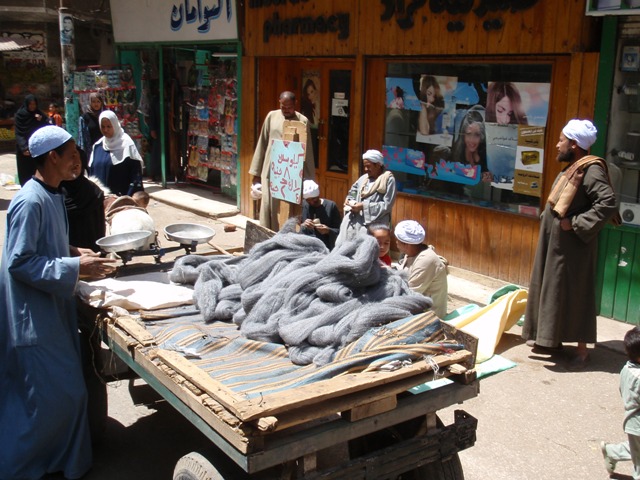
This guy is selling nothing but steel wool. It is a common site to see these carts with only one inventory item. If I did stay here any length of time I would have to find out how he gets to be the dealer in steel wool….or fan belts…or bread.
Later we went to The Luxor Museum and saw lots of old stuff I remember from my History of Interior Design. There were several new items discovered in just the last several years that boggle the mind how archeologist can put things back together. A historical note is that there was no need to protect the borders of Egypt until the Late Dynasty. These Kings formed armies, fought wars, and collected prisoners. One Plexiglas case caught my eye. The knowledge that went into laminating the wood, then bending it into a bow was a conversation starter for several of us. Arrows were primitive but the bows were works of art in themselves. Being a bow and arrow hunter, I wanted to feel the weight and balance for myself. But, alas, just had to read how they used them mostly for warfare.
I was surprised how much you could see and touch…or be asked not to touch. Won't be long before it is all put behind glass and you will walk single file past the antiquity.
Bob & I ambled around town and you could not walk 9 feet without someone honking their horn at you and slowing down to see if you wanted a ride. We ducked down several streets or alleyways depending on what your frame of reference is concerning width and use. Bob was just starting to think it was getting seedy and I was sidestepping piles of garbage. The sidewalks are for planting trees so you walk in the street. 5 teenagers came out of the darkness in front of us. They peered at us; I tightly held on to my purse, and as they approached us they must have said "Welcome" in 5 different languages. We laughed and then they always say "English?" and we say "No, American." To which they say "Ah, don't get many Americans. Why is that?" to which I reply "Because it is too far away! The other side of the world!"
Egyptians are happy for the company and proud of their country
THE VALLEY OF THE KINGS
At the entrance to the Valley of the Kings there is the visitor centre.
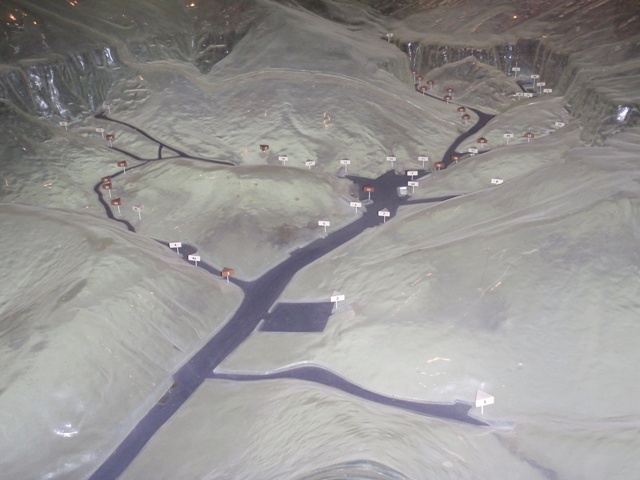
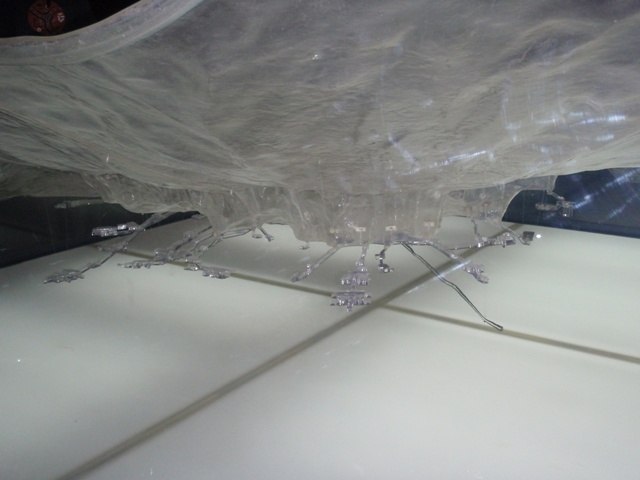
First item you saw was this Plexiglas model of the valley showing the location of all the known tombs.
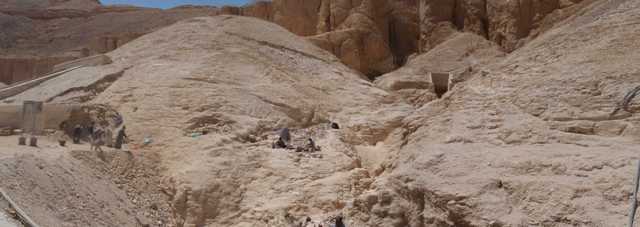
What blew my mind was you could peer underneath and see how the tombs crisscrossed through the mountains. Short reigned King Tut's tomb was relatively shallow with only two chambers where a great warrior king, like Ramses the IV, had lots of chambers and was very deep. We are going to see a temple, 3 tombs, excavation work, and a museum. The tickets had a holograph to make them harder to counterfeit. Looks like the Egyptians spend more money making the tickets than they do circulating money. We have received many scotch-taped bills and Bob had a torn one come out of the ATM in two pieces.
I'll never understand politics but sometime in the Middle Dynasty (1500 BC) this wife of the king (Hatshepsut) decided she wanted to be Queen. It's blurry to me how she got her 7 year old son to be king after her husband died but it happened. Next she put him in a room and said he needed to be a scribe before he could be king. Actually, it was the first step most nobles took to rise through the ranks of power and position. So the king was busy learning to read and write and his mother said "Well, someone needs to lead the people. I guess it's me!" The other blurry part is that the boy king never did finish learning to read and write because we do not hear about him again. Is this part of The Egyptian Way?
By this time in history, Valley of the Kings is now well known in all the ancient cultures as home to grave robbers and riches.
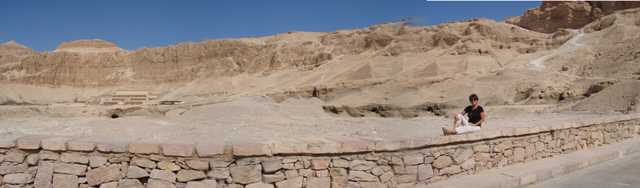
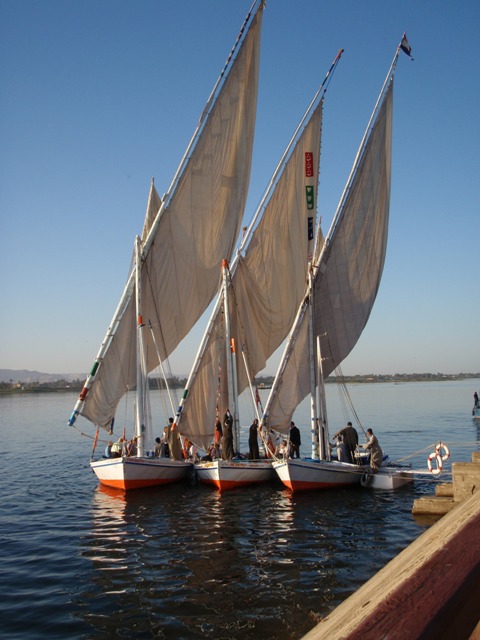
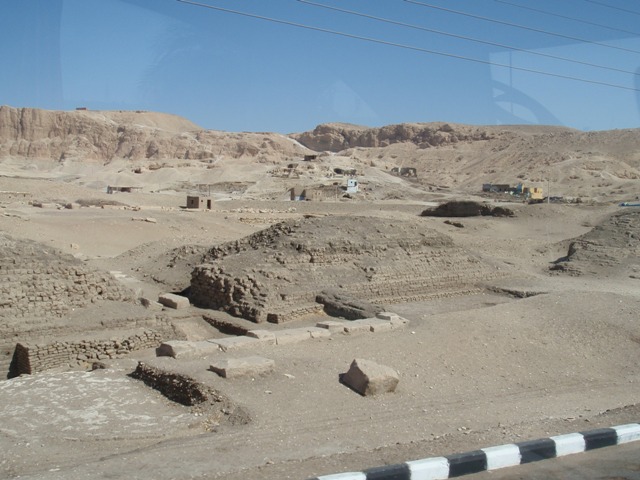
Her temple is right at the forefront of the Theban Necropolis and is spectacular how it conforms to the land. Not to be out done by the big boys she had her temple built in a new style that included vegetation for the first time. She sent 60 feluccas up the Nile (which is south) to Somalia and imported all sorts of middle African flora and fauna. You can still see the stubs of the trees in this dry, arid climate. They were planted 3500 years ago and, although long dead, have not deteriorated. Mind boggling!
People haven't really changed that much over the centuries. The pharaohs always want to one-upmanship from his predecessor so it was getting easier to tell which ones were older than the last ones we saw. It was hard to beat the height but you sure could in sq.ft. or in intricate the sculptures were carved.
Sometimes the king's tombs were robbed within a year of their demise and others were so well buried it took centuries to find them. You could stay for several months to see all the tomb chambers and speculate where the remaining undiscovered 4 kings are enshrined. 2 weeks ago they were digging in a temple and found two 20' or so statues in mint condition. Recently, two brothers died in a cave-in as they hunted for treasures.
I guess you could call it the Egyptian Lottery!
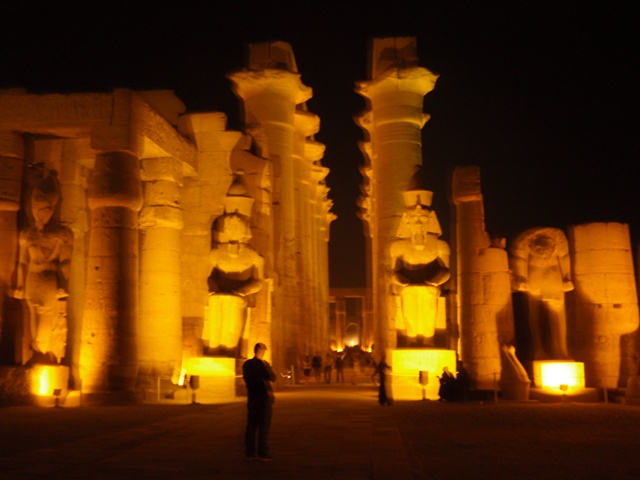
LUXOR TEMPLELuxor grew to become the first major temple in a long line of great Pharaohs tombs and monuments. This is the beginning of the great age of Pharaohs. Because it is older than the Karnack the hieroglyphics were more of a chronological of everyday life. There were feast, markets, disease, and death. There were also Coptic Christian graffiti painted over the hieroglyphics; there was Greek graffiti carved into the walls. Roman arches, columns and niches were scattered throughout the enclosed temple grounds. There was a small side chapel with a statue of a Greek god enshrined. Thousands of years of occupation add a lot of colour to the art. And to think it was all buried and forgotten for centuries.
Maria, our guide, said that the Luxor Temple was more glorious with the lights of the night but many on the tour decided to tour in the afternoon. Bob and I opted for the night tour and we were not disappointed. There were not a lot of tourist but we still got hounded by 2 guys and a soldier with a gun. The locals say it is the Egyptian way to harass every tourist so I used the old standby of 'talk to the hand'. Actually I still want Americans to be looked upon favourably so I patiently told them we had been to the temple during the day with a guide and would like to explore alone. It still cost me $1 each to get rid of the 2 old farts and the soldier with a gun. They are sneaky how they will point out something and try to lead you astray. You do not even have to look in their direction - just being there- they want baskeesch. It is irritating and finally I had to be rude and just scream NO!!! in their face. They didn't run away...just waited till I was looking at something else and tried again. Bob thinks they are testing tourist. At another site a young girl asked me for my 1/2 finished water bottle. I was so stunned I said 'What???' so she repeated it. Weird.
This temple has been ransacked many times. In 1831 someone carved their name across the hieroglyphics…I guess no one cared. In fact, the whole area was filled in with rubble and they built a mosque on the ruins. The Mosque of Aba El Haggag was built over the grave of a revered 12th century descendant of Mohammed's son-in-law. They tried to move the mosque but the faithful would have none of it so now it sits 40' in the air.
I can see how you could spend several months exploring all the tombs and temples. Civilization is growing all around them but they remain awesome. The moon was a crescent over the Luxor Temple last night and I couldn't get enough.
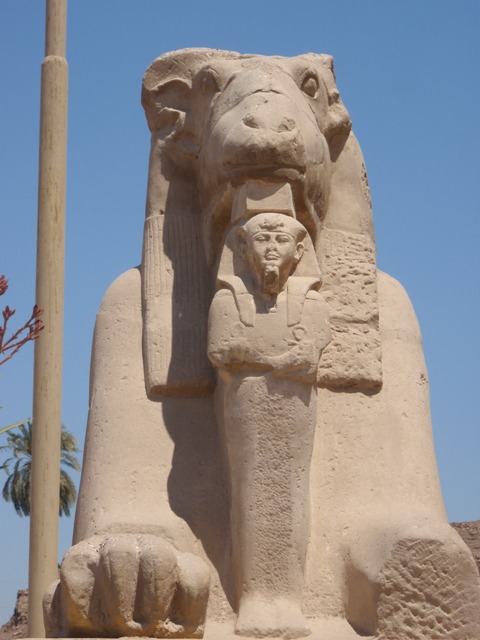
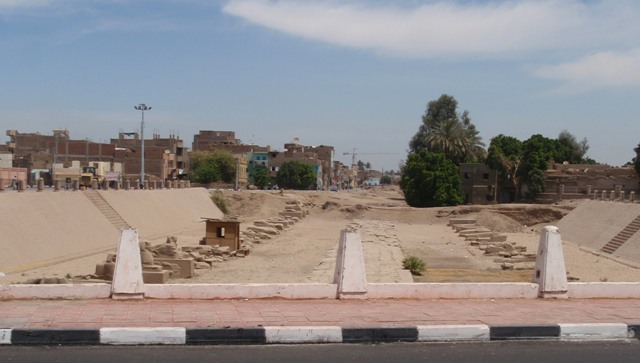
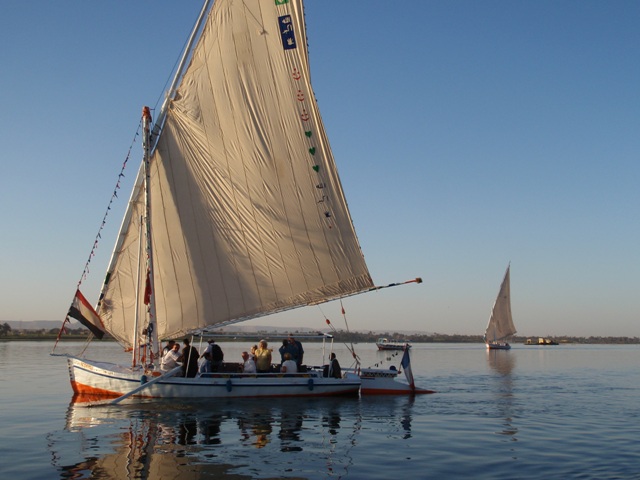
The temple of Karnack and Luxor are linked by the Ave. of Sphinx's (4th century BC). We enjoyed a walk along the Ave. with the original stones that supported hundreds of human feet and horse drawn chariots. Looking back towards the temple you could feel the awe the everyday people must of felt. Also the disappointment because no one except the pharaoh and the high priest were allowed into the temple. It was a long walk between the temples and now the highway crisscrosses many times.
Some areas close to the temples have been restored and some were in such disrepair I don't know if they will ever get it completed to its original splendor. It can never be completely restored because a mosque and an Islamic cemetery are in the way.
We are starting to understand 'The Egyptian Way". I met a Welshman working in Egypt - 6 months on 6 months off. He finds it too frustrating to talk about the Egyptian people. He just shook his head, stared at the floor, and said "UUUGGGHH! Only because the pay is good. You can give Egypt to the Egyptians and leave it at that!" This gave me pause to ponder later. Later came at dinner. I had ordered tea. I received a juice glass of hot water with a Lipton's teabag. The cup was too hot to hold. I asked the teenager that was our server (not the waiter) that I wanted more hot water but I wanted to use the same teabag. I must have explained 3 different ways. He smiled and said he understood. He took away my tea and brought me a juice glass of hot water. Bob & I have a very hard time communicating with Egyptians who can speak very good English. I just can't put my finger on it but no conversation is ever fully received. Do not ask for directions you have no idea where they will take you but it will have nothing to do with where you want to go.
It's not funny! Stop laughing!The trip up the Red Sea to the City of Suez is 180 nm from Hurghada. The GRIB's said it was time to leave and there was much discussion on how to proceed. Gaia has been incredibly lucky with the notorious Red Sea's wind. I keep telling Bob to play the Lottery as he has been flawless with predicting the windows of lower winds. Knock on wood but we have had no problems. Some of the larger, faster boats thought they saw a window and left port 2 days ago. They took so much water over the combing (this is like the ultimate bad) they have had to duck into a marsa. They were at anchor, with howling winds, blinding dust, and rock-n'-rollin. You want to visit another boat but you can't leave the boat; dinghy is either stowed or full of water. 2 days before there is any relief in the winds and seas. No, thank you. Would rather stay in the current theme park resort where the winds may blow but you are securely tied to a concrete dock. Besides, this way I still have a chance to see Donald Duck walking arm in arm with Daisy.
Bob found the window and we left for the City of Suez. We had a very pleasant ride and soaked up the sun and warm air. The shoreline was typical. As far as you could see resorts are being built on the shore. I have no idea how they plan to fill all the buildings with people and tenants. Egyptians have a long history of building but not marketing. Good Luck to them.
It's hard to predict what is going to happen with the weather patterns and the warships. As you get closer to your destination you are expected to give an ETA. Our problem was if you are not at the yacht club before 7 pm don't come into the harbour. Find someplace to go and anchor in a high traffic, commercial port. The safest means is to sail around in circles till morning so you can avoid any freighters because they do not care about the boating gnats around them.
Anyways, back to the story. Bob was trying to time our arrival and we had no wind and glassy seas. 8 boats anchored off of Green Island waiting for dawn. We arrived about 8pm and found great holding. I couldn't see a thing in the inky darkness and let out 150' of chain for a 32' depth in soft mud. Maybe overkill but the wind kicked up to 35 knts from the SOUTH! We had no advanced warning to prepare for this and we were unprotected. Lying in my bunk, I would actually bounce and leave the bunk in some of the action. 3 times I came very close to falling out of bed. Next day we were ready to enter the harbour at 7 am. In the daylight Green Island is not green but a rock outcrop with no protection from the wind and seas in any direction.
SUEZ
All our information tells us that the city of Suez is not touristy. It is a port for disabled ships and commercial traffic. This is the real Egypt and no shorts or sleeveless tops allowed. There are small produce stands and inadequately supplied supermarkets. There are no souvenir stands but you still get the "Where are you from?" So many times that you become sick of answering the question. After all, it is just a way to get you to stop, talk to them, and give them a chance to cheat you out of your Egyptian pounds. I'm getting tired of holding on to my money, getting very rude to the natives, and walking fast with my arm outstretched like a full-back caring the pigskin to the goal line. It's the Egyptian Way.
The best thing about Suez is its close proximity to The Nile River, Cairo, and The Great Pyramids. Rascal, Penelope III, Evelyn, and Gaia decided on an excursion to everything mentioned above. Hassan owned the tour company and for some reason he liked us. We bought the trip with no guide and yet…we had him for the duration.
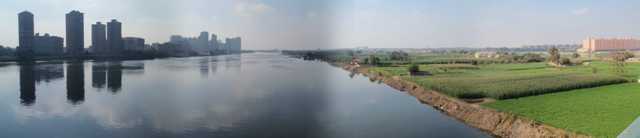
The 65 mile trip straight west had us paralleling irrigation canals till we saw the mighty Nile. According to the guides, farming is the same as it was in the Pharaohs time. You cannot expand beyond the fertile Nile Valley so there is no incentive to produce more than the earth can give. With the power of the Aswan Dam, the Nile does a fine job of irrigation and the sun shines forevermore. I have never had such delicious strawberries, tomatoes, and oranges. The fruits of the land are brought to the market by donkey drawn carts.
Life hasn't changed much over the centuries. The banks of the Nile offer contrast. The sun rises in the east and this is the beginning of life. This is where the people of ancient Egypt lived. This is where villages and fields stretch to the edges of the valley. The sun sets in the west and this is the land of the spirits. Pharaohs, nobles, merchants, and all who lived were interested in the afterlife but some could afford more than others. Thus the life-giving force of the River Nile divides the living from the dead.
CAIRO
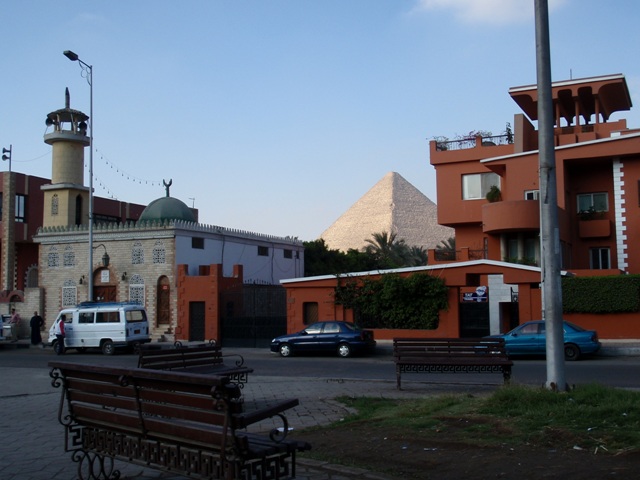
Our guide, Hassan, called the traffic horrible but it wasn't too bad. Seems donkey carts have the right of way and there are no traffic lights. There was calmness to the gridlock with no one stressed about the lack of order. We were fascinated by the city with its construction, destruction, and architecture. Then …what?
OMG!! Over the top of this home loomed this huge structure.
The pyramids are tomorrow today we immediately went over the cliffs overlooking the city to the huge structure called
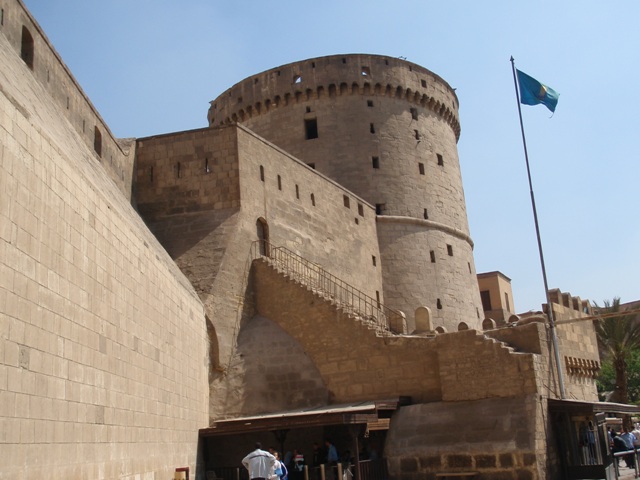
The Citadel.
It was built in the 12th century by Saladin to protect the city from raids. The Libyans, Nubians, and the Crusades were all trying to add this feather to their cap. He made good use of his time by taking the limestone exterior of the pyramids and reusing the stone for the fortress. Wasn't much respect for antiquity at that time.
Our hotel was full of marble with lots of service in uniforms. One night I was supposed to meet everyone on the rooftop for the sunset over the pyramids but there was this music. Percussion, major tambourine, and…a raffee. I found myself in the procession for a Muslim Wedding. The ladies pulled out their finest saris in great colour schemes with lots of sequins. Even the little kids were dressed in their finest. The exotic music drew you into the joyous occasion. ..and all this around the pool.
GIZA AND THE GREAT PYRAMIDS
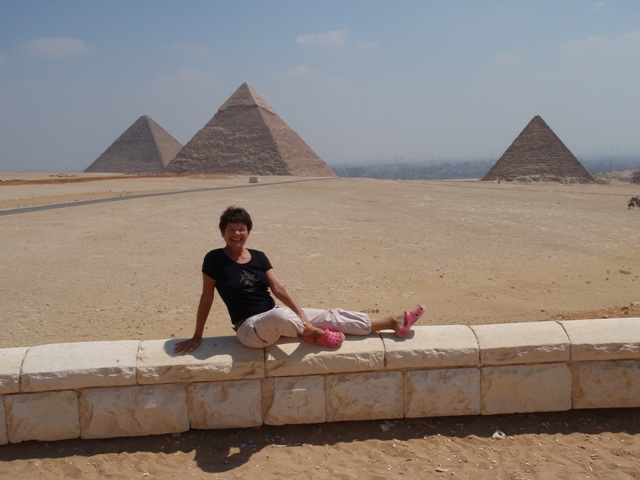
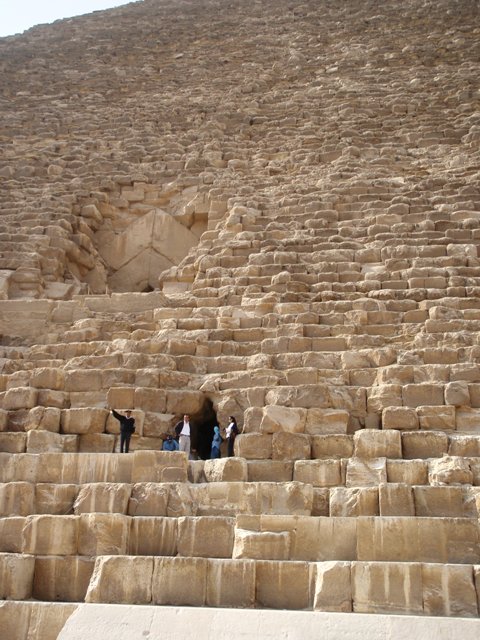
The following morning we set off early for the pyramids and surrounding areas. The largest of the 3 that compromise one of the 7 Wonders of the World was built by the pharaoh Kheops. It took him the whole 23 years of his reign to get it built. We couldn't take pictures inside the pyramids and this is a good thing. We lucked out as only 300 people are allowed inside the Kheops Pyramid per day.
You had to climb through a 4' tunnel not 36" wide with people passing you from the opposite direction. The air is not circulated because no one is supposed to be here. The tunnel would end in a large burial chamber. You are completely surrounded on all 6 sides in solid granite blocks that have been fit so precisely that there is no mortar needed to support the blocks. There are no decorations on the walls…just an eerie silence. I did my part and left an offering for the gods. Somewhere in the heart of the pyramid are my expensive sunglasses.
Khephren's Pyramid is the one with a little limestone facing still on the monument. It is ever so slightly smaller than Kheops and on a smaller base with steeper sides. The limestone was pilfered to build the Citadel.
The smallest of the three, Mykerimus' Pyramid was later and he added smaller unfinished pyramid tombs for his family. One note of interest: The building and furnishing of the Great Pyramids took so many resources away from Egypt that later pharaohs had much smaller pyramids. They also had less bargaining power and the enemies were knocking on the door.
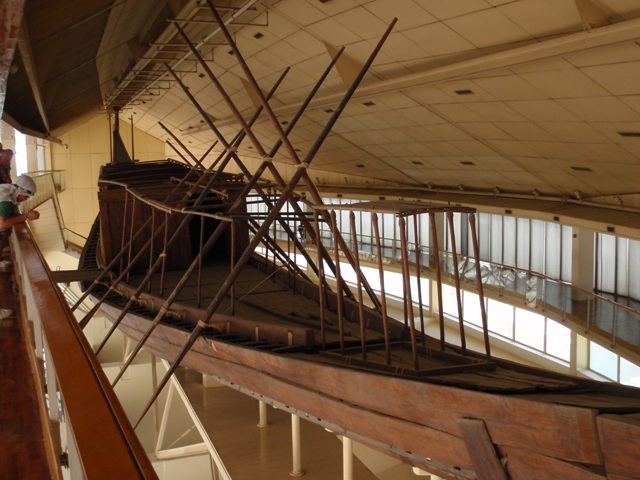
In 1990 we had a great surprise as archeologist were digging around the pyramids and found the burial boat of Kheops. Out of solid limestone the ancients dug a rectangular pit and dismantled the entire ship and buried it next to the pyramid. It was in pristine condition. They mounted a structure over the site and reconstructed the boat right next to the pit.
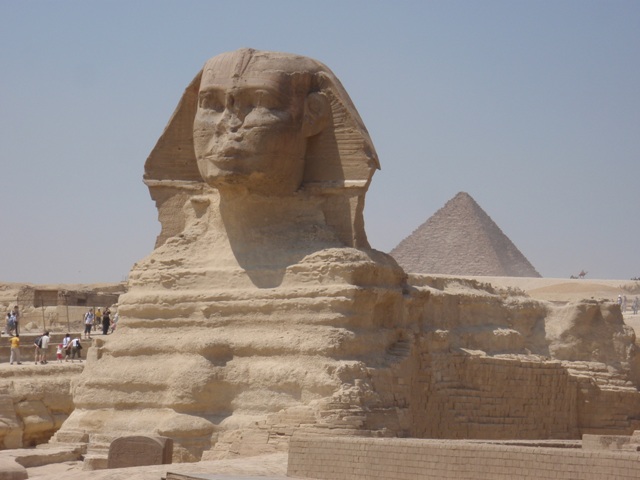
The surprise for me was the close proximity of the Sphinx to the Great Pyramids. Khephren's likeness is on the human face which is on a lion's body. Lots of gossip on how the Sphinx lost his nose with the Brits saying it was the French using it for target practice during WWI. I think this is in retaliation for the fact the Brits were so cruel to the Egyptians during their occupation. The ancients attributed prophetic powers to the Sphinx. Tuthmosis IV had a dream that the Sphinx told him to clean up the area and he would be king…and it came true! I wanted to take a nap and see what I could dream but the troops were ready to head for...
SAQQARA and the STEP PYRAMIDS
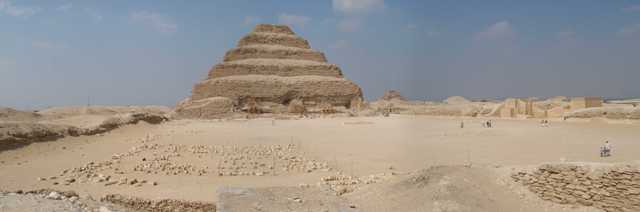
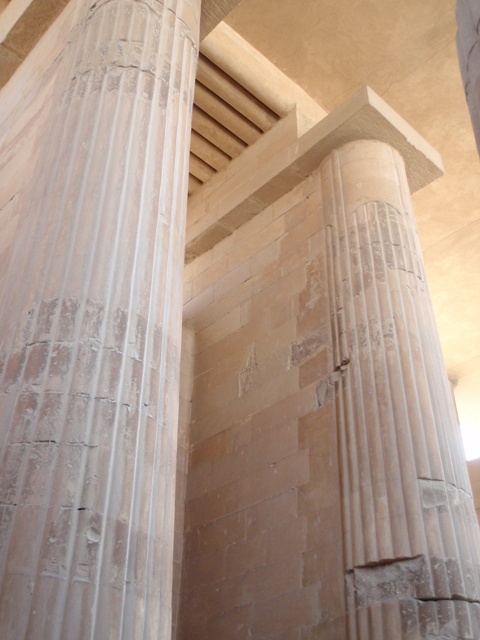
The first capitol of Egypt was at Memphis and the Nile was the heartbeat of this earliest civilization. A sacred place was chosen on the west side of the Nile to house the dead and they called it Saqqara. As the people prospered the tombs became more elaborate. Then Immotep came up with the brilliant idea to honor his pharaoh, Dojeser I, and designed a never-done-before above ground tomb in a never-done-before style. Until this point all tombs were timbered but this one would be carved of stone. The Step Pyramid is the result.
The pylons used to hold up the stone roof in the temple needed to be strong and stable so they are attached to the wall. It would be another 600 years before a column could stand alone.
Surrounding the step pyramids are the Nobles' mastaba tombs. These bench-like, above ground tombs had chambers and corridors on a much smaller scale. These along with the artisan's tombs had more paintings than carvings and were more representative of the everyday life that they lead. This is how we found out slaves did not build the pyramids but the workers did it in their spare time between growing seasons. It was an honour to build them and didn't take as many people as you were led to believe in grade school.
Exercise has not been a problem on this tour. Climbing hills to see the sphinx, over ridges to see Tombs of the Nobles, and running between camels to see if I could find my sweater at the last place I visited has done me well.
THE SUEZ CANAL
In the 12th century BC Ramses 1st tried to link the Mediterranean to the Red Sea. 600 years later the Persians got as far as the Bitter Lakes. 274 BC Ptolemy II got the canal further to the Red Sea; but we're not there yet. Cleopatra tried to reach the Red Sea after she and Mark Anthony were defeated by the Romans. The Roman engineers with their superior building strategies tried to finish the canal but had no immediate success. Emperor Trajan in the 1st century AD was the first to reach the Suez.
Today's canal follows along the same pathway. Over the centuries various enemies trashed the canal. Napoleon's engineers said the Red Sea was 30 feet higher than the Mediterranean. If that was true there would have to be locks. In 1830 a Capt. discovered this to be wrong. He was hired by the British Trading Co to find a route in the Persian Gulf to the Mediterranean. He knew that to be a dead-end and opted for the Gulf of Suez. 1888 saw the measuring of the fees structure that is still in use today. 1956 saw the nationalization of the canal and everyone was so upset the canal was closed for a year. The oil shortage in Europe didn't last long. Soon, 76% of the traffic in the canal was oil tankers.
Gas in the US was 19 cents gal.
Not so bad when you remember the Israeli/Arab conflict that closed the canal for 8 years. By the time the conflict ended (1967-1973) the newer super tankers were being built and they were too large for the canal. Only 23% of oil tanker traffic could use the canal. Whoa! Lots of loss income. Most of the traffic was forced to go around the horn of Africa. That was a bad idea so the canal was restructured and configured. Mostly it is a big ditch connected by Bitter Lakes so it was just a matter of widening the canal. ( Panama is currently in the process of building some locks to accommodate even larger ships that once again will not be able to traverse the current Panama Canal or the Suez Canal. ) When the canal reopened in 1977 they could only do 60 ships a day. With the Egyptian government doing some more refiguring it is a secret how much traffic the canal can handle today.
OUR VOYAGE THROUGH THE CANAL BEGINS!
We have three Groups scheduled to departures on different days for the Suez Canal journey and Gaia was in the Group III. There are meetings to decide when we can leave to go into the canal. Capt. Heebee is our agent and he knows his business. His sidekick, Said (SA - eed), is trustworthy and every morning comes selling fresh bread and produce. Group I leaves without a hitch and on schedule. Then the trouble began. The first group had several problems with pilots switching too often along the way and asking for bakeesch. Ms. Styx hit a buoy and we had to come up with the $3000US bounty or she would not be allowed to continue. There was much confusion trying to come up with the cash but Capt. Heebee had it under control and all ended well.
The biggest problem was that you could not predict if you would be allowed into the traffic lanes of the canal till the night before you left. Group II was scheduled to leave the next day at 2 pm but that was not to be. The second convoy left at 4 am to avoid a warship that would be in the canal that afternoon. No arguing with a warship I always say. Group III has a meeting with Capt. Heebee the night before we were scheduled to leave and we all were waiting for the good news…no… great news! The winds in the Mediterranean are perfect! Let's go for it! Please give us the green light to leave. Most people were disappointed to hear that we had to wait another day before we could leave…remember the warship? It finally got its paperwork shuffled and was traversing the Canal.
The journey plan was to go for it and do the whole distance in a day.
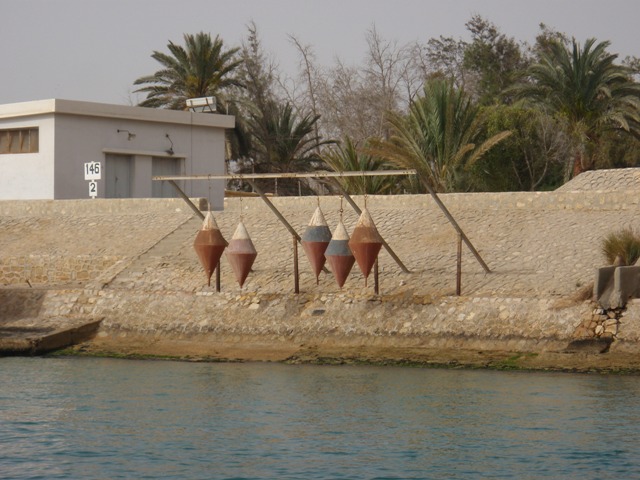
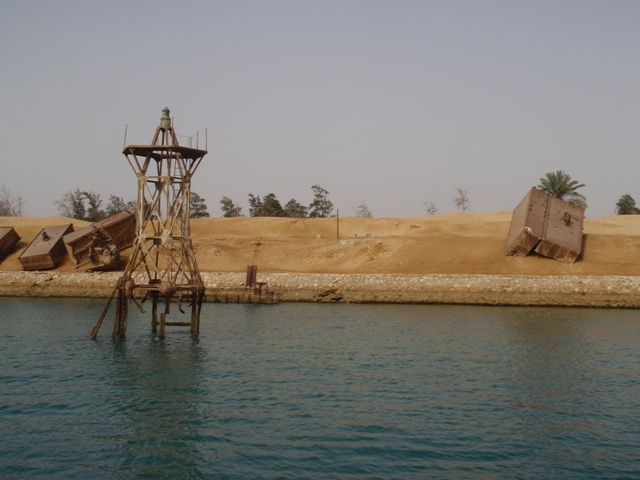
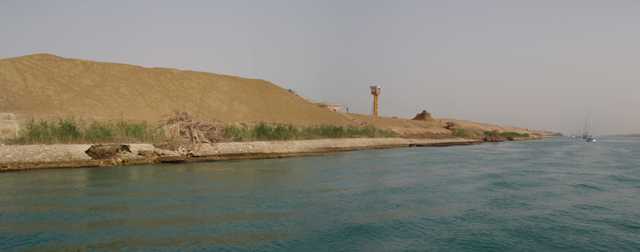
We were told that we were to stay to the port side (left) and hug the buoys. We had a pilot boat and 3 pilots on our convoy. Many a huge freighter passed us going north in the morning and then traffic was heading south as we approached the end of the canal. People waved to us from the banks and there were bollards lining the way to hold a stranded ship till help arrived. In 16 hours we went through 2 lakes and 2 forks and just as darkness was settling in we passed the port of Said and out of the canal. We were greeted with surf pounding in our faces with 25 knts winds and confused seas.
WE HAVE MADE IT TO THE MEDITERRANEAN SEA !!
I have often thought that our worst voyage was the return trip from Maui, Hawaii.Who would have thought what a difference a day makes.
The winds were out of the N-NW and hindered our whole trip to Crete. We zigged and zagged our way west to avoid the worst of the wind. We started a 2 pm net to co inside with our 10 am and 6 pm net. All the boats are starting to have problems - some worse than others. Gaia now has over 30,000 miles to her credit and is ready for a retrofit. We stay in touch with the Group to feel the camaraderie of comparing notes on wind and tactical information to help make decisions where to go to find relief. Two boats wanted to quit and were trying to find out information on Alexandria which we were told not to visit. Israel is too far and the winds too strong. Every other port on the Med was sailing your face into 25 knts winds; both boats were undecided about what to do.
Bob suggested if they could bear away on a starboard tact and find a comfortable heading then that would be their best bet for making it to Crete. For the non sailor this would be like driving from one city to another one that is 410 miles away. You are pushing the pedal to the metal and going 3 MPH because of the wind in your face. The road is full of potholes and you plow into them anyways because there are just too many of them to avoid. Your car, your only home for the last 2 years, is banging, jostling, and bucking. Some how you have to add 100's of gallons of frenzied water over the top of the car roof to this scenario. Despite this you keep making 30 mile zig zags and even go backwards when needed because it is the best way to get to the destination. You can understand why everyone was so upset about not leaving on the day we were scheduled when winds were predicted to be much more favourable.
The GRIBs and their powers of predicting the wind patterns of the world have not always been accurate. Bob has made a discovery. At various times, on various seas, I have heard the GRIBBIES called The Looney Tunes, Star Wars, and satellite beams messing with our heads. The Red Sea and the Med (so far) have had extremely reliable weather patterns. This is a blessing at helping us predict correctly the best course for sailing.
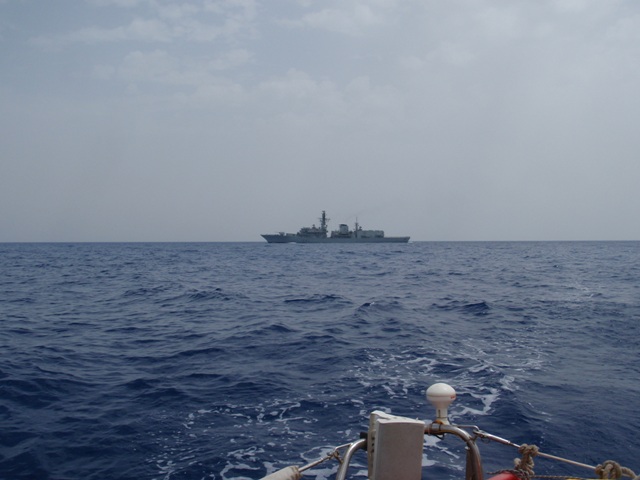
Two days sloshing through rough weather and we are hailed by a warship. They wanted all the pertinent information and told us they were patrolling the waters to keep them safe. We thanked them for their diligence and they were off to identify the next boat at sea. It must be a sign of the times that all the waterways of the world need to be patrolled to keep us safe.
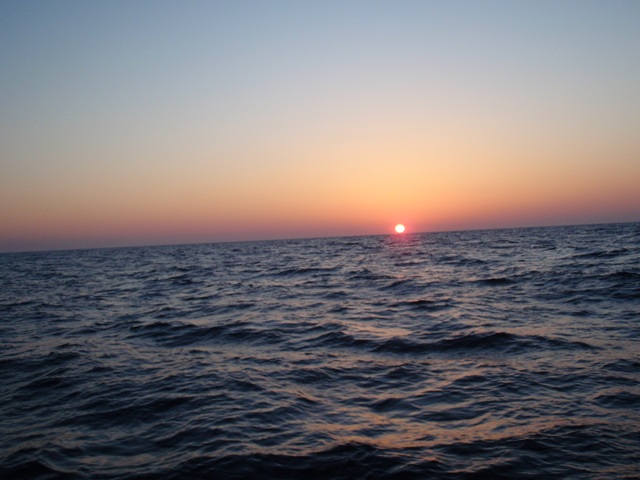
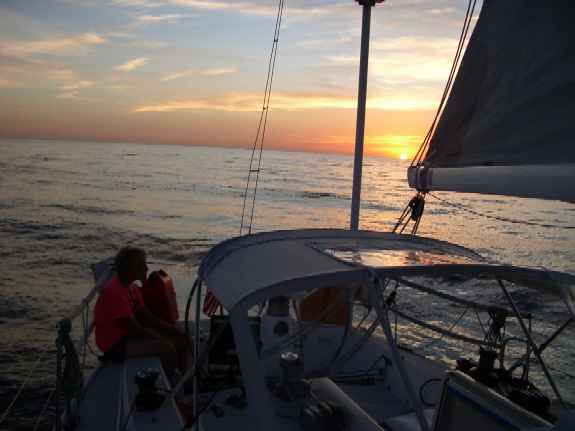
On the fourth day the wind died (as predicted by the GRIBs) the last of the boats left out to sea lowered the sails and just motored the rhumbline to Point Sideros. Bob slept soundly for the first time in 5 days. Our first sunset that we could enjoy turned out to be plucked from the brochure about the Med.
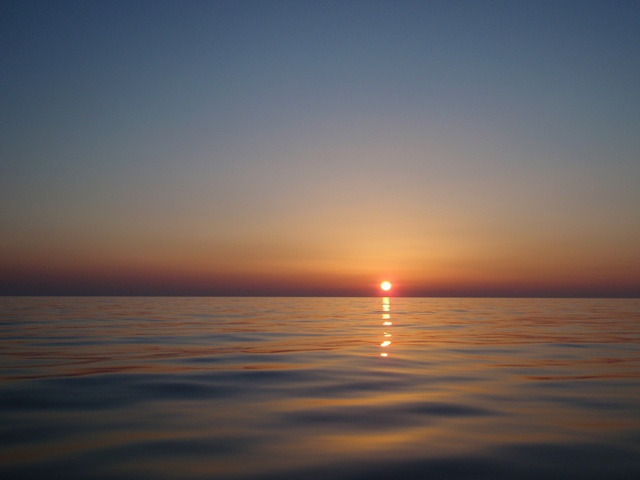
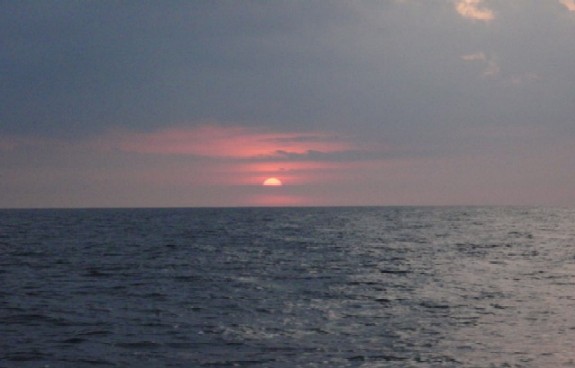
There were no clouds to break up the clear, clean blue of the sky. The sun began to sink into a deep orange as it coloured the sky. It continued to redden until, right at the horizon, you could almost see the shape of the fireball. You could see the ball flatten as it descended into the smooth seas. We waited for the green flash but Alas! Foiled again! The bonus point was a leaping porpoise on the dying light of the water's surface. The nights are cold and you wear your fleece and foul-weather gear. Rather than turn on the heater I will spend my night watch baking something for Bob's sweet tooth. The temperature sure is better for the pantry. The tropical air was murder on the fresh produce and condiments.
I come on duty at 2 am for my 4th night watch of this last leg of our voyage. Once again I am reminded why someone should be alert at all times. I have always been amazed how huge freighters will change course to accommodate Gaia's course. This time a freighter would have sliced us in two had I not changed my course. I spent the early part of the watch with the course charts and maps to put the lands in perspective. We have to go between the south of Crete and a small island or go around the island and add 18 miles to the trip. The passage looks doable. The radar helps you keep an eye on the traffic outside so you can stay warm below deck.
The sky began to lighten at 4 am; Rats, the night is over already. I grabbed my cup of tea and went out to the veranda (cockpit) to watch the sun rise. I took a 360 degree turn and looked overhead at the sky. It felt like Gaia was on the very edge between the night and the new day. The port side was bathed in a triad of soft pastel blues and at the apex over the mast the moon hung at 2/3rd full. As your gaze is coming to starboard there is a planet shining all sparkly and bright. There is not a cloud in the sky and a band of oranges, blues, and lavenders lights the horizon line between the water and the sky. The waters of the Med are calm and reflect a moving keildailoscope of all the soft colour pallet of the sky. They seem to be flashing and moving towards me becoming more intense as the minutes marched on. The band of oranges and purple light begins to implode and as this happens it develops a center of brighter glow tinted at the edges with deeper blues and violets. The sea continues to change its reflection and it wasn't long before a more intense glittery gold and orange flashed up at me. I was staring right at the point when the deep blood-red orange ball peeked over the horizon. It silently and majestically floated up out of the waters of the Med. As it began to rise and become a more intense bright light I could feel the warmth on my wind-burned face.
I closed my eyes and confirmed my beliefs on how easy it would be to worship the sun like many of our advanced civilizations of antiquity.
________________________________________________________________________________________________
SAILING UP THE RED SEA
Bob said it is hard to believe that we are cruising with Gaia between Arabia and Africa; exactly 12 hours (plus one day) from the West Coast of the USA.
The globalization of the world has allowed its citizens to be up to date on the happenings in the Gulf of Aden. The pirates have lost their surprise attack. They are being pursued by larger forces than themselves. Logic says the pirates are going to be looking for 'safer' areas to terrorize. The southern area of the Red Sea is still close enough to Somali, Sudan, and Eritrea to be a threat. We should not take this threat lightly and have decided to maintain some sort of grouping to show the pirates that we mean to be safe.
In the past, Bob had made the decision several times to travel with Group 5 but circumstances led to putting us in Group 3. I mean no disrespect to Group 3. It was lovely to be with them for the dangerous pirate crossing.
The original Group 5 wanted to stay together. Rascal and Gaia wanted to join them. It started out as seven boats that wanted to maintain a reasonable speed crossing the Gulf and the approach to the Red Sea. The Group discussed what we wanted to do about the regimentation of formations to get us through the rough areas and we opted to loosen the formation. It is up to the individual boat to be able to "close up" when we are threatened. This allows faster boats to run ahead, fall back, and change course to follow the wind instead of just motoring and following the rhumb line. Group 5 was very happy to maintain their officers so Cayuco was our leader and Stargazer the communications post for the group.
We were doing well with the wind and seas when Big Blue radioed from ahead that the Straits were blowing 30 knts in your face and several convoys were turning around to find shelter in Omback, the last fishing village in Djibouti before the Eritrea border. It took 2 hours to weave into the anchorage. High, sheer sandstone cliffs and shallow sand spits gave us a peaceful night. The moon was waning and the stars filled the sky. The wind was howling at gust up to 30 knts…and to think we were in the protected area of a marsa.
Several other convoys had left Djibouti hours before we did. They had to join us when they were forced to turn back by theunrelenting wind. The following morning there was a lively discussion on the VHF radio about the next course of action. Every one agreed that we now knew what Tony from Rally control, had warned us about in the briefing on the Red Sea. 3-4 days of howling winds to 40 knts followed by 2-3 days of 15-20 knts off the beam or dead on your nose. Hole up soon and hole up quickly when the winds begin to blow down the 1200nm of baby ocean**. Marsa's are indents in the shoreline with lots of sandbars (shoals) dotting the way. Gaia's C-charts do not chart these places of refuge because every storm creates a different set of hazards. This morning some wanted to leave early and others wanted to leave after the wind did truly die. After all, who trust the GRIB files anyways? We have 3 days to the next marsa and don't want to get stuck in horrible weather.
The next day Evelyn had been having trouble with his engine and Tony on Cayuco is our resident diesel mechanic. They spent the better part of a day radioing instructions back and forth. After 2 days of trying different solutions the problem could not be fixed. Evelyn had to turn back to Djibouti because they could not get their engine started. This was unacceptable to Tony. Since Evelyn was in the group ahead of us Tony offered to rendezvous, raft-up and he would look at the problem. Our Group 5 aimed 12 degrees north and intercepted Evelyn on their journey. We all have the same rhumb line so it was a matter of Evelyn dropping back and our Group remaining the same speed to catch up with her. When Evelyn was within a mile of Group 5 we all slowed down, Evelyn turned 180 degrees, Cayuco pulled up alongside, Tony jumped aboard and had the problem fixed in less than 15 minutes. You could hear the cheers all around the fleet as Evelyn was saved from a serious fate. They would have never caught up with the BWR for the transition through the Suez Canal if they had to turn back.
Later, most of the boats in Group 5 had turned back to circle the ailing boat. With success we headed north and as we formed up some loosely structured formation Gaia came upon Cayuco and gave the Allah Salute to the famous diesel engine healer.The GRIB files were predicting imminent doom for travelers heading north up the Red Sea. Three different groups spent lots of airwaves back and forth with some skippers for and some against the wisdom of the GRIB's. All said and done Group 5 decided to take refuse in a marsa. It would be 2 days before we reached the entrance to the marsa. Slowing down to stay with the group had us doing bare poles. Bare poles and with the current in our favour we were still doing 5 knts over the ground. We did not want to arrive early so we tried to time our approach.
As morning broke over the horizon the whole Group was in good position to make our entrance into the shoal infested waterway to the marsa. Shula3 has the most comprehensive and up to date charts and so he gets the honour to lead. We also like the idea that he has a center board. If he runs aground he just pops the keel and backs out quickly. I was laughing as our charts showed that we had crossed reefs and land several times. This is why we lined up behind Shaula3. We had incredible luck. As we were entering the marsa the wind turned from the S-SE to N-NE. In other words it went from behind the beam (very pleasant) to on the nose (get the meaning). We anchored quite a way inland in 24 feet of water. The wind gusted to 30 often but we were safely tucked into our hole for 2 days.
A boat came into the marsa with 5 men on board. They went from boat to boat looking for handouts. What they wanted were snorkeling mask and spark plugs. I gave them pens and paper for the kids and lots of dried beans. I am starting to think about the Mediterranean and lightening the load for a whole new culinary delight. Ahhh but I am getting ahead of myself. Bob thought the boat and the outboard were too new for any fishermen in the Sudan so we were visited by the government spies. We have no intentions of going to shore so we should be safe.
After two days of catching up on odds and ends the GRIBS said we have a window of opportunity. That's if you believe the GRIBS. After much discussion Bob and I decided to get going. We are sailing close to point and quickly lose the other boats in the Group. There came a time when we had to make the decision to go into another marsa and hole up for another possible 3 days and maybe 7 days before the winds would abate. We would be going into this hole when the winds were favourable and refreshing. It was still another 5 hours to get to the marsa before the storm began. The weather can change quickly and it can be disastrous.
All of a sudden we got lifted and smoothly flew around the spit that was supposed to be our protection. The wind, sea currents, and sun were in our favour...an omen. We were going to ride out the possibility of 40 knt winds and 6-10' seas … maybe, if we are lucky, for only the last 5 hours of the trip.
What would you do?
We decided to go for it. It turned out that we won!! We had winds gusting to 20 but nothing higher. Seas of 5' that made Gaia dance so smoothly it made the journey comfortable. Comfortable enough to make bread - and yeast so hates to bloat when it is rock-n'-rollin. The bliss of a fast, warm sail did not last long as all the rock- n'-rollin stirred up the sediments in the fuel and plugged the intake hose filter. Change all the filters. Runs for awhile…cough. Bob changes more filters. Runs for awhile…cough. Bob sucks the water out of the main fuel filter through a straw. Reminded me of high school kids stealing gas from the construction equipment. Finally we gave up and drove the boat with no engine. We have done this before several times and so we have the routine down.
We had to try to slow down the boat because we would have to wait till 7 am to get into Port Ghalib. The main had been lashed to the boom and most of the night there was no jib at all. We were going too fast and radioed our position to the marina port captain at 10 pm. No way could we enter without an engine and we would have to wait till morning. Ed on Prew was hailed by the marina and we decided to have Ed be our spokesperson on the dock. Ed felt the winds die around sunset and rise in the morning so early morning would be the best time to help us into the marina. We resigned ourselves to watches where we kept enough jib out to keep us headed into the wind. A small nuisance of trying to keep a boat balanced when it wants to head out to sea.
At 6:45 am Bob called the office and he was reminded to wait till 7 am. 7:30 and the port said they were waiting for authorization to decide what to do.
So I decided we must be the first boat after the hapless one on the reef, to have to come in without an engine. Ed was on top of things and he had to swear on the deep pockets of BWR that he was captain of his boat, the yard was not responsible for anything, and nothing bad was going to happen. By the time Ed was heading out to tow us the winds had risen to 18 knts and we had 6' swells with plenty of chop. So much for the lull safety zone of 7 am we were shooting for.
I was on the helm and Bob was frantically getting the lines ready. Ed had asked us if we had 50m of towing rope and Bob had said yes. **--?? Where? News to me! Bob unbolted the spare rudder and in the transom box was the spare anchor and 300' of rope. He hurriedly put the fenders on the port side and prepared the anchor line for his toss to Prew.
I looked over my shoulder and there was Prew, all 52' of her coming up along side of Gaia. She would rise on a 6' high wave and glide down the backside with ease. The Dutch captain, Ed, was gallant and confident at the wheel. As she came closer I found the rhythm of the waves and began to match Prew as she was sliding up and down the waves. Her bow approached on an angle and I slid down a wave bringing the port side of Gaia within 12' of the much larger Prew. Bob timed the motions of the two boats and threw the line to Pauline. She had to crab forward several feet on the gyrating deck to grasp the line. For one harrowing minute the line was slipping off the bow and it looked like she may not reach it in time.
She had this huge smile. Pauline is known for always being game. Whether it's first on the dance floor or walking up to a family on the streets of Malaysia, Pauline is there making it happen. She was in the game of the moment. Pauline is holding this umbilical cord between our two boats and lightly prancing the length of Prew to tie us off the stern. Meanwhile, I have visions of Gaia sudden lurching starboard on a rogue wave and pulling her overboard. I concentrated on the 'Dance of Gaia' and kept her swaying over the waves. I even began to move behind Prew and get in position to be towed to the inner harbour. Pauline gave me the driving sign and then the thumb up and ran forward to be Ed's eyes on the foredeck as he weaved between the reefs.
Everything was going perfectly. In 20 knot winds and 6' seas I could still control Gaia and keep her steady through the narrow passage between two reefs. One reef had a sailboat listing on its side - abandoned - as a reminder to everyone you do not enter this port with out an engine. Gaia never tugged on the towline. I kept it slack and at one point as we neared the cement seawall I had to zigzag my way to slow down. My last zag I sidled up to the dock, gave a last second course change, and the landing was a success. There were about 2 dozen men on the dock and they cheered and helped us moor to the seawall.
My first dock landing ever!!And as Bob is so fond of saying:
We walked away from another one!!
** Scroll to Djibouti and read the paragraph on the geological processes in store for the Red Sea.__________________________________________________________________________________________________________________________________
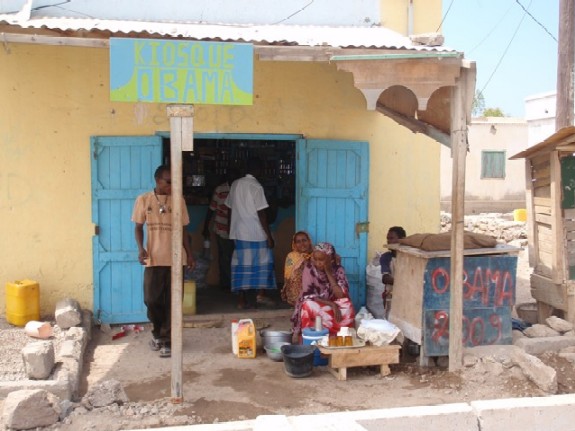
Kiosque Obama
DJIBOUTI, AFRICIA
February 23 - March 2, 2009Bonjour!
We traveled down the length of the Gulf of Tadjoura, off the Arabian Sea, reaching the port of Djibouti at 4:00 AM. I breathed a sigh of relief to be done with the pirate situation. The long offshore sailing went very smooth and the entertainment was intense with yachts so close together you could yell to each other. Sleep came easily as we anchored out waiting for daybreak.
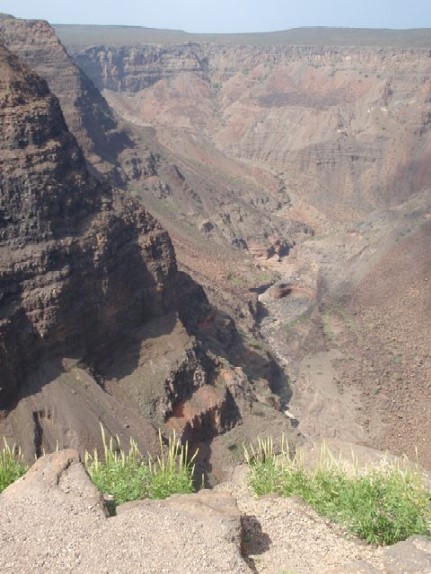
People flock from all over the world to witness first-hand the evolution of the world. Our trip to the inner territory was quite the geological education. Djibouti lies on top of what is left of the earths crust as it is being pulled apart by 3 equal tectonic plates. The Arabian plate, which is moving 2-3 cm per year, is now almost completely free of the African plate (forming the Red Sea). There is only one umbilical cord holding the two plates together and here lies the Afar Depression and the country of Djibouti. In another 2M years Djibouti will sink under the sea, the Red Sea will be an ocean greater than the Atlantic, and Africa will be split into two continents along the African Riff.
Lots of yatchies decided on the shorter 2 day tour. Rascal and Gaia decided to do the extensive tour and see it all! For the first day we would see the same sites so we convoyed in 6 SUVs'. We had a driver, a 4X drive SV, and lots of water.
Good idea to have a driver.
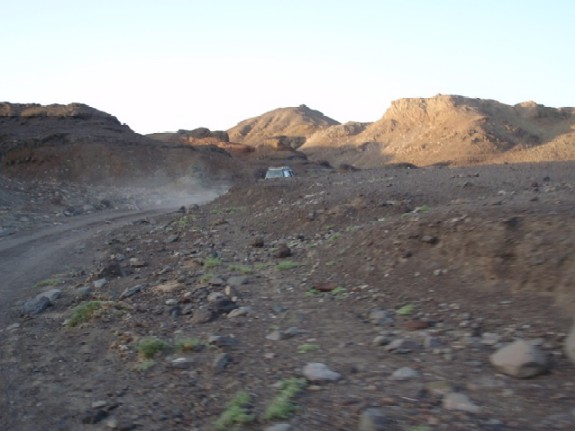
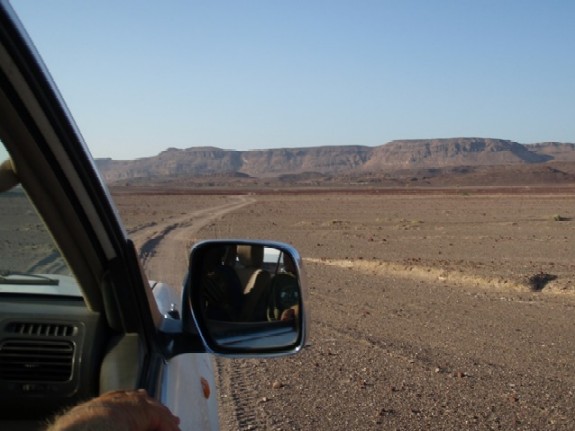
Besides no street signs sometimes there is no road at all.
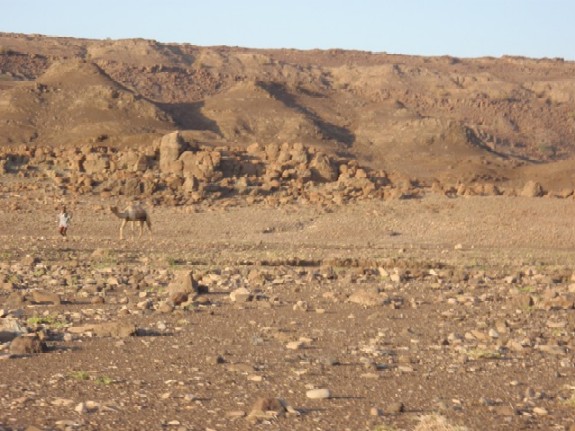
You just take off across the hard-crusted desert and come out on the other end someplace you wanted to be. There would be very well maintained hardtop for miles and without warning a load of dirt is blocking the road. You need to detour around wadi washouts on some of the nastiest erosion and rock infested 2 tracks. The boulders were as large as bags of cement so you can imagine the force of the flash floods that happen 3 times a year (and last for 4-6 hours). I don't think there is a Public Works and people just move off and back on to the highway anyway they can. Going around a blind curve took nerves of steel. It was not unusual to encounter loose boulders on the steep mountain passes.
We had been driving for several hours on the only road that will take you to As Ela.
As Ela
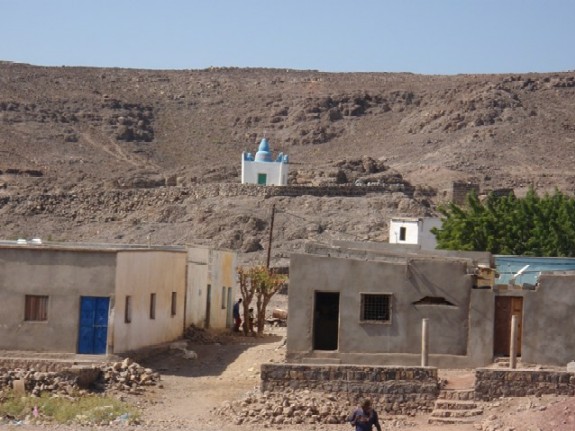
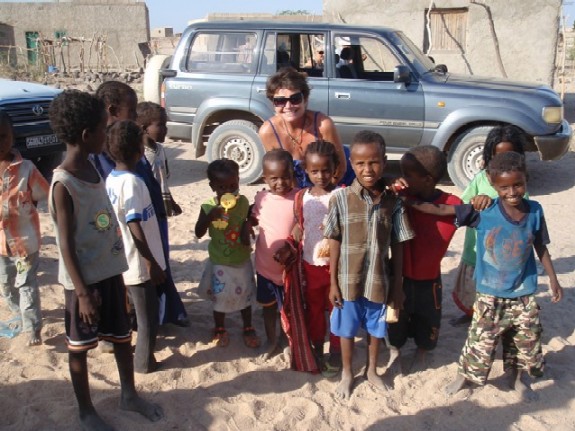
We had stopped for lunch and were immediately surrounded by children. All happy faces, clean clothes, most without shoes; the kids liked having there picture taken. The adults were another story. They would lightly smack the nearest kid and the rest would scatter - just far enough away before turning around and looking over the commotion with curiosity. They did not beg and we had nothing to give. Where are my packets of paper and pencils when I need them?
Back into the 4X4's and the convoy was off in a cloud of dust. We headed east on no particular road at all.
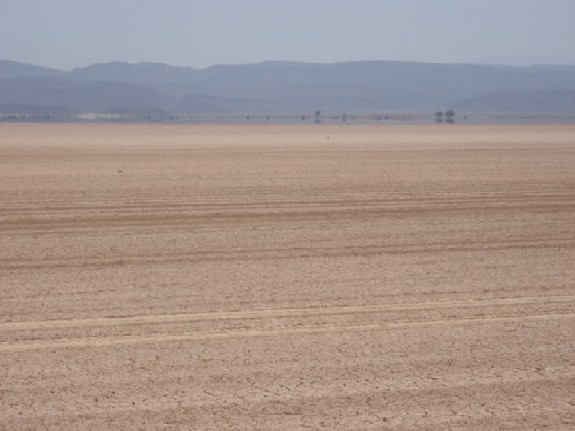
There is no road on the map and most of the time I wasn't sure we were on a road at all. This mirage lasted for hours.
LAC ABBE
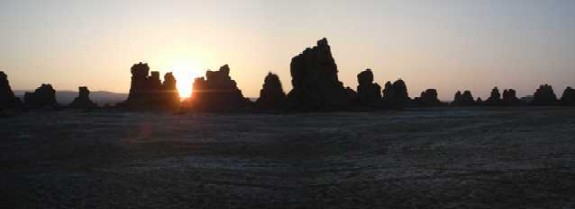
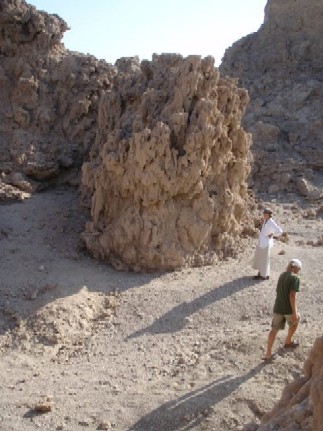
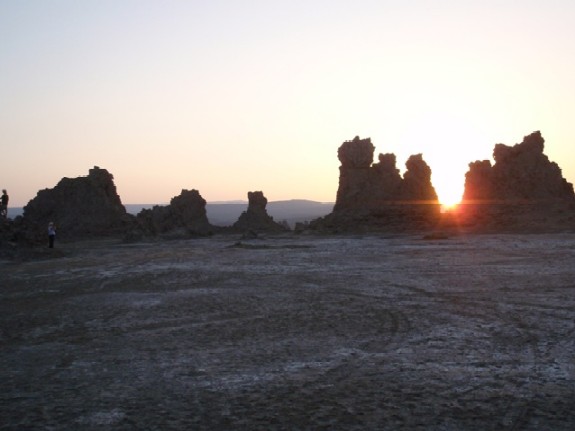
The landscape changes regularly from green hillsides, to red boulders heaped high, to granite cliffs of light grey. We crested a hill and with the setting sun glowing off of hundreds of rock stacks "growing" within the flat basin of the lake we at last caught site of our first set of chimneys. The locals call them "chimneys".
They are large spike-like deposits of travertine left over as the softer sandstone area sinks into the core of the earth. I looked for the Lac Abbe. We circled around in the SUVs' and the chimneys grew in height and numbers … but still no water, no lake. The vast depression that forms this lake is very eerie. It is famous for its moonscape or to my eye, more like Mars and her red valleys spread out in front of you all the way to the horizon.
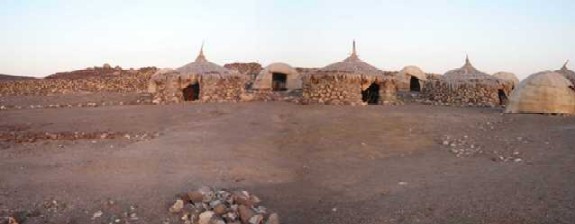
As the sun continued to throw different shadows in its decent over the mountains far in the west, we were rushed off and the 4X4's shot up the hill, and over the crest and there lies our accommodations for the night. Bruno had said you would be living like the nomads of the area. It was all fun and the dinner the natives had cooked for us was delicious. There under a full universe of stars we ate, we danced, we sang, and we had a wonderful nights sleep snug in our mosquito netting.
The next day everyone hustled up to see the sun rise over the chimneys. As first light was ascending we hurried into the 4X4's and headed to the middle of the Lac. The colours changed every time you looked in any direction. It was a 360 degree wonderland. All excited about what we were experiencing some of us started wandering off on paths of discovery of their own. Most kept in eye range and we moved generally in the same direction.
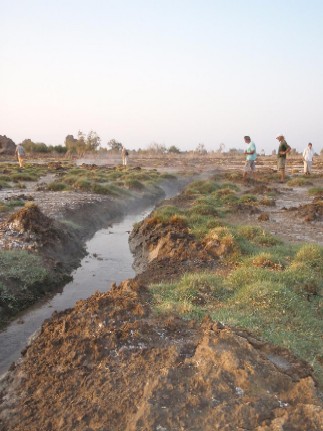
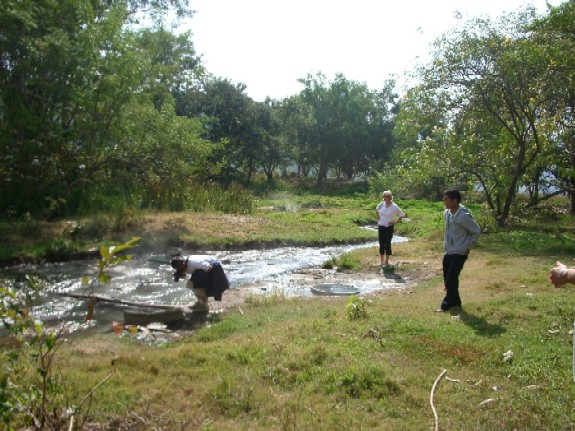
Our Morning Walk led us to some hot springs. Hot springs dot the landscape. I followed one for a while and the water cooled so grasses could survive. Further and a marsh complete with cattails and herons/egrets enjoyed the water wonderland. Imagine out in the middle of searing heat and rock landscape there is an oasis that can attract water animals.
Again we piled into the vehicles and two-tracked it up the hill and had breakfast. Wendy and Pam wanted a camel ride and so we had some entertainment for our breakfast to settle before we started on the rough journey to another Lac.
Now the Rascal/Gaia group are the only ones going for the extended tour. Although we had lunch with the bigger group we sailed off in a different direction. There in the mountains was a turn-off, a parking lot, and nothing.
I walked to the edge of the lot and in front of me was one of the largest depressions I have ever seen. This was no sinkhole. Three streams poured over the sharp edge of the plateau several times a year (flash flooding is common) but for now it was dry.
As we were leaving there was this camel with the sun shining just so and a perfect picture opportunity. Our driver said it was OK (He would tell us when to and when not to take pictures). Two kids came running up and demanded payment for taking a picture of their camel. Our driver in a sharp voice told them No, it was bad for the tourist business…or something close to that. His language is a combination of local tribe and French.
The afternoon found us weaving through a mountain pass on a two-track road. The SUV slowed down and turned at a stick in the ground with a blue rag tied to it.
We traveled for 7 km over donkey paths till we crested a ragged peak and what lay before us looked like Paradise. The village hugged the sides of the steep ravine making room for some rice paddies.
The stream slowly meandered through a river bottom that would flood in the Khareef. The village grew its own crops using irrigation and mango trees shaded the village. It was protected from the desert heat and storms. Suddenly the donkey path turned into a parking lot for 3 SUVs and we were at the Bankquale (the Black Panther). It is promoted as an eco-lodge and it certainly held up to its name.
I thought we were going to live like the natives but we actually had it a little better in that we had a dining room to congregate and smooze with the other guest. Most were German tourist and several had small kids. The dinner was excellent fish…and here we are in the mountains far from a sea.
Snug in our mosquito netting, we listened to a baby cutting teeth all night long. I guess that is all part of the native experience. The next morning we watched the weaver birds building their nests in the trees and then we were off for new adventure.
LAC ASSAL
This is the lowest point on the African continent (153m) and volcanic activity can be seen everywhere. Walking to the water's edge there would be hot springs steaming between the cracks in the salt encrusted shoreline. The local boys were selling the halite (rock salt) in golf ball-size spheres that form in the pools of boiling water. Standing at the waters edge you could be blinded by the intense whiteness of the salt and then looking at the black lava fields (Ardoukoba erupted in 1978) that border the lake would give you afterimages.
Blinding white contrast starkly with the basalt lava fields around it. As the sun was setting the colours of the lake changed and the salt had a crystal glow - almost florescent.
This is the very first time ever that we have walked away with more than just pictures and memories. I couldn't help but snap off an irradiance white, fist-size, arm of sea salt for our grinder.
You know you are in Africa because it is so different from Oman or Sri Lanka. There is a difference in the way people treat you. Djibouti is a kinder, gentler place where the women wear the best saris in bright colours. They take the time to colour coordinate and they are very noticeable on the street. The Djibouti people have an elegance to them in their walk and speech. They look at you with dreamy eyes and you don't know who has been into the khatt (a local drug plant) and who just sees in a different light. I am starting to see in my travels that any community that is cut off from the larger world has a more community concept of right and wrong. Anyone can swat your kid and any kid is welcomed into your home for a meal, a night, a time.
We have to start on the journey up the Red Sea and this is not for the foolish. We have a narrow passage that bottlenecks some mean winds coming down from the north. We need to time our 2 day passage to take advantage of daytime hours, tides and wind conditions. Again there is a shipping lane we need to stay out of and this will put us dangerously close to some of the roughest pirate country. With all the security of the main routes this is the last stop for easy pickings with no warships in sight.
_____________________________________________________________________________________________________________________________________
THE GULF OF ADEN
Home to the Somali piratesThe harbour at Salalah, Oman is full of boats enjoying the last of the Indian Ocean before heading through the Gulf of Aden and up to the Red Sea and the Suez Canal. Coming across the Indian Ocean from Thailand and then Sri Lanka we made the 10 day passage to Oman. It was our first taste of the Arabian Culture and the parching deserts of the region that is to plague us in the coming months. To ensure their safe passage through a region racked with Somali pirates it is best to form groups of 5 or 6 boats. Many cruising boats are socializing on the docks looking to form up convoys for the trip up the Red Sea.
We have the BWR to help us find our way safely through the dangerous waters. True to form they came through with a plan.
The day was bright and the dust storm from several days ago had settled considerably. We had had several meetings about the protocol we would use for emergencies and thought using the same tactics as the RAF in Great Britain was the best approach. It was a shoo-in to elect Paramour as our fearless leader and Neva as our communications post. There are new formalities in the Gulf of Aden and The Coalition Forces want to know our position twice a day. This will be radioed in to headquarters by our communications post ( Neva ).
Feeling secure about having a game plan we left the dock at the harbour in Salalah, Oman at 9:30 am. We were in the 3rd group and expected to do 5.5 knts through the duration of the passage. The 2 mile space between the traffic lanes is a safe zone. We just need to pass one lane of traffic to enter. Problem is the freighters are moving fast. We look at the radar and choose a time period to make our crossing to the safe area. In the Gulf of Amen some of the faster boats were passing us and at one point there were 15 boats all together steaming for the same destination. Once we reached the safety of the 2 mile middle strip the groups had certain times when we were suppose to enter the shipping lanes.
While we were spending our first day motoring in light winds Paramour our leader, thought we should practice our maneuvers. According to the people who know about these things it takes 7 minutes from the time you see the suspicious boat till it reaches you. On our first try we grouped together tightly in 8 minutes. The tricky one was Stage 3 when you surprise the thugs by making a sudden turn…choreographed like the Blue Angels Air Force flying team.
So now you are all bunched together approx 400 ft. apart and need to execute a 30 degree turn to port to initialize a Stage 3 alert. Initially we have a skipper who was in his high school marching band and he thought we would have no problems doing the same maneuvers. We all tried our best but this will take some more practice. Much easier if you are motoring than if you are sailing.
This maneuver ended up breaking up our formation and we all knew how to improve on our next try…later… like hopefully never.
We are monitoring the emergency stations (Ch. 9 & 16) as well as our private station (Ch. 72). Scanning the airwaves we started to get distress calls from a vessel that was 7 miles to our south. Neva offered to send the Mayday for RBO Premium and the captain was most grateful. For some reason his distress calls were not getting through to the rescue helicopter. We relayed the coordinates to The Coalition helicopter and it was zeroing in on the commercial carrier, barely meters above our heads, in 3 minutes. The distressed vessel was 4 miles from us. You could see the cargo carrier plowing through the water creating a large wake in its haste to get as much speed as possible. The helicopter showed up and then the freighter started using water guns over the side of the vessel closest to us. 10 minutes later we heard the copter pilot radio the captain and tell them they were friendly fishermen. The captain was not convinced and continued to hose down the sitting ducks in his vicinity. I think the fishermen will find friendlier waters tomorrow and avoid the 2 mile safety zone in the shipping lanes.
Because of all the excitement our fearless leader had called a Stage Two alert and we were bunched together with a 400 ft clearance between the boats. We maintained 6 knts boat speed (we have a 2 knt current favoured) and cruised till the ship was out of sight. Our leader called off the alert and we continued motoring at a safe cushion of 1/4 mile distance from one another. We usually do 1/2 mile cushions but under the circumstances we feel safer with less distance. The helicopter did radio Neva and ask for a summary of the events. Heidenskip heard the conversation and was afraid that Neva had been boarded. 25 miles in front of us and they could pick up our conversation. This means that so can the bad guys - our need to use the lowest power possible on our hand held VHF could be critical to keeping our conversation to only the Group and not others in this busy area.
Staying in position is proving to be more difficult than it first appears. The ocean is infinite - how do you know where perpendicular to the rhumb line is falling? Add the fact that the boats are not like cars and can stay in designated lanes and you have wandering within the box happening constantly. A half mile cushion between the boats can be compromised very quickly when you are traveling at 6 knts or more.
The morning started out with a new message from the Coalition Forces that we were entering a new block and a different war ship was going to be monitoring us…OK?…at 11 am a helicopter flies very low and Bob waves. You could see very clearly the boy sitting in the open doorway with his automatic weapon slung across his chest. We were hailed and Neva was our spokesperson. Later the helicopter went back to the war ship. We were hailed by the ship and we were asked, and we gave him, our co-ordinates. Saying we are Group 3 of the Blue Water Rally helps push the paperwork and they know who we are. The captain was satisfied and told us we were in the protected area for this coordinate. We could proceed.
Rascal was very upset. He thought that by broadcasting our coordinates over the very public channel 16 we opened ourselves to every flunky who has a radio. Most of the boats in our group agreed that anyone hearing that our convoy was protected by a warship, and seemed to be on a first name basis, would be inclined to be busy fishing instead of threatening us.
The warship stayed just off the horizon and traveled in a clockwise direction for most of the day. It seemed we were the very center of the warship's circling and it was comforting. As we move through the Gulf we will be entering and exiting several blocks with their own warship from all different countries. Our leader Paramour has always radioed the warship and asked if we were in the correct passage area. We are supposed to remain in the two mile safety zone between the two opposing lanes of traffic. It is a win-win situation. The warship gets our greeting, our exact heading, we get permission to be in the safest area possible, and the plan continues.
Day 3 and Neva has questioned their ability to do the required e-mails. This is due to problems with his mail system. The Plan calls for a back up communications person and we had elected Big Blue. Formations have been satisfactory - after all we are not in the Navy and we wander. The wind is off the beam and no one is running their engines. It is much different than racing sailboats. Who would ever guess that Gaia would be pulling in the reins to maintain position with the slower fleet boats? As the sun set in the cloudless sky Group 3 was in tight formation, 1/2 mile apart, motor sailing in 6 knts of wind and clipping right along at 5.5 knts.
Before long the winds kicked up to 14 knots with a beam reach and following seas. Paramour asked for consensus on upping our speed to 6 knts. Rascal did the math and discovered if we increase our speed we will arrive in Djibouti after sunset therefore lets slow down our pace and arrive the next morning. Paramour (and the vote we had later) argued that the sooner we are through these busy waters the better. Rascal did bring up the idea that we do not follow the rhumb line because it will bring us too close to the Somali shores. Rather we should dogleg for an additional 6 hours to stay in the middle of the channel. Our approach to the anchorage would be a perpendicular heading instead of a straight in approach. Everyone agreed with that decision.
The night is filled with trying to stay in position. It requires you to make minute changes in compass and sail trim to stay in position. The sky is filled with the light from millions of stars. The phosphorous tempts you to compare their glittery shine with the stars. Off our portside approximately 2 miles away is a constant stream of commercial carriers traveling very fast in single file. Off our starboard, about 2 miles away, is a dribble of traffic traveling in our direction but much faster than we are traveling.
As day breaks over the horizon Bob and I are intensely trying to get back into position. When you are sailing at distances of 1/4 mile apart, if you are 1/2 knot off the speed of the lead boat in 15 minutes you are seriously out of position. Some boats are motoring; we have been trying to sail and with all the attention to sail trimming we didn't notice how close we were to Neva). Ian, our leader, said we learned two things over the night. 1) Everyone needs to know if you decide to motor, it is tricky when one is sailing and another is motoring. 2) If the wind Gods are favouring us we can go 6.5 knts and maintain position.
Helicopters continue to circle overhead and sometimes we can see the warship. Winds continue to build and we up the speed to 6 knts. Neva is still plagued with e-mail problems and Evelyn has the cable that he needs. They break formation and the package is handed over the side by boat hook. They are successful and Neva once again becomes the official communications post - and that is a relief. Not that Big Blue is not capable it is just that Neva is so exceptional.
In the early afternoon we received a radio message from the warship telling us that we had reached the end of the shipping corridor and we would lose our escort. The next 3 days we are on our own as we traverse the Arabian Sea to our destination of Djibouti, Africa. On Rascal's advice the entire Group 3 will do the extra 6 hour detour to avoid getting too close to the border with Somalia.
We were approaching our last leg of the journey when, over emergency Ch.16, we received an urgent message from Stargazer. Stargazer is the communication post for Group 5 - the final convoy in the BWR. Group 5 had just left the safety of the shipping lane corridor and had received their send off from the warship. They were on their own for the remaining 3 days passage to Djibouti.
Suddenly, Shula3 felt threatened and initiated a Stage 2 alert. Apparently, two fishing dhows (heavy wooden boats with a pronounced bow and low sides) had appeared off Schula3's portside approximately 2-3 miles ahead. As the group was motoring towards the fishing dhows they turned south and moved off a short distance. They started matching the speed of the group. Cautiously, everyone in Group 5 kept an eye on the dhows and started to move closer together for protection. The group was motoring in formation 1/4 mile to several 100 yds apart showing a strong show of organization.
An hour had past and one dhow suddenly turned and approached at a 90 degree path into the heart of the group. The second dhow had fallen back and was behind the center of the group; matching speed. Stargazer wasted no time in hailing the warship that had so recently said its goodbye's. There was no response. Stargazer gave an all bulletin on Ch. 16 about their situation. Maybe someone was listening.
The dhow that was trailing behind the Group suddenly advanced quickly, within 200 yds, of the stern end of Stargazer. This is the first time Stargazer could clearly see that the boat was full of men. No one in Group 5 could see any weapons. Hugh and Shaun sent out a Pan-Pan and S/V Alamak is the first to respond. Alamak is a BWR participant. He immediately radioed the Djibouti Port Authorities. They in turn, radioed the French warship. The French warship radioed Stargazer that they were 6 miles away and would be on site in 20 minutes. Suddenly both dhows turned and sped away from the group. Stargazer received a radio call from the warship asking if his Pan-Pan was still active. Stargazer wanted to make sure the threat would not be returning and replied 'Correct'. The warship replied that they would continue their mission and steamed past the Group to pursue the dhows. Group 5 triumphantly pulled into Djibouti Port to cheers and rounds of beer. All the yatchies were waiting for the good news, the exciting news, and the details! It is a wonderful feeling to pull into a new place with different cultures and views and there is someone to greet you.
It is a pleasurable experience when everyone is safe in the harbour after our most dangerous crossing to date.
_____________________________________________________________________________________________________________________________________
OMAN
January 10 - 17, 2009Slalom ah liq um
First sight of land was some high parched mountains (the Dhofar mountains) overlooking a city nestled among coconut and banana groves. We rounded the bend and the landscape became desolate, pastel, and rocky. A commercial sea port awaited our entry into the country. My first view of the countryside once we left the security gates was Barstow, California. Sun baked pastel pinks and orange rubble with hardly a scrub or grass anywhere. Then you become aware of the reality of being almost exactly on the other side of the earth from Barstow, CA.
We had asked permission to enter the busy commercial port and moor to a seawall across the harbour. We wasted no time coming into the harbour and they found us a spot on the end of the seawall. The fishermen were accommodating and very helpful.
The dock we were moored to (Med Style) was a lesson in agility. We had to climb over 3 yachts that were rocking in the wake of the fish boats entering their harbour. The topsides of the boats were covered in lines and cleats to trip you. Then you need to do something with all the bags you want to carry to shore because you have to climb down 6 feet into a dinghy, get your bags stored, then hand-over-hand the pulley system to the concrete dock. Then grab the rusted iron ladder…OOHH don't let the inflatable dinghy touch the razor sharp barnacles hanging on the side of the dock… sling all the bags onto the dock (5-12 feet over my head depending on the tides) and hoist yourself up the rusty ladder trying to remember if you need a booster on your tetanus shot.
So you can see the need for the skippers of the fleet to devise a better way to get fuel to the boat. We are now very used to the jerry can way of fuel delivery. They are very heavy and most times you will fill them many times before your tanks are full. The mizzen halyard on Cayuco was perfect for a rope pulley system and gravity did the rest.
Because so many boats were showing up looking for mooring the fishermen were all rafted together forming an additional seawall between us and the harbour traffic. We immediately found Mohammad, our contact in this country, and he found us a rental car. There is no contract, you do not leave collateral, and he doesn't even know your name. A yachted showed up and handed the keys to someone else per Mohammad's request. No questions asked. You don't need a license to drive. We hear the roads are excellent and the traffic is always light…a refreshing change from the places we have recently been exploring. We left the next day to go touring with Rascal.
We left the safety of the harbour and discover you drive on the same side of the street as in America. With no speed limits that we can exceed we fly over the very well maintained roads, crest a sandune, and overlook the town of Salalah. It is bustling with new construction consisting of buildings entirely built from local mined concrete. There is no litter, cow pies, or graffiti anywhere - although cattle, camels, goats, cars, and more cars fill the streets at any given time.
The story seems to be that the very handsome Sultan Quabooh had different ideas than his father about the working of the country. It took him till his fathers failing health to get the blessing of his family to take over the Sultan duties. He exiled his father to anywhere he wanted to go…just not in Oman. Dad chose a hotel in London; paid for by the Sultanate of Oman for the rest of his life. That was 1970 and since then there has been much reform and the country is prospering with the oil money. Infrastructure is all new and improved and the Omani people have a bright future.
This is the corner stone of Western Civilization and history abounds in these hills. Our first tour stop was to the tomb of An Nabi Umran. His tomb and mosque are most famous for the unusual tomb. The tomb itself is 42 feet long and houses an unknown amount of inhabitants. It is reputed that his grandfather is the father of Mary and the Grandfather of Jesus.
There were other Mosque tombs throughout the area. Some were very plain and others covered in tile with intricate archways. All were small and open to all people to pray or contemplate.
There is a rumor about how this whole area becomes a green oasis in the summer. Mists and fog roll in over the waters and the mountainsides blossom alive with a deep green carpet. Thus you get the Khareef effect in this southern section of Oman. It is said that most of Oman gets little water except during Khareef (August). The squalls come quickly, dump lots of water, and several hours later you do not know it has rained. The water soaks into the porous rock quickly and gathers into underground streams that supply enough water for the whole region.
Eventually the water will surface in the cracks of the sun-baked crust. It pools and remains wet year around. It doesn't travel far before the stream disappears underground on its journey to the lowest point in the middle of the desert.
The landscape is parched, eroded, and barren but you go around a bend you come face to face with fresh water streams filled with herons/egrets, fish, and grasses.
There are several different kinds of depressions in this rapidly changing landscape but the one thing they have in common is that they are deep, steep, and still falling into the center of the earth...and in the rainy season there are spectacular waterfalls that no one can see because the roads all wash out and traffic must come to a complete halt for several hours.
For dinner Bob and I decided to drive into the main road for restaurants and made a right hand turn at the clock tower.
On the 23rd of July Rd. we had a wonderful authentic Omani dinner. The Omani people have a strong family unit and dining is part of the life style. You enter a room about 10' X 15' (yes quite large) and lounge on carpets with cushions and a TV in the corner of the room. Food is brought in and placed on huge trays in the middle of the room. All the water you could drink, many special fruit blends, but not a drop of liquor in site. We did not turn on the TV and the food was spicy with out being hot…a pleasant surprise over the last few countries we have visited. My favourite part was the option of using a fork…standard is to use your finger tips to make a succulent mouthful. The after dinner tea was very sweet.
By the time we left it was dark (8 pm) and the buildings were lit up like Christmas trees. I guess electricity is not an issue because the streets looked like Las Vegas with a low ceiling. Flashing LED rope lights, florescent coloured tubes, neon in many colours, and moving signs all beckoned you to come join them. Bob made a note to have me help him find Lulu's so he knew where to make a turn and did we have a laugh when you could see Lulu's from outer space.
There were different coloured neon umbrellas on top of the building; arching neon, all different colours, on the face of the building; and every window for 4 stories had lights blazing away. Just down the street in a parking lot was a pole about 25 feet high with a spray of lighted tubes flashing at different speeds. What a change from the dusty, dry colours of the daytime.
Several days later we had our chores finished and Sylvia, David (Rascal) and I planned a day tour in the mountains. Bob was not finished with his chores and chose to stay on the boat and do them instead of going on the trip.The maps are basic as there are not many roads, villages, or sites to confuse you. A lot of the signs are in English and this makes touring without a guide doable. However, these pesky signs tell you somewhere within the next 12 miles is the sight you are looking for but without a camel to guide you will most likely turn around after several miles to observe the same intersection. Because it looks mysteriously like a two-track gully wash to nowhere we have gotten into the habit of tossing a coin.
The mountains, valleys, gullies, and river basins would change over every hill. We started out the tour stopping at every camel and taking pictures and then Sylvia laughed when we passed a caravan of camels and no one mentioned anything about stopping. Just when you begin to think that no one could possibly be herding their animals in the grassless, rock strewn countryside you would come across areas where the rocks would be piled up to form a circular rough wall with an entrance. They were several feet across to several 100 feet. They were not high enough to keep in any domesticated animals I know of and they remain a mystery to us (Where is a guide when you need one.).
When we first started out we had made a list of places we wanted to see and both Sylvia and myself had highlighted notes on the Frankincense story. This is in two parts; the landscape and the museum. Frankincense only grows in Southern Oman, parts of Somalia and a small area in India. It is a scrubby small bush and looks like it could grow on the moon. At one point in history frankincense was more valuable than gold. You burn it in an incense burner and it cures everything from asthma to a mosquito infestation. Wars and fortunes have been won and loss over this sticky, varnish smelling tree sap that hardens into stone-like globules. We found the sign all right and started following the pile of rocks we could see marking the edge of the road; without the pile of rocks you would be hard pressed to know where the two track road was leading you. We went for several miles, crested a hill, and the scenery changed.
We stood on a plain overlooking a valley about 50 feet below us. Dotted here and there throughout the Wadi Dawkah (dried riverbed so large that it spread out over 400 yds.) was dark scrub nicely lined up in farm formation with an irrigation system. It was surrounded by a cyclone fence with barbed wire on top. There was a caretaker motioning us to climb down the embankment and he would show us around. There was a trailer and small tent to call home. He didn't know much English but he made himself clear with pointing to items of interest. He walked us out the fence and into the outback of natural growing Frankincense.
He showed us many types of incisions in different stages of 'weeping'. He would gently pick up the lumps that had dripped off the incision and place them in a crook in the shrub. He would have us hold and smell but always made sure he retrieved the lump and put it back on the shrub.
Our self-appointed guide asked if we would stay for tea and we would have loved to but the sun was sinking and you had to be back at the boat before dark. There are very few other vehicles on the road and they do not drive like they have a death wish so why do we need to be home before dark? Our trip has shown that obstacles abound around every bend. Boulders the size of basketballs,
camels in the road, washouts with no warning signs, and pedestrians all try there hand at tripping you up.
An oddity of this country is that many people speak perfect American English. Bob was in a grocery store and this woman, who was completely veiled in black, asked him to reach something for her on a higher shelf. Not satisfied with the product, she continued to have a conversation with Bob in perfect American English. Bob was amused and surprised. I was amused and surprised when
we were out in the middle of the mountains in a dusty village of not more than 100 people. We were the only car in front of the restaurant but we were hungry. We said "Hello" and immediately all these men (the men don't co-mingle with women) jumped up and greeted us. Several spoke perfect American English.
We had trouble with the menu so they invited us to check out what was on the stove. I was very pleased with the cleanliness of the kitchen. There were huge pots simmering on a bed of coals with round steel trays of smaller pots staying warm on a wood fire. Lifting the lids was a culinary surprise of spices. We chose chicken and goat. The men did the serving (the cooking and most other chores of everyday living are the domain of the women) and we had a wonderful conversation about Obama and foreign influences in Oman (mostly centered on oil and geographical location to some hot spots in the Persian Gulf region). A common site even at gas station is a person sitting at a cash register and doing nothing except making sure no one is stealing or skimming. Here we are in the middle of a dusty town and the only customers for miles and the cashier is happy in his corner while his patriots lounge on cushions smoking and drinking tea. He did not help with the menu, seating, or greeting but he was ready to take our money from someone else who would hand it to him.
The next day we had our briefing with Tony from BWR about the trip across the Gulf of Aden and the Somalia pirate zone. We finished with the last minute chores and did our provisions shopping at Lulu's. This is a huge 4 story complex with everything from a pharmacy to auto tires to cosmetics. I got an exterior keyboard. It was twice - no three times - the quality and half the price of the one I got in Singapore that lasted 3 months. The added plus on this one is I can converse in Arabic with this keyboard.
We are traveling by convoy through the dangerous zone. By arrangement we have an exit time for the beginning of our voyage of late afternoon. This is the perfect opportunity to finish up our touring with a drive along the coastline to some more historical sites. All present and accounted for the Gaia's and the Rascals headed off for the only site that we had not ticked off our list:
The Al Balid Archaeological Site and Museum of the Frankincense Land.
As we were heading up the coast highway we could see the ruins from the roadway. We pulled into the parking lot (past the guy with a gun sitting in a small hut) and into a very newly built structure. We walked past the gift shop and café, and into a largish center courtyard. Straight ahead was the History museum and to the right… Bonus! A Maritime museum! Everyone was extremely impressed with all the exhibits. The videos were in 6 languages, the models top rate, and the information clear and concise. When we walked into the maritime museum I kept saying Oh! WOW! I said it so many times a guard that I did not see till I was fully in the building was laughing. It was magnificent and they did not spare the expense. I'm not sure if I remember the different skiffs and boats that were used over the centuries but I will never forget the replica of the stern of Ibn Batuta's ship. He was the 14 century explorer who was very impressed with this place and described it as a beautiful city.
We left and walked across the parking lot to find out you could rent an electric car and driver to drive you around the ruins of Al Balid. Founded in the 11th century AD, it was the center of commerce which spread for at least 3 miles along the beach. Part of the great mosque and parts of the palace are some of the remains that are restored. It was peaceful and you could sit and reflect on the clear air (today anyways), calm sea, and cloudless sky.
KHOR RORI
Khor Rori is an area that found a need and started to fill it in the 1st century by having a port. It was from this point the frankincense is shipped to all the stops along the Indian/China trading routes. By the 4th century, Sumhuram, as it now became, prospered and was a very wealthy place to be indeed. A drawing of a ship docked at Sumhuram can be seen in a temple in the Valley of the Kings in Luxor painted around 1500 BC.
Now there became a need to protect their investment and the walled city was designed on top of the cliffs surrounding the port. From the road there was an easy sign in Arabic and English and you could see the city was just a short track off the main road. we crested yet one more hill and before us was a formable scene.
The state of restoration is in flux. The archeologists know the layout of the fort, the waterfront village, and the outside mosque. All the easy walls have been restored and the diggings continue. The frankincense was bought/sold/stored/shipped from below the fort and it is off limits.
The main gate to the walled city is completely restored with the original "Welcome" sign. Some archeological students showed us the original grooved stones in the walls that were used to stop a marauding advancement. Large poles would be inserted on one side and slid into a locking position on the other.** Then the enemy would be easy pickings from the 14 foot high walls and narrow passage. Even completely cleared of rubble barely two people could walk abreast…could you see getting a herd of goats into the city this way.
There is an effort to control the curious with footpaths and stone-edged walkways. It is too early in the restoration process for any informative signposts so you pick up bits and pieces from the English speaking workers. The view across the waters lets your imagination run free to roam back to the beginnings of man's journey to inhabit the earth. From what I have seen of the interior of the country and the way it has not changed much in 3,000 years, this must of been an awesome site to be a native walking down the streets of the walled city, after a lifetime of living in the sparse lands, gathering frankincense, and by camel caravan came to sell and trade with most of the known world.
The pamphlet mentions this spot that has anti-gravity qualities. There was no sign and we just had to keep looking till we found the spot. Our car did try and move uphill and I had a weightless feeling…and then a little light-headed. We left quickly.
On our way back to the boat for the final time we noticed a castle was right in our path. We went to investigate and have to report on the city of Taqah (TA- ka) and its beautiful white sand beaches. It is also world renown for the important historical site of the famous Taqah castle.
We pulled into the small village that has the same amount of construction as much more renowned villages on the map. It appeared the village would be 3-4 times as populous in a year if they can fill all the buildings they are constructing. For being so famous it was difficult to find the castle even in the spread out condition of the village.
We misidentified the castle as the one on the hill because it looked more like a castle than the castle itself. We walked up to the door, it had a large padlock on the gate, and we talked about walking up the hill to the 'castle'. Where we were standing must have been the gift shop. A sleepy man appeared out of a darkened room with no door in an alcove slightly behind the main gate. With lots of gesturing we paid $3US for 4 persons to enter the famous castle. We started heading left towards the hill when he hailed us and unlocked the door in the heavy wooden gate.
Great! While he has our attention (and we interrupted his siesta) he wants us to go to the gift shop first. For $3 I guess you cannot expect too much and we did not get a guide or a pamphlet to answer all my questions. Bummer.
A MAN'S HOME IS HIS CASTLE
Walking through the tiny door you needed to take a moment to get use to the dimness of the corridor. It was quite narrow, maybe 6' with a 14 foot ceiling. The walls were thick adobe; the ceiling wood poles overlaid with reed matting and a 4" layer of concrete finishing the roof. On the left a room about 6'by 12'long that held the weapons. The walls had pegs to hang guns and scabbards. There were baskets in the corner for stuff and a rug and cushion on the hard earthen floor most likely for the keeper of the weapons. Directly across the corridor another room used to store the powder kegs and more implements of destruction. Walking further on the left the same size room used for food supplies. The room across from it was for cooking utensils, storage baskets, drying racks for herbs, and cleaning supplies (Brooms & rakes with no handles). Lastly, on the left was an alcove with a 4' high front wall and 6' deep. It was for firewood. I was surprised it held so little wood since it is the main source of heat and cooking fires. I can only guess it is because of termites and other critters getting into the house rather than supply and demand. Further the corridor opened up into a slightly wider area where the walls were lined with raised platforms covered in rugs and tapestry covered pillows…Receiving your guest? Incense was burning in the now familiar burner as you walked into the open center of the castle.
In the center were several trees, two wells, staircases leading to the rest of the castle. The flagstone floor was beautiful and I could see this as a nice way to live. The upper floors contained several rooms, a children's room, and a master room. The master room was 8' X 25'long and the bed with all the tapestries, silk draping, and mosquito net filled the one end of the room. The remainder of the room framed a well worn carpet with lots of tapestry covered pillows lining the two long walls. They added lots of colour pattern to the light sunny yellow of the walls. I wondered if this is where the wives slept since there was not much space or rooms. Where did the men who used the weapons live? On premises? Attached outside housing? Where was the kitchen? And if what was pointed out to me was the bath how did the water get in and out of the room? I would have been afraid to ask where the toilet was if we did have a guide.
The whole structure could not have been 8,000 sq.ft. (including the center courtyard). Large enough for one extended family. The Arab culture has always had violence attached to it. There was the day when no man left home without his scabbard and curved knife. Protecting your property and family was a big time project and the more you had the more protection you needed. So it leads me to believe...
If a man's home is his castle then he must be very rich…indeed.
** Scroll down to the Chapter on the Galapagos Islands to the subheading Isle Florena to see pics of the same technique used 1,400 years later.________________________________________________________________________________________________
SRI LANKA
January 7 - 27, 2009In 1948 when the British Ceylon colonial dynasty ended the small island country off the southern tip coast of India thought about what image they wanted to present to the world. Made up of a population of 1/3 Hindu, 1/3 Buddhist, and 1/3 Muslim they were living together in harmony. Sri Lanka is Singhalese for Three Nations Together. Everywhere I looked there was harmony among the peoples. There was no pushing to get on a bus. It does take a whole village to raise a child; and there is no graffiti. In the north there is a separatist group that has always tried to break away from the country. Because of this unofficial war with the Tamil Tigers there is super security…I'm talking about sandbags and automatics with boys in camouflage and army boots. We checked into customs with just a little hitch and received our security clearance; I do feel safe.
At the front gate, Joseph walked up to us, introduced himself and said He was ours for the duration….Hmmmm… Bob immediately attached himself into the services of Joseph and got lots of work started on the boat. Joseph is a 2004 tsunami survivor and the Rally had set up recipients of our tsunami relief fund to help out the yatchies. I don't like to be chosen by someone who will want payment in the end but Joseph proved to be a valuable asset. Getting around this island is much harder as there is very little signage, all the shops are crammed into small cubicles, and English is not an important asset to live by. We also are finding out that the bureaucracy is outrageous. Paperwork shuffles through as many hands as possible and everyone has a fee. A ransom was paid to get a rudder bearing seal into this country. Joseph kept telling Bob to just let it go. He finally took him for a walk.
A tuk-tuk drive with Lemon, our driver for the duration, netted us pastries served up in a bag made of children's homework. You heard me right. It was an assignment, in English, with red marks on the correct answers. Two pages had been taped together to form a bag. Recycling at its finest! If you are nervous about germs don't leave the USA where you are protected from yourself. Sri Lankans are big on using their natural environment and the coconut tree is called the tree of life. They use every part of it; for drinking, eating, making twine, cooking fires, shade, medicinal purposes (including a most smooth tasting rum), and babies formula. They use the trunks for building everything from boats, furniture, houses; to bridges, fences, and chicken coops.
All our problems with the boat in Thailand had us arriving at Galle (Gaul), Sri Lanka later than most yatchies. There really isn't a marina so they allowed us to moor onto a floating pier with 11 other boats. We were on the end closest to the chained buoy that formed the narrow harbour channel. There had been an 'incident' about suicide bombers getting into the harbour and so they have chain floats to keep traffic restricted to bottleneck for safety.
Furling the main sail Bob noticed our 2 year 3 month old main sail was delaminating. We now have 3 problems with the boat. 1 Intermittent heading to the auto pilot, 2 sloppy rudder, and 3 peeling main sail.
To walk from our boat to the front gate we pass cement trucks and tread in 3 inch deep coarse grit. We also pass fishing boats unloading their catch. We wander past barracks, wind around industrial sites and then reach the showers or front gate. In reverse your lower legs are covered in cement dust by the time you shower and return to the gyrating pier and the boat.
We spent our first day going around the 'old city fort' with Joseph gibbering away in his colourful commentary about the country he loves. We came across this Old Dutch church and the sign said that all the furnishings in the church came from the16th century when the Dutch governor and family had the slaves carry the furniture down the coast for several 100 miles. Bob turns to Joseph and says…."Who were the slaves to the Dutch? Who did they capture?" Joseph wasn't sure it was a trick question and shyly said "We were…who else?"
Throughout the country, there is a recurring motif of the moon and sun. The fort has a bastion called "the moon and sun".
The sides of the fort were very steep and there was this young guy with a Sydney University T-shirt. I offered him 3 dollar US and he jumped off the cliff into an incredibly clear lagoon between the rocks and the surf. He climbed up the face of the fort and had a huge smile. I gave him his money and declared him crazy.
There were several BWR parties. There is a Dutch colonial hotel on the hill and one of the parties was to honour the tsunami survivors. We presented the survivors with a relief fund we had set up for them. In return they put on a dance show with 6 percussionists and native dancers.
Beating those drums gives you the shapeliest arms and they must have calloused hands as they went on for several hours. At this same hotel several days later, I wanted to get on the internet and so the staff's found a far corner of the restaurant for me to try to get on line. Something about the full moon but there are many weddings and I was center-stage observing a Hindu celebration. The women's saris were beautifully constructed and the bride and groom were in western garb.
These cute little boys all dressed up in their finest were so curious about what I was doing on the internet. They shyly kept trying to look over my shoulder…. technology is everywhere for the very young.
P.S. I never got online till the following day.If we decided to sail up to Colombo (the capitol city) to pick up our new sail we would have to ask our yacht agent (not Joseph) to find us another agent in Colombo. We would have to fill out major paperwork to be allowed into the harbour. It is 60 miles away and takes 3-4 hours to drive. You must have an agent to do anything and we have Joseph.
He makes everything easier. We have dined on Sri Lankan foods, he has introduced us to water buffalo curd (richer than yogurt but very tasty, and found propane. He took me to an herbal garden where I got a massage and found a memory card for my camera. He even knows the ingrediants of baking powder.
He invited us over to his home for dinner. He lost both parents in the Tsunami of 2004. He, his aunt, 2 nephews, a younger sister and her husband all live in a concrete building on the back of their beach front property. There are a few brick walls to attest to where the former home had been. It was a lovely beach and a wonderful Sri Lankan feast.
The Rally started to leave for several different destinations and it was frustrating to be left behind. Everyone had to file right past Gaia to leave the harbour and their smiles vibrated with such a radiance and anticipation of the adventure ahead. The good news is that the main sail has been approved and started. We should be able to leave in 7 days. No way are we staying on the floating pier when there is a huge concrete dock now available. We rafted up next to Graptolite a British boat. They are looking for boats to convoy up the Red Sea and who knows? If we miss the Rally we may need to find another way to get to the Med. Our new mooring has rolly seas but much better accommodations. It is all concrete walkways to the showers so there is a lot less dust. The main gate is much closer to the boat and so not as long of a walk when you are carrying packages. Bob was busy with trying to understand the customs process to get a rudder bearing into the county and I had some errands to run. Joseph was available. He, I, and Lemon our driver went to the herb garden to get my mother some cinnamon. She had heard Sri Lanka has the edge on cinnamon and she could be right. The herb garden was filled with a tour of different trees and their benefits. I got a massage and the education on the benefits of herbs. Joseph's family knew allot about herbs and their medicinal purposes.
Next it was off to the turtle hatchery. Somehow there is money to buy sea turtle eggs from the locals to incubate, hatch, and raise for 4 weeks.
This gives the baby turtles a 400% better chance of surviving.
I was surprised how strong the little guy's flippers were when I held them.
Since I did not get the cinnamon for my Mom at the herb gardens I ended up racing in the tuk-tuk down an alley with few doorways to a narrow shop with no sign. 400 sq.ft. of a concrete cube and it was packed with spices. There were burlap bags of Indian lentils, jars of vanilla beans in liquid, and bins of spices drying along the wall. It smelled wonderful. I was introduced to dried nutmeg flowers. The bags of whole cinnamon were overwhelming in their size. He exports them to the Middle East. I know it doesn't kill the tree so they must be huge trees compared to the ones I saw in the herb garden.
We have received good news on the progress of the sail, the rudder bearing will have to do till we find a haul out, and the autopilot is too frustrating to think about any longer. Bob said if we finished all of our chores we could go on an overnighter to Kandy. Joseph and I bustled about and we left with Neel, our driver at 6:30 am the following morning. The roads are in relative good shape. It's the terrible driving habits, oxen in the roadway, and pedestrians that don't get out of the way that make a 70 mile trip take 4 hours. The scenery was rolling hills of rubber trees, rice paddies, and rainforest. Neel took all the tiny one track back roads for shortcuts. Every intersection had some debris slapped together into a roadside stand selling all sorts of goodies. On one steep slope were 7-8 stands selling kid's blow-up water toys without a lake anywhere on radar.
KANDY
The rolling hills begin rising and become more pronounced solid rock pillars, covered in tropical rainforest, rising into the cloudless sky. A quaint town nestled in the crevasse of three mountains Kandy is close to the gem mining that makes Sri Lanka famous. It has a holy reservoir with a Stupa forming the center of the city. We made it in time for the local professional dance troupe to perform some traditional stories. There was also the mandatory walking on the burning coals.
The costumes were bright and had intricate weaving with shells, beads, and sequins. The dances were a mix of several island groups and Hindu.
After the setting sun we went to the Tooth Temple (they do not use the term 'wat' like in Thailand).
This is a significant temple as it contains the tooth of Buddha. The lights of the temple were of all colours and brightness; fluorescents to LED. The area was alive with the faithful and the curious mingling all over the grounds.
Joseph found us a guide and we had a very informative visit. Buddhism is more philosophy than religion. We ran into Graptolite and had dinner with them. The following day we went to a gem museum, walked up to the large Buddha on the hill, and then it was off to feed the elephants.
We had heard that the elephant orphanage was the highlight of the 5 day BWR trip that we had missed because of our delay in arriving. Sri Lankan's care for their elephants and they are still a part of Sri Lankan culture. If one becomes disabled or unable to work it comes to pasture at the orphanage.
Currently they have 68 elephants of all ages. We had lunch and watched them frolic in the river. Bob and I are convinced elephants are the most personable animals. They really like humans. On the roadway back home to the boat I was surprised to see the stands selling water toys had much less inventory.
Joseph's family has adopted us. The day I was provisioning so we could leave we stopped by the house and the family was gathering coconuts for our trip. I have given them nutmeg seeds to grind and they added ground cinnamon to the list. His aunt is the best baker in town and she made us a chocolate cake. I found out all pastries and breads are cooked in a wood-burning oven. It does give them a crisper crust and great flavour. His sister made us some special spices. Later as we were driving back to the boat I realized I did not have any SL tea or curry. Once again I am heading down a narrow alley that doesn't look like it would have any retail advantage at all. People are sitting on the stoops or walking down the alley. Lemon stops at an even smaller hole in the wall and we jump out of the tuk-tuk. Joseph gibbers away and 3 5-gallon clear glass jars are put in front of me. They were half full of three different colour curries. Hand ground, hand mixed, one was toasted over a wood fire. I sniffed each one and bought the scrumptious one. The tea shoppe was nicer. It had glass in the windows and air conditioning. The shoppe was painfully small but made unbelievable use of his space. It had your uppity older man who sniffed at the idea of a teabag - it should be loose…and the water fresh! That would never happen on the boat. Two ladies, most likely Russian by their accent, entered as I was making my selection and they talked to him, in English, about tea medicine.
All my consumerism theories and feelings do not apply in Sri Lanka. The country seems to be self-sufficient in that the island grows, manufactures, and consumes what it can produce for its citizens. I would bet their import/export empire is not a major factor. Tourism is not a high priority and so an hosipitable attitude is not cultivated.
When we were getting ready to leave Joseph, Bob and I hugged and said our goodbyes. Looking him straight in the face you could see what a good person he is and we will miss him dearly. This is as far away from the United States as you can get and not very many Americans come this far. It is a different experience to have locals asking you where you are from (common question) and there is no reaction when you say American! No, "Ohhh rich Americans!" No, "Obama!" Just looks like "Whom? Where?" Most tourists are Finnish, Polish, Russian, or German. Joseph started out treating us like British tourist and we kept correcting his thinking. Joseph has a better understanding of what Americans stand for and how we react to situations. Bob and I set a good example and I think Joseph was most appreciative of our treating him, Lemon, and Neel as equals.
When Joseph was ready to leave, he shook Bob's hand, they hugged, and he looked Bob in the eye and said one last time….
Who were the slaves, Bob?
___________________________________________________________________________________________________________________________________
THE INDIAN OCEAN
The Indian Ocean at night has been enlightening. In our 14 day passage we had crystal clear nights full of stars and a waxing moon. On day 2 we had seen lots of freighter and cargo ship traffic and the occasional run in with a fishing boat. We had no wind and the surface of the ocean became very smooth. At night the quarter moon set around 11 pm and then it was time for the stars and planets to dance and shine across the water.
Once we had passed the southern tip of India we saw no one, we could not reach anyone by SSB and the sailmail coverage doesn't extend this far. We see lots of sea turtles.
They are more cautious than their brethren in the Pacific and we do not have to fear hitting them with the boat. I guess the government program on turtle hatcheries is paying off for the future.
Day 4 was our lucky day!
We caught a mahi-mahi, dolphin, dorado, whatever name you call it we had just landed our first one ever. Not to mention it is the first fish we have landed since reaching Australia. Also, after trying for days out in the middle of the ocean, we made contact with the BWR fleet. For the next several days Bob commented that wasn't it fun that we had 20 boats clustered in a 100 mile area all with a common waypoint that was still 600 miles away? Bob must be feeling very alone out on the open seas.
I, on the other hand, have been enjoying the solitude of the passage. We have steady winds, flat seas and it is a comfortable ride. As we cut through the water we churn up a bow wave. At night the phosphorous in the water comes alive once the moon sets. The one cell creatures get upset with the disturbance in the water and glow with an array of intensities. The movement of the water must change the light patterns they create with their gift. The background is a moving mass of neon green soft light - like on your glow-in-the-dark watch at night. Bright sparks of green blossom up from the background in small eddy whorls. The edges of the breaking waves are flashes of pure white foaming to make a spark as intense as the moonlight on the water of just a few hours ago.
Hello! What do we have here?
Patches of glowing comets would break the surface of the water. You could hear them expel their breath but you could not see them…until they slid back under the water and you could make out their faces and even see their eyes. Porpoises in the Indian Ocean have not been as playful as their cousins in the Pacific but they are curious enough to come take a look.Day 8-9-10 we had to motor all night but in the morning the trade winds picked up again and we had another fantastic sail. It is beginning to get very cool at night. Hot, hot, days and cool night's… sounds like the desert out at sea. As predicted, day 13 and 14 had no winds, seas smooth as glass, and a 1/2 knt. current against us. Both Bob and I were pleased to end the trip but not particularity anxious and we both could have sailed longer into the sunset.
We find the offshore trips to be relaxing, energizing, and thought producing.
____________________________________________________________________________________________________________________________________________
THAILAND
December 03, 2008 - January 07, 2009
To achieve Enlightenment you must lose yourself - Buddha in 580 BC.We had a glorious sail from Langkawi, Indonesia on the Andaman Sea. There were 10-13 knts of wind just off the bow, blowing through our hair; cooling off our hot-for-too-long bodies, and steady as a mother's love. We were on one tack the whole night and I got to meditate on the finer aspects of life. At first light there was the outline of mountainous terrain…and a structure on a hill. It was tall enough to be a lighthouse but too far inland. It was a solid block with a pointed top; too bright to be microwave towers…? I'll have to wait till we get to shore to find out what is on top of the tallest peak around many peaks. The charts were on the money and we found the anchorage at Ao Chalong with not one hitch.
Can life get any better?
Of course!
PHUKET ISLAND
Our friends from the yacht club in Seattle (SSYC) Jack, Jet, Jay-Jay, and Lulu (their dog) who have been living in Thailand for 5 years, were so anxious to show us around they were at the customs dock waiting for us to check in. Then it was off for the penny tour of the lovely beaches, through the tourist towns, back to the villa for relaxation and chatter, then off to a secluded resort for a sumptuous Thai dinner. LuLu had three puppies that were 3 days old, and a spitting image of their mother. They hardly had their eyes open and slept all the time. On our way back to the dock Jay-Jay was asking about sailing and we promised them we would be back for Christmas and take them for a day sail.
The following day we were off for Yacht Haven Marina which is a full day sail away. We motor sailed and started having problems with the heading instruments…this means no autopilot! We found the marina with no problems. As we entered the slip I was dealing with the fenders and the dockhand was mumbling something. I turned to look at him and yelled REVERSE!! We didn't hit the dock and I remembered that it is very impolite to raise your voice in Thailand. Gel-coat is very brittle so I didn't care too much for protocol.
Yacht Haven Marina is 7 miles from Phuket City and 12 miles from the beaches that Jack had taken us to see earlier. Bob had to deal with our boat mechanical and electrical problems so I spent the time talking to the locals and organizing a trip to see the country. We have 13 - 15 days to explore before our Christmas visit to the Hammon's Villa. I really like the local people, the food, the weather …did I mention the food? This is going to be an exotic and wonder filled oasis of culture, agriculture, city, mountains, festivals, arts, history, and fragrant culinary delights. This is going to be an adventure.
BANGKOK - THE CITY OF ANGELS
December , 2008On a 45 minute flight to Bangkok we had a delicious fruit and hot chicken lunch. From the airport we were suppose to take this one bus directly to the hotel but the short story is we took a bus, a tuk-tuk, and a taxi. We checked into the Bangkok Centre Hotel right next to the train station and walked over to check out the train.
Quick! A bit of trivia! What country, at 8 am and 6 pm, play the national anthem and everyone comes to a complete halt and reflects on the music? .....Good Guess!!
I thought I was in a remake of those black&white horror flicks from my youth where time freezes and you are the only one that can move through space. Later we went to the "hip-en-happening" area.
There was a baby elephant walking down the street and you could feed or get your picture taken for baht (money). Now that elephants are no longer needed to work the fields they are used for entertainment. I felt sorry for him but he looked very happy and loved people petting him. Elephants have the most wonderful dispositions and have lots of personality.
The natives felt we should not miss the Grand Palace so we made a day out of it by going to the Palace by boat. A ride in a ferry boat, with the crew using whistles to communicate, people entering/exiting before the boat lands at the dock, is an experience you would not find in a lawyer filled society.
The Chao Phraya River was filled with every description of boat. Some were ferrying small amount of people and goods just across the river, some were polished teak wood tourist boats, and most were working the waterways. Our ferry made 6 stops then we could see the Palace in the distance. There was a high wall and within these confines were the King's Palace, several wats (temples), government buildings, and restaurants. The splendor of the manicured grounds was magnificent. In the median strip are topiaries (trees carved into shapes - elephants, pineapples ect.) of all sizes. Lots of bonsai trees in public spaces
Wat Phra Kaeo Temple of the Emerald Buddha was a work of art and love with trillions of coloured glass inserted in every available flat surface. How many people does it take to cover the outside of a temple? No wonder it takes 10's of 100's of years to finish…just in time to start the renovation in this tropical climate.
The Palace was guarded by military that were like the stone-faced British Beefeaters. This little girl's family was trying in engaging the soldier to no avail. It is fun to watch people make a fool of themselves in an effort to get these guys to react. Wonder what the guards are thinking?
Even the smaller wats were very ordinate and full of Buddhist symbolism. Some parts of the buildings date to the 12th century with many remodels. Sometimes they were painstakingly exact in the renovations and
sometimes the king would decide to cover the chedi ( jed - I ) over with a new design more to his liking.
Murals are a major part of every wat and there is constant renovation. Most of them tell the story of a king and his life and will plaster walls around the entire site. All of them show strife, pain, and natural disasters and above it all Buddha is serene, spiritual, and all-knowing. I've never seen so many man-eating fish with the ship disaster murals.
We got an early start the next morning and found a train to Chaing Mai. The area around Bangkok is in the river delta; the land is flat, and the soil is sandy. There are tenements pressed up against the tracks. I saw chili's drying on a roof, a boy watching TV, and a woman squatting at a concrete trench brushing her teeth. We are heading into the northern valleys and the mountainous range to see a whole different Thai experience. The urban city dwindled and a patchwork of rice patties began to dot the landscape. Thailand is the largest exporter of rice in the world. As the agriculture gave away to rolling hills the country side had elephants grazing like cattle in the lush vegetation. We went through the golden valleys and hugged the rugged, tropical rainforest mountains till, 12 hours later, we found ourselves in Chiang Mai (chAng - MYY).
CHAING MAI
Chaing Mai was the cultural capital of the old Kingdom of Lan Na and it feels like Bangkok 20 years ago. They had the tuk-tuks, the wats, the night markets and the restaurant stalls. They just had less of it with less traffic, crowds, and commotion.
Chaing Mai originally had a fortress wall and moat built in the 15th century. It is a 5 block square area surrounded by remnants of the old walls. New additions are fountains in the moat.
The area has three major wats and is considered upper middle class. We had quite the walking tour and found some quirky perks about Old Chiang Mai. Lunch was at the women's prison and was so delicious we stayed for an hour foot massage.
Another perk is the Sunday Night Walk.
Every Sunday Chiangmai City transforms itself into a festival. The streets were packed with stalls, food booth, musicians, and people. I parked Bob at a bar and took off for the sights, sounds, and smells. I was introduced to the hill tribes with their weavings, sterling silver, wood carvings, and unique style of dress. There were so many beautiful silk, beaded, sequined, or hand-woven fabrics available I thought I wanted to be a buyer for Macy's.
Northern Lanna Style Temple (wat)
We were itching to go further north and meet the hill tribes. We set up an air-conditioned bus tour from Chaing Mai to the Golden Triangle (the 3 country border) of Myanmar (Burma), Thailand, and Laos. They keep reminding you the China border is only 25 km away too. We took a long-tailed boat over to the borders. Myanmar had a huge casino, Laos had duty free, and
Thailand had a Buddha and endless souvenir shops.
Although there are many treks to the villages with no roads we went to the Long Neck Karen tribe (seen on this web at the head of Chaing Mai) ,
the Large Ear Karen,
and the Hmong villages that were assessable by road. There were lots of souvenir stands and beautiful woven fabrics that the ladies were weaving on small looms in the huts.
We cut our tour short to spend several days in Chiang Rai (chAng - RYE) so our tour guides made a special stop at a natural spa. It had waters that were so hot you could not put your hand in them. They did not smell of sulfur.
No tourist destination this turned out to be as a villager, his two kids, and several cows were enjoying the scenery when we arrived.
CHIANG RAI
Founded in 1262 by King Mengrai, Chiang Rai is among the oldest towns in Thailand.
The Thai's are very proud of their different cultures and customs harmonious with each other within their own country. Chiang Rai is smaller and had a different culture than Chaing Mai. You are definitely in the hills. The northern Thais don't call themselves Chinese, Laos, Vietnamese, and ect. they are from all over the mountainous range where they feel there are no borders. It is important for them to define their tribe. The air is cooler and the style of dress is colourful and distinctive. They too, had the Night Walk of stalls and food and now I am getting the hang of the festivities. Park Bob at the friendly English-speaking bar and I am free to explore. Now that we have been to museums teaching us about the hill tribes and their culture I have a respect for their art and way of life.
It held the original Emerald Buddha that is now in Bangkok so had another one carved from a single piece of Jade. It was mined in Vancouver BC Canada. The faithful could not replicate the original so they made this one .1m shorter.
My tour of Thailand has taught me that monks are human and Buddhism is about inner enlightenment. To be meaningful to the faithful religion needs to be updated to remain relevant. Buddhism has its roots to 500 BC but its followers are quickly grasping the western culture.
Hence we have the Wat Rong Khun.
Designed and constructed by the famous Thai artist Chaloemchai Khositphiphat, it is the epitome of the contemporary art style of the reigning king. It was so shocking to see a pure white building with neo-classical architecture with small hits of modernization and no array of colours. It had a Koi pond and several fountains - First time we have seen these at a temple.
The always present murals were updated. The strife was the serpent wrapped around the Twin Towers - as a plane was crashing into them. The head of the snake was a gas fueling hose and it dribbled gasoline into the upturned mouths of people's faces. They looked like fledglings raising their hungry mouths up to their parents offering of a tasty worm. Keanu Reeves as Matrix was standing on war missiles and the brightly glowing golden earth was being bombarded by meteorites, volcanoes, and war….and above it all the serene face of Buddha. They were only one third of the way done with the mural and if the building of this temple takes as long as the more traditional temples the mural with change as it is being painted over the years. I felt I was a part of the temple building and I can see why many people will put in their time to help build such a place of offering. This temple will put Chaing Rai on the map of modern places to visit in Thailand.
Buddha is always the serene power above the hardships of man. Check out the man eating fish.
The murals in the Grand Palace wrapped around a huge courtyard and were probably being painted as the king was alive.
Rubber is a major export and so what do you do with the leftovers? These garbage cans were everywhere and very effective. No cat, dog, or crow could get into them.
We wandered around aimlessly enjoying the smells and sounds when we happened upon a native American looking guy sitting by a small campfire on the sidewalk in front of a small bar ( we are downtown mind you). Welcome! Come on in. I thought I had déjà vu and was a teenager all over again. Videos of Dave Clark 5, early Stones, BeeBop, black-light posters - the whole works. It was called the Teepee Bar but the tuk-tuks knew it as the PeePee Bar (don't ask...I almost didn't meet Bob there one night because of the confusion in name).
We boarded a flight to Chaing Mai and had a 4 hour layover to Mae Hong Son. We hopped into a tuk-tuk and had him drop us off in the old moated section of the city. Didn't take us long to find a simple, well designed massage parlor. I got the oil treatment and Bob went for the Thai massage. Then off for a quick lunch, back to the airport, and we found ourselves on another small 12 person airplane climbing into the clear blue sky heading west over the mountain range to the border with Myanmar.
MAE HONG SON - TOWN OF THREE MISTS
Thailand's most northwest providence it is 75% hills and mountains. It is so far from the influence of the ocean that the air is cool and clean. When our small plane was landing we noticed nestled in the mountains was a picturesque small lake (Jong Kham Lake with the town surrounding it.
Our guesthouse was on the lake and it took 20 minutes to walk around the perimeter and check out the whole village. The Wat Jong Kham was on the water's edge and it is in the Burmese st6ylge with more rugged 'features and no mirrored tile walls. The walls, inside and out, were intricately painted in multi-hued serpents, and gold overleaf. Most of the buildings in the Shrine had timbered supports and roofs which is the northern (Lanna) style for temples. This wat houses the many glass paintings of images; some of them hundreds of years old. The wall was covered with them. It had an excellent Burmese museum with really old manuscripts just lying on top of display cases. There was a seminary and lots of young novice monks running up and down the streets.
We were getting our bearings to decide how many days we wanted to stay when night descending upon us and the streets came alive with vendors, food and fun. Every night was the night market only this time it was on a very small scale with hardly anyone speaking English. The Thai nationals speak Central Thai and they couldn't understand the North Thai language either.
We wandered over to the wat and the area was bustling with chanting, lighting candles, and handicraft stalls. I bought some honey and watched people light up rectangular balloons and let them go into the night.
These balloons would climb to great heights and flickering as they moved into the wind stream. It was for Good Luck and the sky had a steady stream of them floating off into the distance.
The next day we got an early start and rented scooters to go exploring through the mountains. The air was crisp, clean, and cool. We had a good laugh because we were so cold we had to stop twice and absorb some sunshine. It is such a change from the hot, southern regions
.
Our goal was Mae Aw and the border with Mynamar. The winding mountain roads were paved and the scenery expansive. There was a sign that pointed down a dirt path and we decided to have a look. The Fish Caves proved to be interesting. A cave where the soro brook carp thrive no where else on earth; only in this provenience. What wonders when you get off the beaten track!
Added treat was this contraption. I thought it made wonderful music. Bob thought they could judge how much water was in the stream by the sound of the bamboo tubes hitting the rock. Either way sounded very relaxing.
We went to the Kings Gardens. When the king was younger he went to visit the hill tribes and they were growing acres of poppies for opium. The king was startled because opium is illegal. It is all they know that will grow on the mountain slopes with no irrigation. He started a research station and experimented with lots of different crops. The research goes on today and the hill tribes grow all the organic food for several large corporations (Thai Airways for one). You can get organic strawberries, green peppers, watermelon, and lots of food that previously was unknown in Thailand. Jimica is pronounced the same in Spanish or Thai. They also had stations for deer, cattle, water buffalo, and sheep.
The well maintained road twisted and switched back on its way to the border with Myanmar (Burma) and the border town of Mae Aw. It became more desolate with very rugged mountains rising all around us. We searched for Mr. Hilary who owned a guesthouse and spoke very good English. He is the foremost authority on Thai coffee. Bob liked the coffee and the atmosphere so much that we stayed for lunch. Bob walked away with a 2 kilo bag and he is one happy camper!
I had called several days before to ask about availability in Mr. Hilary's guest house - reading in Lonely Planet about the great misty mountain views from your very own bungalow. After finding the place I was glad to hear it was high tourist season and his guestrooms were full. Note that the roof is covered in large flat leaves.
With the sun quickly going down in the west and the fog creeping in from the east we put pedal to the metal and hugged many a hair-pin turn. Back into town before last light, we feasted on a northern Thai dinner and watched the Good Luck balloons rise into the night sky.
Hong is Northern Thai for 'caves' and we needed another day to explore the caves in the region. This time we had jackets and made better time than yesterday on the scooters. We followed the maps and ended deep into the forested countryside. We followed the maps but never found any caves. They must have been off on side two-tracks with no signage. We detoured onto dirt roads that took us to several small hill tribe settlements literally hugging the slopes. Thai people everywhere believe in eating out and these hamlets would have a house or two that was selling something cooked right there on the side of the road. Bob commented that we must be in the real Thai Hillside country because there were no souvenir stands.
We decided to go up the main road to Soppong and stop into a bar where the bartender knew which caves could be accessed by the public. Before we arrived in the town there was a handmade sign…"Coffin Caves" and we pulled over.
More than 83 of the over 200 limestone caves in this region are known to house ancient coffins carved from solid teak logs and suspended on scaffolding. They have been carbon dated 1200 to 2200 years old but they know nothing about who dragged bodies up sheer cliffs to interr them in hollowed out tree trunks. This particular cave had been catalogued and opened to the general public.
You would have never gotten away with this in America. Hand grips that wobbled, steps of bamboo - very uneven and sloping, and climbing indiscriminately through three caves - sometimes having to crawl - to witness first hand the stunning views that some privileged dead have seen over the eons. Magnificent!
Later in Soppong we found the bar and had to wake up the bartender and the cook. The owner was the knowledgeable one and he was nowhere in sight. This is the only fuel stop for the whole trip. We topped off our tanks and did the fast route back to MHS before night fell and the crazy drivers appear around every bend. Absorbing the local culture, we had dinner off the street carts, sitting by the lake, watching the night market revelers traveling up and down the roadway. We had chicken satay, BBQ pork on rice, and green papaya salad. We had our fill for a total bill of $2.80 US. The Good Luck balloons filled the sky …those monks know how to make money
.
The next morning the mist was heavy on the lake when we bid goodbye to our host and caught a plane back to Chiang Mai. I had visions of staying till Monday morning so I could go to the Sunday Night Market again but that was not to be. Flying in Thailand is very reasonable albeit not very many flights. Hence if I did not leave on Sunday I was staying till Thursday. We decided to go back to the old moat section (Chiang Mai City) for a night on the town. This time we felt like long time residents haggling with the tuk-tuks, scrutinizing the selection of meats at the restaurants, and dashing through the traffic to check out some parrots that were acting up.
The next morning we were in the airport for our flight to Phuket when the loud speaker squawked something and then music started playing. I still get all goose-bumpy when everyone freezes and there is no movement or noise. I would not look out the window for fear that planes would be in the process of taking off and frozen into a moment. Then the national anthem stops and everyone resumes doing whatever.
PHUKET
This resort island has the largest and newest airport and is close to the Yacht Haven Marina. We haggled with the taxi driver and it took several tries before we found someone who would meet our price. Phuket is expensive!...I joked to Jack when we next saw him. After all this time on order our compass still was in customs fantasy vault and wouldn't be available till after Christmas.
We filled up the rental car with goodies for the holiday and headed south to Jack/Jet/JJ's. Traffic was reasonable and we maneuvered through the infamous traffic circle of death without a hitch. We felt a warm welcome in the Hammon's home. J/J/JJ are very gracious hosts. As we have wandered over the Thai countryside all of the beds we have slept on have been very firm. Jack's hospitality was the softest of the overly firm.
CHRISTMAS 2008
Bob & I were blessed with an excellent Christmas Eve at the Hammon's Villa. Jack likes to water his lawn sitting in an inner tube in the pool. So I wasn't the last one in and Jay-Jay made it fun. I got yelled at for running on the deck but it was JJ's fault. Later on in the evening we retired to the deck and dined on BBQ tenderloin and Phad Thai noodles. The grill had real charcoal…no compressed disks for this crowd.
Christmas Day is for the kids and JJ made it a delight. He loved his new surfboard. I thought it was fun throwing around all the wrapping paper. Lulu's puppies are now sitting up and aware of the festivities around them. JJ couldn't wait to get to the beach so we piled into the Suzuki and we were off!
We went to the beach so he could surf on his new board. The sand is a pinky-white and powder smooth; the water azure blue. Bright umbrellas and endless lounges lined the beach getting ready for the sun crowd that would soon arrive. As your feet sink into the sun warmed sand, JJ ran ahead with his board down to the water. We had breakfast at a café on the edge of the beach where we could keep an eye on JJ's progress. Bob and Jack went to the dinghy beach to scope it out for our arrival in a few days. Nai Harn Bay is known for its swells. Good for surfing; bad for beach landing the dinghy.
Jack had an open house at the villa and 30 people showed up to bring in the holidays. It was a wonderful party. I met lots of local personalities and learned the subtleties of living in Thailand as a foreigner. Jet had lots of food, Jack was charming, and the fountain over the pool with the indirect lighting was the finishing touch.
The next day we took a much needed shower, did laundry, and bid ado. It would be several days before we would meet them in Nai Harn Bay. We did some last minute work jobs and had a final year's end dinner with some BWR friends. We left the following morning and sailed around the southern end of Phuket Island to Nai Harn Beach. It is a peaceful bay that doesn't allow jet skis or power boats. It also is 1 mile from Jack's villa.
Did I mention Nai Harn Beach is known for its swells? Coming into the beach the surf was cankerous and we didn't negotiate very well. We ended up swamped. I got soaking wet and so did my camera…. Toast ! We haven't experienced any significant surf since Mexico and so we're out of practice. After that fiasco I have put everything into water-tight bags and take our chances. We have a major water tight bag on board but can't imagine where it is…probably protecting something non-important. Had a few misshapes but generally the rest of our stay was successful. I have had a new underwater camera that I purchased in Singapore so now I will get to use it.
Jack and company were on the beach and now it is time to take Jay-Jay out for his promised sail. The day was lovely, the wind agreeable, and the seas happy to help us along to our destination of Patong Beach. Jet had brought along a snack bag of goodies and Bob & I never tire of the Thai diet. Spring rolls are so much better after a lovely sail..eh?
I asked Jack If he needed anything and he had this far away grin on his face and said "No, I am perfectly happy". He looked to be reminiscing about sailing the far seas of the Pacific NW.
We got into Patong early enough to go ashore and check out the beach. All ready fireworks were being sold on the streets and you could hear the pop of sparkler*s. J, J, &JJ left to go back to the villa. Bob and I ran into a BWR couple and had some cheer before we went back to the boat to get prepared for New Years Eve.
W*e had a BBQ of tenderloin steaks and watched the best show on earth! The fireworks never stopped and they were of every kind and colour. It went on till 4 am. I wonder what the beach looked like the next day.
On January 2 we were ready to leave for Sri Lanka. I know we said we were not leaving till the heading was fixed on the instruments but we need to move on and, after all, we have lone more than 8 days hand steering the boat before. It wasn't 24 hours when Bob and I both felt drained; we were not ready physically or mentally for the challenge. The autopilot refuses to work and the seas are confused. We decided to do a sweep to see if the compass worked in any direction and it did! East! Back to Thailand! Bob saw it as an omen and we turned around and went back to Nai Harn Beach with the autopilot working the whole way.
I started to get nervous about not catching up to the Rally before we enter the Arabian Sea and the country of Oman. I feel the exotic part of GaiaWorldTour is soon to be finished and a new chapter begins. We called the dealership for the compass for advice on our new information from the 24 hour sea trials. This almost makes it seem like logic to turn tail after 24 hours by calling it 'sea trials'. Jack & Co. were next. He did not seem very surprised to hear from us; almost like he expected this to happen often after visiting Thailand. After a conversation with the electronics guru, Bob & I did this synergy thingy and followed the wires to the autopilot to see if we could troubleshoot the problem. We are having mixed reviews and are not sure what the solution is. We have decided that if we do not leave by the second morning we will miss the last boat to the Red Sea and we would be alone. So again we are leaving with a semi-fixed autopilot and no inclusive sea trials.
Jack Hammon to the rescue. We did all we could do about the boat and then JJ had the idea to go to the Big Buddha.
Our mystery about the large structure on the hill, overlooking 3 lovely beaches, was solved.
We drove down the narrow roadway that was paved most of the way down to the beaches and the Hammon Villa. We had a Final Send Off BBQ chicken feast of 4 different sauces. Once again I was yelled at for running on the deck and once again it was JJ's fault…what can I say? The puppies were spilling out of their nest ready to explore their new world. They were standing on wobbly legs, whimpering about unknown territory but ready to go see the world. Reminded me of someone I know.
The next morning we were getting ready to leave and changing the headsail when you could see Jack on the beach waving…I knew what he was waving. Bob turned to me and said "What did you forget now?". It's always a challenge but we had a safe landing through the surf: onto the beach staying dry, we shook hands with Jack, Bob handed him our last bag of garbage to deposit at the top of the stairs and Jack handed us the laundry I forgot to pick up on our way out. We said our goodbyes for the fifth and last time. Now we were ready mentally and physically for the 7 day trip to Sri Lanka.
We were determined to get to the Med or Bust!!
The breeze was slight, the waters calm, and the sun warm on our backs as we headed on our journey. 6 hours into the trip you could barely make out the mountains of Phuket but you could still see the Big Buddha on the hill. At 5 am the breeze filled out to 15 knts. and we were sailing! Mr. Auto was in attendance and we had a night filled with a full moon and a galaxy of stars.
The next day there was this thudding and it wasn't mechanical because it was too random. We tried to heave to stop the boat so Bob could dive under the boat and see what we had snagged. The wind is blowing 18 knts. With all the braking techniques I know the very slowest speed I could do was 2.5 knts. We joke about going overboard and not being able to be rescued and I had visions of Bob trailing off. Bob dove overboard with a harness and a line trailing off the stern…just in case. Sometime during the night we had T-boned a thick 15' long bamboo pole covered in barnacles.
We were off again when there was this very noticeable bumping every time the boat heeled to starboard. The steering wheel started to squeak. Bob went on mission and he soon discovered the rudder bearing is compromised (Again!!) The remainder of the voyage was tryinlg to keep this young stallion of a racing boat moving as slow as possible to not put strain on the rudder. We furled the main and let the smallest of jib and we were doing over 4.5 knts. Bob wants to keep it under 4knts. but when I tried to do that I got PooPed! Gaia usually bobs over swells on the stern but when she is not moving fast enough to surf it can spell disaster. Bob was standing in the companionway and he saw this wall of foam come over the stern. I was behind the wheel and the wall was over my head when it hit me full in the back…PooPed! Never saw it coming.
It took us 10 days to do a 7 day run but it was delightful. Bob thinks it was a most relaxing offshore to date. Sunny skies, steady NE trade winds blowing in the high teens, great food from Thailand, and nights filled with hevenly bodies. Bob remembered Todd from Crisis Mode saying that he never wanted a passage to end…and that's how we feel about this one.
_______________________________________________________________________________________________________________________________________
MALAYSIA
November 09 - December 03, 2008Salamat Datang
Technically, Singapore is not in Malaysia. It is a sovereign state and an island. I put it in this category because, like most of Malaysia, it is made up of many cultures and countries coming together to profit from the Far East Trade Route. The shipping route runs from China to India on the way to Great Britain, Denmark, and the rest of Europe.
SINGAPORE
November 09 - 18, 2008Since before the 13th Century Singapore has had a widely diversified population. They come from all over the East Asian Trade Route but today it is mainly Chinese. In 1806 and again in 1822 the British navigator, Capt. Daniel Ross surveyed the China Seas and thought the swampy island would make an excellent port. There Stamford Raffles built the British Empire for the East India Trading Company. By the beginning of the 19th Century Singapore became the commercial and transport centre of all of SE Asia and grew into a city. In several phases, Lee Kuan Yew led the port city to independence from British control starting in 1939. After WWII Yew was instrumental in propelling Singapore to its current status as a major player in world commercialism. It joined the Federation of Malaysia in 1963. That proved to be short lived and they gained full independence in 1965.
We arrived at 1:30 pm and entered the Republic of Singapore Yacht Club. We pulled up to the fuel dock and had to wait to be cleared at Customs. You cannot leave the boat till you are cleared so we settled in for several hours and cleaned up the boat. BWR had called this a 5 star hotel and marina but it is not nearly as nice as the one we were at in Nongsa Point. Since DJ only has one more day we were anxious to get out and go exploring. It was not to be. Checking in took forever and we had to change berths twice. The ferry boats have no respect for yatchies and they create huge swells in the marina that rock n' roll the boats. We had dinner at the yacht club and called it a night.The next day we filled it with a Mass Rapid Transit (MRT) trip around the city. We visited Little India, Chinatown, and
Clark's Quay.
The MRT was more like an airport shuttle than BART in San Francisco. There were nice seats along the perimeter but the main center was left for standing. Little India was more like Chinatown in San Francisco. Narrow streets with aging buildings, vendors spilling out their wares into the streets, and food items I have never seen before. Everything smelled of curry. Chinatown was the opposite. Very clean, wide streets and new shopping malls filled with the latest of everything. There were whole malls devoted to electronics or clothing. I had fun with the language. There are four official languages but who knows English, Mandarin, Malay and Tamil? So there is Singlish.
Can we discuss the price? - Can make cheaper lah?
Do you take credit cards? - Visa can?
Talk rubbish - Tok kok
Wow, so expensive! - wah so ex one meh!
Check out the full moon. Clark's Quay was the hip n' happening place to see and be seen. It is situated on the Singapore River were the Hippo water taxis lazily drifting under bridges that were illuminated with the latest in LED lighting entertainment. Beautiful people wandered all around and you could find any ethnic food you wanted. A Moroccan place would be right next to a Basque restaurant. We had a drink at a Japanese bar right on the river. Then we had dinner at the Laughing Elephant and watched the Ultimate Bungee Trip twang screaming passengers on the ride of their lives.
The next day DJ left at 9 am for the trip to the airport and home. He missed his girlfriend terribly but I hope when he gets back to cold, rainy Seattle he remembers the trip fondly. Bob and I took MRT to the electronic mall and I found out my motherboard is compromised on the laptop. Bob went looking for an external keyboard and I went looking for an underwater camera. We were both successful considering the amount of bartering you have to do. I had to say to one guy "Are you arguing with me?" when he insisted I buy the camera from him because I said I was ready to buy a camera. Every mall has a food court and it is the only cheap food in the city we have found so far on this adventure. They have hawkers for the food vendors! The margaritas were so good and we haven't had any in so long we went back to Clark's Quay for dinner and had a great day.
When it rains it pours and it has been doing that a lot. All over Singapore there is a trench system to handle the water.
Even in front yards there is an irrigation system for moving the water away from the buildings. There is a waterway similar to the LA River and one day I went by and it had a trickle of water in it. 3 hours later it was filled to 12' deep and surging to the harbour.
Bob has been busy researching for a new hot water pump, playing with the autopilot, and tinkering with other problems on the boat so I tagged up with Jenny and we went to Raffles Hotel for High Tea. It had the usual assortment of British fare but true to Singapore style they had a table of Asian foods. Everything was excellent and the grounds were beautiful. We hear the rooms are $5,000 a night. Stamford Raffles founded a settlement in 1819 and protected the trade route for Great Britain from the Indian Ocean to China and established Singapore as a free port. There is a famous folklore story about finding a tiger at the hotel under a billiard table. He had just dined on a patron. Whether it is true or not is left up to your imagination. What is fact though is this is where the "Singapore Sling" was invented. There must be 8 ingredients (3 of them liquor) and you could buy a 4 pack of airline size bottles (just add the booze) for $42.00.
Because it was pouring down rain (in buckets) we lingered in Tiffany, Harrods, and YSL and marveled at the quality which we have not seen much of since Tahiti. We cabbed back to the marina and got together a group and had the Buffet Dinner upstairs in the expensive restaurant. You have to wear long pants so Bob had to dig deep to find his white jeans. A fine group of people and we enjoyed the company.
The next day was the briefing and we discussed which islands were good stopping places on our 5 day trip to Phuket. The biggest part of the briefing was the pirates in the Gulf of Anon. Recently terrorist hijacked a tanker right under the noses of the Allied Nations and are running amok. So we are sticking to Bob's thoughts that they don't care about us peons but we will be cautious and group together like we have all through Indonesia.
We spent several days dealing with our problems on the boat and I walk every day through the West Coast Park. Singaporeans love sports. How much? They even have a collage of sports on their $2 bill. The small children's exercise area had a plush padding for falls but the equipment? Forget monkey bars there are rowing machines, those walkers that costs a fortune in the States that you can shove under your bed, and twisters, stair climbers, and sit up / pull up bars are all included.
There was a bicycle obstacle course that looked like so much fun I wished I had a bike
.
Check this out! A exercise walk that exercised your feet. The first day I got cramps in my feet but I used these torturous feet walkers and had no cramps the rest of the week.
For a large city, Singapore is the cleanest, best laid out city planning, and personable place we have been to date. I keep referencing San Francisco and how much better the city would be if the adopted some of Singapore's ethics. Then reality sets in. How do you get Chinese not to litter? How do you get Hindus, Muslims, and Atheist to live with each other? How do you deal with backward thinking in the busiest port in the world? Only a politician could come up with the idea to fuse this melting pot into a coherent conglomerate. Lee Kuan Yew, after 31 years at the helm, formulated a constitution of paternalistic methods. Basically this means, just like a parent to a child, you do as you are told. No First Amendment. You do what the government tells you to do. I asked a cabbie what he thought of the government and he had no comment. You can be arrested. You can buy gum but can't chew it in public. You can be arrested. You cannot jaywalk, litter, smoke, or graffiti without going to jail and paying a huge fine. It works in a country that has too much diversity. Don't like it? Leave! Life will go on. There isn't poverty in this island nation although there are still upper, middle, and lower classes.
We had all sorts of plans like going to the resort island of Sentosa and taking the cable ride to downtown but the rain…oh, the rain. It would fill our buckets in an afternoon. The one day the sun did shine I spent the whole day washing the cushions in the salon and V berth because they were full of salt from all the sailing since Australia. We would have washed down the exterior of the boat but the anchorage was filthy with oil, debris, and garbage. We will wait once more till we are in crystal clear waters and jump overboard and clean the boat.
We were constantly talking to other yatchies about when they would leave to head for Phuket, Thailand. We were concerned about maintaining safe passage through the freighter/fishing boat tangle of the Straits of Malacca. There are 4 possible stops along the way but not enough time to do them all. It's like herding cats so we have decided to head 90 miles to Port Dickson.
We have observed that if you stay along the edge of the shipping lanes you avoid most of the hassles of freighters and fishing boats. Murphy's Law on our trip held true. It poured for Bob's watch and he was soaking wet. When I came on duty at 3 am it was a sprinkle and stopped by 4:30 am. As we approached the shore of Malaysia it was full of high rise buildings. This is the most populated country for Muslims. We rounded the point and found the anchorage for Admiral Bay. As we were heading in several BWR boats were heading out for new adventure. We still couldn't get moorage with electricity because there are two other rallies settled in for the week.
PORT DICKSON
November 19 - 26, 2008Admiral Marina & Leisure Club is the 2nd most posh marina we have been in to date (Barra de Navidad, Mexico is first). The town of Port Dickson is 5 miles away and we had to cab in to do customs/immigration/port captain. Nice little town and we ran into Cayuco and had lunch,
went to a temple, and taxied back. Bob is in a hurry to leave for Phuket so I couldn't talk him into going to the fabled city of Malacca. During happy hour we ran into several boats that thought Malacca would be so great to explore they were going to do an overnighter. With no electricity at the dock we can't join them because we still can't leave the boat overnight and keep the fridge running. The good news is that they were so convincing that we are sharing a cab with Cayuco and going to do a day tour.
Bob badly needs a haircut. How bad? Guess which one is Bob
MALAKA
November 20, 2008It was 25 km to the city of Malacca (spelled differently in English than Malay) and we passed huge palm oil plantations. We took the back streets to see the towns along the way and I was impressed. No potholes, no crumbling sides to the road, no garbage or graffiti, lovely housing, and well fed animals. As soon as we left the cab we ran into Paramour (one of the boats that had spent the night) and he gave us the lowdown on touring the city. We also found out that Malacca was just designated a Historical City by UNESCO. Malacca is famed as the place where the history of Malaysia began. A great honour indeed! I must find out why.
First stop the maritime museum and a replica of Flor de La Mar, a Portuguese galleon sank in the Straits of Melaka on its way to Portugal. She was laden with stolen goods from Melaka. For some reason the Malays find this significant. My guess is because it held indigenous Malays that were going to Portugal to be put on display (in a zoo?...they were in the hold bound in chains.). Paramour was not impressed because he wants to see things; reading signs and looking at models is not his thing. I like to read signs and I found out why there were no antiques. I also found out why it has been designated a world heritage site.
In 1396 an exiled prince from Sumatra named Parameswara showed up with some followers and he thought the small settlement of fisherman would make a great place to have a stop for ships following the Indio-China Trade Route. Fresh water, good soil, and an inviting harbour. He called himself King and they prospered. Trading with ships from India, Arabia, Europe and China they originally began bartering but the king (now the grandson) decided to make his own currency. When the Portuguese got wind of it they sent Alfonzo Albuquerque to see if there was gold. He came and killed everybody, disposed of the King, and said he founded a great stop for shipping trade - pay tax to the King of Portugal (better than gold). He destroyed every building in town including an architectural marvel, the Sultanate Palace (built of a local very hard wood with no nails).
In 1511 he used the remains to build A' Famosa, a fortress, to keep out the menacing Malays and other Europeans. Portugal became greedier and countries started looking for other places to trade. In 1641 the Dutch thought the Portuguese were doing a poor job with their Golden Goose so a bloody war raged and in 12 years declared the city for the Dutch King. They destroyed more buildings and added on to the fortress. It didn't take them long to see that they could fill their coffers by making every ship pay a 8-12% tax on their entire stock - not just what they were trading. Ships now went elsewhere and the Dutch had to attack ships, bring them into port, and make them pay tax. Of course the British would have none of that and, I'm not sure about how they accomplished it, but there was a oil painting showing a large British sailing vessel in the harbour with several small Malay fishing boats and that was it. All of the ships on the Indio-Asian trade routes were going elsewhere. The days of wealth were over. Later I found out that in 1795 the Dutch so hated the French that they gave Malacca to the Brits instead of having to turn it over to the French when the Netherlands was captured during the French Revolution. The Brits thought they could build up the trade again…but they had a hard go of it. They gave it back to the Dutch in 1818 under the Treaty of Vienna but later it was exchanged by the Brits for Bencoleen, Sumatra. In 1808 Britain ordered the fort destroyed and leave no trace for fear it may be rebuilt and used against them when they came back to claim whatever progress had been made. Sir Stamford Raffles (yes, the same guy from Singapore) pleaded to leave one portal and so we have the only structure of the very earliest settlements -
the Portal of Santiago.
There are many museums and they all have a few relics but now you know why there are not an abundance of objects of antiquity to put in any museum.
Enough of that lets go exploring…
and for that we need a trishaw ride!
We saw lots of churches that were not destroyed by some marauding European and the Stadhuys, the 1650 Dutch government building that is still in the original structure and form. There were Dutch graveyards (with some Brits interred there) and What? A Carrefour's grocery store (like the new Safeway's), just like the one we shopped in Tahiti. They were building the huge shopping mall across the street to show that time marches on and there is still commercialism and profits to be made in this city.
Kuala Lumpur
November 22, 2008Well, look who showed up in town. Big Blue and they were looking for adventure. Bob still couldn't leave for Phuket with Mike and Lorraine asking us to join them. We were given a moorage with electricity and were free to do the overnighter and see the city properly. For this adventure we took the train. It was a 1 1/2 hour ride to the capital city of Malaysia. It was clean, the people friendly, and the kids were chatty. First thing was to find a hotel and we did well. Next, we got out the Lonely Planet guide and planned out our 2 days.
They have the largest Chinatown outside of China, an India town, and the main area of government buildings. After dinner we went to our rooms and had a beautiful view of the downtown including the sterling silver view of the Petronas Towers (now the highest twin towers in the world). Next day was a walk-a-thon with lunch in the revolving tower overlooking the whole city.
There was a big green in the middle of town with the largest flagpole and an government building that the Brits built. To remind them of home they installed a "Little Ben".
Walking onward the guidebook told us to look for the largest Pitcher Plant fountain in the world (possibly the only one too). It was pretty ugly and was not in use for so long weeds were growing out of it. We hopped on the train for home and did some provisioning. First time for this…to get to the grocery store you had to pass through the Macy's like store and find the down escalator. There was the food store on the lower level. Bob and Mike found an ice cream shop that had beer and we parked them till Lorraine and I finished with the grocery shopping.
The next day we left for Langkawi. I had planned ahead and we had a great meal for Thanksgiving out to sea.
I had lots to be thankful for because it gave us plenty of leftovers for the next few days. The wind and weather still are not cooperating so we had a rough go of it. How rough was it? Since we had to drive the boat because of no compass it became very exhausting and finally we had to just drift for 3 hours and sleep.
This eagle was 5 stories high and the mascot for the island
LANGKAWI
November 29 - December 3, 2008The passage into Bass Harbour is full of islands and they were very rocky with steep cliffs and covered in vegetation. An eagle was lazily soaring over one of the islands; circling it and looking for updrafts. We hailed the Royal Langkawi Yacht Club and had a bit of a go at trying to enter our slip in the strong current. Big Blue was coming in the same day and the dockhand was barely whispering the same thing he told us and Lorraine couldn't hear him either. I yelled "THE CURRENT IS TOO STRONG GIVE THE DOCK A WIDE BERTH!" Sometimes this politeness can cause problems when you can't hear what they are saying.
This island is famous for being the only island that is totally duty-free. Bob and I went for a walk into the town of Kuah and WHOA!! Get me out of here quickly. I bought a pair of strappy black sandals with pearlized hearts for $1.50 US. There was a 2,000 sq.ft. store of chocolate and as I entered I asked myself could it be true..could they have my chocolate that I have not had since Don bought me some from the States to Panama? Yes!!! They had a whole section of US chocolate and a display of Hershey's. Purple Hershey Kisses!!! OMG! Designer clothes, perfume, booze, you name it they had it and cheaper than the USA. That doesn't happen very often at all.
Cayuco was ready for a tour and so we convinced Tony to be our driver and we hired a car. Good choice for driver; bad choice for navigator. We had a very basic map that they give to tourist and Bob had us circling the airport twice and in 15 minutes were so lost we had to pull over and figure out which way was north. Guess he needs GPS and charts. Bob wanted to see the marina that most of the BWR boats went to and I wanted to see a waterfall.
We did both and I found out from a taxi that the 7 Pool Falls was the only one that still had water flowing in it. It is the dry season and the other ones were dried up. The next morning we still had time with the car to go provisioning and we found Pepsi and the biggest prawns I have seen to date. There are these bananas that are the size of your thumb and packed with flavour and I could get as many as I needed. Tony thinks you can judge the economy of a nation by the price of Coke. Panama it was $.50, Tahiti $3.20 and here $.10. Coke and Heineken are brewed everywhere so there is no duty, it's fresh and it's available.
We had a leisurely breakfast and left for Phuket, Thailand at 10 am.
________________________________________________________________________________________________
INDONESIA
October 05 - November 08, 2008Salamat Pagi
Welcome to the Gateway to Asia and the Spice Islands.The exotic part of the trip begins. Indonesia is expansive covering an area of 1,000 miles north to south and 2,500 miles from east to west; all of it along the equator. By area it is the fourth largest country in the world and the largest Muslim population. All of the 17,500 islands vary in terrain and biodiversity from volcanoes to icy glaciers, to lush mountain rain forests to arid wastelands. The Inner Tropical Convergence Zone means that there is no wind at the equator except when you are in a squall. The temperature varies very little from summer to winter but the humidity makes it feel much hotter.
KUPANG
October 06 - 09, 2008The approach into the harbour at Kupang was different than any landfall we have experienced in the past. The coastline was steep rock cliffs coloured orange, green, and an amazing light blue. They towered over the entrance into the harbour contrasting with the vivid blue of the sky. The top of the cliffs formed a flat plain and there were little piles of white sand 6 feet (or a meter?) high dotting the coast. The air smelled of cloves and cinnamon. When we entered the harbour you are confronted with a crumbling colonial waterfront and you climb the very steps Capt. Bligh did when he landed the dinghy after the mutiny on his ship the HMS Bounty.
Kupang is what all the guides call a city and is on the one island that is mostly Catholic so ladies don't have to cover themselves completely; you just have to be ultra conservative in your dress. After my stay I found the city to be cheerful, Nelson the Chief of Polisi to be first rate, and no graffiti in sight. We anchored in 30' of water. Very typical of Indonesia there was no breeze and the air was extremely hot and humid. Ellie from Jenny jumped into the water. I still had my chores to do so I watched her with envy till I noticed something long and yellow in the water. It was a water snake about 5' long! I almost could not believe my eyes when all of a sudden a hawk swooped in and took off with the snake gripped firmly in its talons. After our chores and customs check-in were completed we went to Teddy's Bar which was to be our hangout for the remainder of the visit. Lots of yatchies were already there buying up the trinkets and beautifully woven fabrics that the street vendors were displaying. The exchange rate was $10,000 rupiah to $1 US dollar. For $100 US you could be a millionaire!
We immediately signed up for a full day excursion around town. We had 16 boats sign up so we splurged and got an air conditioned bus and Mario, our guide. I like having guides because I ask so many questions.
I thought it was ironic how similar Kupang and El Salvador looked and felt. Monuments to great moments in history, fresh produce markets that fill the pot holes in the street with discarded vegetables, and the smallest people I have ever seen. In all the countries we have visited since we left the U.S.A. school children are always in uniform and bouncing down the street with backpacks (shoes are always optional).
The world really is a small place. We should see more of our similarities and less of our differences.The Flobamora Mall was quite the site. You taxi out of town and large 2 and 3 story buildings start giving away to single story shopping strips. You come to this intersection and on your right…KFC Kentucky Fried Chicken - U.S. born and prospered. This Mall was quoted in a local guide as saying it
"was the cheapest and the most complete shopping center in Kupang
…or even the NTT providence".
It had a food court, kids major play area, and a fitness studio.
Billiards and Karaoke are big time attractions for the Timorese. I could see the mall as a place to hang out for the whole family.At Teddy's Bar we met Alfredo, who at 23 years old was the head of an orphanage. He managed to persuade us to come and meet the children. I took 2 of my packages of paper and coloured pencils, Wendy from Heidenskip took lots of toys, and everyone had a great time. Most of the children were not orphans but handicapped or abandoned. He was using his own money to try and teach them skills so they could be independent. We were impressed by his fortitude and the happy smiles on the kid's faces. Back at Teddy's two lady students so wanted to hang with us to practice their English that they offered to take us to dinner (our treat) with the street roach coaches. We were warned under penalty of gastronomical pain not to do this but what a feast! 12 people had all the food they could eat for $10 US. We were told we ate no dog meat although there are no dogs in the neighbourhood.
"
I went snorkeling with Jenny and saw the best 'coral garden' yet. The colours and textures were varied and plentiful.
Although I did not see as many fish as the divers in our group did, the ones I did see were very vibrant. My favourite one was a frilly white fish with perfect round black polka-dots. At one point, I heard this chirping under water and when I asked Donovan, our guide, what it was he said "Dolphins or Marlins I can't make out the accent. I asked him about the little piles of sand and discovered that the locals sweep it up and sell it to the construction guys for making cement. No building codes so who cares if there is salt in the sand - it's cheaper than fresh water river sand. Hence this is why most buildings all around town are in disrepair.
Piracy is an ongoing problem. Last year there were 16 reported cases; this year there have been 64 to date. Commercial carriers were the targets with not a single case on a private yacht. As we enter this area, 8 nations are having a conference to discuss the problem and a possible solution. With that in mind, the Rally should off-set the threat of piracy and travel in groups. We spent several days discussing where we wanted to go and, as a group, we decided to keep it loosely structured. A nice way of saying you could not get 4 boats to decide on an itinerary; the group's members would change in every anchorage. There are so many interesting islands and anchorages it is hard to decide which islands to visit. We had a one island game plan: Rinca, Home of the Komodo Dragon.
We left Kupang with strong winds and a swift current and entered the Sava Sea. Most of the boats in the Rally had left for other destinations. Our group was compromised of five boats, which left together, a matter of hours apart. We were deflating the dinghy when the other boats had waved goodbye and started on the journey to Rinca. We followed up last with no worries. Gaia is much faster than the other heavier boats and we had passed several of them by the next morning. We goofed around with Paramour de Mer and took pictures of each other. It was comforting to know we were always in sight of one another and GPS kept us informed of everyone's location. As we passed Sava Island you could see its volcano majestically rising up out of the mist. It reminded me of Mt. Fuji in Japan with its perfectly formed cone. Coming through a pass there was a 5 knt current against us. Everyone motored full speed to end up doing 2 knts over the ground. Let go of the wheel and the boat would spin around so fast it would knock you off your feet. The pilot guide says this will be the norm all the way to Bali. We will refer to the tide charts before we begin a sail to a new place. We did not catch any fish. Well, I should say we threw back two small (one meal) tunas. I found out later Amber Jack Tuna are small. Our first one was possibly a keeper but definitely not the second baby tuna.
RINCA - ISLAND OF THE ORA or MONITOR LIZARD SUPREMEO
October 11 - 15, 2008We sailed with the spinnaker up for 2 days and only motored the final 5 hours into the bay at Loh Buaya on the east side of Rinca. We arrived at 7:45 am. We went snorkeling and had a very peaceful day. Happy Hour was on Paramour and we rowed back to Gaia with the almost full moon glistening on the water.
The next day we left for an 11 mile journey around to the northwest side of Rinca and Lehok Uanda Dasami. The Komodo National Park is compromised of 3 larger islands with dragons and several smaller deserted islands. It is a UNESCO World Heritage site. Only 14 Parks have all 4 qualities to make this impressive list. It is the duty of the world to save our children's future from the ravages of time. This area is the best diving in all of Indonesia. When we arrived two dolphins were playing in the bay and a large manta ray waved at us. We had to anchor around the bend from the entrance to the park to find shallower waters. We anchored in 115' of water and had Happy Hour on Stargazer.
The days are uncomfortably hot and since there is no real town we were spared having to wear lots of clothes. We wanted to get an early start exploring the Park. There were all kinds of boat fees, Park fees, people fees, and some more fees for conservation. With all those 0's the money exchange seems horrendous. After figuring it out it only cost us $100 for both of us to stay 3 days and have a guided 4 hour hike. We immediately ran into some dragons and monkeys hanging out at the ranger station. The only enemy of the dragons are themselves; humans make a tasty treat. These 9' lizards eat once a month so if they are well fed there wasn't much danger. If they looked in your direction you became cautious; if they moved in your direction you stood behind the guide with the stick. Although they have been clocked running 30 kms it was too hot and they stayed in the shelter of the rocks and trees.
We saw wild deer, horses, monkeys, and water buffalos which have been released on the islands to feed the dragons. Someone asked the guide where he lived and he said the other side of Rinca. How do you get there; we don't see any roads? Silly us, by boat of course! There are no domestic animals for obvious reasons and no farming. All supplies have to be shipped in to the two small villages. No one is allowed to immigrate; you must be born on the island. By the time we finished the hike we were exhausted and could not wait to get back to the boat and go snorkeling. Intense heat has a way of doing that to you. Happy Hour was on Shula 3.
We have a week to work our way to Bali and pick up DJ for his adventure with us from Bali to Singapore. We island hopped our way to several great anchorages. This is the first time Bob feels like just showing up in a sheltered cove, going to shore, meeting and talking to the locals, and being thankful for what we have. Every anchorage we would be the last boat to leave port, and if there was wind, would be the first to the next anchorage.
The snorkeling was always grand and I would see new species of coral, sponges, or fish on every trip. Happy Hour was on Neva. Small parhas ( PROW - haws )…local boats they use for everything from fishing to taxi service to moving supplies to the next village, would come up and try selling pearls and trinkets. They didn't seem ready to ask for a handout but the women would point to their tops and look at you; the men would pull on their pants and look at you. They would never say 'No' even when the only clothing I could give to them was a spaghetti strap top (Muslims must cover their shoulders).
This couple lives aboard their parha and cruise from island to island. They even had a cooking fire on the boat!Oh, oh it was our turn to host Happy Hour but we have a problem….we have no bimini or dodger to shelter us from the intense setting sun. I decided to host dessert and after dinner drinks. We had Starbucks coffee and brownies. My mother had given me 'fairy lights' that are solar powered and with the light of the full moon and cool night breeze I had made the best choice.
SUMBAWA
October 16 - 18, 2008When we arrived at Brendi Beach at dawn there was a breaching whale in the harbour. It came almost half way out of the water, turned over on to its back, and slammed into the ocean. Sumbawa is 94% Muslim so we needed to cover our bodies. Even wearing t-shirts would give the women a chance to shake their heads and bow a prayer of silence. Bob never wants to be the first to go to shore so I hailed Shaula3 and we went to shore. We asked permission to leave the dinghy on the beach and instantly we were surrounded by children. We walked down a dusty road looking for the village but all we saw were rows of split-bamboo fences painted in bright colours. This island had more substantial housing with ornamentation and paint than the other islands we have visited so far. The children chattered away and I responded likewise neither one of us knowing what the other was saying. When we were heading back to the boat Neva and Paramour were going in to shore.
I went back to the boat to print pictures I had taken of the children.
Then Bob and I went to shore and more children were out of school so we were surrounded. They loved the pictures and wanted to know what else we had for them. Seems Neva had candy and balloons. Two girls maybe 11 years old were asking for makeup or earrings. Sign language showed them I wasn't wearing any makeup and didn't have earrings on either. The girls were taking turns holding my hand and Bob had the cutest little boy holding his hand. I did bring some clothes and two pairs of shoes. I bartered for two large papayas. I also received some cashew fruit. It is sweet with a slight bite. I tried to roast the cashew nuts but they are full of oil and only managed to stink up the boat. You must have to boil them first or something.
When we were heading back to the shore there was this pony cart and a yellow-fin tuna. Funny how we fished for 3 days with no luck but look what the natives can do.
The next day the flotilla was off again around the island to Latoka. The guidebook said to look up Boric and he would take care of all our needs. We didn't have to look him up he came to all the boats when each of us had finished anchoring. We have various needs (fuel, laundry) but we all agreed on hiring a bemco and going to dinner. At 5 pm it was time to land on the shore and the beach community was there to welcome us.
Kids were laughing and helping us to drag the dinghies onto the beach. Mothers were there with their babies. And all the fathers were cheering and smiling. Harry played his guitar and the whole troop walked with us to the very narrow alleyway. A local offered us his hose to wash the sand off our feet, we went through his yard to the street, and got into a very cramped 6 seater Toyota that had the seats removed and benches installed around the perimeter.
We were all waving and blowing kisses, the kids were chasing the bemco and Harry played his guitar till we were gone around the corner. Ian exclaimed that he felt like Prince Charles and we all practiced the Royalty Wave.
The restaurant had a small parking lot and a front door. When you entered the premises it opened up to fountains, ponds, palm trees, and various huts with thatched roofs. The walkway was lined with torches. We crossed a small concrete bridge, scaled a wooden plank, and were seated, Indonesian style, in an open cabana. Boric helped us read the menu, we ordered food, and they put small bowls of water with flowers floating in them all around the table. Ah-ha! I remember when my Dad drank the water and the waiter wondered where it went so now I am cultured. We ate with forks; Boric ate with his hands. He would grab a small amount of rice and pick up meat or veggies with the same hand and pop it into his mouth. Then he would wash his fingertips in the water and pick up his beer. There were several Manx cats hanging about and Bob wondered how they got there from Isle of Man off the coast of England. This started a conversation about the differences in cat names from England to USA. When we were returning to the dinghies you could see that some homes had a light burning in their interiors and many others had candles. Everyone was on their porches talking and enjoying the cool of the evening.
The next day we took the same bemco and went provisioning. First stop was to an open air market for fresh produce. Cut up chickens and pork were displayed on a table with no refrigeration or protection from flies and people….no thank you. We did get some healthy fruit and vegetables. Boric introduced us to lizard fruit. It is a dark, scaly skinned bulb about the size of a lemon. It tasted like pear but the texture was like garlic; crisp and in cloves.
Next stop was the ATM and a grocery store. The actual town was a bustling, motor scooter congested myriad of homes and businesses. This was quite different than the beach community we had just come from to get here. We toured the town, stopped at a museum, and headed back to the boats. We got settled in and the next morning left for Gilli Air.
There seems to be a lot of man-made debris that we have to avoid or risk hurting our boats. The Indonesian locals have rafts; in Kupang they were 30' sq., in Sumbawa they were 8' with a thatched roof center. These rafts have no lights and the locals use them to fish with nets and lines. How they don't tangle the nets and lines is beyond me. Anyway, Stargazer had just had a run-in with a net and it cost them a lot of rupiahs. Hugh had to dive overboard with his bush knife and cut the netting away from the prop. They got to keep the section of net (it was well paid for) and it had several fish in it. Dinner was served for the next night. We were all made wary of the cost of running over a gill net. And then the next night, before the now waxing full moon had risen, Neva sights a Sumbawa raft…5 miles off shore! No one is aboard the raft; we are in too-deep-of-water-for-the-depth-meter so it is not anchored, so what's the story? Escapee from its mooring? Gill net? Single lines? Losing the prop in a tangled mess? There was vigilance that night and the 5 boats talked frequently. It was a good thing. Gaia was second in line and, in the blackest of nights; Bob spied a tree floating in the water. He radioed Paramour who was 1 mile behind us. Not only did we save her from impending doom but Viv spied a large plank off her port side. Paramour warned, next in line, Shaula 3 of both obstacles. Shaula radioed Stargazer, who was 6 miles behind, Shaula's coordinates so they could remain diligent and avoid both obstacles. The night was full of stars and no wind.
GILI AIR
October 19 - 21, 2008Stargazer was the first to arrive (due to a brilliant navigation plot). Michael from Big Blue had been there for 2 days so was instantly on VHF helping with the arrivals. It was 8 am and we were coming in at low tide so we saw the dry-washed rocky shoal on the starboard side and the shallow reefs on the shore. We anchored on the first try, blew up the dinghy, and headed out for a ride. This place has it own municipal swimming pool! The water was crystal…I repeat…crystal clear. Living, healthy reefs and corals of every texture and colour. Bob saw a huge Parrot Fish (by far the most colourful fish in the seas) and I saw Manta Rays (they have no "stingers"). We couldn't wait to go snorkeling.
This sealife I couldn't decide if it was flora or fauna. If you touched it it would recoil but to look at it it was very fern like. It was my favourite to date. I was in awe of the coral and surprised when I popped my head above water and was only 8' from the shore. We came upon sheer drop-offs where, even snorkeling, you saw massive amounts of sea life. I saw a squid that was large enough to be mistaken for a small octopus. We did all this and it was 10:30 am.
Bob took a nap and I cleaned out the refrigerator. When Bob woke up he noticed a mooring buoy right behind the boat. Wasn't there before so must be detached from its anchor…and look Bob! The rope is so new there is no growth; it is valuable to someone. Tug as we may try it wasn't budging. A Miracle! We tied up to it and were quite pleased with ourselves.
We don't think Gilli Air has any religion (except maybe the vacation god) and so beach wear was the code of the island. We headed to the beach for a walk and were so fascinated by it that we almost walked around the whole island.
It was all resort bars, restaurants, and lounging platforms made of bamboo and colourful fabrics. The sleeping bungalows all had porches, beautiful carved front doors and thatched roofs. The walkway was along the beach and you wove in and out of the small resorts. Ponies decorated with bright tassels were pulling hand-built carts full of tourist. No body was in a hurry and the ponies would clop along lazily up and down the beach. It was the off season so very few people were vacationing. We didn't notice how late it was getting so we stopped for happy hour at the end of the line and watched the sunset from a cushioned platform. The neighbourhood cat was prancing up and down the beach pouncing on tiny crabs.
When we were ready to walk back it was inky black; there was no electricity. Candles would tell you a bar was open and a wood fire with the selection of seafood ready to BBQ would tell you the restaurant was open. When we were almost to the dinghy we bumped into a BWR party and had a delightful dinner at a place called "The Zip" as in zipper. I had chicken cordon bleu and it was perfect. We went to retrieve the dinghy and we were lured back into the bar where we started out the day. Iatero asked us for a recommendation for music, I said Reggae, and he put on Pink Floyd, Dark Side of the Moon, remade as reggae!! It was fantastic and Bob and I sang the whole thing. Iatero was laughing as he didn't think we would know the music. The bars don't close till the last person leaves and the sky was getting light as we pushed the dinghy into the water and motored back to Gaia.
\LOMBOK
The next day we took the ferry to Lombok. According to the guides this is suppose to be the un spoilt Bali. We landed in town and had a tour arranged for us from Gili Air. Two Toyota Jeeps meandered through the rainforest and soon we were getting off the jeeps at the top of a mountain and the guides said we were going to see the Mountain Monkeys. Before we got to the location I noticed monkeys in the trees checking us out and screaming forward that we were coming. So much for wild life…they were expecting us.
The whole tribe showed up. The babies were full of energy and the mothers could care less. After all there were peanuts to be had. Mothers always share with the younger ones - not so with the males. We found ourselves not giving any to the males and saving peanuts for the babies. No one threw a tantrum and everyone had their fill of peanuts. Then we followed the same road back to the village and off on another road that went from paved to dirt to two-track. They piled us out of the jeeps and we started walking
.
We had to walk several hundred meters to a thundering sound that beckoned us forward. And what a view! You could get very close to a cascading waterfall that was perhaps 40 feet high. The air was moist, the plants very green, and the ground was slippery. The noise was deafening and awesome. I went off by myself and filled my head with the sound. After the heat and dust of the islands this was a grateful relief. Give me more! And so they did. We had guides that helped us maneuver around the trails that were not much trails at all and sometimes you had no idea where to walk. You would never get away with this in the USA. Like no handrails…no escalator. We need to be protected from ourselves. There were irrigation locks that fed rice patties for many miles. They looked like they were built 30 years ago but very well maintained. The roar was heard long before we reached the second set of falls.
Several of our group started running and stripping off their clothes and leaping into the broiling pool. It was too cold for me but I needed some relief from the heat. Bob headed straight for the cascades and he found it very refreshing. Bob wasn't the only one taking the abuse. I enjoyed eating bananas and crackers while we waited for them to come out of the torrential waterfall. The walk back to the taxis was uplifting considering the streams we had to forge and the rocks we needed to climb over to get back. Then we were off back to the coast and the ferry dock and took the ferry back to Gili Air. Most yatchies went out to dinner but I prefer my own cooking so I whipped up a BBQ feast on the boat and we got a great nights sleep.
We left at 5:45 am the next morning for the trip to Bali. Once again I did not want to leave because…
I love this place!!!!
BALI
October 21 - 28, 2008Whenever a local would talk to us they would ask us if we were going to Bali. I knew a little about the art and culture but I didn't relate Indonesia with Bali. Here 90% of the population is a branch of Hindu and the tourist industry is king. We pulled into Benoa harbour at Denpasar and there were several paragliders in the air and a swarm of powerboats criss-crossing the waterway. This was a navigational nightmare and we had to stay very diligent with the charts and buoys to avoid the many reefs and shoals at the entrance. We entered the marina at 1:30 pm and the Bali Marina was full. We rafted up to Shula 3 till a suitable mooring could be found. Miss Styx had a small spot next to her and Bob was super at angling the boat into a tight fit. The harbour-master was impressed and started calling Bob "Capt. Bligh". The showers were clean and spacious, the food was good and cheap, and the staff was very helpful. We settled in to wait for DJ to arrive.
Penelope III wanted to go on a tour and we joined them. The towns all have a specialty and we stopped in the batik factory. Then we were off to the art painting area. We decided to skip the stone carving and wood carving towns. I was amazed at the amount of inventory and the cottage industry manufactured right on the street.
Furniture was being carved right by the street (check out the cig hanging out of his mouth). There were statues that had to weigh hundreds and thousands of pounds. How do they transport them? Who buys such large scale art and where do they put it? The mind boggles!
We headed for the volcano and temple. As we exited the taxi we were swarmed by locals trying to sell everything from hand carved Harley-Davidson motorcycles to T-shirts. Jane showed some interest and she was overcome with the amount of people in her face. She fled into the restaurant.
As we enjoyed our Balinese buffet we could relax and enjoy the view of the volcano with the lake in the background. At the Temple we were accosted again and we must rent a sarong to enter.
This Temple looked old and also had some new construction. We learned that all the small kiosk were different deities. Some must be more popular than others judging by the amount of offerings on the altars in front of the kiosk. At one point John was asking Bob, as a veterinarian, could he save it? Bob said "He's at deaths door and, sorry, he couldn't save it". Save what? I asked. John pointed down and there was a smashed monkey. A goner for at least two weeks judging by how many times people must have stepped on it.
On the way back to town Nada, our guide, took the backstreets and we really saw how the locals live.
Massive carved stone and concrete walls surround the compound that includes many buildings and the home's private temple. The front gates were constructed of ordinate metals that included copper, bronze, stainless steel or aluminum. The designs of the walls and gates were endless and ageless. In the 1970's brick was incorporated into the designs or was faced with concrete. We never saw two alike. What were alike were the Temples. The architecture never varied and every home, great and small, has one in the corner of the yard. Most times it is the highest structure in the compound. My impression of Indonesian architecture is bamboo and thatched roofs; ready to fall down in the next monsoon. Bali is unique with a feeling of substance. Nothing is falling down for centuries and some of the temples date back to the 11th century!
The tour ended with a great dinner at a restaurant. The outside was a solid wall but when we entered it was filled with fountains, gardens and soft mood lighting with small private kiosks. Later we stopped at the Marina Bar to talk to the yatchies gathered there for the evening.
We had the next morning to get ready for DJ's arrival. We figured he would have jet-lag after the 18 hour flight but we were wrong. He couldn't sleep the night before he left but made up for it on the plane. I hope he wasn't sleeping on his back as he would have had to apologize about all the noise he makes sawing those logs! We hadn't made any plans so we wandered around the high end area of Katu. This area use to be for the surfers and the waves were fabulous.
We flagged down a taxi and on the way to dinner there were guys selling newspapers during the stop at a red light. He was pressing a British paper up against the window and when DJ said "no" the guy got this wide, very white toothy smile and pulled out the New York Times. We laughed and said "No thank you" and then…very slowly…he pulled out a US Today! How's that for marketing? At the next light the guy asked where we were from and DJ said Germany. Sure enough he pulls out the latest German newspaper.
We had dinner at a seafood restaurant on the beach and watched the sunset. A band of musicians were stopping at the tables. They would ask the diners where they came from and they would play pop tunes in many languages. Bob requested Santana. The lead guitarist was getting into his version and everyone enjoyed the music.
The next day was jam-packed.
The only thing I wanted to do was ride an elephant.
Bob wanted a traditional Balinese dance troupe and DJ wants anything and everything.
Weedie, our guide, picked us up in an air-conditioned bus and he was a wealth of information about all of Bali and the Hindu religion. His English was very good with no accent. This is something I have noticed all through Indonesia. They do not teach English in school but if you are motivated to better your life and your children's future you learn English…and for the Balinese you learn Japanese too. I was shopping in a bazaar and we struck up a deal. Finished the shopkeeper turned to a stunning Japanese lady and spoke Japanese. She must have been very good because the lady understood her completely. People learn languages on the streets and work up the taxi pyramid. A metered taxi got you from point A to point B; English very broken but always willing to talk up a storm. The real money was in being a taxi tour guide. Weedie excelled.
Our first stop was the Elephant Experience. And what an experience it was!
Bob fell in love with Cindy. When I said "Cindy Flynn" the trainer said "no, Cindy Crawford". DJ's cute little miss was Mary. "Mary Macay?" "No, Merry Christmas!" I asked what Cindy was afraid of and the driver said she was afraid of nothing but did not like dogs. Sure enough we ran into a pack of three dogs and Cindy's ears flattened against her head and the dogs went for the ditch. The girls were so darling we fed them a treat basket and they both hugged us.
Then we were off cruising the countryside passing rice paddies in various stages of harvest.
We went through villages and waited for a procession of banners and music in a small settlement. We went past major temples from the 11th century and smaller ones with colourful intricate hand-made banners and lots of fruit offerings. We drove along the cliffs looking at the ocean and through the mountains with lush vegetation and a swirl of flowering bushes and trees.
We ended up at the Monkey Temple which was on a cliff overlooking the most beautiful sunset. We were warned not to have anything shiny on us and sure enough there was this monkey sitting on a roof playing with some unlucky guy's glasses. He had to hire the little kids to chase the monkey and get his glasses back.
Lastly, Weedie took us to The Bali Dance restaurant and show. When we entered the building you crossed a tile floor and then the building opened to the sky and the stage was full of flowering trees. I would love to read the book on the interpretation of the legong dances. The costumes were very intricate and colourful. The movements were choreographed with eye, head, hand, and foot contortions that must have had meaning in a culture I would never have time to understand.
Watching the show the need to celebrate my favourite holiday, Halloweenie, was met. I could not have come up with anything remotely close to the experience. The whole day was 10 hours of pure delight. When we got back to the marina the three of us split the tour fee and we were laughing how we always divide up the monies making sure we are exchanging the exact amount with each other. We quibble over $.60 cents. Yes, but it is $6,000 rp. That is a lot of paper money to be exchanging hands.
We fell into bed and were asleep in minutes.
At 8:15 am we left for Kalimantan (Borneo) and the Tanjung Puting National Park. Bob is so excited. It is only 590 miles to the orangutans. This time the convoy consist of Big Blue, Paramour de Mer, and ourselves. We motored for 24 hours and then got a beam reach for the next 6 hours. DJ is getting his sea legs.
The beaches are lined with very slim, 10' long sailing/motor vessels. There are hundreds of them and the sailing vessels all have different coloured sails. The motor ones appear to be line fishing so we were cautious about snagging their lines on our prop. One motor vessel was on a rhumb line towards us and it made me nervous till he came along side and asked for cigarettes. This happened several times over the next several days. The nights were filled with watching out for fishing, tow boats with barges, and cruise boats. Several times a night we would have to change course to get out of their way. Currents are constantly changing and very strong. There is a lot of debris in the water. DJ thought he would be lulled to sleep with a gently rocking boat but we are tossed about by the currents and with the motor running it is hard to sleep.
KALIMANTAN (BORENO)
October 31 - November 02, 2008The water turned from sapphire blue to a creamy coffee colour when we were still 3 hours from the mouth of the Kumai River. It is very shallow and at 3:30 pm we had timed the tides perfectly for our entrance and anchoring in the river. DJ is so happy to finally have the boat stop and anchor. The island has been divided up into four countries, Indonesia (Kalimantan), Malaysia (Sarawak), Brunei, and Sabah. Kalimantan is Joseph Conrad country, the land of rivers and his romantic stories of Lord Jim, Tom Lingard, Almayer and Heist. It was a much different Borneo back then but they still have plaques all over telling you you are standing where Lord Jim stood.
We had Arain stop by and we set up a trip to visit the orangutans. We are having trouble starting the engine on Gaia so we could not go with the slower boat and do the overnighter; we had to do the extended day tour. He will have Ambo (Rambo without the 'R') pick us up at 7:30 am and we will be taking a speed boat to the jungle. We talked to Happy Wanderer who had been on the tour several days ago and Mary told us a female orangutan was so infatuated with her purse that there was no stopping her from taking it. Her arms were so long the guide couldn't retrieve the bag. I guess she was motioning him to "talk to the hand" as she waved it in front of his face. She knew the sunscreen went on your arms (after she tasted it), the lipstick went on your lips (after tasting it) and the mints popped into your mouth. Bob was laughing so hard I had a hard time hearing Mary on the VHF.
Ambo came by and picked us up and we were off. The Kumai River was muddy brown and the banks of the river were lined with palm bushes.
Later we shot off into the Sekonyer River. It is so named because a Dutch schooner was sunk in the river. The people don't have any love for the Dutch colonization. The water turned cocoa black and the bank's vegetation began to change to grasses and trees. The tropical rain forest would drop its leaves into the water and the tannin would turn the water crystal black. We passed several slower boats with people from our group and they saw swimming monkeys and water snakes. Seems that when a boat is passing by the animals know that the crocodiles are not happy and the crocs hide from the noise of the engine. If you want to cross the river now is the time to do it. We had lunch and began the hike into the forest.
At first we were hiking through fields that were reclaimed farmland.
Then, all of a sudden, it looked like we were entering a tunnel into the rainforest canopy. The air became damp with a fresh earthy smell. Keeping a sharp lookout for the tangled roots in the path we came upon a clearing with a platform. The guides put bananas on the platform and an alpha male showed up and hogged all the bananas. They call him Tom, King of the Park (He's the one at the start of this island adventure).
We ventured to another site and watched the babies and young orangutans have their daily milk. I feel you should not feed the wild animals but we were at the Camp Leakey Preserve for orphaned orangutans. They are children who need a mother for the first 6 years of life. The preserve fills this need.
They have two famous orangutans and we met Princess. Most orangutans ignore humans except when they need help. Princess has learned lots of signs and 'speaks' to the staff often; she loves hanging out at the preserve and view humans as amusement. Bob has often said he wants to hold an orangutan but after seeing these powerful, wild creatures he declined. It is best to look and admire from afar.
On our way back down the river we would see the trees full of proboscis monkeys. The Dayaks (locals) call them Dutch monkeys because of their impressive noses. They would drop 20 feet into the underbrush and you would hear them crashing into the branches.
The next day we caught the 10 o'clock tide and rode out of the river into the shallows of the Java Sea. Everyone knows there was no wind but we haven't much choice. We need to be in Nongsa Point by November 8 if we want to do some exploring before DJ leaves Singapore on the 11th. By nightfall we were in very shallow waters and it was still very muddy from the river. We motored all night. In the 5 days it took us to get to Nongsa Point we had two 6 hour sailing time and one 2 1/2 hour of glorious silent engine. The only saving grace was the moon and the calm night shifts for meditating. The rainy season starts in October so we expect to get rain. It pours down in buckets cooling off the heat and, surprisingly, there is little humidity. These squalls happen frequently and don't last long. We had 3 major ones with the first one coming on so suddenly at dusk that DJ got to really find out what a tether is all about.
As the days progressed the water became crystal sapphire blue and we saw many water snakes, a sea turtle, and some playing porpoises.
DJ was so helpful that I decided to make him a cherry pie. The boat was rocking but I am so use to it that I didn't notice …till I spilled water all over the table and onto my laptop. OOPS! Now some of the keys don't work. It is mildly frustrating so I will have to get it fixed in Singapore. DJ wanted to lose some weight on this trip but Bob loves his 3 meals (and sweets at night) so we stopped twice to swim. The water was very clear and with my mask on I could see no fish. No wonder we can't catch anything!
The excitement during the trip came from the fishing boats and freighters. Navigational lights on the boats were all colours and didn't mean anything so you would not know what you were looking at or how to avoid the nets. This one time I was on watch and this fishing boat was making a rhumb line straight for us and I got a little nervous. Pirates? I asked Bob and DJ to come topside. When the boat came along side us they had big toothy grins and asked for cigarettes! I was really relieved. Later Bob was frustrated because every time he would change course to stay out of the way this one freighter would turn in the same direction we were heading. I thought maybe they were going to ask for cigarettes. On DJ's watch he had a huge freighter come right at us, stop, and do a 180 degree change…in the middle of the sea! The mind boggles!
NONGSA POINT
November 07 - 09, 2008Nongsa Point Marina is on Bantam Island in the Riau Group just south of Singapore. We slowed down to 3 knts so we would be entering the marina at 9 am. Peter from the BWR was there and he had a pilot come out and show us the way to the finger pier. We were given the #1 spot and I told Bob that was because we were the prettiest boat in the marina and they wanted everyone to see us! The marina was being remodeled into a 4 star resort.
It was very tastefully designed. The internet was free so you could not complain about the sllooowww service. In the news the "Bali Bombers" who blasted the beautiful beach (Katu) and killed maybe 170 people (mostly Australians) in 2006 were executed and the news quoted a Muslim that said it is good for the religion to kill the hijad but they should not do it in Bali…go figure.
The marina put on an excellent BBQ for us, we went into the town for shopping and provisioning, and then we were off at 9 am the next day for the 32 mile crossing to Singapore.
The Singapore Straits are full of freighters anchored out waiting to be loaded at the shipping docks so we wove our way into the harbour. The skyline is dense with skyscrapers reaching for the sun. My brother loves Singapore and I am ready to experience it for myself.
________________________________________________________________________________________________
AUSTRALIA - OZ
July 28 - October 2, 2008Hello and Welcome to the Land of OZ, Mate
Australia is, geologically, an ancient continent. U.S. and European land formations date back 2 million years but there are formations in Australia believed to be 140 million years old. Until the Europeans arrived in the 1600's it was an isolated land with isolated flora and fauna. War, migration, and boat technology could not penetrate the Great Barrier Reef, currents, and nasty weather patterns surrounding the 6th largest land mass in the world. This, along with wildly swinging temperatures, fluxuating rainfall, and wind conditions, allowed everything in the country to evolve differently than the rest of the world.
There is debate on whether the flora and fauna is "unique" or just generated different sub species. For instance, the eucalyptus trees, which are also in Africa and Tropical America, have over 600 different varieties that survive only in Australia. Australians believe in evolution and have the Aborigines for proof. Science has given them their own species, Austriod; even though they were thought to migrate over a land bridge from Asia. Others say there was no land bridge and they had to come in boats. If they came by boat the Aborigines have no use for the sea now.
Almost all the 20 million Australians live within 200 miles of the coast. 80% of them live on the east coast as the west coast and the entire interior is arid and not habitable. Australia is rugged and has more venomous snakes, spiders, insects, and man-eating crocodiles, than anywhere in the world. I'm afraid to fish because of all the poisonous fish that look edible inhabiting the Great Barrier Reef.
MACKAY
Over the centuries Australia has been overrun by invasive species and they have a strict system of quarantine checks both on board and under the boat. We have been hearing how quarantine will take away all of our fresh food stocks, canned meats, wood and shell treasures, and other bug infested items since we left Tahiti. This helped to some degree because it gave us plenty of time to use up our meat, grains, eggs, and even honey. I thought it was a perfect opportunity to clean out stuff we haven't used since we left Seattle in September, 2007. The reality of the exercise was that they did take some dried apples from my friend, Jim Gayther's trees and some eggs I didn't have time to use up. That was it. Lots of unfounded fear on the Rally's part; most likely to over inform than to under prepare us. From the customs dock we received a slip in the Mackay Marina. This new marina has restaurants, shops, and services that could rival any place we have stayed at so far on this trip.
We arrived on Monday and on Thursday we hauled out to get the bottom painted and polish the fiberglass sides and top. The yard is so large that management drive scooters to get around. In a month when we arrive in Darwin they will lock you out of the harbour till you prove you do not have any red-lipped mussels growing in the garden attached under your boat. The best way to accomplish that is with this haul-out. Living in the boatyard has all the glamour of camping in a cement parking lot. We can't use any water on board as it may foul the undercoating. We have to climb a ladder 16' in the air to get into Gaia. The bathroom is 100 yds away and the shower is all the way at the other end of the marina.
I asked a local gal, who was shivering in a skimpy sweater, what the deal was about the weather. According to the charts the state of Queensland is tropical rainforest. How come I have pulled out my sleeping bag and heavy clothes? Not unusual for winter but the locals haven't seen it this cold in forever. Tuesday we went back in the water and it was great to get back into a routine. The boat is all shiny clean with the fiberglass polished. I cleaned the dodger to like new appearance.
The town of Mackay is just like being in America. Fast food abounds and the portions are so large its making the population overweight. Men are generally stocky, women shorter, and the kids are very cute. The parks are very clean, no graffiti, and Sunday is a time to picnic with the family. Most of the town is 4 miles down the road but the bus system is great and I find it easy to get around the round-abouts. I took the Mackay Explorer, a free Sunday bus, to explore the town.
There is a great ArtScape area with high design buildings, out door sculpture garden, and Australian art, both contemporary and traditional. The botanical gardens were a delight and you could hear the call of so many different birds. My only regret is that I forgot my camera. Still don't want to rent a car and drive on the left side of the road so if I didn't take a bus Patrick from Canopus would haul us around. The houses are all about 3' above the ground and nothing is higher than two stories…a reminder that cyclones do pass this way occasionally. Sugar cane is the predominant export and there are huge silos of molasses in the commercial part of this port. Sugar cane maybe king but coal is what attracts workers from all over Australia. Huge ore carriers wait off shore to come in and load. We wondered who buys so much CO2 emissions in the world.
Tuesday we said Goodbye to the Rally and left for a 3 day voyage north to Cairns (CANS). We have various routes we can take and various comments about whether you can travel at night. The inside of the Great Barrier Reef is riddled with islands and sunken reefs, shipping lanes, and strong currents. Hopefully, as we travel north towards the equator it will begin to warm up.
THE CORAL COAST
If you are on shore it is "The Coral Coast"; if you are on the seas it is 'The Great Barrier Reef. We have been traveling to Cairns for 2 days and it has never been deeper than 112 ft. with short waves, no rollers, and all new species of fish. There is very little phosphorescence. The wind has been at our back making for a most enjoyable trip. I could get use to this.
CAIRNS
We arrived at midnight and pondered whether to take the chance and enter at night. Imagine our surprise when we saw airport lights: flashing red/green every 100 yds pointing the way. It has a dredged channel for 1.5 miles and we had an open invitation into the marina where we moored for the night. There were lots of lights and an area of mega neon activity…I wondered if it was a disco, kids major amusement park, or something else. The next morning I swear I had a flash back and am at the Fisherman's Wharf in San Francisco. The lobby for the day cruise boats is as large as a train station. This is a tourist Mecca. I thought Sunday would be mostly closed down as in Mackay but not if there are tourists hanging about.
Took the City Bus Tour and found out that Cairns was settled in 1840 on a spit of land sticking up out of the mud and mangroves. They filled it in and the town flourished on the banks of a river with the best harbour in the northeast coast. The hysterical society is very strong and no one is allowed to alter the old ( a relative word as no building is older than 150 years ) buildings in any way…even the inside. So what you have is quaint wood and plaster buildings from the late 1800's with towering new contemporary buildings behind them. For example, the courthouse, built in 1860, has a sign that says it is a Hilton Hotel. You enter the tall columned portico, through a small inner reception area with leather sofas and plasma screened TVs, and into a vast circular room. It is a bar with a huge dome top and lots of walnut wood. It still has the original Blind Liberty statue dominating the center of the room. You walk through the bar, into a perfectly landscaped courtyard, and into the lobby of a huge structure. This is repeated all over town. I love the character of the cobbled streets, raised sidewalks, and high relief ornamentation. The neon light display is a large casino that had no restaurants and only a few bars but plenty of one armed bandits and card tables.
Gold was discovered near town and in 1856 every man was prospecting. The town couldn't keep a postmaster or policeman so the women had to take over. We went on a train tour up into the mountains to the mining town of Kuranda what a treat. Old buildings, lots of history with gold and timber, kangaroos, butterfly, and birds abound. The aboriginal art is intricate and represents animals of the land with every symbol having some sort of meaning to the "dream". We took the Skyrail gondolas back to Casavictoria Lakes through the rainforest where we saw many cockatoos and soaring vistas of gorges, waterfalls, farmed flatlands and lakes.
Then the next night we went to A Night at the Zoo where I petted a koala, held the cutest wombat, and had to fight the kangaroos for a place around the campfire. Great BBQ.
The next day we were getting ready to leave and we couldn't believe our eyes. There was Into the Blue waiting for our slip! All of us are amazed at how many times our paths have crossed since the first time we met in the Tutumotos. Every time I see them we think it will be the last. They are with the ARC Rally and will be going around the South African coastline whereas we will be going to the Red Sea. They should be several ports ahead of us by now but they are lagging behind to dive, snorkel, and go to restaurants. I always return all the brochures that I don't use for recycling but this time I dropped off several of my favourite places to go so they had a head start on exploring Cairns. Most of the time Into the Blue is telling us where the best places are. As we were pulling out of the slip Robert yelled that they would be in Darwin on August 27. We will not leave for the States till September 2 so we made a date to do dinner "for the last time our paths cross".
Cairns is the last place to provision for the remainder of the trip up the Coral Coast. Customs is on constant lookout because if you do not do customs in Cairns the next place is 560 miles to the north at Thursday Island. The reef is very much a barrier. You risk life and limb to cross it anywhere in between Cairns and Thursday Island. If you do then you must have something to hide.
Sam from Into the Blue, always full of knowledge, told us one of the ARC boats dismasted and another shipwrecked on a reef, sunk, and the crew had to be airlifted out. Bob is diligent about charts and we are on constant lookout for rocks, reefs, and current. Several days out of Cairns I kept telling Bob to head more to port and he was saying "No". I went to drive and Bob went to the charts and sure enough we had to head straight for a rock island and let the current pull us to starboard. The water depth is averaging 55' so it is the colour of the Caribbean - a mostly bright green blue. One time the passage between two reefs was only a mile. I was surprised that this was the main shipping lane. Does it bottleneck? I put the radar on long distance to make sure no huge freighter was coming in the opposite direction when we were going through the pass.
The land in the state of Northern Territory is very arid and desolate. We stopped in Flinders Bay for a much needed overnight sleep. The books tell you the rocks may look inviting for hiking but they are as huge as 2 story houses. We passed a small, 200' cargo ship that had fenders over the side. Fishing Trawlers have no place to provision so you just pull up along side and give your order. It gives drive thru convenience stores a whole new meaning.
OOPS! Do I have egg on my face. When we stopped in Margaret Bay for an overnighter we were invited to a prawnboat for a party. The cargo ship boys were there and they were miffed at being called a supply boat. They are a mothership. They pick up the frozen prawns and take them to shore…it's just an added convenience that they also have fuel, water, hoses, and food. We had the ultimate tour (the owners were on shore) and I found out exactly how to fish for prawns using all the gears and nets. We were having so much fun that the mothership had to go get more supplies for the party. Bob thought I was making a mistake taking cookies to a beer party but it's all about timing. As we were leaving I passed out cookies as a Thank You and got lots of smiles.
2 days and an overnighter and we stopped at Possession Island. We are now over the large peninsula called Cape York and leaving the Great Barrier Reef behind. Possession Island is where Capt. Cook declared all the land he stopped at belonged to England. There is a monument on a small hill surrounded by mangroves. Another night and we stopped at Potmuth for a short 2 hour stay waiting for the tide to change so we could enter the two passes to get us to Darwin. Took a much needed shower, had lunch, and were on our way. This trip we have been hailed by a customs boat and 5 times by passing customs airplanes. They always want to know who, where, and when we are going to get to Darwin.
DARWIN
In Darwin we immediately headed for the quarantine dock and we had to tie up to Crisis Mode. Again, this is a J boat that we keep running into since I first mentioned him in the Galapagos. We both had to have the Exotic Marine Pest Clearance dive boys come and coat the boat. We had to wait 14 hours to turn on the engine so we had a great Thai dinner, spent the night and left at 7 am for Tipperary Waters Marina. During some times of the day the tides do not allow you to approach this marina.
All the marinas have locks because they cannot handle the huge changes in tides. This is a posh marina with beautiful homes, restaurants, and stores.
We took a tour to the National Park of Kakadu which is on Aboriginal land.
Saw some way cool rock paintings that are spiritual and uplifting to the "original land owners". I like the customs and attitude of the aboriginals. They believe it is their duty to take care of the earth. Everyone is in charge of taking care of the children. The men and women have very distinct jobs and men/women are not allowed to touch each others punishment stick. The woman aboriginal that was the tour guide did not know what the men carried in their pouches. Women are revered because they are the life givers. If a man has a problem with his wife he goes to her mother and sisters and complains. Likewise the wife will complain to his father and brothers. Neither family wants the person back so they make sure the offender changes their behaviour. Everything stays in the family. If you catch dinner you offer it to the elders and they will take what they want and the rest is for your family. The Australian court system will step down if the elders ask them to and dole out appropriate punishment. This usually involves a spear through the muscle of the thigh or calf. If you kill someone the spear is through the left lung and most likely you will not live to kill again. If you rape then the spear is through the Achilles heel so that when the women see you hobbling about they clear away…you live a lonely life.
We will be here for a month while we fly to the States for our first vacation in a year.
I had another one of those 'destiny' moments. I made airline reservations for Bob and I to go home to the States and ended up with a 17 hour lay-over in Sydney. So I thought …OK…line up a talkative taxi driver, find a hotel for the night, and go on tour of the city. I swear the next day we get an E-mail…
" you don't know us but we are the J-boat dealer in Sydney and we follow your adventures on the website. If you ever find yourself in Sydney you must let us be your tour guide and you must spend the night at our home."
Bingo!!
We had the most delightful time with Ray and Sandra Entwistle. Ray started out racing Flying 18's which require very high energy, athletic men (sorry my lady sailor friends it appears way too crazy for most women) who race these sleek boats through treacherous waters.
The next morning during breakfast at their lovely home I got up close and personal with the wild lorikeets and watched a family of Cockatoos acting silly. Ray escorted us around the city and we went to the north entrance to Sydney Harbour.
Everyone knows the Opera House and the Harbour Bridge but do you know what the enterance to the harbour looks like from sea? The coastline is very steep and jagged sandstone with a 2 mile long entry. You could see the Emerald City just over the next hill and it looked so inviting. Before we knew it we were off to the airport for the 12 hour flight to San Francisco.
Wow!! What a ride my vacation turned out to be. I needed another two weeks. Qantas Airlines filled us full of food, movies, and great service. We needed to sleep off all the extra calories. What other adventure can we get into since we have a week before we leave for Indonesia?
We decided on a trip in our rental car to Litchfield National Park. Once again the countryside was very arid with few trees…till we crested a hill. In the canyons carved out by erosion were rivers of crystal clear water with deep green foliage canopies.
So clear are the cool waters there is not enough nutrients to grow any algae. We went swimming in pools surrounded by vegetation and birds of all colours. It gives community pool a whole new meaning.
The magnetic termite colonies were a treat. Looked like a graveyard of tombstones. They are grass eaters and they were doing a fine job of keeping down the vegetation.
The Cathedral termites built tons of mounds. These are the critters that eat out the interiors of the eucalyptus trees to form the Aboriginal musical instrument called the didgeridoo. We saw a pile of firewood and every piece had some of the interior wood eaten away. It doesn't kill the tree, the termites replenish nutrients back to the impoverished soil, and other animals find refuge from the advancing waters of the summer rains.
Australia is like a fractured mirror. You see reflected the same view but from different angles…all at the same time. If reading the first few paragraphs are not enough the people are very individualistic, rustic, and progressive. We did spend most of our time in the State of Queensland and I have heard the rest of the country finds them 'crazy'. I'll have to come back and spend more time in this vast island/continent especially to the south and Tasmania.
Most of the boats left on October 2nd for Kupang. 9 boats are going directly to Bali. We are entering the Timor Sea. It is a shallow (112 ft.) sea with very little wind or wave problems except for the occasional 'line squall'. We did have some excellent sunny, hot days of 11 knts of wind and virtually no waves. I would have loved to go wakeboarding for miles on one direction. We put up the spinnaker for the 3rd time since leaving Seattle. It was lovely.
Part I of GaiaWorldTour was Seattle, WA to Panama where we signed aboard the Blue Water Rally. I would call this Part the "Getting Acquainted with the World" We had San Francisco, the Tehuanepec fickle weather, slipping through salt marshes, Papagayos, charting rocks we couldn't see, and hiking to volcanoes. We did the Baja HaHa Race to Cabo San Lucas and went white water rafting.
Part II was Galapagos to Australia. This part of the trip has some of the most pristine waters and islands anywhere in the Pacific. Snorkeling, walking on coral beaches, passing atolls with one palm tree and the Tahiti Pearl Regatta. Bob has become more relaxed about decisions and has even let me "do the net report" and talk to the huge cargo ships on VHF. This is "The Paradise Part" of the trip.
Part III is NOW! Indonesia to Suez Canal. Out of my comfort zone and into "The Exotic Part" of the trip. Really different food, customs, and architecture await our astonished eyes. We have learned that common sense has no place here. I wonder how much English will be a hindrance.
I am so looking forward to the next 6 months.
_________________________________________________________________________________________________________________________________
VANUATU
July 14 - 20, 2008Halo!
Vanuatu (vah-nu-AH-too) means "Land Eternal". The people are mostly Melanesian and have more than 115 distinctly different cultures and languages. Vanuatu is recognized as one of the most culturally diverse countries in the world and every island and sometimes a district has its own culture. Again, this is one of those island nations that the French and British fought over and managed to disrupt to the point of destructive behaviour. With so many influences when the New Hebrides became independent and renamed Vanuatu they had to make up a language that everyone could understand.
Hence, we have Bislama. Mostly a pidgin English that I found was fun to try to interpret. Good Morning "Gudmoning" or Maybe "mebi". Those are easy - now try Excuse Me "Skusmi" or Please "Plis". My favourite restaurant and FREE internet was right on the canal and the name was "Nambawan". It took Susanne from Cheshire (another 'small world' she knows Susanne from Altair in Seattle and were told to look out for us) to tell us the meaning….give up…."Number one" Good one eh?
We arrived at midnight but found it easy to enter the harbour and drop anchor. Next morning we moved closer to the quarantine buoy and hailed customs. We were lucky all they took was the bananas and limes. Paramour had everything from potatoes, tomatoes, to eggs taken from them. We then asked Yachting World for a mooring buoy and got the prime spot right by the clubhouse. Bad news is the clubhouse was a favourite place for night life and the band would rock-n-roll till everyone left. The Waterfront had a great band, a great watering hole, and it was great to see the yatchies group filtering in slowly over the week we were there. Before we found our mooring we found the boaters net and signed up for a dinner at a Thai place up the hill. It was excellent especially the raw fish in coconut milk. Pelle V and Our Island were the only ones from the Rally in port so they came and joined us.
Port Villa on the island of Efate (EH-fah-teh) is the nation's capitol and a bustling deep port. It has a fresh market were the locals come and spend the night hawking their wares; its open 24 hours. OMG!! This is the first port of call where they drive on the right side of the street. Maybe I can drive a car here. It has been 11 months since I have driven a car. All the women wear this brightly coloured "Mother Hubbard" dress. The seamstress is right there on the main street making all the clothes for the islands. They even have a Chinatown - although it isn't much different than the rest of the town. Across a small inlet is Iririki Island where Michener wrote "Bali Hai".
Pelle V spent a whole day researching tour guides to find the best way to fly to Tanna and go see the volcano at Mt. Yasur. It is the most accessible, active volcano in the world and we forked over $400 US apiece for the privilege of seeing it up close and personal. Only problem was…disappointment. The plane never showed up. We did get our money back and to lick our wounds decided to tour the island.
First stop was Hideaway Island. It was very peaceful after the hustle and bustle of the city. They have the distinction of having the first underwater post office and so I just had to send postcards. The coral was magnificent with many textures and colours and the tropical fish were huge! When we landed on the mainland at noon the secondary school was at recess. The kids were swimming in the bay, climbing trees, playing basketball, or eating coconuts. Then we were off for a tour completely around the island. Everyone lives along the coast with no roads leading to the interior of the mountainous tropical rainforest. 80% of the people live in small clan-based villages of less than 50 people and headed by the chief.
Some of these enclaves are so small I was surprised to see them listed on the map. Most villages have a traditional "nakamal" (village clubhouse) where the men gather and drink kava (women frown on women drinking kava and this is good as it tastes like dirty dishwater, your lips go numb, and makes you lethargic). The national dish is Laplap. The women gather laplap leaves which are the main wrapping for all dinner goodies that they throw into the community oven pit. Flying fox (fruit bats) are a staple meat product for the laplap. I saw some women laughing and gossiping while they made dinner. The kids all would laugh and pose for the camera. I cannot say they live in poverty as they all looked well fed, were always smiling, and had clean clothes hanging on the line (I think this is what they used for a dresser) but, as Bob is fond of saying, if fuel and electricity were to disappear they would just revert back to the 18th Century and be very content.
We drove through an area where the Americans had the largest military installation outside of Pearl Harbour. Malapoa Point is called "Million Dollar Point" because at the close of the war the Americans bulldozed $1M worth of equipment to make the point of land sticking out into the bay. Good news is that they created a wonderful snorkeling lagoon. The Americans had imported this vine that I have seen in North Carolina to cover all the buildings in the installation from the prying eyes of the Japanese. Now it is covering everything, blanketing the landscape in green. I'll never forget looking over a sea of vine and barely making out the remains of a building. Around the next bend and there was a lamppost sticking up out of the blanket. Across the street were two more…other than that it looked like jungle…eerie! I mentioned to Our Island about why the locals didn't move in…plumbing, electrical, roofs. Brian said that with rural island living they would burn the house for fuel and live in the garden.
THE PASSAGE TO AUSTRALIA
For days Bob was studying the GRIB files and could not find a weather window that would carry us the whole 1,400 nmiles or 10 day voyage to OZ. Friday we were ready to leave but the weather forecast was ominous. Waiting for better weather was not an option so on Friday we left in the same winds as we had coming into Vanuatu. 20-24 knts. 5-6 ft. high waves and cool temperatures.
The confusion on the weather stems from a developing low over the Coral Sea. GRIB's are not too accurate 3 days out and this low will not show itself until Thursday; almost a full week away. It is going to be oblong extending from SE to NW. The winds will be 5 knts. out of the SE or 25-30 out of the NW. Take your pick. We found out Tony from Cayuco is coming from Fiji, bypassing Vanuatu, and heading directly for OZ. He is about 2 days behind us. We decide we will set up a net with Cayuco and call in our location, winds and strategy for the day. So far our strategy is to study the patterns and, although I am a betting person, we are going to wait and see what develops. Going north and over the low will add a day, plowing through the center is anyone's guess.
On Monday we are now close enough to take the low seriously. Our dilemma is still to go through the low or north above it. Tony is still behind us and has decided to go through a reef instead of the extra time it will take to go around it. He has regretted that decision. The Coral Sea is full of reefs with none of them having any exposure above the waterline. No Chart is going to attempt to chart them. Coral reefs are living environments and their mass fluxuates yearly. Tony has no idea if he has 20 ft. of clearance or 5 ft. going through the pass. We opted to go north over the reef and it is only slightly out of our way. Cayuco is now 1 1/2 days behind us. He is experiencing winds of 25-30 knts., we have winds out of the south-east at 18-22 knts.
Tuesday, as we predicted, towards dusk the winds started to come around behind us. Perfect. We have had a wonderful, fast sail. We are one day ahead of our schedule and feel the low will be behind us before it becomes a nuisance. At 3:30 am the winds shifted to the north and we tacked to head into the center of the low area. This is following the rhumb line with winds of 15-18 knts. gentle wave action, and (Wednesday early morning) cool, sunshine weather. Cayuco has the same weather we do. Oh -oh! Wednesday night the winds shifted to the nose and at 20 knts. we were doing 2 knts of speed. We tacked back and forth all night for 4 knts of forward motion and in the morning we discovered we may have covered 30 - 40 miles but we have moved forward 12 miles!
Saturday was heavenly with 18 knts of wind just off our beam, gently rolling seas, sunshine, and cool breezes. Sunday was 25 knots of breeze as we headed into Hydrographers Pass. We continued to track reefs that are scattered under the water level like kids playing with marbles. We passed three huge ore ships in the middle of the night. I was on watch and so I hailed them to make sure they had us on radar. We were moving down the middle of the shipping lane and so I asked them what they would like us to do to get out of their way. Must have been my voice because they would always say they would change course to accommodate us!
The harbour at MacKay ( mah - KYII ) is very sheltered and we made it to the quarantine dock on Monday at 9 am.
~~~~~~~~~~~~~~~~~~~~~~~~~~~~~~~~~~~~~~~~~~~~~~~~~~~~~~~~~~~~~~~~~~~~~~~~~~~~~
FIJI
June 28 - July 11, 2008Bula !!
THE VOYAGE TO FIJI
This Rally has been blessed. Of the 30 yachts in the Rally we have had very little trouble with our health, our boats, and the trip. In the hundreds of thousands of miles we have traveled you are bound to run into something breaking down but so far it has been easily fixed. Tapestry has been in Papeete, Tahiti installing a new engine and hopes to catch up with us by Christmas in Phuket, Thailand. Entropy was suppose to join the Rally in Panama but didn't surface till Papeete. All was well till Raiatea. They had troubles and showed up in Raratonga the day we left. After a short visit they left and abruptly turned around and went back to the shipyard in Raiatea for generator work. We don't know what is to become of them. Cayuco had problems with a chain plate and his shrouds but they put out a message on the boaters net and found someone with the exact size they needed. Shredding sails is always a problem. The sun and wind take their toll. Several boats have run lightly aground but managed to pull themselves off. Lots of boats have bounced off the bottom trying to get into some desolated place. Gaia is a racing boat and built to take lots of stress. It is not hard to realize we need to take care of her so she can pass with flying colours to the end of the Rally in the Mediterranean There is no need to push her like we have racing in Seattle. Therefore, even though the winds are light and the seas can be lumpy we put a double or triple reef in the mainsail and leave it there unless the winds become so favourable that we love to change them and get more speed. The Rally knows what we are capable of achieving and consider us the more athletic boat amongst all the heavier more comfortable boats.
When we left Tonga the winds were mild - the seas plesant. We had a double reef in the main and we were cruising a paltry 6 knts. and enjoying the sail. During the night it is typical for the winds to increase and the first night was no exception. The following morning the seas were still building and we had 15 to 20 foot waves with a 10 second interval and winds of 27 knots. This is perfect weather for surfing. Typically, I can spend hours looking for the perfect wave, climb to the top, and surf off the back. This trip isn't typical though. The trade winds were from port stern to starboard bow. This time I would look for a building wave that wasn't ready to crest yet, turn my stern into the force, straighten out the rudder, and ride, baby, ride. I judge my success by breaking 10 knts. A few times on this trip I broke 11 !! I challenged Bob to a contest and I went first. In an hour I had racked up 5 - 10 knotters and 2 - 11's. Bob went next and after his hour was up he said it was more important to follow the rhumb line. The chart says I am well within the limits of rhumb so I think I must have won !
The whole trip was sun, sailing, eating, and sleeping. One of the most enjoyable passages we have had in the South Pacific.
These 332 islands are volcanic, coral, combination of both, or upthrusted limestone ledges. Most of the islands on the windward highlands use to be covered by tropical rainforest but slash-and-burn agriculture has given away to secondary bamboo, reed, and scrub. On the leeward side most islands are sparse with low vegetation. The natives have given most of the lowlands the name "talasiga" (sunburned land). The land is very fertile with sugarcane and coconut being the main export. The rivers on the two largest islands are numerous and quite large for the size of the islands. The Fijians use to be fierce warriors and Capt. Cook took soundings as he was being chased by the canoes. They still use his soundings for charting so you can imagine how far off the charts can be. Sometimes the charts indicate you are crossing land when there is none in sight. The natives are proud of their cannibalistic past and will talk at length about it. They are Melanesian and quite different looking that the other Pacific islanders. Not much is known about the people and culture 4,000 years before the Dutch arrived in 1643. Following years of conflict in 1871 they became a British colony. Typical of all of British colonies there followed a period of pacification of the countryside, the spread of plantation agriculture, and the introduction of (Hindu) Indian indentured labour. In April 1970 Fiji became an independent country with its own Fijian government. In 1987 they had elections and Indian voters won all the seats. This led to several coups as the native Fijians were none too happy. In 1990 the population of united Fiji was 45% Fijian and 50% Indian. The Indians settled mostly in the urban areas and they voted. Things settled down till 1997 when a liberal constitution was enacted and an Indian prime minister was elected. This coup was more violent than the previous coups and in 2001 the indigenous Fijians took over again. In 2000 the census was 52% Fijian and 44% Indian. The marketplace is filled with Indian artifacts and the Fijians will pull you aside and ask you to shop Fiji not Indian. It makes you uncomfortable but I'm not one to pick sides.
SAVUSAVU
We left towards the end of the exodus and ended up coming into Savusavu, Fiji more in the middle of the pack at noon on Sunday. Savusavu is a new port of entry. It is on the larger island, Vanua Levu, and is an area of old plantations, a whaling station from long ago and the location of geothermal springs. Rally control was there and we found a mooring with no problems. We had bought our courtesy flag for Fiji in Tonga from some guy on the street that said his sister made them. Right away we noticed we were the only ones with a red background on our flag; everyone else was flying a light blue background. We were not allowed to go to shore till immigration, customs and the port captain boarded our vessel and gave us our clearance (and we gave them lots of money…creative way of getting $100 for the health system). When they were getting ready to leave I mentioned the flag and immediately they told me we had the marine flag everyone else had the land flag. Big Blue couldn't wait to hail us and ask about the flag. Jokes on him. We took a lot of ribbing from the crowd for this one. Sunday is all about religion. No business is open, no sports are allowed, and restaurants have very limited hours. We spent a quiet day getting acquainted with the surroundings and visiting other yatchies at the Savusavu Yacht Club (SSYC) and the Copra Shed on Nakama Creek. The Copra Shed is the oldest and most historic building in all of Fiji. Of course, Bob brought out his SSYC (Seattle Singles Yacht Club) shirt and everyone was going crazy wondering how he got a local shirt when all the stores were closed.
There is a large farmers market, some great grocery stores, and wonderful restaurants. My favourite restaurant, Bula Re, was right next to a boutique that had replicas (I hope) of the dishes that were used to serve human delicacies to the chiefs. I was fascinated with the design and wondered about the ritual. Fijians are great on traditions and have special ways to offer gifts to the chiefs and to drink at the Kava ceremonies. You should never visit a village without giving a gift of kava to the chief and that usually involves a mediator (for a small fee). We took a tour of the rain forest and guess what? It was raining…hard. Everyone got wet even with a raincoat. The interior of the island is very mountainous with lush greenery. Wild orchids blanket the sides of the road and the trees are covered with bromeliads.
Our main reason for being here is to be reacquainted with the Rally and prepare for the trip to Musket Cove. Curly, a tall, skinny old salt with a full beard, heads up the boaters net and gave us the briefing on the passage to Musket Cove. He gave us three options, one based on the prevailing winds, and then we started the discussions about which way to go. Debating went on for three days and Gaia would not commit. The consensus was down to 12 for the north and 12 for the south. I definitely wanted the north because we would stop every night; there was an interesting island, Makongai, which was a former leper colony with great snorkeling. It would take 5 days and you would have to stop in Lautoka for customs. ( Fiji makes you file forms at every destination you visit.) My vote was for lots of places to explore. Bob wanted to do the southern route because there were no reefs and would take 2 days. A stop at Cuvu Harbour would make it three days and we would arrive at Musket Cove in time to get checked in there and not have to make the trip to Lautoka. What's the hurry? We will be at Musket Cove for 10 days.
Guess what we did?
When we arrived at Cuvu Harbour it was July 4th and I thought the day would go past with a salute and a silent prayer. Hakuna Matata, a large catamaran, invited the Americans (us and them) over for an Independence Day celebration and the Brits and Euros' (9 boats) over to celebrate getting rid of us. I baked a cake and decorated it to look like the flag: white icing, blueberries, and cherries for the trimmings. Big Blue, with nothing better to do, counted the blueberries and had to make sure I knew there were not 50 berries on the cake. Pat served hot dogs, potato chips, and pork n' beans for I.D. authenticity. Bob read the Declaration of Independence and everyone nodded at the famous words we Americans love to live by. It brought a tear to my eyes. Had a wonderful time, ate dinner on the boat, and left the next day for Musket Cove in 26 knts of wind.
MUSKET COVE
We arrived on Saturday in plenty of time to get checked in to customs. We had to wait till 3 pm and the rising tide to make it into the small, shallow harbour. Peter, Rally peon, was there to help. He misspoke to Bacchus and they went the wrong way around a small spit and ran aground. Easy enough to back out of the sandy bottom and reenter to the right of the spit. We had Mediterranean style moorings for us once again. The new cement dock had been designed to accommodate boats with stern ties so it was easy to jump to the dock from the boat.
This is the first place we have been to that looks like the resorts I am used to. White sand beaches, thatch covered huts with their own docks, water toys, and lots of kids on holiday. Food was plentiful and the bars were happening. I played volleyball for the first time in years and had a great time. We even got the ball caught in the coconut trees and had to send a little kid scrambling up to get it. I took a long walk around the manicured grounds and marveled at the different bungalows that could be rented. Some were on the beach and crawling with kids and others were very isolated.
We took the ferry on a 45 minute ride to Port Denarau. We had no idea what to expect but I was shocked when we pulled up and there on the dock was a Hard Rock Café. The whole area was high end complexes with lots of building under construction. Prices were in New Zealand dollars.
The golf courses were impeccable with lots of flowering bushes and flowing streams. The ride into the nearest city, Nadi (rhymes with candy), was the opposite experience. It was full of shops catering to tourism. I was surprised by the amount of Hindu Indian artifacts and shops. Again, the Fijians would pull you aside and ask you to shop Fiji. People would not only hawk on the sidewalks but would almost forcibly pull you into their shops. I didn't mind for awhile; I wanted to see everything but after 5-6 shops you saw everything and there was nothing new to see. Barter is king but I hate to do it. Just stare at the item, look it over, put it back, and they had come down 50% on the first price. At the end of the main street was a modest Hindu temple. Bob took a taxi to Lautoka to check out so we could leave early and get to MacKay, Australia.
Blue Raven left the Rally in Bora Bora. They plan on traveling around the Pacific Islands and summer over ( cyclone season ) in New Zealand. Hakuna Matata, was leaving the Rally in Musket Cove and had a large Moving Sale. Everyone found treasures from fishing lures, boat parts, CD's, to food. They were spending more time in Fiji before moving to Australia and selling the boat. They will live in Maryland and Jeremy will go back to work at Pepsi. Moonshadow had a private cocktail party at the Island Bar for their send-off from the Rally. I gave them my leftover New Zealand change and Liz said she would add it to the collection. They will summer over in New Zealand also.
Upon leaving to cheers from everyone we had our anchor chain tangled with MoonShadow. Neva came out in the dinghy and we managed to undo the mess in 11 feet of water. This time I did not have to tease Bob about his superstitions about starting a voyage on Friday and we left Musket Cove on Friday at 12:30 pm.
~~~~~~~~~~~~~~~~~~~~~~~~~~~~~~~~~~~~~~~~~~~~~~~~~~~~~~~~~~~~~~~~~~~~~~~~~~~~~~~~~~~~~~~~~
TONGA
June 12 - 26 , 2008Malo e Lelei
Tonga is the first group of Pacific islands to see the start of a new day. The International Date Line curves around the east side of the island chain so the kingdom is in the same day and time. 170+ islands only 40 are inhabited. They are spread out over 100's of miles and divided into 4 groups. You have the uncharted depths of the Tongan trench on the east side and the fault lines on the west. Some islands are volcanic and some are raised coral/limestone beds but all are covered with a rich volcanic ash and very lush landscape. Many small islands with safe coves, calm seas in the face of winds, and strong currents/tides remind me of the Puget Sound. The exception being the coral islands have very steep sides that the waves have carved out; sometimes back cutting the rock with no shoreline. The humpback whales migrate to the islands from Antarctica to mate and calve. Although early in the season, several of our group has spotted some herds frolicking in the surf. It is the only Polynesian culture to never been run by a foreign country. The women are fantastic weavers and wear traditional clothing woven from grasses. The men wear skirts and everyone wears a ta'ovala which is a woven mat worn around the body and tied with a rope. Some are plain but many had intricate designs and natural colours woven into them. We went to the Vava'u ( VA - vowl ) group and the largest village of Neiafu.
We were required to do customs, immigration, and port clearances immediately. We ran into Into the Blue and went to the local watering hole to exchange lies. Before we could order lunch we had a full group of merry makers and we were running on borrowed energy. Bob fell asleep in the middle of a sentence when he was talking to a local named Hani. Bob and I checked into the only hotel to dry out. Gaia took 3 days to dry out.
Sunday in Tonga is a time for the family…and church. They are known for the beautiful singing and robust clapping. Nothing is open; the town streets deserted. We had a full day to rest and started pulling everything out to dry. Only problem was that it would not stop raining so we covered every horizontal surface in the cabin with wet items that needed to dry. The hotel room was covered with clothing that needed air to dry. We exchanged all the hangers' everyday for 3 days. Tony from Cayuco is a diesel engine trainer and gave Bob great advice about the engine. It was not a blown gasket but a leaky fuel pump. Several yatchies had spare Yanmar parts but none fit Gaia's model. All we had to do was order the part and Tony would help put it in.Monday, 7 am, Bob left the boat to go order the part. By 4:30 he was getting desperate and the search was on for a way to get the pump ordered from New Zealand. The phones were down, the local phone company blocks Skype, and there was no E mail access. Jenny came to the rescue and we managed to do it with a satellite phone call from Great Britain to New Zealand. To celebrate Jenny had us over for cocktail hour. Now Bob could relax and join in the festivities that the Rally had planned for us for the next several days.
We were not done harassing Zipadedoda as they invited us onto their boat for the trip to the two bays around the island where we had an excellent Tongan feast with dancing and a BBQ the next day on a "proper sand beach" ( Dorothy from Niva said ). I went snorkeling because we actually had a half day of sunshine. The amount of fish was astonishing with so many varieties of fish and coral on a pristine white sandy bottom. We had a dinghy race where you could only use one oar and have a sail made out of anything except a sail. Marianne won the race with Marianne manipulating 3 umbrellas and Eric doing an excellent job of steering on the rhumbline with the oar.
Thursday came with no fuel pump and no idea where it was. Small world; we ran into a skipper from the SSYC in Seattle.
Ron Newell left Seattle 3 years before we did and has been all around the Pacific. He was in New Zealand till several weeks ago when he started traveling again. It was great to catch up with him and exchange a whole new set of lies. We also ran into a boat we had moored up with in Golfito in Costa Rica. WMD was looking for crew to Fiji and found a nice girl through the cruisers net. We went on a buggy tour of the island. They were small single stroke dune buggies that bounced wildly on no springs and threw up lots of mud.
The whole idea is to play in the mud and see the sights. We had a great time. Couldn't help but notice there are more pigs than chickens in the kingdom…could be more pigs than people.
We are working on plan 'B'. Friday we are suppose to check out of the kingdom and make sure we are gone before Sunday night. Richard (Rally peon) helped us set up with customs. Seems you need to give them 24 hours notice of leaving but they are closed on the weekends. We strolled around the village going to new places and who should we run into but Hani
( Haniteli 'O. Fa'anunu ). He is the retired Minister of Agriculture who has had 4 meeting with Pope John XXIII. Notice he is wearing a skirt...pinstripes for dressing up on Sunday. We had a great talk about the history of Tonga, their rivalry with the Samoans, politics in America ( he went to the University of Hawaii ), and the slave trade in the 1800's.
He invited us to his home at 'Ene'io Beach where he has a restaurant, bar, botanical gardens and a private beach. We loved it. Over the weekend Pelle V ( Hallberg-Rossi 54') pulled into Port of Refuge from Papeete, Tahiti where they spent several weeks dealing with a generator problem. Had a great time with them, went to dinner, and they left the next day to catch up with the rest of the Rally.
Monday I cooked dinner on Rontu, Ron's boat, and we watched a movie on his computer with wrap-around sound system. Tuesday Ron, Bob, and I took off in the dinghy for snorkeling.
We took a side trip to this island with many cool caves; some having flocks of sparrows and others had many colours of rock and coral. The water is so clear you can see that the floor of the caves looks like the ceiling.
Ron is more adventurous than Bob or I and he snorkeled underwater to a buried cave that when the swell condenses the air it becomes foggy. The island had tons of blowholes where the waves would shoot out a stream of mist from the cliffside.
Wednesday Bob parked in the FedEx office then the customs office till the pump arrived from the airport! It took two days for the small package to go from the international airport on Tongatapu to the regional airport at Neiafu. Then the wait for customs…they have a word for "the Tongan Way" which means don't be in a hurry to do anything ( like wait over 2 hours for your food to arrive after waiting forever to order ).
Bob got the engine to run smoothly so we prepared to leave. I had this bag of rye flour that I found out was not conducive to making rye bread on a boat and was afraid I would have to dump it before we arrive in Australia. The Austrian baker in the village apologized for not having her signature rye bread because she had run out of flour and could not get anymore till the supply ship came at the end of the month. We struck a deal and she made us 2 loaves of the best rye bread in exchange for the flour. I finished provisioning for the trip to Fiji, had dinner at our favourite place, the Dancing Rooster, with Ron and on Thursday morning we said farewell to Tonga and left The Bay of Refuge with light winds and smooth seas.
________________________________________________________________________
RARATONGA
June 2 - 9, 2008THE JOURNEY FROM BORA BORA TO RARATONGA
Back in Seattle when we started this voyage we thought the Pacific would have lovely trade winds gently pushing the boat on its way to paradise. We would set the angle of the sails to rhumbline and sit back and eat coconut cookies (with chocolate). It has taken us 5 days to do 500 miles (not good and we motored a lot). Many boats started out earlier than us in dead calm. We waited 2 days for the wind to begin our passage. We had bumpy seas of 20 knots which we thought was fine considering there was a stationary front with lots of wind and rain. Later the boats that had started out earlier than us were reporting winds of 35 knots; we had 12 knots. Then the weather caught up with us and we started hearing this pinging in the mast. Daunted, Bob, in pouring rain, made a visual inspection and we had a doohickey slip in the rigging and it was pulling on the spreader. Was this minor or would it compromise the mast? This is where the Rally boats really count. Everyone with any knowledge gave us their opinion and, although not minor, we should continue to proceed to Raratonga.
And so we did…with a triple reef in the main, a smidgeon of jib for balance, and 40 knots of wind on our stern we plowed forward. Even with so little sail we were doing 6 knots and going too fast. We wanted to put no stress on the mast and we did not want to arrive at the harbour before daylight; so we bare poled and were still doing 4 knots. Zipadedoda was catching up to us and we would be entering the harbour at the same time…5 am…first light. The charts were slightly wrong with the colour of the lights and there was a derelict freighter washed up on the rocks right at the mouth of the channel. Already Robert on Heidenskip was up and he talked us into the harbour.
AVATIU BAY IN RARATONGA
Kia Orana
We knew there wasn't much space in the harbour to anchor and we were supposed to be staggering boats within the Rally. Because the weather was not cooperating many boats did not want to leave. The only space for us was wedged between Rally boats and a rusted fishing boat…and that was because of our size. We went stern in and had lots of help getting settled. Exhausted we slept all day. Next day found us checking into customs, going to the ATM for New Zealand dollars, fixing the bilge, and hoisting Bob up the mast for a look at the spreader problem. Again, Rally to the rescue. Handsome Camille from Miss Styx stopped by and offered assistance with a jib malfunction. Bob was impressed and wants to see an 'X' boat up close and personal.
With the bilge running, the rigging fixed (I had to be hoisted up the mast to the first spreader Gulp!), and the jib fixed Bob was relaxing. Now if we could only get the WiFi to work! Finally, on day 3, we could concentrate on the island and its people. Raratonga is the most important island in the Cook Island chain. Most of the people and the government are here in Avatiu. The town is Avarua and has all the benefits of home…even a cinema! It is from this island that the Maoris traveled to New Zealand in 1350. Although a sovereign nation they are connected to New Zealand for protection and economy. There is plenty of fruit and veggies and the people are so friendly…and speak American English! Everyone smiles, the dogs are happy and walk with a bounce, and the chickens are FAT! The chickens beg at your table like dogs in America. This young boy was feeding a chicken under the table and he started to ignore his charge. The chicken leaped up into his lap (or tried anyways) and the kid started bawling. His parents didn't know what was going on but later I saw the kid wedged between his parents.
We had a chance to move from the rusted fishing boat and a problem with anchoring because of the rocky bottom. With boats starting to leave we were able to move further down the quay (key ). Med-style anchoring. Drop the anchor, back up to the wall, stern tie to the cement dock. After we were finished we were not sure where the anchor was and it looked like we were over Marianne's.
We took the bus "anticlockwise" around the island. Several of the Pacific islands have a policy about giving 8 acres to every boychild with a sliver on the beach. You would see beautiful homes right next to an empty field that was right next to a summer shack which was right next to a garden plot. Most had graves right by the road. Many were quite elaborate with roofs and plastic flowers covering the above ground graves. One had a roof large enough for two graves but there was only one so the remainder housed the bikes and kids stuff.
We were waiting for a weather window to leave but it was not going to happen so we prepared to leave in heavy weather. Bob became quite agitated because Cayuco, Marianne, and Gaia had their anchors tangled. Zipeadoda saw what was happening and dinghy over to help put the puzzle back together. After thinking it over we all realized Gaia should have left the dock first, then Marianne, then Cayuco and there would have been no problem. I thought we were just practicing for the Mediterranean. We all left in a caravan and started to head for Tonga. The winds were blowing 20 knots and things started to rock-n-roll. We were distracted and didn't see Marianne turn into the wind to raise her sails and we almost T-boned her. Bob really showed his agility as he leaped from the companion way to the helm.
THE PASSAGE TO TONGA
There has been this huge convergence zone since we left Bora Bora. It stretches to Fiji and will be hanging over us for the 1,200 mile passage. This is not good; welcome to Seattle (albeit a little warmer - but not by much). We had not been to sea for 4 hours when the engine started knocking, coughed, belched black smoke and quit. A check of the engine and we noticed water was leaking into the fuel filter. Cleaned out the filter and fired up the engine. Ran like a dream for 3 minutes, started knocking, coughed, belched black smoke and quit. Further investigation and Bob changed the injectors. Ran like a dream for 3 minutes, started knocking, coughed, and quit with a huge burp of black smoke. We went the rest of the night with no engine.
No engine means no autopilot. Up to this point we had been driving the boat because the waves and wind were stressing the autopilot; it was a choice. Now we had no choice. We did 99 minute watches (that's how many minutes there are on the galley timer) and braved 35 - 40 knot winds and rain till daybreak. At the 10 am call in we voiced our emergency and asked for advice. Remember Ian from Paramour? He thought there would be water in the oil so we should check and, if so, drain and lube numerous parts to keep the saltwater from rusting the rest of the engine; we had a blown head gasket. When Bob took out the dipstick oil came gushing out the opening. There was something in the oil but it didn't look like water. Devastated, Bob did what Ian had suggested. With no engine we cannot charge the batteries. There was constant rain, wind, and building seas so no way we could run the portable generator. We must conserve the batteries at all cost to run the radar and charts so we had no choice except to turn off all the electrical.
This is a major inconvenience.
No autopilot, no watermaker, flashlights at night, no bilge, and turning on the radar only when we needed to check the location of Beverage Reef. This is a true atoll with no visible land above 8 feet and with the seas cresting at 10 - 15 feet we were not going to visually sees it. With no refrigerator all the food is going to spoil. Even though it was too rough to cook I was not throwing a whole chicken and 5 lamb chops into the brink. I tied myself to the sink and stove to keep from being thrown into the chart table and possibly hurting myself. I don't want to keep moaning so I won't tell you what it was like to try and put the third reef in the main; it was sheer terror for me. This went on for 3 days. On day 4 we ran out of propane; we have no stove. Bob could not risk installing a full tank. A full tank is heavy, the valves too temperamental if not installed properly, and a leaky tank is fatal. This has happened before and so I know what we can eat without heating it. I have learned to always bake goodies before we leave port and so we had banana bread, fruit, and canned veggies to sustain us till we arrive in Tonga.
Remember Zipadedoda helping with the anchor entanglement in Raratonga? They left a day after we did and upon hearing of our dilemma hung back and never were more than 12 miles from us the whole trip. With the bad weather I thought they would abandon ship and head for the comfort of a safe cove but…no…they would have none of it. We checked in with them every even hour, 24 hours a day, for 5 days so they could plot our last known position. We asked for help on two different occasions in calling a freighter and a cruise liner that we wanted to make sure saw us before they plowed through us.
We finally arrived at Tonga at 10 pm and could not safely go into the harbour in darkness so we did figure 8's all night in 30 knot winds in a bay on the NE side of the island. Neither Bob nor I could sleep but we were exhausted so we started doing 30 minute watches. Zippy didn't want to be so close to shore and so they decided to circle the island. On the SW side they experienced winds in excess of 55 knots. The winds and seas scared Jenny terribly. At first light, Zippy towed us into the Bay of Refuge in Neiafu on Vava'u Island in the northern group of Tonga. There were already too many boats there awaiting better weather before leaving and so we rafted up with Paramour. Noticing how exhausted we were Viv asked us what she could do for us and I said "A hot cup of tea, please!" My first tummy warmer in 3 days!
________________________________________________________________
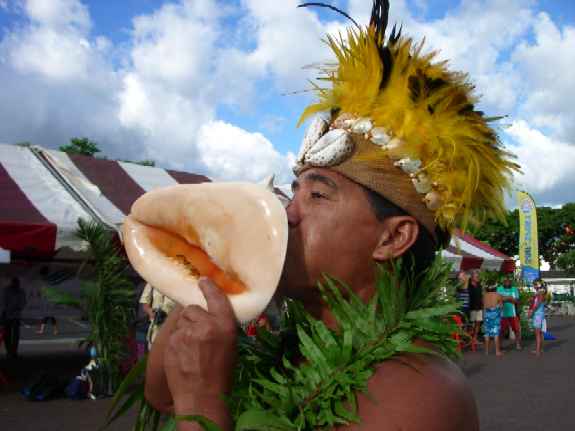
TAHITI & The Society Islands
April 21 - May 29, 2008Tahiti is part of the Society Islands and Papeete is the capital of all of French Polynesia. It is a city (notice I have been saying 'village' allot) and the major incoming sea port for the islands. French Polynesia is #1 for sugar consumption per capital, #1 for diabetes per capital, and #2 in traffic deaths for the whole world. When we arrived in Papeete and went to shore both Bob and I commented on how we had just stepped onto the Embarcadero in San Francisco. A beautiful, center island, tree lined street that traffic stops before you reach the intersection, ferry building, and long, wide sidewalks with lots of cafes, tourist type stores, and joggers. The only thing wrong with this picture is the amount of graffiti… everywhere. Can't read it in the US and can't read it in French but they use the same style of handwriting.
Rally Control asked us to do 'ships full dress' while we were in the harbour. Most boats have a full set of signal flags and the harbour was very colourful with all those flags flapping in the wind. People walking along the boardwalk were very pleased with the view. We received a hearty welcome from the Tahiti tourist board. During the day they had put up tents and had fruit, punch, beer, and booths with lots of information. Later on was a cocktail reception where we met the Vice-president of FP, the mayor, and other dignitaries. They put on quite the show of dancers; both female and male dancing. Much different dance moves than the Marquesas as the Tahitians are not as full of testerone as their counterparts in the Marquesas. Even the Tahitian men wear the official flower, the Teiare, tucked behind their ear. The dancing is not as fluid as the Hula but full of fun with lots of hip jiggling and white-teeth smiling with coconut oiled bodies.
They came up with a contemporary dance celebrating a traditional fish dish.
Notice the main movements of the fish celebration dance.I must come forward with a confession. Before I left Seattle I had my teeth cleaned and a full set of X-rays…I passed with flying colours. In San Francisco I broke a tooth and had to have it pulled; Mom's recommendation for $1,800.00. In Tahiti I broke a tooth and with the recommendation of the Rally had a root canal, crown, and a new type of filling for another tooth for about $2,400.00. He was handsome and Paris, France trained. I had excellent care and recommended him to another yachtie that needed dental work. He thought the price was astronomical (his words) but I think he is use to socialized medicine. I did have to fly back to Tahiti from Raiatea for the crown but I feel I still came out ahead of US pricing. The views from the plane were worth the flight.
MOOREA
We left on April 28 for Moorea and more adventure. It is 9 miles from Tahiti Nui and we had a great, on the beam, sail in light winds and not much current (which is unusual; the current can be very strong ).
We entered from the east thru Passe Irihoni and anchored in front of the Bali Hai Hotel. Baie de Cook is very scenic and photographed so often it is the most recognizable site to most people about Polynesia. It is the backdrop for the movie "South Pacific". After spending time in Papeete it is so quiet and peaceful. The mountains are lush and rugged. The island is rung with coral reefs so you get all the colours of blue and green. It is tranquil and dangerous all at the same time. The magic continues. We rented scooters and I had two near crash experiences. Bob said we have come all this way and now a small bike is going to put us in the hospital for a week. I thought it was a great way to see the island.
We went back to Papeete to get some more dental work, provision at a very large French market (not Costco because you didn't have to buy large quantities but almost as large sq.ft. wise), and get fresh water to wash the boat, do laundry, and fill the tanks. It is amazing that even with a watermaker you still want to have fresh water at the docks in the marinas. Every afternoon the sun would be at just the right angle to see all the colourful fish in the marina. Imagine several angel fish nibbling on the bottom of your boat while a school of 23 bright orange/neon blue fish swim by. Who needs snorkeling? We cannot use the marina's electrical power though because they are 220 and we are 110. The engine on Gaia continues to run twice a day. Bob saunters down to the local gas station to buy fresh French bread every morning while I sleep in. There is nothing like waking up to the smell of fresh bread. By the way, to wash a load of laundry is a bargain at $8.25 - bring your own soap and no dryer time. In Moorea it was $13.00.
I am getting use to the pricing though. I said "What a Deal!!" when I bought a Pamplemousse for 125CFX. In Daniel's Bay on Nuku Hiva we paid a local guy 50 CFX for a fresh one just off the tree. I am going to miss Pamplemousse when we leave French Polynesia. Already it is not as good as the Marquisas where it is famous. In Tahiti it tastes and looks more like grapefruit. Why the Marquisas cannot export this delectable fruit is beyond me. Speaking of Marquisas there are 8,000 Marquisans in Marquisas but there are 20,000 in Tahiti…just look for the tattoos. They are the premier tattoo wearers. They use a lot of geometrics and curves and cover their bodies with them. Many of the yatchies have gotten tattoos and I'm not just talking about the young guys. They are magnificent. This guide we had on one trip talked how the Marquisans are rugged individuals…the meek and mild locals head for Tahiti. In Tahiti they kill wild goats with a gun … in the Marquisas they run them down and use knives. I believe it. I saw a guy out run a horse in a race…barefooted… when we were visiting a marae on the island of Nuku Hiva.
RAIATEA
Raiatea ( Ray-ah-TEH-ah) and its sister, Taha'a ( TAH-ah-ah )are surrounded by one reef. The reef is awash in some places, submerged in others, and motus abound. The reef makes a large enough lagoon that you can sail clear around Taha'a and 2/3rds the way around Raiatea. This was unbelievable. You would have 12 knots of wind and the water would be so smooth you could walk to the bow without hanging on for dear life.
We entered Raiatea through Passe Teavapiti. Bob is starting to have more confidence about entering the passes. They are well marked and the ones lately have been very deep so the only worry is current and stray coral heads. To enter the harbour we had to line up two markers, one on shore the other on the hillside, turn to port, lay the red markers on our port, and zig-zag on into the inside of the reef. It is important to be on the bow to watch for the current, coral, and where the channel is deepest. When you are sailing in the lagoon the red/green buoys are not universal because are you entering port or leaving? You check the charts and find out, on this particular lagoon, the buoy markings are counterclockwise.
We entered the harbour at Uturoa. It is the main village on Raiatea and has a new concrete pier. There were lots of festivities going on with tents and flags. The village is small but does have a paved main street with 3 grocery stores. There is no graffiti, no disco bars blaring music all night, and lots of very nice schools. We immediately saw our old friends from snorkeling in Rangiroa, Into The Blue, tied up at the dock. They helped us get stern-to and tied up right next to them.
Notice the difference between a 35' J boat and a 50' Oyster. (Ours is the one with the Blue Water Rally flag flying)
This time we don't have a gangplank so I have to leap across the chasm from stern to concrete dock. I'm getting very use to it after so many times with little 4" planks - leaping seems a better alternative. We not only are the smallest boat at the pier we are the only Blue Water Rally boat.
Oh, you might be wondering why I am mentioning the fact we are the only BWR boat … we are excited because this is the home start base for the …
TAHITI PEARL REGATTA !!
We have invited Paramour del Mar to join us. They have a 36' Rival which is too heavy to do any damage in a race but they are use to tight quarters and they are excellent sailors. Welcome aboard Ian & Viv!! And were they excited. They told everyone at BWR and we got lots of envy from the pack. They moored their boat at Apooiti Marina and we downloaded tons of weight. Not only did we pack the dinghy, gerry cans, out board motor, spinnaker pole, generator, boom tent, and spare anchor and chain onto Paramour but clothes and linens were loaded too (we need room on the boat for bodies). I even said "Sorry if I am ignorant but the life raft is 80 lbs… lets ditch it" Yeah!
The first day of the race was from outside of Uturoa in a figure 'S' pattern to Tahaa staying inside the reef. We were in a down wind start and we popped the spinnaker perfectly at the starting line. We shot off like a rocket ( according to Viv ). About a third of the way through the course we ended up in a convergent zone on the lee side of the island and there we sat. What was so unusual was how 12 boats had collapsed sails and in between them all… a boat sails through; spinnaker full. Ian asked him, as he whooshed past, "What are you doing to get the wind?" The skipper replied "I don't know but no one on board is moving!" You had to bide your time and finally we escaped and overtook 3 boats on the rest of the course. This first race was totally inside the reef but covered both islands. We anchored in an area with no bay or land for protection….the reef can do it all! White sandy bottom, 25' of water, and you could see 50' or so as you were snorkeling. Saw my first ray, in no particular hurry to go anywhere, along the bottom of the reef flapping its wings so gracefully. That night was a party with lots of island food, music, and awards for the day. It was a great day!
The second day of the race was up to the pass, go through to the ocean, around the north end and back into the lagoon through another pass for about 3 more miles of course. We were approaching the starting line a little late and I couldn't believe Bob was so calm…none of the old Bob who would be having a panic attack for not being in the swarm of boats an hour before the race start. As it was, we tacked at exactly the right time and were the first over the start line and no recall! That put a smile on Bob's face. The pack behind us was jocking for position and we were out in front. The race was both inside and outside the reef. Every tack/jibe went off perfectly, the genniker worked without a hitch, and we were confident….until we went into a pass and forgot about current. The locals were hugging one side of the pass but we uninformed went for the middle. Not to worry, we made it up after we were through and into the lagoon. We were doing so well Bob decided to let Ian see what it was like to steer with the autopilot disconnected. Maybe it was a mistake and maybe it was a godsend but the knocking noise started immediately. After the race we decided to go back to the first anchorage because the water was so clear and the white sand bottom made it very light underwater. Bob and Ian dived under the boat and discovered that there were no rollers left in the lower rudder bearing.
So, we motored over to the Hibiscus Yacht Club for the dinner and rafted up to another French boat because the water was 150' deep and you needed a mooring buoy. I was in total denial until at the excellent dinner we announced we were retiring from the race. The next morning we hailed the water boat that was delivering fresh bread and watched the start of day 3 racing. They were heading for Bora Bora for two more action packed days of racing. We proceeded back to Raiatea because they have excellent boat services.
Bob sent out E-mails to everyone he knew connected with J boats and by the next morning he had 3 replies. By that afternoon the parts were in the mail and, miracle of all miracles, DHL managed to get the parts through customs in 2 days!
THANK YOU PYI ( Phil ), CSR Marine, and J/Boats!!We tried to get a haul-out on Friday but we had to remove the radar tower to get it into the sling. No weekend service and a 20 knot storm were due on Monday so no go till Tuesday. We went back to Apooiti Marina and went to the guest dock. No way! At the equator storms usually move much slower than at higher latitudes but this one was early. We were in a direct path of the winds and they were pushing us into the cement dock. We inny-meeny-meeni-moe and choose one of three mooring spots inside the marina proper. We Won!! The owners of the other two spots returned before dusk but our owner did not show up…we didn't have to move. We have 4 days till Tuesday so we explored the island. Since there is no public bus service you hitch-hike back to the main village of Uturoa. We always got a ride within 2-3 cars. Everyone spoke some English and just about everyone arrived to this island by boat and stayed. One woman, who was a traveling nurse, told us Raiatea is for raising families and there is nothing for the kids to do and no jobs. So they run amok in Papeete. The winds and rain plummeted us all night on Sunday. Monday morning was calm with blue skies. We called the carenage and we got into position to haul-out on Monday…a day early. YOOHOO!!
Everything went well with Bob & I doing the work on the rudder. We dropped the rudder, removed what was left of the old bearing, put in the new one, and reinstalled the rudder. Might as well clean the bottom and change the zinc….all that in one day! The magic continues. We really didn't have much to clean on the bottom of the boat. We just don't seem to be picking up the marine life like we have on this journey. Another incredible point is that the V-berth is dry! There is no condensation anywhere on the boat… hence no rusting. We made friends with Ironie who is originally from Seattle, shared lies and bananas, and complemented the workers for their efficiency. Into the water we went and back to Marina Apooiti. We used their fresh water to wash down the boat, fill our tanks, bought fresh bread and headed for ….
BORA BORA
The 25 mile trip was uneventful but we raised the main in anticipation of a squall to wash down the sails. It missed us but that is OK the sails didn't have that much salt on them. The Americans had a great influence on this island. In 1942 they built the airport, a road that circles the island, and the first power plant in the Polynesian Islands. All this work was done in anticipation of the Japanese invasion that never materialized. Wouldn't you love to pull this duty for 4 years? They even changed the name. The Polynesians do not have a 'B' in their language so the island originally was called Pora Pora. This means 'first born'. Raiatea is the mother island and the most sacred place in Polynesia. From her all the other islands were born.
Bob is now experienced about getting through the passes. I am still doing the mandatory bow watch as we enter every pass. You never know when a living coral head will grow up from the bottom in any depth of water. Passe Teavanui has a depth of 70 feet and I could see the bottom: sandy with tons of fish and the occasional smallish coral head. We entered the lagoon easily and headed for the Bora Bora Yacht Club. They only have a few moorings and they were full so we headed for Bay De Povai & Bloody Marys. In 95 feet of water we anchored because the moorings were full. After this trip we were not going anywhere else. Party that night for 40 people was at Bloody Marys and it was great.
Charlie's Charts says the best snorkeling is just off of Motu Piu Ani. We went there but couldn't find the area. Most of the inner lagoon of Bora Bora is very shallow. We were cruising over 4 to 15 feet of the most pristine, crystal clear water. Bob commented about how we were in a dinghy on a swimming pool. I had to stand up in the dinghy and direct Bob around the coral heads; dark spots sometimes only inches under the surface of the water.
Some of the dark spots…moved.
We saw many rays in 4 feet of water. We found another area of lots of different kinds and colours of coral and dropped anchor. The snorkeling was spectacular.
We seem to be developing a tradition. Whoever is having a birthday puts on a cocktail party with tons of food. Peter on LouSill one day and Jeremy on Hakuna Mata two days later were our hosts when we were anchored by Bloody Marys in Bay De Povai. Bob and I are also going native and eating like the French. We have fresh bread with cheeses and lots of fruit for breakfast, French toast or pancakes for lunch then a great dinner with a sauce. There is lots of New Zealand lamb and the BBQ is going most nights. One of the Brits commented on how the French, and the Americans second, really enjoy a good meal. This after they found out I was marinating lamb and they were having pasta with a tomato sauce.
We have been almost all the way around the island by dinghy so now it was time to get together several boats and sign up for a land tour.
It is a good thing most people drive Range Rovers because some of the trails to the top of the mountains were extremely rough. We would never have found the entrance by ourselves because some roads looked more like driveways. If you did find them and moved forward you would have never guessed the hiking trail would lead to a vista…
or cannons from WWII. The views were expansive and well worth the bouncing ride.
Some people have left for the Cook Islands but are motoring with zero, zilch wind. We waited several days to see what was in store for wind. Not to be detoured we left on May 29 with no real plan in mind. We are going to check the 10 am call and see what those ahead of us are experiencing. With that information we will decide what is in store for us at our next stop.
See you then.
~~~~~~~~~~~~~~~~~~~~~~~~~~~~~~~~~~~~~~~~~~~~~~~~~~~~~~~~~~~~~~~~~~~~~~~~~~~~~~~~~~~~~~~~~~~
ARCHIPEL DES TUAMOTU
March 24 - April 19, 2008
This group of 78 islands is spread out over 2,000 miles. Almost all of them are coral atolls with little vegetation and hardly any population. They barely rise 8 feet above sea level…some are not above the surface of the sea. Atolls are long extinct volcanoes that have been replaced with living coral.
They are a ring of coral with lagoons in the center. The good news is that snorkeling in the lagoons is like being in an aquarium. The bad news is that coral is just below the surface of the water and can turn your boat into a derelict before you see it coming. Typically the motus (islets) are clustered on the north and west sides with the south and east being awash and very hard to see or hear.
MANHINI
We decided to take the northwest passage through the atolls and make our first stop at Manhini ( ma-HE-ne ). The currents are reported to change 30 minutes after hi/low tide which makes it easy to plan your entrance into the lagoon. This is not so in many of the other atolls. Passe Tairapa is a well defined pass and close to the village of Manihi. The coral reef is close to shore on the ocean side, but the lagoon side is full of coral. The entrance is 250 feet wide but decreases to 130 feet on the lagoon side. The current can run to 6 knots and you need to have it against you or you will be traveling too fast to navigate. We hail Xavier and he says the best time to shoot the pass is 12:30 or 4pm. If we want a pilot we will have to wait till 5 pm.
We have arrived at 3:30. We hail the Blue Water Rally boats and Glendora gives us the information for entering the pass. The part I remember the best is Teri telling me that the coral looks like it is too shallow but the water is so clear, and don't worry, there is plenty of room. We have been informed by Rally Control to have a lookout on the front of the boat to navigate around the coral heads. I am elected to lookout and Bob is going to drive. So far …so good.
Enter going east to west on an angle to the pass. That is easy to see and do. You can see the water is darker and the current is troubled so it is running deep.
Stay close to the port side of the red markers… but not too close. Yes, the water is so clear I see a deep drop off on port and starboard is a gradual slope of coral. Bob says we are in 27 feet of water and I can clearly see the bottom. It is sandy and has coral heads. There is a school of larger silver and blue fish swimming through the current near the bottom. Suddenly a school of smaller black fish comes into view at 6 feet. I am mesmerized by the view
At the last marker head for the yellow and black buoy. Bob is not heading for the buoy but for the middle of the channel. I motion to move to port and head for the buoy. Bob is staring at the depth meter. I am staring at coral heads that appear too close. Teri's words come to mind and as long as we are heading for the buoy we are not in danger of running aground. We have 4 knots of current against us but it looks like we are traveling way too fast. I am shaking my arm at Bob to head for the buoy. All the colour has drained from Bob's face.
Round the buoy on starboard and keep the house on stilts to port. Difficult to do considering we need to backtrack a hairpin turn around the buoy.
The house was not as I pictured it in my mind. The house is sitting in the middle of the water on a coral head a good 200 yards from shore. It was a sharp 'S' curve but again I could see the darker water from the sand and coral heads. It was definitely a channel that you could not meander away without running aground on the coral.
You will see all the yachts anchored to the north but do not head for them…you still have to go around 3 coral heads before you reach us. The water is crystal clear and I can see the heads long before we reach them. The depth meter says we are in 150 feet of water and all of a sudden…one foot below the surface of the water is a coral head. These atolls are so different from the volcanic Marquises. Pure white sand, aqua water, and, although it is breezy, there is no wave action.
We have made it into the lagoon! Bob says we are using a pilot to leave…or…following a boat that has a longer draft than we do. Three boats actually bounced off the bottom of the pass. It was 8.5 feet and we draft 7 feet.
Of course, there were parties to go to. Anahi had a spaghetti feast for 23 people and it was a welcome event for our end-of-passage. Another night we had dinner at the hotel in town for 18 people and insisted on one long table.
We took a tour of the black pearl farm and how they 'grow' them.
It was a lot like dentistry with drills and long stainless steel implements. An oyster can grow 3 pearls in its lifetime. They extract a pearl and plant another 'graft' with each one getting larger than the one before. You could buy a string of 20 oysters for $100 US and its like Las Vegas; sometimes you hit the jackpot and sometimes you come up emptyhanded. The look on Harriet's face as she opened each one was worth it. She got 14 pearls. One she will put into a ring because she loved the imperfection of it and 2 very good ones will be earrings. She got a grade B one which is worth the whole price for the string. We ended the tour at a jewelry store and spread our money around the atoll.
This anchorage was the calmest one we have had in a long time. The 360 degree view of palm trees on white sand beaches with stretches of water with waves in between reminded me of a string of pearls. Bob was anxious to move on and he was looking at the current and tides. He had decided he didn't want to be the last one to leave. Marianne and Big Blue wanted to leave at the same time. Big Blue was hopelessly tangled on the coral and had to hire a diver to free them. The only time the diver could come was 7am but we were not leaving till 3pm slack high tide. Bob tentatively tried to hoist the anchor and we were going to have problems. By the time we were leaving Big Blue was fouled again. Fernand (correct spelling) was the tour guide and all around handy man for the Rally. He came by and free dived the anchors and freed the chains on both of our boats. He and his family were instrumental in helping us have a great time; between fresh bread in the morning, to the pearl farm, to the water taxi for the restaurant, he was always available.
This time we planned our exit for slack high tide and had no problems with the pass through the atoll. Big Blue was first, Marianne second, and we brought up the rear. Fernand stayed on board Big Blue till we cleared the passage. We had plenty of water under the keel and Bob was very happy. We were on our way to more adventure.
RANGIROA
We had an excellent sail with steady winds and a waxing moon. Rangiora is a major stopping point and the largest atoll in the chain. It has a circumference of about 100 miles. It is 40 miles long and 17 miles across. I would have loved to see the volcano exploding in this section of the Tutumotos. Passe Avatoru is a torturous passage under any wind or current positions (but the best one available). It can give a false sense of calm, or angry, confused seas, or eddies swirling around that can capture your boat and not let go. It is well marked, a deep 'V' channel, and there is help on the VHF for the conditions at any time.
Bob wanted to wait till slack high tide at 3pm but Big Blue and Marianne were not to be discouraged. The channel was deep and at 9 am was slack low tide. Marianne went for it, followed by Big Blue, so we had to go for it. Easy and such a beautiful view. We were anchored by 11am. I was amazed to see that we anchored in 50 feet of water and you could see the sandy bottom and plan the anchor drop to not hit any coral. Later we found out one of our boats had confused currents of 6 feet waves and water got in his cockpit.
There is a 5 star hotel on the beach and we went for cocktails and joined many in our group. They had come to the atoll the day before and had been on a picnic to the "Blue Lagoon" and loved it. When we got back to the boat, sure enough, a water taxi came by offering a trip the next day to the "Blue Lagoon". So at 9 am the next morning we were off with a group of guys from In The Blue , which is not with our Rally. The trip was long with a stop midway for a walk around a tiny island. When we arrived we went snorkeling in the inner lagoon and then decided to go for the more adventuresome outer lagoon. What an experience! Crystal clear water, many varieties of coral, fish, and sharks! Worked up a big hunger and had a lunch of BBQ chicken and fish. We fed the leftovers to the sharks.
Then off for more snorkeling at the small island where we fed (and swam) with more sharks. We had a stop to watch HUGE rays feeding. Their wing spans were 6 feet. One came at us and you could clearly make out his weird head shape and large mouth. He passed under the boat and you could make out the graceful gliding motions of this wings.
This vacation is not for sissies and there was more snorkeling at the pass where we entered.
This was the best snorkeling I have ever experienced. The guide threw leftover rice from lunch into the water right in front of me and my mask was filled with swirling colours of fish trying to grab the goodies. Living corals of pinks, purples, blues, and golds dotted the sandy bottom. The texture of all the different corals with lots of hiding places for the hundreds of colourful fish living in the pass was astonishing. I couldn't get enough of the memory.
I wanted to get invited onto In The Blue because it was a 50' Oyster (Cadillac of the boating world). Found the niche by being asked for tuna recipes because they had lots of fish but were tired of the same old ways of cooking it. We went over at 6pm for cocktails. Robert said he was finished racing on uncomfortable boats and decided to go for luxury on the Oyster. Gorgeous boat! All wood interior complete with freezer, washing machine, 3 showers, and ice maker. We enjoyed their company so much we stayed for dinner (of tuna with one of my recipes) and I uploaded all of Ed's underwater shots of the snorkeling.
The next day everyone was deserting the anchorage because we only have a few days to get to Tahiti. Rally Control has lots of plans for us and wants us there on time. The first day and night we motored on absolutely glass-smooth waters with a full moon. Caught a good size tuna and spent the sunset carving up some great steaks and making sashimi. At 6am Bob gets the GRIB files and saw that a storm front was heading for us from the south. Bob was constantly putting the jib out - taking it in. Squalls were stirring up the wind; then it would die. Seas got lumpy, wind was everywhere in every direction but we had to take it slow so we would not have to wait to enter the harbour at Papeete at sunrise. Regardless, we arrived at 4 am and motored in with Lousell in the lead. We have a great position on the cement dock with a stern-first tie.
We are in Paradise….we are in Tahiti.
~~~~~~~~~~~~~~~~~~~~~~~~~~~~~~~~~~~~~~~~~~~~~~~~~~~~~~~~~~~~~~~~~~~~~~~~~~~~~~~~~~~~~~~~~~~~~~~~~~
ILSE MARQUISES
March 19 - April 9, 2008
Bon Jour and welcome to French Polynesia.
The Marquises are the northernmost group of islands forming part of French Polynesia. There use to be 100,000 proud and warlike islanders but Captain Cook and those to follow decimated the population with contact and diseases. There are now about 8,000. In the 1970's the fertile soil had promise of plantations. The population rose to 90,000. Mostly labourers from Martinique and Chinese who went back to their homes after a drought brought the demise of the farms. Marquisas is a local word for "The Land of the Men". The 10 islands and numerous rocks are broken up into the northern and southern groups.
We hit landfall at Baie Taiohae (toh-ah-HAY) on Nuku Hiva, the largest island in the northern group. This is where Herman Melville jumped off a whaling ship in 1842. The town, Taiohae, lies in the open remains of a volcanic crater with the caldera walls surrounding the town. Even though it looks like very high jagged cliffs, Takao is the highest point at 3,888 ft. There are no protective reefs in these islands and the sharks are free to enter (and feed). The anchorage is rolly with no reef to filter the ocean currents. Our first night I woke up with a start thinking Bob was asleep and someone needed to do the night watch. I actually leaped out of my bunk before realizing we were at anchor…only pitching and yawing like we were still out to sea.
Landing on the beach is always a wet affair. You can go to a concrete wall and get your dinghy scraped up by barnacles (which does damage your craft), and climbing the rusted ladder is a challenge. The village itself is gorgeous with huge flowering trees in all colours, lush greenery, many species of palm trees and tropical buildings of stone and adobe. There are the remnants of a penal colony (lucky stiffs) and a ceremonial site where they use to practice cannibalism. The grocery store has more stock than in the Galapagos; when the ship has come in.
We took a tour around 2/3rd of the island. First stop was Baie du Controleur around the bend to the NE. It is divided into 3 bays and is home to a large coconut production co-op at the village of Taipivai.
This is the setting for Herman Melville's Typee. If you want to know about this area before the influence of Western civilization and about the rugged terrain you must read this book.
Everywhere we looked were paepaes (ancient stone platforms that acted as house foundations. I'm not just talking about this baie but all over the islands. I guess this is what happens when your population is decimated very quickly.)
A river in the center of the village keeps the valley very lush and everyone has a horse for transportation. The horses are beautiful and Bob found out they originally were imported from Spain. Interesting how they process the coconut for shipment to Papeete. Everything is subsidized and everyone gets a house and a 4X4.
At a party this French guy was telling me how generous the French are to the Islanders with pensions and subsidized fuel. There were no French on the tour of the island. The Swedes, Danish, Hollanders, Brits, and Aussies told me No, No, No, they take what they want; nuclear wasted some islands (up until 1995) much like the U.S. did the Bikini Islands, and heavily tax everything not French. A can of cold Coke cost $5.50 and a very small watermelon is $22.50. Finally, we have come to a place that I consider expensive. I must admit it is the cleanest fuel we have seen since leaving Mexico. Bob asked the tour guide where the fuel came from and he didn't know but had been asked before by other boaters. I have been unable to buy eggs for 4 days.
Second bay we visited was Baie D'Hatiheu. This is where Robert Louis Stevenson settled down and wrote South Pacific. It is idyllic with dirt sand roads, high cliffs with lava pinnacles, flowers overflowing everyone's yard and a great restaurant. Chez Yvonne is owned by the mayor and famous all over the island. I had goat in coconut milk and there was too much to finish. Bob had the gastronomic delight (that was the name of it) of fish, fish, shrimp, and fish. He finished it all.
In the vicinity is an archeological site called a tohua (public plaza) and named Hikoku'a. It is a large, well-restored ceremonial center consisting of stone platforms. The high priest use to stand on the platforms so they would be above the everyday man. In 1998 there was a huge affair that included all the islanders from as far away as Hawaii. They carved some more tikis and you would think they were made 1,000 years ago. The weather takes it toll on the stone. Further up the hill is tohua Tevanaua'ua'a. Back then they didn't bury their dead but let nature take its course, threw the bones into a community pit for use as hooks, needles, or other tools, and put the skulls into a sacred place.
This banyan tree must be 500 years old and had its picture taken in 1872 showing hundreds of skulls wedged into the branches. Thought Pam was going to faint when she came back from standing right next to the tree. She didn't see any skulls and wasn't going back to look.
We were treated to an excellent party and pig roast and Bob just had to meet Patrick the main drummer. The 5 piece band really got things heated up and everyone was clapping and dancing. There is this one dance (Pig Hunt) which is very important to them. They snort, stomp their feet, and lunge at the ground with an imaginary spear. It is quite effective.
Then the next day we headed around the bend to Baie de Taioa (Hakatea) for another party. This bay is known as Daniel's Bay for the 60 year old guy who lived there with his family. "Survivor" bought him out for one of their shows and now he lives in town. I can see why he lived here so long. Wild pigs, goats, and chickens; several pamplemousse trees, mangos, papaya, and breadfruit; Fresh water stream; all the benefits of home (minus anyone else to talk to). Our Rally peon, Tony, organized a Cricket game and I saw Bob play his first sport game ever. The two teams tried to intimidate each other with the Pig Hunt dance. Thought I was going to die laughing.
We loved this baie so much we stayed 3 days. Wendy from Heidenskip commented that since meeting Bob in Panama he has become more relaxed and not so uptight.
We sailed back to Baie D'Hatiheu because I loved the site and we did not experience it enough on our tour. Bob was hesitant because it meant we had to beat into the wind for the 5 hour trip. It was pleasant; Gaia is great at beating, and the view of the coastline was not to be missed. We took a walk up to a ridge and saw an amazing amount of wild goats. They just stared at us and ignored us. We enjoyed the view of the bay with the only boat being Gaia.
It is time to move on. Bob is anxious because we are the 4th to the last to leave Nuka Hiva and we have more islands to explore. Chickens, goats, and pigs everywhere but they are never on the menu or in the store. I asked for a chicken and was handed a box of Tyson's that looked like it was 3 years old…no thank you. Finally, I managed to purchase some eggs so off we go.
UA POU
We checked out the guide and listened to the net for where others in our group were going and decided on Baie D'Hakahau. It is a 3 hour trip to Ua Pou (WAH-pooh) and we need to make drinking water. We sailed with only the main to slow us down and arrived at 4 pm. Bob hated the bay with its freighter dock and no real cozy place to anchor so we made a last minute decision to head for Baie D'Hakatetau. Again the coastline was incredible with different coloured bands of rock, volcanic spires, lush greenery, and tons of caves at the waterline. This island has countless soaring mountain spires and towers. Clouds cloaked the spires and gave the island a mystical look. We arrived in plenty of daylight so thought we would row over to the dock and check it out. The guide books warned us about the never ending swells and we thought it was impossible to land the dinghy with swells splashing 6-8 feet up the side of the concrete dock.
Let's wait until tomorrow.
Tomorrow came with rolly seas but not as bad as the night before. We rowed (we thought the outboard motor would get damaged in the swells) over and sat and stared at the concrete wall of the dock. The noise was deafening with angry waters splashing and swirling all around the dock. Are we capable of not having a disaster? How come there are no local boats at the dock or in the bay? Do we really want to go into town to meet the locals? We sat and pondered. This local guy was motioning us onward so we did. I had to be hauled up the side by my arms because I'm too short and wasn't going to wait in that washing machine for the right moment. A big welcome from a big guy and his wife and two cute kids was refreshing. He helped Bob haul the dinghy up the side (10 feet) so we could leave the dinghy on the top of the dock. He didn't know any English so we gestured our thank you. He, in turn, gestured with a pointed finger asking us if we had a gun. Huh? You know…he took both hands and with his index fingers next to his ears made like a Billy goat. Sorry.
The guide book said to look up Etienne Hokaupoko, the Marquisan mayor/school teacher for a history of the Marquises and for a very warm welcome. Bob asked several people and they pointed up the hill. We were pleasantly surprised at the concrete streets, rows of houses with lots of flowers in the yard, and the exquisite stonework on the church. Walking around the village I spied a young girl and chatted her up. There was suppose to be a vegetable garden somewhere and how can I buy some supplies. She didn't know what I was talking about but if I wanted fruit she could help me out. It was Bob's idea to have her drive us to her home to purchase fruit. We got more than we bargained for. Great views of the bay, a look at the interior of a Marquisan home, and guess who her dad was. We purchased huge avocados, papayas, guava, breadfruit, limes all over the yard, and a fruit we have no idea what it was but it was delicious. To get to her home she made several stops and waltzed into these homes and sometimes picked things up or dropped them off. Bob, trying to make conversation, asked her if they were friends or relatives. She didn't understand the question. I said since there was only 2,000 people on the whole island most likely everyone can go to anyone's home and be welcomed.
So back to the dock we go with two huge bags of fruit and a coconut. Same big guy is going to help us get back into the water. His wife and kids were looking over the other side of the dock and letting us know when it was safe to put the dinghy into the water without capsizing it (that gesturing was easy to read - English or French). Now comes the good part…having a huge guy yell at you (very loudly to be heard over the angry seas) in French to jump. You jump. Can't believe I made it into the dinghy. I stood up and he handed me the bags, I stowed them and sat down...all before the water whooshed out and we immediately sank 8 feet straight down the face of the dock. Bob is desperately trying to get the oars into the oar locks and the big guy is yelling at us to get our ___in gear and get out of there before the next swell squashes us up against the dock (French is becoming an easy language to learn).
We made it!
The big guy is still yelling at us….holding up a coconut. He must have thrown it 40 yards and we rowed over to it and I plucked it out of the surf. Big smiles all around. Sorry Etienne there is no way I am going back to that dock just to have lunch with your family…and I had fantasies about giving him a large package of paper and pencils for the kids at the school.
So it is time to say good bye to the Marquisas (have you noticed I spell it differently every time…that's because it is spelled differently every time) and we set sail to follow the trade winds for the Archipel de Tuamotu which are 400 miles to the west/southwest.
~~~~~~~~~~~~~~~~~~~~~~~~~~~~~~~~~~~~~~~~~~~~~~~~~~~~~~~~~~~~~~~~~~~~~~~~~~~~~~~~~~~~~~~~~~~~~~~~~
THE VOYAGE TO THE MARQUESAS
The Plankton-rich Humboldt Current supports lots of fish and we are getting our share. We are also entertained during the night by an unbelievably bright neon glow stretching out 25 ft. behind the boat. It is glittered with thousands of lights shooting off in all directions and the occasional, volleyball size, depth charge. It reminds me of a starry, starry night. Speaking about the weather the first few days we were heading south of the rhumb line seeking the Trade Winds. We were motoring all day and night. We tried sailing when we could but not enough and not long enough to make a difference. It is 3,000 miles to the Marquesas and we need to ration fuel.
What we did get, at one point, I counted 9 squalls on Port and 2 huge rain clouds on Starboard. We were hit by some and slipped between many. Finally, on day 3 we got some steady wind out of the S-SE and took the reef out of the main and put up the Genniker. I made oatmeal bread on lumpy seas.
Day 6 and a major breakthrough! The trade winds that Bob was sailing south of the rhumb line were found! We had steady 12-14 knot winds off the beam, and sunshine! Glorious Sunshine! The sunrise was spectacular with golden tinted clouds and rays in all direction. I was looking for the inspirational poem you usually see written across just such a sunrise. The water is a beautiful deep blue with large rollers that gently push us ahead at 9 knots. The wake churned up the seas and, surprise! the colour is the same as glaciers; a bright, light, pale blue-green. The flying fish go surprisingly fast, skimming just above the water for quite long distances. There are these small dolphins that leap clear out of the water. This big roller had 5 dolphins burst out in complete unison. I thought Sea World taught them to do that but obviously it comes naturally to such playful creatures. I could sit and look at the water all day but there is too much to do.
Remember the smug fuel delivery guy in the Galapagos who said we didn't need a filter with his fuel? We spent several hours siphoning the fuel in the secondary tank, through a filter, into the gerry cans and then filtering it again into the main tank. The fuel filters had to be emptied and then we finally had to change them because they were all gummed up. We shook out 2 reefs from overnight, put up the Genniker, made a pressure cooker full of split pea soup, and had breakfast all before roll call at 10am. And you wonder what we do all day long.
Since finding the trade winds we have gone 5 days without ever making a sail change. We are screaming along at 8-9 knots (7 knots is boat speed) which means we are up on a plane and moving faster than would be possible in some other boats. Bob is bored. We are not overtaking any boats and have been maintaining position with the much larger boats ( You do remember we are the smallest boat in the Rally and everyone wonders if we will be able to keep up with the big boys ) He charts everybody's position at roll call and we never gain or lose on any of the boats. Did I mention Bob is bored?
One night when I came on watch Bob said that we were being accosted by flying fish. He was hit in the head with one and another one smashed into the hull making quite a lot of noise. OK. So I ended up fishing two more out of the cockpit. The next morning there were quite a few "stiff ones" as Bob calls them covering the decks. Below deck was starting to smell fishy. I had cooked tuna but never had a fishy smell before. Searching the quarter berth (pantry) I found the culprit that hit the hull. His aim was good and he shot in through the porthole window. He had managed to shed slime and scales everywhere. Oh well, the pantry always could use some cleaning up anyways.
Fashionable Evening Attire for the Equator
Even though we are 5-7 degrees from the equator it is cool enough to have to wear clothes. At night its sweaters and long pants! I have gotten out the Jerry Blankie and wear PJ's. We are heading due west so the mornings fill the cockpit with warm sun and in the afternoon the sails block the hot sun and we get the cool breezes. This has been a great voyage and I feel blessed.
Bob went from bored to frustrated on day 13. No matter what we did the wind was directly behind the boat. We tried poling out the jib, flying the spinnaker, doing a wing-on-wing but all we got was slap, slap, BANG! We tried heading for the rhumb line, paralleling it, and forgetting about it and jibbing back and forth but to no avail. Finally on day 16 with an ETA of day 19th we could see the end of the voyage and so let's go for it! We motored the rhumb line.
Bob didn't want to visit any of the most easterly islands in the chain. What I saw through the binoculars was the most awesome sight. The islands were like fortresses from another world. Huge jagged mountains with towers rising up to the clouds with flat tops. Tan and copper cliffs with seams of grey stone lacing through them. Nature made rice paddy-like levels right next to drop offs to the ocean with caves along the waterline. Don't call it coastline because the cliffs went directly into the water. Striking sharp peaks rose hundreds of feet into the sky with eroded slopes to the water. I was fascinated for hours till we arrived at Nuku Hiva at 5pm.
What happened next I had no idea? We pulled into the baie, talking to Rally Control all the way, and by the time we anchored we were invited to Our Island for a Welcome party…or maybe it was just cocktail hour…I don't remember. Gotta tell you several things
1) I started a conversation about our continuing interest in charting Marianne because she was a big boat right behind us for the full voyage. "It isn't a race but Marianne was a boat Bob wanted to make sure didn't pass us" at which our host Brian on Our Island made the comment "What??…It isn't a race but no J-109 was going to pass me. I put up all sorts of sail changes trying to stay ahead of you…tell me you didn't put up a spinnaker"…Well….yes...2 days and a night. Several skippers groaned and said OK now we know why they were keeping up with us.
2) Since we were invited for cocktails I thought it would be wonderful to bring an appetizer of Blue Fin Tuna Pate with crackers. Euros' and Aussies do not do the American habit of Pot luck. Margret graciously accepted the gift and put it into the fridge where we never saw it on the table. We had the most amazing appetizers. There were huge shrimps and I commented on where they had got them (assuming it was in Marquesas) No…fresh frozen from, who knows?? The moon??. OMG!! You have a freezer? Which started the conversation about when you custom design your boat you have options. You have room for a dishwasher or an ice maker but not both. The women, and I am talking about 3-4 boats, wanted the dishwasher: the men said "If you will agree to the ice maker I'll help with the dishes. All the women agreed and all the women wished they had not agreed. Men don't do dishes. I said " Gee, I fought tooth and nail for a microwave."
3) Tony, our Rally Control peon, asked if we had been dry on the boat. I foolishly replied "Yes, we saw 9 squalls on our portside…." Everyone burst out laughing and I turned red (Yessss….) when they were talking about cocktail hour. I have since learned there are several boats that will not risk foolishness or night watches for a mug of grog… but not many…remind me…what did the British do?
4) Which brings me to the next point. Of the 8 boats represented at the party there were no Brits or Frenchmen and we were the only Americans. The French have the privilege of going wherever they want with out checking in so they are exploring all the islands we cannot dock at until we check in…then we won't go back to explore them because the wind will be on our nose….lucky them. They have left France in May or June of 2006 and in March of the following year have found the first country that speaks their language. Rally Control usually says " Welcome to …" but in French Polynesia it's the French boats saying "Welcome to our Country" I, on the other hand, am having to learn my 5 phrases in French..Bon Jour, Si vue plat, Aue bein, merci, and….I don't remember. I do remember I just got comfortable with Spanish and now I have to learn a new language. I want to be better than b4 so I keep practicing out loud so maybe I will become more comfortable with my 5 phrases. I keep saying the words out loud and Bob keeps correcting my pronunciation but I'm sure I'll catch on as soon as we leave French Polynesia. …sigh
5) Notice the emphasis on nationalities? I never have considered it. But it was the Aussies that reminded us that there were no Brits or Frenchmen at the party. Hmmmmm…there is a certain amount of competition among other countries that may go back hundreds of years. When someone asked Tony about news ( since we have heard or read nothing in 3 weeks ) He mentions Hillary and Obama. Have Americans risen so far above that they don't conceive of differences or is it just ignorance? Or I am ashamed to say Indifference. I love being with other countries with other opinions. I think it keeps me on my toes…or maybe a better way is it keeps me learning new thoughts so I remain young at heart.
As we were leaving Our Island I was handed my appetizer and Margret told me she had graciously left it in the fridge till we were ready to leave and so I had to say "Sorry, I am totally American and only want to help…Invite me again and I will do the same… Thank you for the wonderful party."
And a wonderful Welcome it was. The Marquisas is truly a magical place and I want to experience it fully.
Stay tuned.
~~~~~~~~~~~~~~~~~~~~~~~~~~~~~~~~~~~~~~~~~~~~~~~~~~~~~~~~~~~~~~~~~~~~~~~~~~~~~~~
The GALAPAGOS
February 20 to March 4, 2008
The Archipelago de Colon is a group of thirteen major islands and several minor ones. They are all volcanic and geologically very young. Darwin estimated the number of extinct volcanoes at 2,000. The Humboldt and converging El Nino Currents flow side by side around the islands but not always in the same position. I suspect this is why no one discovered the islands till 1535 when Tomas de Berlango, a bishop that was traveling from Panama to Peru, was pulled off course by the current. Probably the same reason there were no indigenous peoples for the Spanish to destroy (sorry, I meant exploit). Every island is totally different in flora, fauna, and topography. Many have indigenous species found no where else on earth and on any other islands in the archipelago.
We pulled into the harbour at Bahia Academy at 6am. The first thing I noticed was a strange black bird that looked like a Pterodactyl. It had a huge wing span and a forked tail. It hovered in the air, spiraling upwards forever without batting a wing. Bob wasn't in the mood to look because he was worrying about the bow/stern anchor system we needed to use in this crowded bay. The water is Caribbean Blue-green. Now that I am a world traveler I guess that colour will be Tropical Blue-green from now on. We searched for an area where we would not cross anyone's anchor and hailed a boat. Todd was so delighted to see another 'J' boat that he couldn't get in his dinghy fast enough to take the stern anchor and drop it in the right spot. He also warned us about taking the dinghy to the dock. Seems you should take the water taxi to shore to keep the local economy healthy. Also, to stimulate the economy there was fuel service, water service, garbage and laundry services; all by boat. The fuel guy was indigent about Bob using a filter…his fuel is clean. We don't know about the water but they said it was potable. I was too cheap to use the laundry service and found a great place that got stains out without bleach! It gave me a chance to explore the town off the main drag.
Our first shore outing was full of surprises. I guess I didn't know what to expect. It was very clean and most of the buildings were very new construction. The architecture seemed to be a Spanish/Roman/ComicBookArt/Adobe look with lots of curved lines and blocks of colour. A marine iguana was on the dock to greet us…just walking among the people without a care in the world. Bob commented that the town was like a theme park; almost surreal. This is the first place we have been to that was not overly crowded. We were told everything would be very expensive and I guess by Panama standards it was. The restaurants were good, the main street was 4 blocks long, and 'The Rock' made a very good Mojito. Towards evening, we were walking on the new sidewalk when this motorcyclist came to a screeching halt, leaped off his bike, and started to do this funny dance. He got my attention. Then I saw an iguana moving out of the street quickly to get out of his way. When he made it to the sidewalk he turned around with a "Harrumph" and sauntered off.
You cannot help but notice how flat the coastal plain is and then the steep cinder cones and volcanoes rising up into the clouds. Every day it was raining up the slopes and most times would dump all the water before making the harbour. We would gamble and leave the windows open in the boat and mostly lose. That's OK, the cushions would dry out in no time and the locals said they really needed the rain on the coast. On most of the islands the coast has a desert climate complete with cacti and the highlands were carpeted in a rain forest…all on one island!
40 of us took a bus up a volcano for dinner. Glendora had just made it into the harbour from Panama and they hopped onto the bus. Teri leans over and asks me about provisioning. I was giving her the usual when her eyes get huge and she says (a little too loud with a little too much panic) "But I hear there is no beer!!" So I gave her pause by saying "No eggs but you can buy beer in bottles - no cans". When we reached the Royal Palm Resort we were treated to a walk thru a lava tunnel. It was like a cave with craggy formations and smaller tunnels going off into the darkness. True to rainforest we had the most torrential rain during dinner. On our way back to town the bus conked out and so, once again, the Welsh and Brits sang songs till another bus arrived and took us to the home dock.
We had two days to clean up and get ready for my friend Cindy's arrival. Bob decided to clean the bottom of Gaia and as he was in the water washing the boat this iguana kept knocking him in the arm with the attitude that Bob was suppose to move out of his way. The water was so clear we saw a spotted manta ray swimming by and we could see our Fortress anchor getting buried in the sand.
The first place we went to after getting Cindy settled in was to walk to the Charles Darwin Research Station built in 1959 with the help of several organizations.
Galapagos is a Spanish word for Giant Tortoise and we saw many varieties including "Lonesome George" the only tortoise of his species left in existence. The islands are all volcanic and every volcano has its own species of land tortoise. Once again thanks to the Spaniards and American whalers most of the tortoises are endangered and live in corrals on the different islands. At the center there was an emphasis on indigenous as opposed to introduced species of flora and fauna. Ecuador is making a great effort to preserve their first national park, Although I applaud their efforts of teaching children conservation, trying to stem the flow of illegal aliens, and eradiating the islands of feral rats, cats, dogs, pigs, and goats; I'm afraid these islands will soon no longer be unique and unusual. How sad that the wild animals may develop a fear of man because they sure don't have any fear now.
Some of the people in our group decided to take the 7 and 11 day island cruises. I couldn't see getting off one boat and onto another. You cannot travel anywhere among the islands without an official tour guide and we would have had to get permission to even leave the harbour to make water. Hakuna Matata said that they will never get a chance to do it again so they were going on the cruise. I think that even if you come back in 5 years it will not be the same so I think they made a very good choice. Richard says that in the 4 years he has been coming here they have paved the road in town and added tons of buildings.
So hire a tour guide we must.
ISLA ISABELA
Cindy and I do a bunch of research and come up with a 3 day 2 night tour to the largest island in the archipelago. This will give Bob and me a chance to sleep in a real bed and take a long, long overdue shower…with hot water! Isla Isabela is so different than Isla Santa Cruz and Puerto Ayora. Upon entering the harbour at Puerto Villamil I saw 7-8 penguins (indigenous) on the rocks. The Bay had several sea lions hamming it up for the photo op and some new seagulls.
It was hard to call the collection of buildings a town. No paved streets, very few tourist, and hardly any restaurants - but they had the coolest street lamps made from tree trunks. The first day we got totally drenched on our walking tour to visit the tortoise breeding grounds and visit the native pink flamingos.
The second day we went to the second largest caldera in the world (Sierra Negro) on horseback and hiked to the small volcano that erupted in 1998.
The terrain was so desolate and unearthly: but breath-taking with a panoramic view of the bluest ocean meeting the black ooze. Ms. Gaia will have quite the time changing that lava mess into the lovely planet that she is. Again, coming back down the volcano we got even more drenched (Cindy's words…but I do think I was even more wet the second day…if that is possible). I was on horseback and Bob and Cindy hiked the muddy and slippery trail back to the base camp. We would never get our Eagle Scout pins because we didn't have any foul weather gear. Dinner was in the hotel both nights and that made it really easy to sneak away early and dive into bed…exhausted. At 6 am we were on a sleek boat with twin 115hp outboards and made the trip back to home base in 2.4 hrs.
ISLE FLOREANA
Cindy and I decided to do a day trip to another smaller island. As we were approaching the harbour there was no town! A super small church, a naval building surrounded with a cyclone fence and a huge sign welcoming you to the island…that was it! The first colony in all the islands was settled on this harbour by 3 German families but it did not succeed. There are only 150 people…mostly farmers and fishermen living a subsistence living.
This island has the only fresh water spring for over 900 miles. In the 17th century the pirates defended it to the max.
They cut up the lava flow by the stream and turned it into a fortress complete with dug out caves that had sleeping platforms and an oven for cooking. They could see well out into the ocean and defend the position. They call all the islands the Bewitched Isles because they appear and disappear (???) I found out in the winter from July to December the islands can be covered in mist. The ships would be washed up onto the reefs and be ripe for pickings by the pirates. It was great fun running amok in the maze of the fortress imagining what it would be like to be a buccaneer.
Later that same day we went snorkeling at two different sites. The first one we had a bunch of sea lions check us out. One was swimming upside down right under Cindy and was looking right into her mask. I now know why they are lions. This one guy decided to get in another's face and it didn't bark it ROARED!! Cindy wouldn't do the second dive at Devil's Crown because there were sharks. Yes, we saw a white-tipped shark (vegetarian, they say) but saw many more different starfish, coral, and fishes. One starfish was lapis blue! Another was called the chocolate chip starfish and it looked like a lump of cookie dough with legs. Cindy's worried about sharks and I am worried about barnacles. The smallest of critters get into the drainpipe for the sink and love to mess with the knot meter. Bob constantly has to scrape them off and dig them out with a screwdriver.
Having the skipper that keeps me safe has its downside. When the weather says it is time to leave Bob wants to leave. I wasn't ready. Bob was. But we haven't taken any pictures of blue-footed boobies and I need to go back to the Darwin Research Center to see the giant land iguanas. You know how you visit everywhere except your own backyard? It was so surprising to me to learn that the birds that were like missiles hitting the water in our anchorage were the blue-footed boobies. I thought I was going to have to take a tour to another island to go see them. When it came to fishing, the pelicans would smack the water, the frigates (pterodactyls) would gracefully skim the water and pick up a fish but the boobies would dive bomb at amazing speeds…and usually come up empty-handed.
We were bringing up the stern anchor first and were having a bit of a try because there was another boat right over the anchor. It wouldn't budge so Bob had to dive the anchor. The bottom was all sand except for two rocks and guess where our anchor line was caught. As we were lifting the bow anchor a small hammerhead shark was watching. Since they travel in schools of 30 or so I wonder where the rest of his cronies were.
So, with anchors away, quarter berth full of supplies, plenty of fuel, and anticipation for the future adventure we were off at 11:30am for the 3,000 mile journey to the Marquises.
~~~~~~~~~~~~~~~~~~~~~~~~~~~~~~~~~~~~~~~~~~~~~~~~~~~~~~~~~~~~~~~~~~~~~~~~~~~~~~~~~~~~~~~~~~~~~~
LAS PERLAS & THE VOYAGE TO THE GALAPAGOS
We left Panama at 8:30 am on 9, February, 2007 with a light breeze behind the beam. I was trimming the jib when I was startled by a very dark mammal surfacing right next to me. Thinking it was a dolphin I looked towards the bow for the pod that would be playing in the wake….nothing. Not a minute later you could hear the expiration and see the plume of mist rising 20' in the air…..A huge whale surfaced and dove gracefully back under the deep blue sea. There's another one…and another! I can only assume a calf was curious and came to visit. I'm sure its mother reprimanded it severely for being so foolish.
The Blue Water Rally keeps up quite the chatter on the VHF. They are constantly talking over their plans for the next day. This makes it real easy to decide where to go ourselves. Those Brits and Danes do have a different grasp of the language. The radio doesn't come in "loud and clear" it comes in "crisply". I wonder how long it will be before I begin to sound like them. The second night at Punta Gorda 5 boats anchored and several had successfully fished Yellow Fin Tuna and Dorado. With all the excitement on the radio I put in a line and in one minute had a fish on! Yellow Fin that got away! 18 people had dinner aboard "Hakuna Matata". Sushi, Sashimi, BBQ, what a feast. All I had to bring was red wine. There was lots of discussion on the sharks that people saw when they were cleaning their fish.
The next day and night we had the cove all to ourselves. We scrubbed the belly of Gaia and rested up for the 9 day voyage to the Galapagos.
Bob and I had visions of tropical trade winds gently pushing us along the path to paradise. What we got was beating winds and seas for four days. There was constant current of ½ to 3 knots against us. This allowed me to practice my skills at cooking under adverse conditions. I found out bread doesn't like to be knocked around when it is trying to rise. Once again the pressure cooker came to the rescue and I served up some killer cabbage rolls and beef stroganoff. Thanks Mom, the pressure cooker is a must on any boat.
We made it to the Galapagos in 8 days. There were only a few boats that made it faster than we did. They were larger and did a lot more motoring. Larger boats have a longer water line and much larger sails; this allows them more slippage so they travel faster. Bob was a crazy skipper. He stayed up for several days making sail changes constantly. Between the currents and the changing wind conditions he had to recalculate the wind angles and charts to get the most out of Gaia. He commented on how much his Laser racing training came into play. If you mess up in a Laser you capsize; in Gaia you would get an inadvertent jibe and break something important. That would never happen with the skipper that is keeping me safe. Finally one day he passed out and slept for 6 hours. I had to change the course direction to maintain the wind angle. I didn't dare try and mess with the sails because that would wake him up and he needed the sleep. With first light Bob was awake and we were only 3 miles off the rhumb line. Actually, we never veered more than 35 miles north or south of the rhumb line the whole trip. Most boats cannot point as well as Gaia and they were 100's of miles off the line. They had to do this to maintain any kind of forward motion; the current was that strong and the winds were that calm.
I was amazed at how much fuel many of the boats consumed until we heard that several boats ran out of fuel and barely limped in to the harbour. A week after we arrived there was still 3 boats that had not arrived. Finally "Kaimen" offered to run out fuel for two boats that could not make it in to the harbour with the strong current against them. They caught a 50 lb. Wahoo and had a lunch BBQ party on their boat when they returned for all who wanted to cheer the successful fuel run. Always a silver lining when you do a good deed for your fellow yachtos.
My friend, Cindy, will be joining us for the Charles Darwin adventure of a lifetime. I will write more on that adventure when we are traveling to the Marquises. Bob is hoping it will be 21 days but we are expecting the same weather patterns. We will need to ration fuel consumption to make it. Will write to you in 21 to 121 days from now!
~~~~~~~~~~~~~~~~~~~~~~~~~~~~~~~~~~~~~~~~~~~~~~~~~~~~~~~~~~~~~~~~~~~~~~~~~~~~~~~~~~~~~~~~~~~~~~~~
PANAMA
January 18 - February 7, 2008
ISLA COIBA
Bob decided that I could pick the next 3 days of anchorage. I immediately poured over the cruisers guide for information on the north coast and islands of Panama. Al Poole, a bartender Bob & I had met in San Francisco, was a great fan of Coiba. He had property in Panama and a 28' boat with no engine. It was his favourite haunt in Panama. It is the largest island in the Pacific Americas. It has many jungle-clad coves and other smaller islands surrounding this mountainous island. I was looking for great snorkeling places.
First, we went to Punta Cristo off of Punta Machete. It has two smaller islands, Isla Rancheria and the tiny twin Islas Cocos surrounding the bay. The view is a sheltered cove with very dense foliage that grows right down to the water's edge. We couldn't go to shore because we did not have a permit for the national park system and we hadn't checked into the country yet. No problem, I just want to snorkel anyways. We got the dinghy into the water and went exploring. After all, we are in the Inter-tropical Convergence Zone so it was raining and didn't look like it was going to end anytime soon so I decided to head to a better spot where the grass was greener.
Many people had urged us to go around the top of Coiba to the South side and Bahia Damas. The cruisers guide was commenting on the pristine, very fine sandy beach and the great snorkeling. The coordinates were cross haired on a mooring buoy that the Panamanian Navy uses often. Stay to the North because the South is too shallow. There is an abandoned penal colony. The Forest Service did not want you to go ashore because 5 escaped convicts from 1996 were still not accounted for. No problem, I want to go snorkeling. We found ourselves at the cross hairs looking for the buoy and wondering if we had the right spot. There was no buoy, no pristine beach, it was shallow on the north side, and, yes, there were abandoned buildings on the shore. Obviously, a storm had pushed all the sand out about 20' into the bay creating a shoal that was so shallow the pelicans could stand upright, The buoy was gone and so were all the cruisers. We spent the darkest night at anchor ever and headed for Panama City the next day.
BALBOA & PANAMA CITY2,966 miles from Seattle we finally finished the first leg of our World Tour. We called on VHF for permission to enter the restricted area of the Panama Canal (no longer called the 'Zone' after 2003). Currently, we are moored on a buoy in Balboa Yacht Club and are entertained all day by watching huge freighters pass each other on their way to their destinations. No dinghies here so a panga (Panamanian style…diesel powered) picks you up to take you to the dock. The clubhouse is new construction and opens to the breezes. Most of the members are retired US canal and Navy personnel. Hence the big Super Bowl Party and live music from 60's-70's-80's American style.
Our first ride into the dock we pulled up alongside a fully loaded, long sea voyage yacht ( do not call it a boat or there is much more paperwork to shuffle ) and from some little cranny out pops Bruce. He has been in Panama, off and on, for some 5 years. He had no particular plans and so he took us under his wing and made a 2 day experience of getting checked into Panama happen in 4 hours. Without his expertise of knowing how the system works, and his command of Spanish, we would have been lost souls. He E-mailed us an almanac on the bus system, told us how much and where to get taxis, and even where his favourite pizza place was & what to order! Once again I feel blessed on this voyage.
Exploring the city I was amazed how international this country really is. Although Spanish is the official language most billboards and signs are in English. The small stature Kuna Indians has very distinctive facial features and only the women wear the traditional clothing. Their art is "molas" a colourful appliqué that depicts animal or geometric shapes. There is a Super Kosher that had items I have not seen since grocery shopping in San Diego. I'm not just talking kosher but semi-sweet Hershey kisses, Crisco shortening, and Hunts tomato paste. There is an old and a new China Town. Italian, Greek, Russian, you name it, somewhere there is an enclave of ex-pats. Retail is different here. No real mark-up. Bob commented that the profit motive is not important here. Get enough to live comfortably and enjoy life. That makes for a more comfortable, enjoyable adventure for us.
Bob took a stab at contacting the Blue Water Rally and wouldn't you know it they were having a meeting in about an hour. We met Tony and Richard and they filled us in about what was going to be happening on the Panama Canal trip to help get 28 boats to the Pacific Ocean from the Atlantic.
Soon after that, my friend Don Bernesconi showed up for a 10 day visit and we shanghaied him into joining us for the Canal transit.
TRANSITING THE PANAMA CANAL
Richard picked the three of us up early and we drove the 2 hours to the East side of the canal. We met many cruisers and our host Michael & Lorraine Evans. Shelter Bay Marina is in a leftover compound from the American occupation. Most of the buildings are in disrepair and have been stripped of anything useful by the locals. We boarded the Lagoon 40 catamaran Big Blue, and I was spoiled by the amount of space for hosting a huge party….or 4-6 guest. We were boarded by our advisor, Even ( just like it sounds ), and off we go. Boring really, going very slow because we would have to wait our turn for the locks but true to sailing we received our 90 seconds of sheer terror.
Just after last light we needed to raft up between Bacchus and StarGazer. Now the wind picked up and decided to make things interesting. We were T-boned by StarGazer, yelled at non-stop by Bacchus ( I think he was in a state of panic ), and almost collided with the raft up in front of us who decided to do a full reverse. The rest of the trip was exciting, informative, and adventuresome. Did you know that the Atlantic side of the Canal is actually further West than the Pacific side?
There are 3 sets of locks and you rise 85' go through Gatun Lake and then lower 85' to the Pacific. The Ballard Locks on steroids. They have started to dig much larger locks to accommodate larger ships and are very eco-minded about the process.
ISLE TABAGODon was getting tired of the city life and wanted to head for the beach. There are no beaches in Panama City so the locals take the ferry 7 miles south to the quaint town of Las Flores (pop. 1,000). It lives up to its name with flowers everywhere, a beautiful seashell spit beach to a smaller island, and the Tobago Island National Wildlife Refuge covering most of the desolate lands. Don thought he was transported to Tuscany….even though he has never been there - or myself - but I had to agree. The hotel was absolutely charming with brightly coloured walls, mosaic floors, and a two-story atrium in the center. It had the best food on the island.
We immediately went snorkeling and I was surprised how cold the water was along the shoreline. Later in the afternoon we tried to give ourselves cardiac arrest by climbing to the highest point (1,013 ft.) where there was a 100' cross. The trail was crumbly, steep, and wild but the view was spectacular. In the Central Plaza is the second oldest church in the New World. Like the canal, we saw another private yacht with its own helicopter. You would not have thought you were so close to a major metropolitan area because it was so tranquil.
We did a lot of exploring going hiking in jungles, white-water rafting where I was tossed out of an inflatable kayak by a rapid, went to a great museum about the Panama Canal, and exploring the city. We went to a Jungle Park called Gamboa. Because we went the day after a 2 ½ hour hike in the jungle we were not interested in spending $50 for a tram ride through the jungle. We found the best part of the flora/fauna experience to be watching a mother and baby bird walk across the wetlands. This crocodile took an interest in the birds so the mother diverted his attention by waving her wings and generally making a ruckus. The baby was oblivious to the whole scenario. The crocodile looked bored and the mother and baby made it to safety.
GETTING READY TO LEAVE
Carnival is February 1-5 this year and Panama host the 3rd largest party in the world. Who would have thought how empty the town would be? Every store, large and small, was closed up for 3 days. I would have provisioned earlier if I knew. Well, it gives me several days to turn Gaia upside down and do a complete cleaning and take inventory of the stock. Good thing I did it. A bottle of bleach had exploded and things needed drying out. At least there was no chance of mold!
Finally I had a chance to provision and go to Price Smart. Who would have guessed how many Costco products they had? It didn't take long to fill a cart to capacity. We lugged it up to the membership desk and to our chagrin they don't do day passes. Bummer. Pay $35 or go home empty-handed. Bob and I decided to ask someone to sponsor us on their card. Bob said I was cuter so I was assigned the task. I approached, or should I say tried to approach, 10 to 12 people but just couldn't get up the nerve (I'm really shy you know). Take a deep breath, square your shoulders, look for an English speaking person, and get the job done. Before I could finish the sentence this guy waved me in line and we were whisked through the checkout. On the way out the door we told the bag boy (you really get great service in this country) that we needed a taxi. Taxi! Our angel would have none of that and drove us to the marina. We never got his name but he was Indian from India, spoke 5 languages, was a representative for a perfume company, had 2 daughters, and loved Panama. Upon leaving and not accepting any money for gas or anything said "Welcome to Panama". I love this country.
We had a final meal at the clubhouse with some of our fellow yachtos. The ribs were absolutely the best! We have the feeling that this trip with the Blue Water Rally is going to be memorable. There are 28 other yachts and everyone is friendly, open minded and looking for adventure. Some have already left, some are leaving soon, and two are staying longer to work on repairs. Everyone will meet up in the Galapagos on February 14.
We will have more adventures to entertain you at that time.
~~~~~~~~~~~~~~~~~~~~~~~~~~~~~~~~~~~~~~~~~~~~~~~~~~~~~~~~~~~~~~~~~~~~~~~~~~~~~~~~~
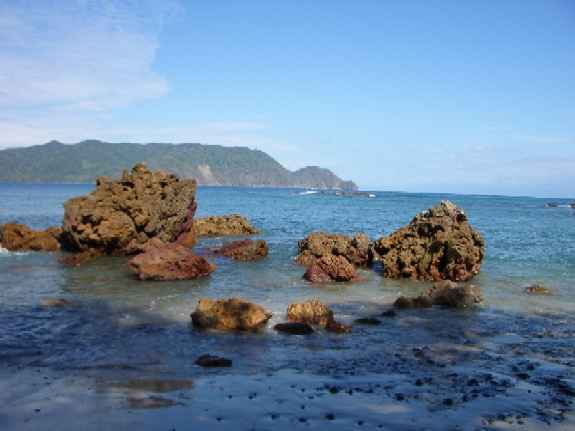
COSTA RICA
DEC. 29, 2007 - JANUARY 2, 2008
PLAYA DEL COCO
220 miles south of Barillas Marina Club in El Salvador we headed for the one mile wide, semi-protected Bahia / Playa del Coco in Costa Rica. We are exhausted and have never been so happy to see a safe haven. The two days from El Salvador was a beating we have not experienced since Hawaii in '04. The Tehuantepec tried hard to manipulate us but we were over prepared. Not that this time we were not ready for anything Mother Nature could hurl at us. We had a double reef in the Main and we carefully monitored how much jib we were letting in and out. Bob commented one time to be extra diligent watching the wind angles because the wind kept trying to sneak around to the stern and we did not want an inadvertent jibe. The wind would fluxuate from 3 knts. to 25 knts. The wind angle was changing 120 degrees in a matter of minutes. We hugged the coast to minimize the abuse keeping a careful eye out for rocks and reefs. The seas were chop with swells. During conditions like this Bob cannot sleep and keeps vigil all night. I can sleep but am awaken often to help him change sails and make sure he doesn't fall overboard. We arrived at the mouth of Playa del Coco at night and because the winds died we decided to drift and sleep till daybreak,..there are rocks and shoals and we need to be able to see them.
New Years Eve in Playa del Coco. The supermercado (grocery store) was full of people getting supplies for the nights festivities. We wondered if we were in the Fort Lauderdale of CR because everyone was young with very tight-fitting lots-of-skin-showing clothes on…beachwear even in the grocery store. Firecracker stands and bars were doing a brisk business. By the looks of what was developing we decided to have dinner and watch the zoo from the boat. Bob had steak and I had the most delicious Dorado ever. At midnight the fireworks intensified and the whole beach was ablaze in coloured lights. The music from a beach disco boomed and throbbed till 4 am.
We couldn't believe the Captaina de Puerto was willing to call immigration and customs and have them come check us in on New Years Day. The streets look like a war zone with cars crunching on bottles, plastic bags and glasses everywhere. We had to be at his office at 11 am but the town didn't stir till noon when the clean up began. We took a very long beach/road walk and were amused at all the real estate companies from the States. Coldwell Banker, Better Homes, Century 21, just to name a few. All the signs seem to be in Spanglish, ½ Spanish and ½ English. Found a cute little place to have New Years dinner and planned to come back later.
Later - no way. By sunset, and it was spectacular, the winds in the bay had been gusting to 25 knts. Bob was very happy we spent the time to change anchors and put out the heavy chain but he didn't want to chance us leaving to go ashore and having the boat drag. Something must have gone wrong because with all the wind there was a terrible fire storm raging up the side of the mountain just behind the city of Coco. It reminded me of my friends Dana and Manuel and the fire in Oakland, CA. where they lost everything. Bob commented that there were no houses in the area and it burned itself out when it came to a ridge.
Right before dark we saw Barbarian coming in to anchor. Barbarian is a tri-maran that had left Barillas several hours before we did. We stayed in touch for awhile on VFH. Barbarian first hugged the coast and then, because they cannot point as well as we do, they decided to swing out to sea. They were going to Santa Elena so we didn't expect to see them again. Morning came and Bob noticed that Barbarian didn't have a mast. We dinghyed over and sure enough - too much sail in too much wind and the captain was asleep. They snapped the mast in half. Thankfully no one got hurt.
Bob is the skipper that is keeping me safe.
Bob is in a hurry to leave this anchorage because the winds are so strong and, although he has the 300' heavy chain, he worries about the anchor holding. We have done a lot of homework and on the advice of my good friend, Caryn, who spent several years on Trade Winds in Costa Rica, we are making our next stop Bahia Ballena and Playa Tambor.
BAHIA BALLENA JANUARY 3 - 7, 2008
Once again we were battered by the Papagayos and when we turned the corner around Osa Peninsula we had the wind in our face. We motor sailed like crazy to get out of the wind and seas and managed to drop anchor at 3 pm. Bahia Ballena (Whale Bay) is a sleepy little bay with such fine sand that it feels like you are walking on urethane foam. The wind was so strong that none of the fishing boats and pangas went out that day and so they were just hanging out around the cement dock (aka the ONLY dock) in the bay. Several times during the afternoon a boat would idly cruise past us… just to look. They claimed they were cleaning out their boat but they would come awful close to Gaia and we would hail them. We were the only non-fishing boat in the bay.
Later another sailboat came in to anchor and he immediately got in his kayak and came over. "Hi, I'm a Papagayo refugee!" Brian, single handling on Compass Rose, was all the way to Nicaragua, about 500 miles off the coast, and was hitting 14' seas with a 4 second period. This means that the waves were so close together and so high that his 40' boat didn't have time to climb the wave and surf off the back from one wave before the next one hit - he was smashing through the waves about midway. Scared him so much he turned tail and was swept backwards all the way to Bahia Ballena. Had him over to dinner and shared lots of lies about what we all had done over the past few months.
Next day Brian put his dinghy in the water and ferried us to shore. We didn't want to go through the hassle of blowing up our own dinghy because we were only planning on staying a few days till the wind died down. The three of us took a long walk down the beach and into the small village of Tambor. It consisted of 3-4 blocks of sand roads with church, campgrounds, and several small businesses (no bar…what a surprise!!) The air-conditioned Mercedes busses would just stop anywhere to pick up and drop off people. We tried to cross a stream but it proved to be deeper than our shorts.
While Brian was wheeling and dealing to buy some fuel Bob and I took off in the other direction for some exploring. The gravel road narrowed to a two-track and then to AV access and then a rough trail. We passed several squatters that were hugging the banks of the coastline. They were either fishermen or surfers. They had no electrical, plumbing, or floors. One was living under a piece of black plastic strung on a rope from two trees. About a mile of hiking along the beach it began to expand into a two-track and we saw lots of cars and SUV's.
This point had a great beach and a tree out in the middle of a lava bed! If we had traveled further we would have found the touristy, surfing village of Montezuma. When we got back to the dock the fishing boats were coming in with their haul and we picked up a whole Dorado for $20.00 Yummm.
The next day all was calm and we set sail for more adventure.
GOLFITO JANUARY 8 - 13, 2008
Golfito is a larger village on a small bay of the same name buried in the East side of Golfo Dulce. Most of it is too shallow to anchor so we needed to keep an eye on the depth gauge. It took some doing with temperamental seas and wind but we made it. Bob and I noticed that no matter what the wind faxes or the satellite weather forecasters were predicting anything could happen for any length of time and so we always needed to be prepared. We have had a double reef in the main for weeks now and the oversized jib for following winds is adjusted continually for the strength of the winds.
Everyone whom we consulted, including the Rains Guide and yachto's heading north, said to go to the Banana Bay Marina. This was a bright yellow building with absolutely new docks and a great restaurant. It is owed and operated by an American ex-pat. The happy hour was great, the internet did not work, and diesel fuel was $4.60 a gallon. All this for $100 a night! I almost passed out from shock!
I'll have none of that so the next day we set out on foot and ¼ mile closer to downtown found Samoa del Sur. A French owned establishment that must have had some history long forgotton. There was a building that at one time housed the Port Captain, Immigration, and Customs…not anymore. There was another building with about 8 showers and 5 toilets (on the woman's side) and dock slips for two boats. You could see the piers of a dock that must of fallen into the sea years ago. There was a restaurant/bar that could seat 200 easily, 12 or so hotel rooms, basketball court and a huge swimming pool. We could anchor out and use the facilities for $2.00 a day or dock for $28.00 a day….more like what I had in mind.
Now the fun begins. We didn't want to blow up the dinghy so we requested that we would like a dock slip. No problem, they would send out a linehandeler and show us where to pull in. No way - first the dock had no pier. It was just a floating finger that would sway with the strong current. Second, when the tide was out there was maybe 4' of water at the most and that would spell disaster for Gaia with a 7' draft. So we opted to anchor out and figure out how to get to shore. Oh no!..The owner would have none of that. He wanted us to do, what I call, a European anchor. This is quite the dance. Throw out the anchor, back up maybe 30 yards and stern tie to the dock…easier said than done. With Bob at the anchor and moi backing up Gaia I had to try 3 times to line up the boat because the current was so strong it would easily push us away from the 42' sailboat that he wanted us to moor against. I had to aim for the second boat over and full steam backwards and try to hit the sailboat next to us. When we finally accomplished this feat we both wondered where the anchor actually was on the bottom of the bay.
This is the port that we were going to exit Costa Rica and what a time we had! So far every time we entered or exited a country it was simple. Be polite, look and dress decent, try to speak Spanish, and the Port Captain would smile and handle everything for us. This time it was Port Captain, bank, Immigration, bank, Customs, Customs, and Port Captain. It took 2 days.
Our last day was to go to duty free and pick up some goodies. Bob thinks it was an old banana export warehouse operation that closed down in the 1980's. There were 42 stores with most of them selling Samsung or 5 and dime items. They all sold the same things and the acre or two was packed with people. I never did figure out how so many people were leaving the country. Bob thinks it was consumerism at its best. Most of the shops we have seen in Mexico and Central America have one specialty. You go for bread one place, meat another, produce another. There was a shop that sold nothing but ribbons and wrapping paper. Because they haven't had anything of this scale, in so much quantity, they could shop and pay the tax…I guess.
I poured Bob into a taxi with all our goodies and sent him to Gaia because I wanted to walk the 2 miles back to the boat. I needed to stop at another supermercado for provisions and I needed to snag a banana leaf. I found a recipe for Coconut-rice Custard and needed the leaf. Funny how back in the States the only time I cooked was to heat up leftovers from a restaurant, invite friends for a BBQ, or make something for a potluck. Now I'm wrapping things in banana leaves and making my own mayo….go figure!
That same day we left port and headed for Panama. Big goofy smiles on our faces as we sailed along with 12 knots of breeze to our backs and calm seas. Hopefully the Papagayos are behind us and the Inter Tropical Convergence Zone is open for us to enjoy a glorious ride to the islands West of Panama.
~~~~~~~~~~~~~~~~~~~~~~~~~~~~~~~~~~~~~~~~~~~~~~~~~~~~~~~~~~~~~~~~~~~~~~~~~~~~~~~~~~~~~~~~~~~~~~
EL SALVADOR
DEC.18 - 29 2007
I really wanted to spend some time in El Salvador because I knew so little about the country and its people. We had been getting all sorts of information about two marina locations in El Salvador and we were having a hard time deciding which one to go to. Our voyage took care of the answer when we sailed up to Bahia del Sol at 3 am. Too dark to chance crossing the shoals that are tentative at best in high tides we traveled onwards. The sunrise opened onto a land of low, green plains with mountains and volcanoes showing a misty purple backdrop against the brightening sky. Barillas Marina Club was another 30 miles from Bahia del Sol and we arrived at the way point at 7:30 am. It was now time to call in and have the panga meet us and show us the way.
Show us the way? No matter how many charts we had to work with we never would have been able to navigate the waterways and find the Club. First, the panga headed straight towards the coast and in line with a stand-alone volcano. After ¼ mile he made a sharp left-hand turn and we went full speed for 4 miles. To our right was the coast and to the left waves were breaking over shoals that I didn't see until we were across them. We next made a right hand turn between two low sand spits. According to the charts we had crossed land. We knew the charts can be as much as 2 miles off its target and now we had proof. About another mile and the pure white sand beaches gave away to palm trees with huge fronds swaying in the breeze. Our first sign of civilization was a series of fishing villages. Every so often you would see a sign that read Rancho Don Carlos, Rancho Mareita, Rancho so and so. They ran the gamut from shacks of variegated metal to nice adobes with tile roofs. All of them had pangas pulled up onto the beaches and racks of nets drying in the sun. We saw a threesome that was playing a game of tag and everyone looked like they didn't have a care in the world. Saw many a thin, long legged dog, tongue wagging, sniffing at the air. Also saw a curly tail porker bouncing on the beach with two friends. Wonder if they knew they were destined for dinner.
Another stretch of mango trees and smooth water and we came upon a lone structure on poles about 10 feet up in the trees. There was a lashed log ladder leading up to a 15' X 12' log and palm frond hut with a thatched roof. In the large doorway sat a man whittling on a stick with a boy sitting on the top rung of the ladder. Another lazy day in the mangroves. Three pangas were tied up underneath and there was no ground area around the hut.
Barillas Marina Club is a compound that was financed by the ex-president of El Salvador. He visits often and stays in one of the ten "bungalows" that are part of the Club.
We felt so safe in the compound that we didn't worry about leaving the dinghy at the dock anytime. Took a walk around the grounds and discovered the water supply is artesian.
Another walk took us to spider monkeys, sugar cane fields, and the aftermath of the hurricane from this past summer. A trip into Usulutan for provisioning netted us a memory stick for the computer even though most of the town looked very third world. There wasn't a single stop light and I don't think they would have paid any attention to them anyways. It was a godsend that we were not driving because there was major gridlock to the point that a policeman had to direct traffic to break the lock. Vendors filled the streets and this being the most populated country in Central America, people packed the narrow alleys and made.
We were going to stay 3 days but after talking to Lila we just had to spend time letting her show us her lovely country. She was very knowledgeable telling us her personal stories of the war, pointing out weeds that had medicinal purposes, history, geology, geography you name it. She could spin a yarn on any question we asked her and we asked her about many varied subjects.
When she found out we had never stopped by the side of the road and drank / ate a coconut she immediately added it to our experiences.
We took a hike down the canyon to the Lake and it was rough. We passed lots of people coming up from the ferry that transverses the lake. As usual, going down was much harder than coming back up the side of the canyon.
El Salvador is the size of Massachusetts with 20 lakes and 57 volcanoes. Their civil war ended in 1990 and they have had an uneasy truce every since that time. The country has been restructured twice in the 20th century and will be again this time. Every time the land has been redistributed it doesn't take long before the haves and have-nots become more divided. Nevertheless, we were impressed with the progress they have made. Bob wanted to draw similarities for the Iraq and the Israelis / Palestinian conflict and this is when we found out a real shocker. The current president of El Salvador is Palestinian.
San Salvador is a modern city that has been rebuilt several times because of volcanoes erupting and the earthquakes that follow. We went to a Military Museum and saw the Popemobile complete with a dove on the hood. Monuments to Peace, fountains, and Christmas cheer were everywhere.
Gaia all decorated for Christmas.
We spent Christmas in Sachitoto, a colonial town high in the mountains, where the Spaniards settled and prospered in the late 1500's. Salvadorians celebrate Christmas with fireworks all night long.
Lila introduced us to Alejandro Cotto who is the town's main source of inspiration. Fine arts, music, and education for all the children are his mantra. The right and left politicos would come to his estate and 'dialogue'. He was neutral territory. His property was filled with antiques, fine art donated from the entire main artist population in Central America, and music.
There was a monument to his contribution in the central plaza and both Bob and I thought the design was very well thought out.
Our last day of the tour we went to visit the San Andréa's Mayan city. It was discovered in the 1970's and is a slice of everyday life in a small town in 1000 BC. It was buried in 7' of ash from a volcano and no one knows why they abandoned the site for 500 years. Most of the town is still not excavated yet and what has been has been incased in concrete to protect it. Cows graze on the grounds and that keeps the grass short. They also have discovered an indigo camp that the Spaniards made in the 1500's. Indigo is in favour again because it is a natural dye with no side effects to humans or the environment.
Provisioning day is Friday and so we went into Usulutan to shop at the supermercado. Bob won't leave on a Friday so Saturday morning after breakfast we followed our panga driver out of the mangroves, past the breakers, and into the wild blue to continue our adventure.
~~~~~~~~~~~~~~~~~~~~~~~~~~~~~~~~~~~~~~~~~~~~~~~~~~~~~~~~~~~~~~~~~~~~~~~~~~~~~~~~~~~~~~~~~~~~~~~~
GULF OF TEHUANTEPEC
DEC. 13 - 18 2007
According to lore, crossing the 'pec' ( or Tehuantepecker to those in the know) can be a crap shoot. Sometimes you are lucky and sometimes Mother Nature looks without favour on a hapless sailor. Regardless, the weather channels cannot predict the gales they can only monitor them as they are happening. Looking at the geography, it is the large bay that is carved out of the Pacific coast of Mexico just east of Huatulco. Looking north across land to the east coast of Mexico, the inner curve of the Yucatan Peninsula leaves a small area of lowlands creating a break in the Sierra Madras Mountains. When there is a high over the Gulf of Mexico it funnels gale force winds out over the 'pec' and can blow a boat 300 miles out to sea. Bob and Enrique studied the weather maps and decided we had a 3 day window to make the crossing. Several boats had been coming up the coast and they said the ride was smooth. We were still undecided whether to go as-the-crow-flies or hug the coast but off we went.
The first night, on my 7 to 11 pm watch, it was smooth with hardly a ripple on the water. When Bob came on watch, sometime around midnight, it picked up to 23 knots of wind with building seas. The wind changed several times and we had quite a beat up to Salina Cruz, a commercial port. 4 large container ships were anchored out waiting for entry into the harbour. We wove between them and headed for Bahia Ventosa. It is right around the corner and not listed as an anchorage in any of the guides. It was a beautiful large bay that was not well protected from the winds. We anchored in 26 feet of water with a sandy bottom. Even though the wind did not diminish there was much less wave action. We had a sweeping view of uninhabited sparking white sand beaches and low lying plains covered with palm trees We waited out 6 hours by taking a much needed nap, repairing the autopilot, and had a hearty lunch.
There was no change in the weather window and it was forecasted that we were to keep moving so we did. The wind was 25 knots off the beam so it was perfect sailing weather…for the time being. Our sailing expertise was tested every several hours with changes in wind and current. So we hugged the coast even closer and managed to keep our speed constant. I have not talked about some of the wind changes that may or may not be attributed to the Papagallos but the one thing we learned is that we need to be ready and prepared for any changes in the wind, currents, or vices that Mother Nature throws at us.
We had an incredible sunrise with purples, reds, and oranges. The sky is now a creamy, bright blue and contrasted delightfully with the colours of the sunrise. It was time to hail the Barillas Marina in El Salvador and have them come get us. The dreaded Tehuanepec was now behind us and a new country was ready to be explored.
~~~~~~~~~~~~~~~~~~~~~~~~~~~~~~~~~~~~~~~~~~~~~~~~~~~~~~~~~~~~~~~~~~~~~~~~~~~~~~~~~~~~~~~~~~~~~~~~`
HUATULCODEC. 6 - 13 2007
We have found a gem in the rough. Hualtco (wah-TOOL-koh) is clean, modern, and unspoiled So far it is not a tourist destination. Cruise ships do come in the harbour but the town of Las Crucecita (Little Cross) is a mile away and a delight. There is an international airport and I would go to the hospital anytime I had to go. There are 12 very scenic smaller bays spread out over 20 miles and they all have gorgeous condo set-ups with pools and all the things that make life great. Guest have to fly in because there are no roads over the mountains. Didn't see a golf course though but gotta be around somewhere.
Google Earth had a ½ mile long pier strutting out in the main harbour that is obviously used for cruise ships. It was built about 2006 and so the cruise guides are out of date. There is no anchoring out in the darsena. We elected to go to Marina Chahue (CHA - way) one bay over to the East. (If you look at your map we are no longer looking at terra firma from N to S but from W to E) It was hard to maneuver and Enrique told us to call when we were an hour away and he would come get us. We called and called and finally went in by ourselves.
We traveled about 3 knots and I sounded out the depth every 20 seconds. Felt like The Search for Red October. The channel was very narrow with a high cliff on starboard and a rock breakfront on port. The channel was 25 feet across. The lowest number for depth I called was 11.2 feet….but we made it. Later we found out the reason the channel was so tight was the swells. The marina was brand new and not quite finished yet.
Believe it or not almost all the boats were from the Seattle area. Enrique was a valuable source of information (and so handsome). He helped us get fuel, find laundry services, and gave us the name of a fantastic restaurant. We did not go into town for the first two days because we were still recovering from the squall and our chores need to be done first. The boat and sails needed to be washed down with fresh water, the fridge needed cleaning and we put up the boom tent to protect us from the sun. We were going to leave the next day and so I went into town to provision. When I came back I told Bob we were not leaving for several days. He said it was OK because winds were too strong over the Tehuantepec. Enrique had a personal experience with the crossing of the 'pec' and he helped Bob make some decisions that we were glad to follow.
Altho money exchanges all tote US Dollar the second flag they fly is Canadian. Everyone in the marina (5- it's off season - hi season doesn't start till Feb.) are from the Seattle area but everyone I have met in town is Canadian and mostly from the Vancouver area. This one guy exclaimed he wanted to retire there but probably couldn't afford it in 5 years. I said Yeah, buy now sell for a profit in 5 years and find the next undiscovered spot. He said he was in a great condo owned by a Canadian friend and he bought it for $145,000CA....soooo what? 130K US? I wouldn't buy the mega luxury complex by the marina and closest to town because its speculation (see pics in the picture gallery). If you are so inclined, check out www.suenodelmarcondos.com for an idea of how big Mexico builds its resorts. These mega resorts are everywhere there is a serene bay or port. Bob says we'll come back in a year but I wonder what it will be like. Our life path will not allow us to stop to do the necessary research but we like it so much I am speculating buying a condo. We are staying longer than we anticipated and now we have to wait for a weather window to cross the Tehuantepec...most likely about 3-4 more days...hopefully not more.
The story about Las Crucecita is worth repeating. In 1587, Thomas Cavendish made a port call in Bahia Santa Cruz. The local people were worshiping a wooden cross on the beach. Thinking it blasphemous Cavendish tried repeatedly to chop and burn it down. Finally he tried tying it to his ship and yanking it out. All his efforts lead to no avail. He gave up and sailed away. In 1611 the bishop of Oaxaca ordered that the cross be carried to the state capital for examination. When they approached the cross the base was buried in less than 2 feet of sand. Doesn't fare well for Cavendish does it? Later the "miraculous wood" was cut up and made into numerous smaller crosses and distributed around Mexico and as far away as Rome. I walked the mile to town every day and basked in the atmosphere. Some days I have walked there and back 3 times and every time I bring back some goodies from the Mercado to munch. We are in the state of Oaxaca and they don't do rice and beans. Potatoes, yams, and other root veggies are the starch. Dishes are not as spicy. While I am in town Bob prefers to stay on Gaia and pour over the weather faxes and reports to figure out what we are going to do next.
The last night we were there Bob and I walked downtown and the whole town showed up in the central plaza to wish us a Bon Voyage. It was awe inspiring. The little ninas and ninos were all dressed up in cultural costumes. The girls (ninas) with colourful billowing skirts, double braids intertwined with ribbons with white socks and black patent leather shoes. The boys (nino's) in a kung fu like outfit with a brightly woven sash and belt with sandals. There was dancing, food booths and great bouquets of fragrant flowers everywhere …especially at the church. Because there are no lawyers in Mexico, we were right under a booming fireworks display both overhead and coming from a tall tower that rivaled the steeple on top of the church. Parents were laughing as they soothed their children who were crying from all the explosions. The Bomberos was a fairly late model fire engine and it had its red lights flashing all night. We did have a problem with the language barrier though. They kept calling out to the Virgin de Guadalupe. I tried to tell them to just call me Phyllis but they didn't understand.
The next morning I went into town to provision and we had a send off with Roger and Lorraine whom we met in Ziwa and Enrique at 6pm.
~~~~~~~~~~~~~~~~~~~~~~~~~~~~~~~~~~~~~~~~~~~~~~~~~~~~~~~~~~~~~~~~~~~~~~~~~~~~
THE GOLD COAST OF MEXICO
NOV. 15 - 17, 2007
MAZATLAN
Latitude 23 degrees North and the start of the tropics. It's practically on the same latitude as Cabo but gone is the Baja desert and now we are seeing lush green mountains, swaying coco palms and my first view of a papaya tree.
The trip over from Cabo was uneventful. Such a pity because they said there was going to be 25 knots of wind out of the north on Tuesday. We had no wind and it took 3 days to do a 2 day trip. Because we motored we arrived earlier than we expected ( 3 am ) so we 'heaved to' until dawn. Gaia doesn't like to 'heave to' and so we had drifted 14 miles south and didn't make landfall until 10 am. After racing last week we wanted to slow down and let nature happen naturally.
When we were 50 miles from M we heard this chirping and Bob took his oil can and looked all over the boat for the cause. Where is that noise coming from? It was a wren! What was a land bird doing so far out to sea? The little guy spent the day inspecting the boat and cleaning up the sole (floor) of all crumbs. Several times he took off and made a large circle and headed back to the boat...landing on my head. After he left without saying goodbye we had to inspect and find all his calling cards. He graciously hit the sink and lots on the deck. Is that why they call it a poop deck?
We opted not to go to the huge commercial port with the cruise ships, sport fishing docks, ferry terminal and shipyards and went to the newer marina basin 7 miles north of town. Upon entering the narrow passage into the harbour there was a huge dredging machine. There were several small boats with 3 guys standing up monitoring the hoses. We went as slow as possible but it was so narrow with shipping in both directions it was amazing that these guys didn't fall overboard in the cross wake.
When we were ready to moor there were 3 boats flying the Baja HaHa flag and we have this kinship. The other boats got in a day earlier than us and so knew the lay of the land. One 50' ketch, Wind Swept, had 3 kids. Being teachers themselves they decided to take off a year and home school. Their teenager was not happy leaving her friends but that didn't stop her from enjoying the pool. The marina/hotel 'El Cid' is so huge they have a shuttle that runs to all the other premises that they own including several golf courses. We took it into town and had dinner at a little out of the way place. The ribs were a little tough but the sauce was very good. The old town section boasts the best preserved old town on the Mexican coast. Does that mean the last to modernize?
We did not want to stay very long here in M because we have so far to go in so little time. We checked into the marina for one day. The look on her face when we asked what time was checkout. She went and found someone who spoke better English than she but to no avail….they don't understand the concept. So naturally we stayed one day / two nights and left the first light of day...along with about 12 fishing boats.
TENACATITA NOV. 19 - 22, 2007Finally I am getting my way and we are going to anchor out. I guess so since there are no marinas. In fact, there is no town only a modest size hotel that caters to Mexicans. It was a little dicey getting past the mouth of the bay because of a string of rocks so we traversed it during daylight hours. Total tranquility with only 4 sailboats and 2 powerboats (with an incredible amount of noisy toys) we felt totally at home.
One morning Bob was intent staring thru the binoculars. "Checking out the 'hood?" I said. No, he was observing 3 boobies harassing a pelican. He was wondering what the pelican had that the boobies wanted. Boobies are a sable coloured thin bird that has a nails-on-the-chalkboard screech and a disposition to match. They circle like vultures and then dive bomb the water with a smack! Sometimes they come up with a fish and sometimes they don't. They will attack each other for a fish - even flying upside down to grab the goodies. There was this one bird that had landed on the top of the mast and was trying to balance on the wind vane. Bob would have none of that since it is very delicate ($$$) equipment. He swung the boom to and fro, banging away. The bird would throw out a wing this way, its head another, then the other wing and a leg trying to maintain balance. Finally Bob got him to fly away only to make a circle and return. "X#^^*(" I had a vision of Bob getting out the shotgun and blowing off the whole top of the mast, and the boobie jumping up out of the way and laughing.) The next morning, I swear, I was awakened by a chorus line of tap shoes dancing on the deck. Bob popped his head out the forward hatch and surprised several birds. Such squawking! Of course, they left calling cards and every morning Bob would have to hose down the decks. Never saw Bob as happy as when he trapped a bird on the spreaders with the halyard and it almost fell off. Of course that meant that he left more calling cards.
There is a "Jungle River" trip that you take your dinghy thru the saltwater mangroves and goof off looking at strange flora and fauna, then end up at the beach for happy hour. Cruising guide says not to be missed. When we went the entrance was blocked by a sandbar and you had to be very careful and stay in the eddies. The contrast between the deep green mangroves and some beautiful yellow / black birds was eye-catching. The pelicans would perch in the trees looking so much like vultures. You could see them staring at you, waiting for a laugh if we got stuck on a sandbar. We took the trip several times because the narrow channels were fun to race along and there were no bugs.
There are also two other places for gunk holing nearby that we did not go to but many cruisers do. Chamela and Careyes. Careyes turtles are endangered and if you are there one of 4 X a year you can help them get to the ocean. Palm trees, beaches, and clear water with few hotels … someplace to anchor out.
BARRA de NAVIDAD NOV. 22 - 24, 2007
THANKSGIVING DAYBarra de Navidad is the place Bob's friend, Mike Crippen and our friend, Judy Palm, says not to miss and it is a hangout for Canadians. It's a 2 mile wide bay and was named by Mexico's first viceroy, Antonio de Mendoza when he anchored here on Dec. 25, 1540. A quaint town of small cool looking hotels and ocean breezes blowing through open beach cafes. With both the ocean and a tranquil lagoon you have your choice of surf shops or thatched beach umbrellas for sipping cool drinks.
Tricky harbour. Call them shoals or sandbars but they were everywhere. Watch the charts and the depth sounder and go slow. We needed to hail the harbour master and I handed Bob the mike. Since Bob was handling everything and navigating a narrow passage we almost hit another boat. So I learned Bob is not a Super Skipper like I have always been saying and I am not on the Princess Cruise. This princess is going to have to help keep us safe.
Bob wanted to fuel but we couldn't make the dock…only 6' of water and we have a 7' draft. Again, I wanted to anchor out and there were 2 larger boats in the inner bay. We dinghyed over and had a great chat with Don. He had been staying there a year and told us how to get into the bay (stay to the far left until you see the scraggy palm then quickly turn right) He drafted 6'. Bob is the skipper that is keeping me safe so it was a no go. So, off to the 5 star, Westin Bahia Grande and the mega marina we go. We are early in the season and there is no problem getting berths anywhere we go. Mega grounds with unbelievable landscaping. Waterfalls, huge boulders, acres of green, and fantastic architecture. We could walk forever after dinner and still not see everything. I wanted a picture of the pools, slides, and hot tubs, with their columns and masses of colourful flowers, but Bob said we are suppose to be roughing it…don't want the folks back home to think we got it easy.
According to the cruisers guide, this is the only place for 900 miles to provision and we need to badly. Already I'm jonesing for chicken. I cannot find a fresh chick to save my palate. No refrigeration so the limp veggies and withered fruit have me eating out of cans...and we are on shore! Provisioning? I had to go to 5-8 places to find the last avocado, the last tomato….this one place had a large bin out in front with 5 mini loaves of bread in it. Last night's leftovers? Stuck my hand in and they were still warm. Yum! Another place had a butchers block by the cash register and it had chicken guts all over it. Yep, got my chicken. Bob wondered if it was 'free-range'. I thought it most likely was 'free-range-of-the-house'. And to think I use to pay extra for a happy bird.
We had to motor through the night because of light winds. Walter, on the way to Cabo, got me interested in the stars. There was the full moon for the night watches from 10 pm to 5:30 am so only the planets would shine. The water was inky and shimmering. It was very poetic. The phosphorus was up to some new tricks. Behind the boat were all these mini depth charges. Green neon light explosions that were about a foot underwater and lasting for a second or so. It was quite interesting to watch because some would be very close and others 20 feet away.
BAHIA ZIHUATANEJO NOV. 27 TO DEC. 3, 2007
This bahia comes from the Nahuatl words "cihuatl" (women) and "tlan" (place of). Cihuatlan is the western paradise of the Goddess Women. True to their ignorance the Spanish added "nejo" to denote the smallness of the bay. Local slang calls it "Ziwa".
They say fishermen come to the Gold Coast to fish for all the seasons but cruisers come here for life. True statement. Many cruisers get grounded and do not go any further down the coast...in fact they come back year after year. Walking down the beach we heard someone hailing Bob. Bob Furlow from Seattle SSYC. For the last 2 years he would come here for the winter and stay anchored out on his boat and goes to Seattle for the summer and stay at his house. Then he decided hey, it's cheaper to rent in Mexico and keep his boat in Seattle where he spends the summer at Shilshole. He was our first dinner guest. I BBQ'd steaks and had the Gloria (Regis) fruit salad. Mom had given me candles that run on batteries and it created a wonderful atmosphere.
Playa Municipal had a municipal pier, a Navy station, and hundreds of pangas. We would check out the best positioning for the dinghy landing between the pangas. We wanted to be good neighbors and stay out of their way. On the beach was a fenced off area that had all these 1' high stakes sticking out of the sand. Come to find out it is a sea turtle egg incubator. Mexico is doing its part to preserve its natural treasures. Playa La Ropa was just around the rocky jetty (or call it a reef) and had lots of resorts on sparkling white sand. We dinghyed over to Las Gatas to check out a beach that is only accessible by boat. Didn't land but thought about snorkeling in the rocks off shore. The boobies were back and I wondered at the futility of the fish getting nailed from birds above and fisherman's nets from below.
Don't know why this place wasn't listed in the guide as the place to provision. . Centro Mercado had aisles and aisles of lush produce and goods from small independent farmers. I felt like a kid in Disneyland. Bob had a meltdown though when it came to finding a steak. He couldn't get out of there fast enough when he saw the huge slabs of dried beef hanging with flies everywhere. The cases were not refrigerated and the meat was marginal. Reminded Bob of anatomy class when he was in vet school. Then we heard about Commercial Mercado… the Costco of Ziwa. Bob got fresh milk, steaks in a wrapper, and I got yogurt. They even were giving out free samples. I picked up sugarfree pudding with a pencil erasure taped to the top (?). They have the same problem small towns in the USA have. The local farmers at Centro thought it would put them out of business but the Mexicans still frequent the local market.
The basketball court was right on the water and most nights they would have something going on. On Sunday night the whole family turns out at the basketball court for some kind of festival. They will have music, seminars, or plays. The Sunday night we attended we saw Spanish rappers. Brightly lit fiber optic toys, inflatable beach colours and mouthwatering smells from the food stalls beckoned me to casually check out the place. One had icy fresh juices that they would put in a bag with a straw. They sure love their ice cream. Come 10 o'clock and it was like a light was turned off. It was deserted and we had the night to ourselves.
The last night we were going back to La Brasierea for the best fish tacos when Bob heard his name. Dan and Lynn were friends of his that he hasn't seen in 15 years. They were originally from Issaquah but were living in Yuma, AZ. They had driven through the mountains and have been to Mexico many times even sponsoring a child to finish school. She is now majoring in law, the first in her family to finish high school. Lynn cleared up an observation that I had made. No one in town is overweight. There are some locals that are amazingly short and some with the longest legs. Lynn explained to me that different tribes have different characteristic and there are many all through Mexico. Ziwa has been the melting pot of many cultures for hundreds of years. In the 1700's a slave ship was shipwrecked around Acapulco and there are people with distinctive Negroid features. The young people are truly beautiful and wear clothes that show off their best features. Love those flat 6-packs and glowing muscled arms. Sighhhh
We are having a hard time figuring out where to go next. Black Dog II was anchored out and we decided to ask them where they had been exploring. Bob guessed the boat was a Bill Garden ketch and Roger was plesantly surprised. He opened up and had lots of stories about their excursions from Panama heading north. Lorraine is a travel agent from Seattle and she was the one who set the schedule. She had lots to say about the different anchorages on our route. After cocktails we went back to our boat we started looking up Google Earth and the cruisers guide to make our own schedule. We still needed more information so we next visited Steve and Claudia on Naiad. They have been here for a year. He had hailed us when we first entered the harbour to give us a hearty welcome. Steve started a cruisers roll call at 8:30 am and we were on call for the inaugural event. He is looking forward to the prime season when the bay fills up with boats.
We need to Zarpa (exit visa) out of Mexico … somewhere. We are leaving with no plans except to stop at Huatulco (wah-TOOL-koh). We have no idea about Guatemala, Nicaragua, and I want to make an effort for El Salvador. You will have to stay tuned till we get somewhere in Costa Rica b4 the next internet service.
We left around noon passing by Roca Negra with its picturesque mini lighthouse on our way south. In two hours I had counted 6 sea turtles. I would have to change course to avoid some and others would dive for cover long before we caught up to them. The phosphorus was acting different again. Instead of being in the wake and glowing there was glitter all around the boat. Large sparks going off in all directions. We hugged the coastline for the first time at about 6 miles out and marveled at the endless stretches of beach. During the night you barely saw any lights. We passed Acapulco right at sunrise. It was beautiful the way it shimmered like a diamond necklace laying on a velvet cloth with the mountains in the background. It was the most spectacular sunrise to date.
Remember the little ditty
"Red sky at night sailors delight….Red sky in the morning sailors take warning.
It WAS a spectacular sunrise. We motored all day because there was no wind. Along about sunset we noticed large billowing clouds full of electrical charges. No problem, the day was exceptionally hot and humid and remembering my Michigan days we called it heat lightening…. harmless.
Wrong.
About 10 pm I noticed they were getting closer and there were horizontal streaks of fuzzy bright light (couldn't call it lightening) shooting out of the darkened clouds. At 11:30 when Bob came on night watch I commented that maybe we would outrun the squall.
Wrong again.
Bob decided at some point to heave to and turn off all the electrical equipment to ward off a surge. Powerful light was flashing all around Gaia. Still no wind and we were drifting. At 2:30 am we awoke to a banging Genniker in torrential rains. Did I mention the wind? Did I mention no lights because of threat of explosion? Bob used his head lamp and I used a flashlight. I was lowering the halyard slowly because of all the jerking caused by the wind and I thought I should check Bobs progress. I shined my flashlight towards the bow and all I saw were knees and arms wrestling with the sail. It looked like the sail was trying to throw him overboard. He was lying on his back pulling the sail towards, and on top, of himself. I kept the light trained on him until he finished getting the sail into its bag. Rain was pouring in all the open windows and the boat was rocking n' rolling. When we got the boat settled down I was wondering… if the blow was from SW to NE we would be drifting towards the coast. Bob said last time he checked we were 16 miles off the coast. Radar said we were 2 miles…and closing fast. Another voyage out into the rain to start the engines and head out to sea…fast. My skipper was keeping me safe. You didn't see me going out in the rain. I got him a raincoat because it was cold and went back to bed.Good news is that the next day it was balmy with light humidity. The sea turtles were back and we saw a lot of blue and black marlin. The bad news is I was so proud of my skipper that I decided to forgo my rule about if I do the cooking someone else is going to do the dishes. I gladly did the dishes all day knowing I didn't have to go up to the bow in rough seas or out in the cold rain.
The next night the phosphorus was at it again. You would see flashes of very bright green light going off in a moving pattern. Obviously, some creature was traveling around the boat disturbing the one celled organisms. All you had to do was connect the dots till they went out of sight to know where they were traveling.
I came on my 3:30 am watch in sweatpants and a fleece. Haven't had a wear my fleece since Bahia Santa Maria (Baja). The wind on my face feels good. The moon was just visible above the horizon and Venus was nearby slightly to the East. In its last quarter, she was wearing a Cheshire cat grin and a faint golden light shone on the water. Night watches allow me the pleasure of meditating on the past days adventures and I realized the last 48 hours have been a radical change from the month before. Hot, humid, no wind days have been replaced by 10 mph, cool winds. The water has changed from a bright, slightly green hue to a deep almost purple blue. We have left the Gold Coast of Mexico.
~~~~~~~~~~~~~~~~~~~~~~~~~~~~~~~~~~~~~~~~~~~~~~~~~~~~~~~~~~~~~~~~~~~~~~~~~~~~~~~~~
OUR FIRST SOLO OFF SHORE ADVENTURE
First, define "Solo Offshore". Bob & I originally thought it would be the two of us using our synergy to dance with the wind and waves and end up in one piece in San Diego. Ah, the folly of fools and blind men.
What really happened was leaving the Brisbane Marina at 10:30 am and no wind. We motored till we went under the Golden Gate Bridge at noon. All of a sudden we have 8' swells and good wind…in the wrong direction. We continued to motor. I developed a tender stomach and was wondering about seasickness. No nausea, no green around the gills but a little too under the weather to cook anything that didn't involve just opening a can. Night watches went as scheduled.
The Second day I slept more than usual and couldn't muster enough energy to cook anything till dinner. Did some magic with a can of chili and Bisquick and Bob loved it! I thought we should duck into a safe haven for the night but there were none to be had. Night watches went as scheduled.
The third morning we set into Santa Barbara for fuel. There are no guest docks so we couldn't enjoy the city without spending the night. We opted out of that idea in favour of getting to San Diego for some needed chores. Once we set off I became increasingly more tired and my headache went from pounding to splitting. Luckily there was no wind and we continued to motor. I slept all day and kept waking up with a splitting headache and a churning stomach. Add to that fact that I could not stay awake for 10 minutes. I was miserable. No night watches for me! Bob said that solo racers stay awake for weeks on end so he could do it too. And so he did. I got to sleep with the help of chamomile tea that knocked me out all night. When I relieved Bob at 7:30 am we had 0.5 knots of wind on very smooth seas and the radar saying nothing was in site. Except for a very light coating of soot from some forest fire Bob saved the day!
THE BAJA HAHA RACE TO CABO SAN LUCAS
It wasn't till we moored in San Diego did we find out the city was burning down. No police at the station so we called around till we found moorage. Walter showed up several days later and the Baja HaHa begun! Because of the fires, all the parties were changed to the parking lot at West Marine which was a short walk from the marina. The Halloweenie party was festive with beer, burritos, and salad. A lot of people went all out and competition was stiff. As Bob says never think you can compete against animals or babies. Since no one knew me I used one of my old costumes and I can save it for Mardi Gras in February…if they celebrate it wherever we are in February.
We spent 5 days in San Diego and Bob took care of some needed repairs. He was quite impressed with the diesel mechanics and they obliged him by giving him some good information on maintaining the diesel engine.
SAN DIEGO TO BAHIA DE TORTUGA 51 HRS 23 MINS 381 MILES
We were so proud that we could sail all the way. Walter had plenty of first. First time offshore, first time doing night watches, first time throwing a can overboard (organic debris), and first time sailing by instruments. He is a good understudy. Within one rough, 18 mp/hour winds, starless night Walter honed his skills and became quite comfortable with the new information. What I wouldn't give for a video of Walter making a cup of coffee and doing a Joyce (read the first article on our trip to Maui) I am still mopping up coffee grounds out of the fridge and underneath the stove.The part that Bob had fixed on the engine in San Diego developed a leak and we were in despair. Walter saved the day with a stainless screw and some Teflon tape. A new part is being shipped to Cabo but so far we will remain with the Dutch-finger-in-the-dike part till it gives away.
TURTLE BAY TO BAHIA SANTA MARIA 41 HRS 24 MINS 240 MILES
The race started with some good wind and the larger boats shot into the lead. About 2 hours into the race the wind died and we excelled. It was kind of embarrassing the way we passed boat after boat. They were all flying colourful spinnakers but they were no match for us because we had the genniker trimmed perfectly. We went out from shore to maintain a strong steady wind and were all alone till the next morning when 4-5 boats thought we had the right idea and crossed our path.The bad news is the wind continued to die and we decided to motor. The good news is we could BBQ the steaks I carved from a beautiful yellowfin tuna that we had caught the day before. I had asked for a fishing line in the water and Bob did not even have time to tie off the line before we hooked a young 34" yellowfin. This was the perfect size for a night of sushi/sashimi, tuna salad for lunch the next day, and steaks for dinner the next night.
We arrived in Santa Maria at 4 am and Bob did a Joe Macay (Dad). That means that we anchored about ½ a mile from everyone else far, far to the west. We decided not to inflate the dinghy because the surf was treacherous and we need to hone our skills with less wave action. I mean they were surfing the waves were so big! This was the first day it felt tropical and Walter commented the water was starting to get that "tropical green colour". Bob and Walter went swimming. Work is never done and Walter cleaned off all the food and coffee that was spilled overboard on the side of the boat.
The parties were great and I learned from a geologist that the hills around the bay are relatively young. So young and soft were the rocks that sea shells were all over the place about 60 feet above the beach. They looked like they were just placed there but they came popping up out of the soft sandstone. We climbed a steep hill overlooking the bay and kept a sharp eye out for rattlesnakes.
I cooked my first apple pie as an incentive for Bob to install a latch on a shelf in the quarter berth so things would stop falling out when we are at sea. My perfect pie didn't come out of the oven till after dark and where was Walter? We had left him partying on the beach and expected everyone would be home by dark. HMMMM…turned on the VHS and guess what? Walter and 71 of his friends were stranded overnight because of the high surf. Even the panga guys didn't go home. The prodigal son didn't arrive till 6 am on race day- hungry and tired. He was happy though, they got all the beer they could consume. I said that if it happened in the US they would sue the panga guys. Bob said Yeah, but here in Mexico they tipped them heavily. LOL
BAHIA SANTA MARIA TO CABO SAN LUCAS 28 HRS 38 MINS 187 MILES
We started the last leg of the race Wednesday at 8 am. Because so many people were stranded and so many others wanted to make Cabo before dark on day 2 we had a free for all start.Way Cool!! At 1:15 pm we had what can only be described as a whale fart. About 15 feet from the boat a 6-7 foot bubble of air came to the surface with a whooshing sound. Good thing we were upwind. All day long we saw a large (3-4 ft. long) turtle just floating away about 9 ft. from the boat. There were rays that would jump out of the water and do a twist & backflip. One guy called asking what were the black sticks in the water and got the reply…Marlins! We saw 3, about 5 ft. long, jump clear out of the water…wonder how big the fish was chasing them. No wonder they call this the Sport Fisherman Capitol of the World.
We did have to motor for about 4 hours because the winds died to 3 knts.
Currently, I am sitting on the boat at the marina answering 157 E-mails. We put up the new boom tent and turned on the fans. It is very comfortable on board.